iPhone Games Like Asteroids: Modern Alternatives 2026
 by Galaximus
iPhone Games Like Asteroids: Modern Alternatives 2026
If you grew up feeding quarters into Asteroids cabinets or remember the thrill of piloting a tiny ship through an endless field of tumbling rocks, you know what made that game stick: simple controls, real consequence for every move, and the satisfaction of mastery through practice. Modern iPhone space games have evolved far beyond simple homages, keeping that core arcade DNA while layering in deeper mechanics.
The best modern Asteroids-like games on iPhone fall into two camps: streamlined arcade experiences that prioritize twitch reflexes and quick sessions, and physics-driven explorations where gravity becomes a primary tool.
What Made Asteroids Work (And What Modern Games Inherit)
Asteroids succeeded because it nailed three things: immediate readability (you understand the threat in one frame), responsive controls (your input felt direct), and escalating pressure (the game got harder in ways you could feel coming). Modern space games either honor these principles or deliberately subvert them for a different payoff.
The arcade original didn’t have gravity. Asteroids drifted in straight lines until you hit them. Your ship coasted with inertia — you’d press a direction and the ship would keep moving until you corrected. That inertia is fundamental to the feel. It’s why Asteroids feels different from a top-down shooter where you stop the moment you release the button. The physics, though simple, taught players to think ahead.
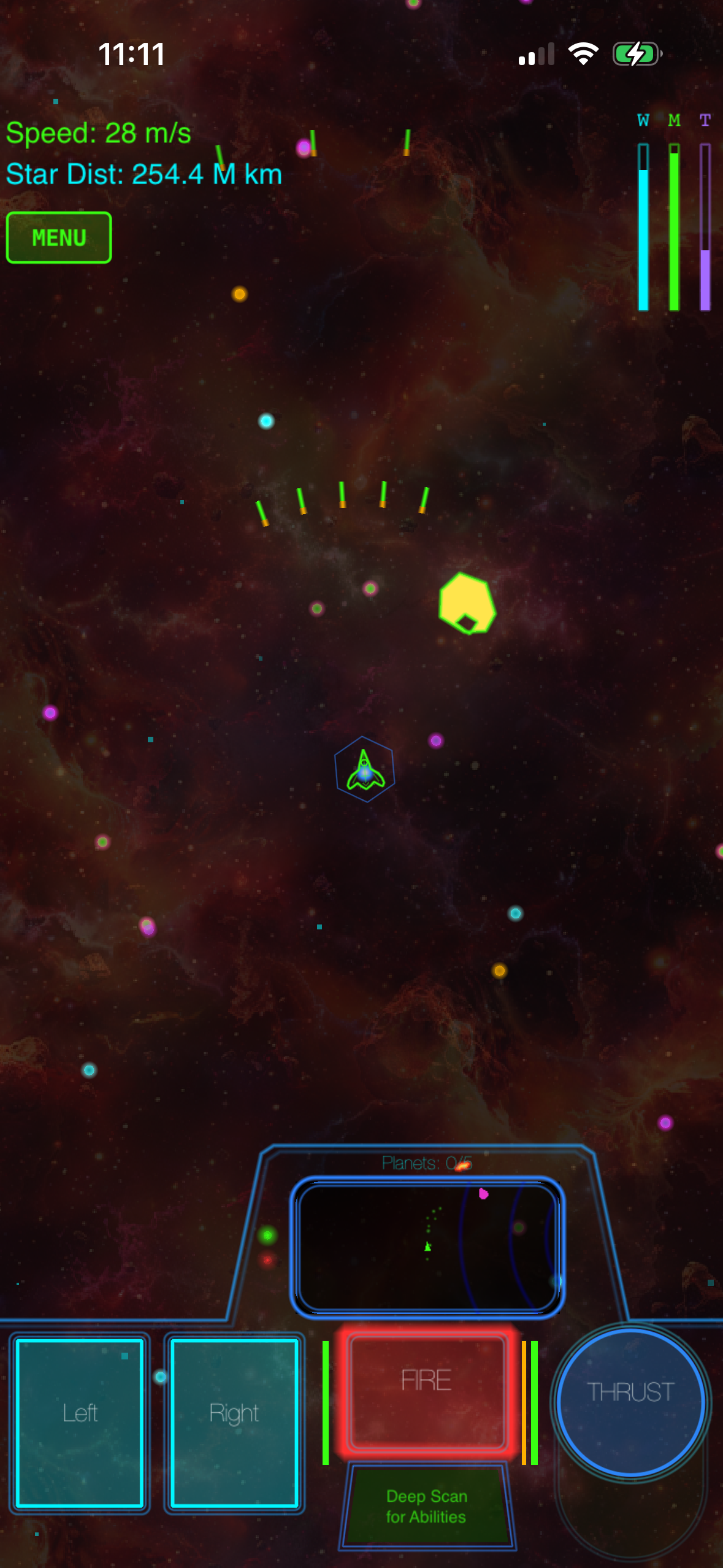
Modern Asteroids alternatives either keep that inertial model or replace it with something deeper. Some replace it with real gravity — every planet, moon, and asteroid pulls on your ship in real time. The learning curve is steeper, but the payoff is that mastery means something different: you’re not just dodging obstacles, you’re using gravity as a tool.
Physics-Based Modern Alternatives
Real Gravity, Real Mastery
If you want an Asteroids successor that respects your intelligence and doesn’t insult you with fake physics, physics-based games are where the depth lives. These games ask you to understand how gravity works, then reward that understanding with elegant solutions to navigation and combat.
Games built on orbital mechanics make gravity the interface, not decoration. Your ship is subject to real physics: limited fuel, actual thruster burn time, and positioning that matters more than reflexes. You can’t just point and shoot; you have to position yourself in space such that your shot will connect. It’s arcade-action, not a simulator, but the physics is the engine.
The learning curve is real. Players typically need 30–45 minutes of focused play to transition from “I’m fighting the controls” to “I’m using gravity.” After that, the game opens up. Slingshots — using a planet’s gravity well to accelerate without burning fuel — become your primary tool. Positioning matters more than reflexes. A player who understands orbital mechanics can solve problems that would be impossible for someone mashing buttons.
Kerbal Space Program Mobile
If you want the deepest physics sandbox on any mobile platform, Kerbal Space Program ( on iOS, also available on desktop) is the answer — but it’s a different game than Asteroids. KSP wants to teach you to be a rocket engineer. You assemble vehicles from parts, manage fuel ratios, calculate transfer windows, and debug your design failures. The physics is accurate to a degree that borders on educational.
The tradeoff: KSP has a much steeper onboarding curve than Asteroids, and the gameplay loop is “build, test, fail, redesign” rather than “fly and dodge.” If you want to learn actual orbital mechanics through play, KSP is unmatched. If you want arcade action with gravity underneath, it’s overkill.
Orbital Mechanics Games for iPhone: A Physics Lover's Guide
Arcade-Fast Alternatives (Closer to Original Asteroids DNA)
Not every Asteroids fan wants to learn orbital mechanics. Some players just want a tight, responsive arcade experience where the controls feel direct and a session can end in five minutes.
Geometry Wars 3D ($4.99 on iOS)
Geometry Wars 3D keeps the inertial movement and dodge-and-shoot core of Asteroids but layers on contemporary visuals and enemy variety. You’re still piloting a ship with momentum, still managing a crowded screen, but the threat types are more diverse and the visual feedback is sharper.
This game has a lower learning curve than physics-based alternatives. You can pick it up and feel competent in two minutes. The skill ceiling is still high (veteran players develop subtle positioning techniques), but the floor is accessible.
Void Bastards ($14.99 on iOS)
Void Bastards combines roguelike progression with tactical space combat. You pilot a ship through procedurally generated sectors, scavenging derelict vessels and managing limited resources. The controls are turn-based rather than real-time, which makes it feel different from Asteroids, but the core loop — navigate space, avoid threats, gather resources — shares DNA with the original.
What Separates Modern Games from the 1979 Original
Modern space games have advantages Asteroids didn’t:
-
Procedural generation. Each playthrough can be unique without requiring human level designers to hand-craft every scenario.
-
Synthesized audio. Asteroids had beeps. Modern games can generate complex soundscapes in real time, maintaining a consistent aesthetic while using minimal disk space.
-
Narrative framing. Asteroids was pure abstraction. Modern games can wrap the core gameplay in a story that gives the action context without slowing it down.
-
Physics accuracy. Asteroids used simple Newtonian physics because that’s all the hardware could handle. Modern games can simulate gravity in real time, which opens up entirely new gameplay possibilities.
Premium vs. Free-to-Play: Why It Matters for Space Games
Most free-to-play space games on iOS gate progression behind energy timers, offer “speed-ups” for real money, and introduce premium currency that makes the grind feel mandatory. Examples include Star Wars: Galaxy of Heroes and Empires & Puzzles, both of which rely on daily login mechanics and energy systems.
The Asteroids lineage — arcade games built on the principle that mastery and progression should feel earned — is fundamentally incompatible with that model. You can’t have a game where positioning and skill matter if half your playtime is spent waiting for energy to refill.
Premium space games eliminate this friction. One-time purchase, no ads, no IAP, no energy timers. The entire game is available from the moment you install it. This model is increasingly rare on iOS in 2026.
Top Paid iOS Space Games Without Ads 2026
The Learning Curve Question
The biggest decision point for modern Asteroids alternatives is whether you want to learn something new or just want to play.
If you want instant familiarity: Look for games that keep the inertial movement model and arcade pacing. You’ll feel at home in five minutes.
If you want to expand your skills: Physics-based games ask you to invest 30–45 minutes learning how gravity works, then reward that investment with elegant solutions and a deeper sense of mastery.
Neither choice is wrong. It depends on what you’re looking for in a space game.
Offline Play and No-Internet Requirements
One underrated advantage of premium space games: they can afford to be fully offline. No authentication servers, no live-service components, no dependency on network connectivity.
Most premium indie space games run entirely offline. This matters if you play on flights, in areas with spotty coverage, or just want to guarantee the game will work in five years without worrying about server shutdowns.
Offline iOS Space Games: Best Single-Player Titles 2026
FAQ
Q: Which of these games works on older iPhones? A: Geometry Wars 3D and Void Bastards have lower system requirements than physics-heavy games. Check each App Store listing for minimum iOS version requirements.
Q: Can I play these games offline? A: Most premium indie space games run entirely offline. Free-to-play games often require authentication, which means they need internet at least once per session.
Q: What’s the cheapest Asteroids alternative? A: Geometry Wars 3D is the most affordable option that directly inherits Asteroids’ arcade DNA. Void Bastards offers more content but a different gameplay style.
Q: How long does a typical session last? A: Arcade-fast games like Geometry Wars support 5–15 minute sessions. Physics-based games typically require 20–45 minute sessions to feel rewarding, since the learning curve makes short bursts frustrating.
Q: Which game has the steepest learning curve? A: Kerbal Space Program. Expect 2–3 hours before the interface stops feeling overwhelming. Physics-based arcade games fall in the middle (30–45 minutes). Geometry Wars has the flattest curve (5 minutes).
The Bottom Line
Modern Asteroids alternatives fall into two categories: arcade-fast games that keep the original’s twitch-reflex DNA, and physics-driven games that use gravity as a gameplay tool. Which you choose depends on whether you want instant familiarity or whether you’re willing to spend time learning something new for a deeper payoff.
Geometry Wars 3D is the most direct successor if you want immediate recognition. Kerbal Space Program is the deepest physics sandbox. Void Bastards offers a middle ground with roguelike progression and turn-based combat.
All three are premium-only, which means no energy timers, no ads, and no pressure to spend beyond the initial purchase.
Best Space Games for Asteroids and Lunar Lander Fans