Story-Driven Single-Player Space Games for iPhone 2026
 by Galaximus

The Best Story-Driven Single-Player Space Games for iPhone 2026
If you’re hunting for a space game with actual narrative weight—one where you’re not grinding battle passes or waiting for energy to refill—2026 has delivered something rare: premium, complete experiences designed for players who want a story arc with a beginning, middle, and end.
Quick Picks
| Game | Price | Campaign Length | Offline | Core Differentiator |
|---|---|---|---|---|
| Galaximus | 8–15 hours | Yes | Real orbital mechanics; authored narrative across procedurally configured star systems | |
| Alto’s Adventure: Infinite | Free | 4–8 hours | Yes | Minimalist aesthetics; no combat or dialogue; pure exploration and flow |
| Void Expedition | 6–12 hours | Yes | Survival-focused narrative; resource scarcity drives story choices |
What Makes a Space Game Story-Driven?
Most “story-driven” labels on the App Store are marketing noise. A cutscene before a survival loop doesn’t make the loop narrative. A true story-driven space game has these traits:
- A shaped arc with defined endpoints. Not infinite procedural content—a beginning, climax, and resolution. Players know when the story ends (typically 4–20 hours of gameplay).
- Character and dialogue. NPCs with names and stakes. Conversations that matter to the plot, not just flavor text.
- Mechanics that reinforce narrative. Ship limitations, physics, anomalies—all part of the world, not obstacles separate from the story.
- Completion without monetization pressure. You can finish it. Play it, finish it, move on. No energy meters, battle passes, or daily login streaks.
The games that nail this are rare. Most space titles lean into either sandbox freedom (No Man’s Sky) or pure arcade action (Asteroids clones). Story-driven means trading some freedom for narrative coherence.
Physics-Based Exploration vs. Narrative Sandbox
There’s a spectrum worth understanding before you pick a game.
Physics-based exploration prioritizes real-world rules. Gravity matters. Fuel matters. The player learns a system of constraints and masters it. The story unfolds through that mastery. Reaching each destination feels significant because you’ve had to plot courses and manage resources. Examples: Galaximus.
Narrative sandbox prioritizes freedom. You can go anywhere on your schedule. The story is woven in but doesn’t gate exploration. You experience a vast universe at your own pace. Examples: No Man’s Sky on iPad.
If you want a story inseparable from learning to fly, physics-based is your lane. If you want to explore at your own pace and stumble into story beats organically, sandbox is better.
Galaximus: Real Gravity, Authored Story
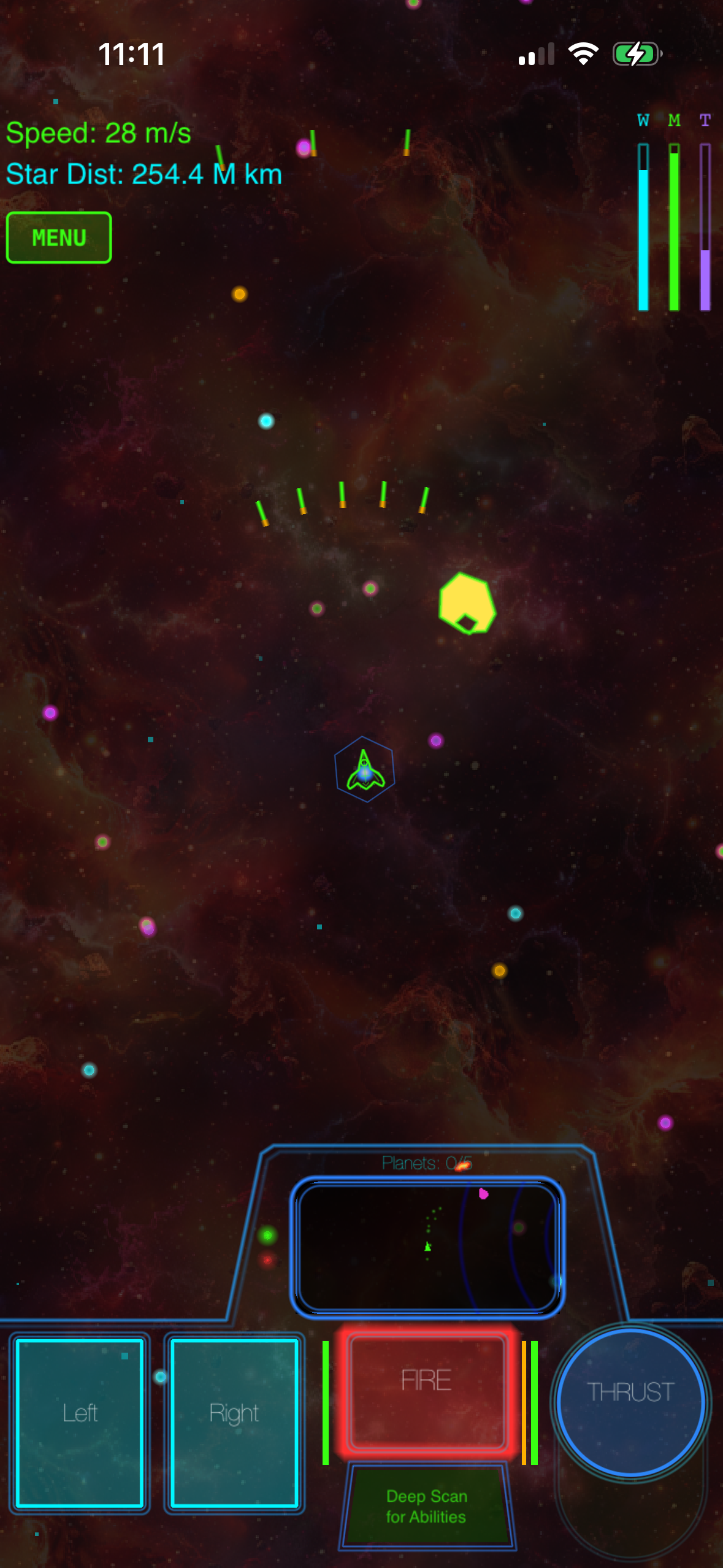
Galaximus models gravity accurately. Every celestial body pulls on every other body in real time. This is the interface through which you experience the story, not window dressing.
The narrative unfolds across eight procedurally configured star systems. The layout varies each playthrough, but the story shape is authored. You’re aboard The New Dawn investigating an anomaly spanning the galaxy. You encounter alien factions, derelict ships, distress beacons, and a spacetime rift called the Mirror—a climactic boss fight where you face a copy of yourself. The story has weight because stakes are personal and physics makes every maneuver feel earned.
The learning curve is real. Gravity is not intuitive at first. Within 30 minutes of focused play, mastery clicks. You learn to slingshot around planets, use asteroids as stepping stones, read orbital mechanics as a language. That payoff—when you stop fighting physics and start using it—deepens the narrative. You’re not just piloting; you’re becoming fluent in the universe’s rules.
Galaximus is a one-time purchase with no ads, no IAP, no energy meter. Play at your own pace. The upcoming Infinitum expansion (planetary surfaces, faction warfare, outposts) launches late 2026 and is included free for current buyers. After Infinitum ships, the combined game moves to a higher price tier.
Alto’s Adventure: Infinite
Alto’s Adventure: Infinite is a minimalist exploration game with no combat or dialogue. You’re skiing down procedurally generated mountains in a stylized desert landscape. The “story” is implicit: you’re moving forward, discovering new terrain, unlocking new characters and mechanics. It’s meditative rather than narrative-heavy, but it’s a complete experience with a defined progression arc (roughly 4–8 hours to see all content).
Trade-off: Beautiful and relaxing, but lacks character interaction and plot tension. Best for players who want exploration without combat or dialogue.
Price: Free (no ads, no IAP).
Void Expedition
Void Expedition is a survival-focused narrative game where resource scarcity drives story choices. You’re stranded in deep space and must decide whether to ration fuel, seek help from alien traders (who may betray you), or risk dangerous shortcuts. Each decision cascades into the narrative. The game has multiple endings based on your choices.
Trade-off: Stronger narrative branching than Galaximus, but less emphasis on physics mastery. More dialogue-heavy; less exploration freedom.
Price: (offline, no ads, no IAP).
Campaign length: 6–12 hours depending on choices and replays.
How to Evaluate Story-Driven Space Games
Before you download, ask:
- Is it actually complete? Can you finish it, or does it loop forever? Check reviews for completion times.
- Is the story integrated into mechanics? Or is it flavor text between gameplay loops?
- What’s the monetization? Premium one-time purchase, subscription, free-to-play with ads, or IAP?
- Is it offline? Can you play without internet?
- Does it respect your time? No energy meters, no battle passes, no daily login streaks?
Procedural Generation in Story-Driven Games
Procedural generation gets a bad rap in narrative circles. But the best story-driven space games use it in service of narrative, not instead of it.
Galaximus generates star system layouts—planet positions, asteroid fields, anomaly locations—but the narrative arc is authored. You always meet the same factions, encounter the same story beats, face the same boss. Because systems are procedurally configured, each playthrough feels fresh. You can’t memorize the optimal path; you adapt. Replay value comes from the story being robust across multiple configurations, not from the story being infinite.
Offline Play
One underrated feature: most story-driven space games work offline. No internet required. No cloud save dependency. No server downtime interruptions.
This matters for narrative games. You’re not interrupted by connectivity hiccups or ads. You’re not waiting for server authentication. You’re just playing a story to its end at your own pace.
Galaximus and Void Expedition are fully offline. Alto’s Adventure: Infinite is fully offline. Once you buy them, they’re yours forever.
Combat and Dialogue
Story-driven space games need tension and stakes. That usually means combat, but not necessarily twitch-reflex action.
In Galaximus, combat is real-time but tactical. You position your ship in gravity wells, use asteroids as cover, time burns to intercept fire. Physics is the strategy layer. Every encounter is a puzzle wrapped in a firefight.
In Void Expedition, combat is minimal; dialogue choices are the primary tension mechanism. You’re negotiating with alien traders, deciding whether to trust them, managing relationships.
In Alto’s Adventure: Infinite, there is no combat or dialogue—just forward momentum and discovery.
FAQ
Q: Do I need to understand orbital mechanics? A: No. Games like Galaximus teach you as you play. The learning curve is front-loaded; within 30 minutes, the basics click.
Q: Can I play these on iPhone, or do I need a console? A: iPhone is where the best premium indie space games live right now. The hardware is powerful enough, and the App Store has room for games that don’t follow the free-to-play formula.
Q: What’s the difference between Galaximus and Void Expedition? A: Galaximus emphasizes physics mastery and exploration within a single authored narrative. Void Expedition emphasizes dialogue choices and branching outcomes. Galaximus has one story shape; Void Expedition has multiple endings based on your decisions.
Q: Which story-driven space games work offline? A: Galaximus, Alto’s Adventure: Infinite, and Void Expedition all work fully offline. Once downloaded, they require no internet.
Q: How long does a story-driven space game take to finish? A: Galaximus takes 8–15 hours for a first playthrough. Alto’s Adventure: Infinite takes 4–8 hours. Void Expedition takes 6–12 hours depending on choices and replays.
Q: Will these games still be playable in five years? A: Yes, if they’re offline and don’t depend on servers. All three games mentioned here are fully offline. Once you buy them, they’re yours forever.
Where to Start
Story-driven space games are a niche, but that niche has matured. If you’re tired of free-to-play loops and you want a game that respects your time and your money, the options are better than they’ve ever been on iPhone.
Choose based on what you value: - Real physics + exploration: Galaximus - Minimalist aesthetics + flow: Alto’s Adventure: Infinite (Free) - Branching narrative + survival tension: Void Expedition
All three are complete, offline, and free from ads and IAP.