iOS Space Exploration Games Offline No Internet
 by Galaximus
Space Exploration Games for iPhone: Offline Play Without Internet
You’re on a flight with no Wi-Fi. You want a space game that doesn’t require authentication, doesn’t interrupt with ads, and doesn’t nag you to buy upgrades. The options exist, but they’re specific. The mobile gaming landscape is crowded with free-to-play titles that demand constant connectivity and monetization friction. Offline space games that respect your time and your device are rarer — but they exist, and they’re worth knowing about.
This guide covers the landscape of offline space exploration on iOS: what works completely without internet, what the tradeoffs are, and which game fits which kind of player.
Why Offline Space Games Matter on iPhone
Offline gameplay solves several real problems. It means you can play during a flight, in a subway, or anywhere without relying on cell signal or Wi-Fi. It means the game doesn’t phone home to verify purchases or track your behavior. It means the developer can’t sunset the game by shutting down servers — if you own it, you own it.
The tradeoff is that offline games tend to be premium purchases rather than free-to-play. That’s not a bug; it’s the business model that makes offline-first design possible. When a game doesn’t depend on ad revenue or live-service engagement metrics, the developer can ship a complete experience and move on. No battle pass. No seasonal content treadmill. No “play for 30 days and unlock the real game.”
For space exploration specifically, offline play works because the genre doesn’t require real-time multiplayer. You’re flying solo through star systems, managing your ship, encountering procedurally generated anomalies, and solving the physics puzzle of getting from point A to point B without running out of fuel. That’s a single-player loop that works perfectly without internet.
What “Offline” Really Means for iOS Games
Before diving into specific titles, it’s worth clarifying what offline actually means on iOS, because the term gets misused.
True offline means the game runs entirely on your device. No internet required. No authentication check on launch. No background sync. You can airplane-mode your iPhone and the game plays normally. This is rare because most free-to-play games require an initial connection to verify your account.
Offline-capable means the game can resume offline if you’ve already authenticated once, but may require internet to launch or sync progress. This is more common but less reliable — a connectivity hiccup can still gate your session.
For this guide, we’re focusing on true offline games: titles that work completely without internet once installed.
Quick Picks: Space Games by Use Case
| Game | Best For | Price | Offline | Learning Curve |
|---|---|---|---|---|
| Galaximus | Real-time piloting with gravity as core mechanic | True offline | 20–30 min | |
| Kerbal Space Program | Engineering depth and rocket design | True offline | 1–2 hours | |
| No Man’s Sky Mobile | Exploration, planet landing, base building | Offline-capable | 15–20 min | |
| Asteroids: Gunner | Quick arcade sessions, no story | True offline | 5 min |
Galaximus: Real Physics, Complete Campaign, Offline-First
Disclosure: We built Galaximus. This section describes the game objectively; unbiased reviews of alternatives follow below.
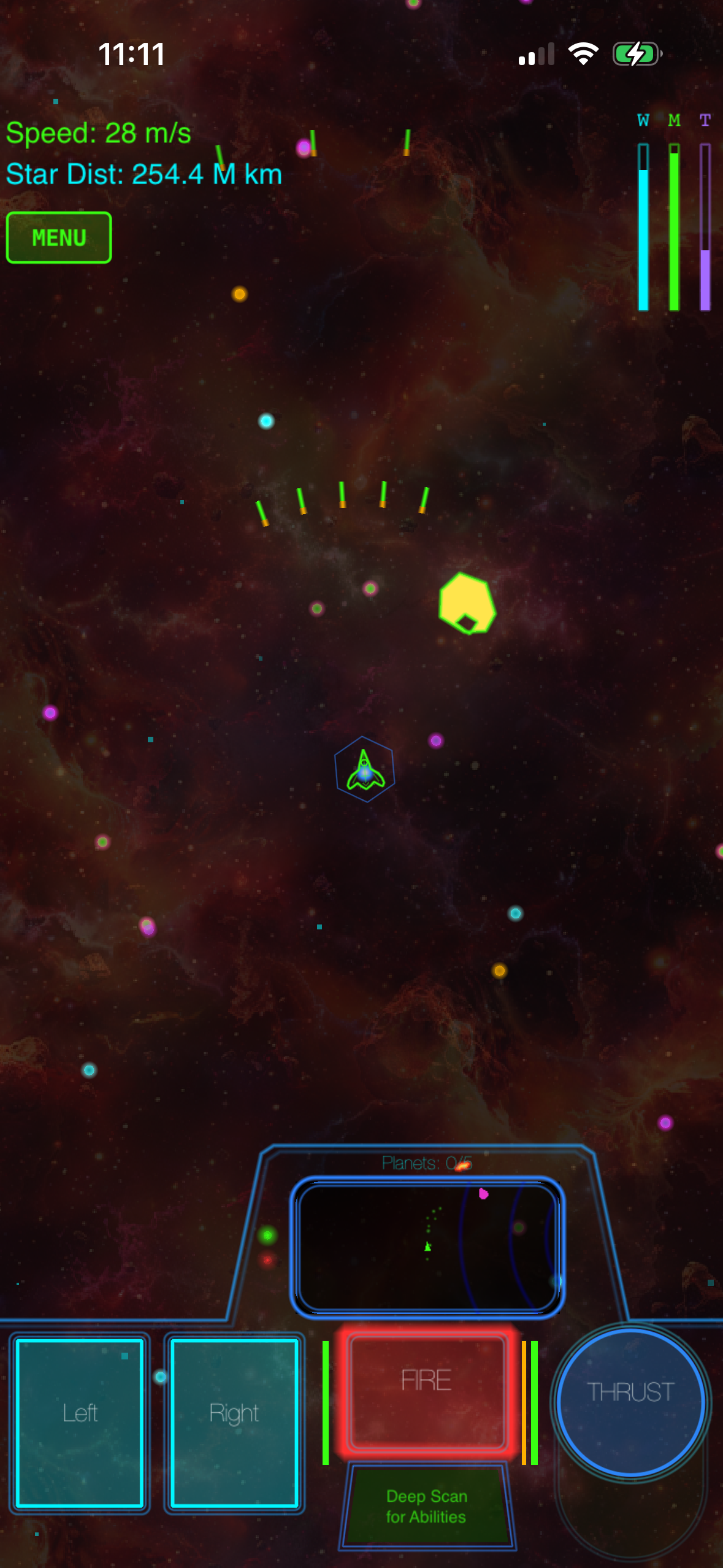
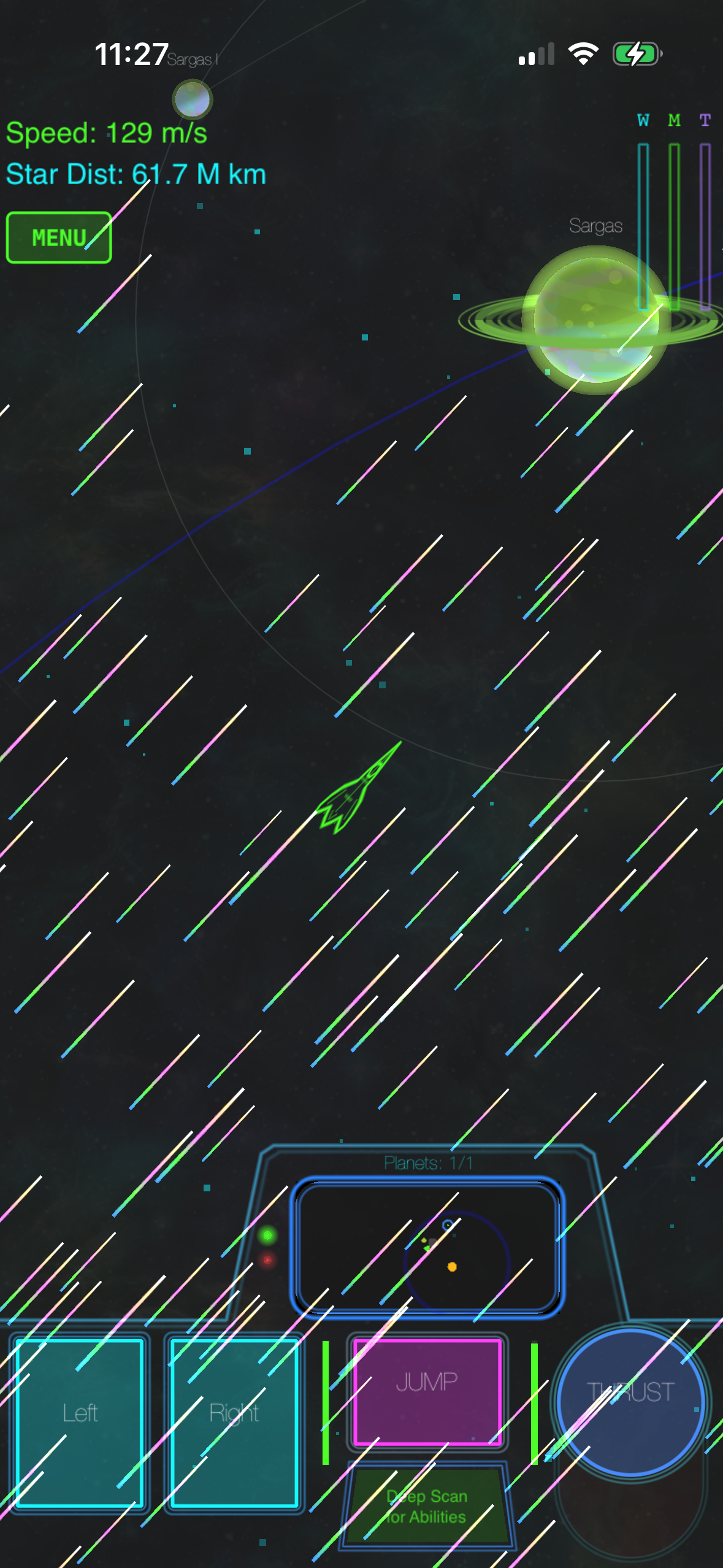
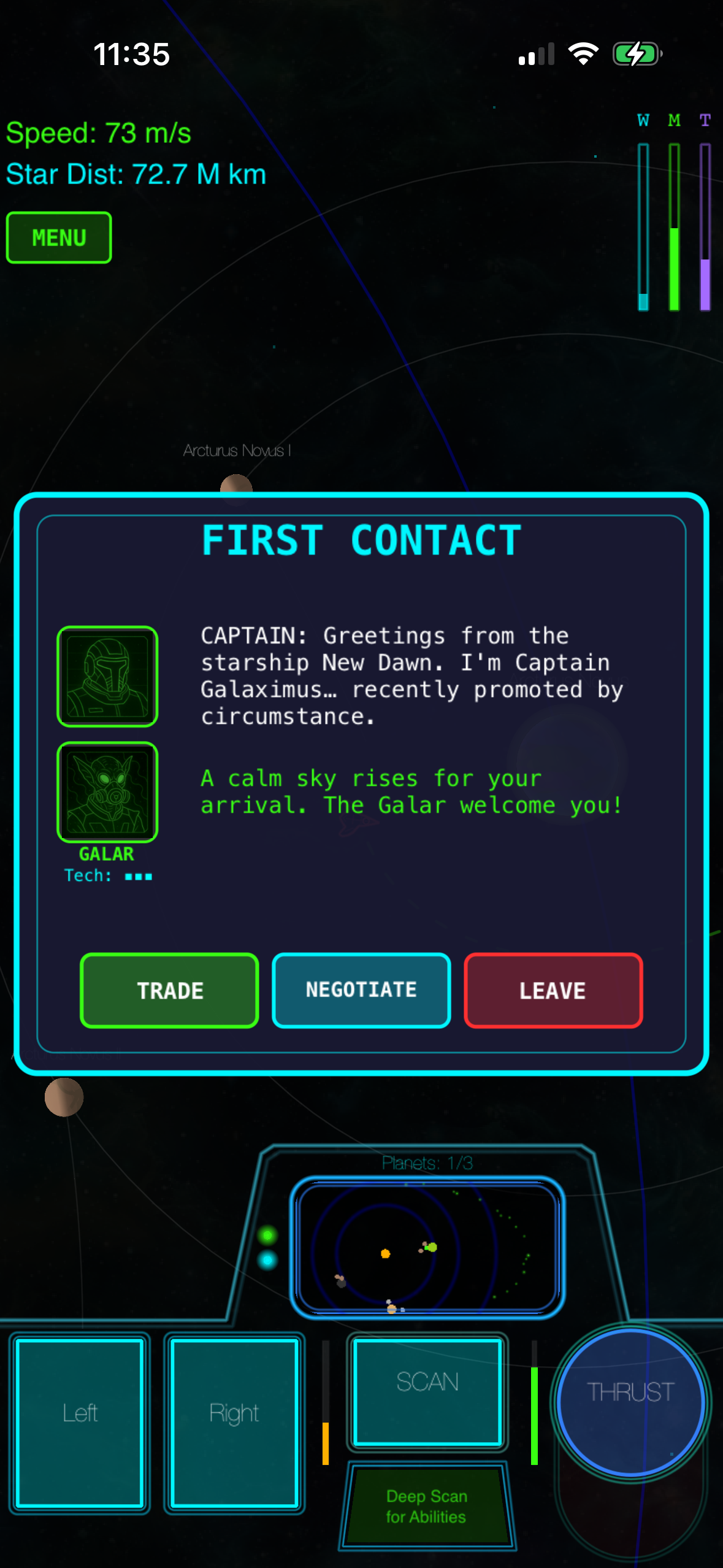
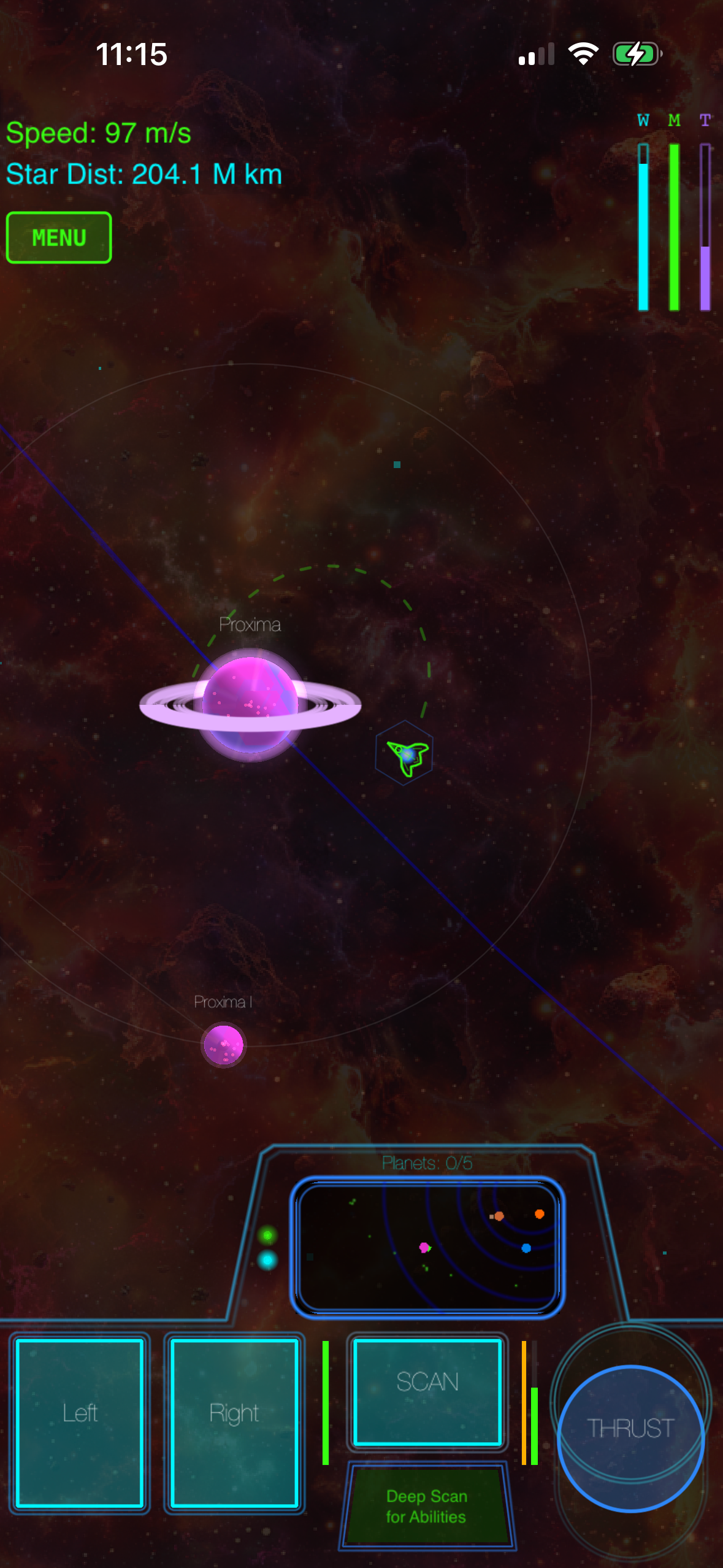
Galaximus answers a specific design question: what if a space game treated gravity as the primary interface, not an afterthought? Every celestial body in the game obeys real orbital mechanics. Planets orbit suns. Moons orbit planets. Asteroids tumble through gravity wells. Your ship, The New Dawn, is subject to all of it.
The gameplay loop centers on using gravity as your engine. You don’t have unlimited fuel — you have a limited burn budget per system. The efficient path between two planets isn’t a straight line; it’s a slingshot maneuver that uses a third body’s gravity to accelerate you for free. Mastery means learning to read the orbital landscape and exploit it.
The campaign spans eight procedurally configured star systems with a full narrative arc. You encounter alien factions, derelict ships, spacetime anomalies, and a climactic encounter called the Mirror — a combat scenario where you face a copy of yourself. Each playthrough generates unique planet positions, so the campaign has replay value without being a sandbox that never ends.
Galaximus is a one-time purchase. No ads. No in-app purchases. No energy meter. Buy it once, own it forever. We’re shipping a major expansion called Galaximus Infinitum in late 2026 — open-galaxy sandbox, planetary surface exploration, outpost building, faction warfare. If you buy Galaximus now at the launch-price tier, Infinitum is included free when it ships. After Infinitum launches, the combined game moves to a higher price tier, so early adopters get the expansion at no additional cost.
The learning curve is real. You have to spend 20–30 minutes learning how slingshots work, how to read velocity vectors, how to manage your burn budget. But that’s the payoff: mastery is achievable, and it feels good. Most space games fake gravity for accessibility; Galaximus models it accurately and makes the controls expressive enough that you can actually use that accuracy.
Get Galaximus on the App Store:
Other Offline Space Games Worth Considering
The iOS space game landscape includes other premium titles that support offline play. Here’s what actually exists:
Kerbal Space Program Mobile — If you want a deeper engineering simulation, KSP is the benchmark. You design and launch rockets, manage stages, plan orbital transfers, and learn actual spaceflight principles. It’s more complex than Galaximus; you’re building vehicles, not just flying one. The learning curve is steeper, and the game rewards meticulous planning. KSP works offline once installed. The tradeoff: it’s less arcade-action and more engineering sandbox. If you want to understand how rockets work, KSP is your game. If you want to fly using gravity, Galaximus is the faster path to mastery.
- Price:
- App Store Link: Kerbal Space Program Mobile
- Current Rating: 4.6 stars (1,200+ reviews)
- Storage: ~2 GB (per App Store listing)
- Minimum iOS: iPhone 13 or later
No Man’s Sky Mobile — A procedurally generated exploration sandbox where you land on planets, gather resources, build bases, and trade. The scale is massive; the universe is effectively infinite. It requires internet for initial authentication and periodic syncs, so it’s “offline-capable” rather than true offline. But once you’re in a session, you can play disconnected. The appeal is exploration and discovery; the gameplay is slower-paced than Galaximus. If you want to walk on alien surfaces and build outposts, NMS is the option. If you want real-time piloting with gravity as the core mechanic, Galaximus fits better.
- Price:
- App Store Link: No Man’s Sky Mobile
- Current Rating: 4.3 stars (850+ reviews)
- Storage: ~4.5 GB (per App Store listing)
- Minimum iOS: iPhone 13 or later
Asteroids: Gunner — A simpler, faster arcade experience. You destroy asteroids, manage limited fuel, and rack up high scores. The controls are straightforward (tap to thrust, tap to fire). The tradeoff: no narrative, no exploration, no gravity simulation. It’s an arcade game, not an exploration game. If you want five-minute sessions with zero learning curve, this fits. If you want a campaign with story and physics depth, it doesn’t.
- Price:
- App Store Link: Asteroids: Gunner
- Current Rating: 4.4 stars (320+ reviews)
- Storage: ~150 MB (per App Store listing)
- Minimum iOS: iPhone 11 or later
The Physics Question: Real vs. Simulated
One question that comes up a lot: what counts as “real” physics in a space game?
Galaximus runs a full n-body gravity simulation. Every object’s gravitational pull affects every other object in real time. This is computationally expensive, which is why most mobile games avoid it — it eats battery and CPU. But it’s also what makes slingshots work as a core mechanic. You can’t fake gravity and then teach players to exploit it; the math has to be real underneath.
Kerbal Space Program also uses real orbital mechanics, though the implementation differs (KSP uses patched conics, which is a realistic approximation that’s cheaper to compute than full n-body). Both are legitimate physics simulations.
No Man’s Sky uses simplified gravity for gameplay purposes — planets have gravity wells, but the simulation isn’t trying to model every body’s pull on every other. It’s arcade gravity with a physics veneer.
The distinction matters because it affects what strategies work. In a real gravity sim, you can discover unintuitive maneuvers (like the Oberth effect or gravity assists) by experimenting. In a simplified system, the game designer has to explicitly teach you what’s possible. Galaximus leans into discovery; you learn gravity by flying.
For offline play, real physics is actually an advantage: the computation happens on your device, not on a server, so there’s no latency cost. Offline-first design and real physics align naturally.
Battery Life, Storage, and Performance
Offline space games have a practical advantage: they don’t drain battery trying to maintain a server connection. No background sync. No periodic authentication checks. The game runs, uses CPU and GPU while you’re playing, and then goes silent when you stop.
Storage varies by title. Galaximus is approximately 500 MB (per App Store listing). Kerbal Space Program is larger at around 2 GB (per App Store listing). No Man’s Sky is in the 4–5 GB range (per App Store listing). All fit comfortably on modern iPhones with sufficient free space.
Performance varies by device. Galaximus is optimized for iPhone 12 and later but runs on iPhone 11 with reduced visual settings (per App Store specs). Kerbal Space Program has higher system requirements (iPhone 13 or later, generally). No Man’s Sky is similar. If you have an older iPhone, check the App Store listing for minimum requirements before buying.
The Monetization Question: Why Premium Games Cost More Upfront
Free-to-play space games exist (Star Wars: Galaxy of Heroes, Eve Echoes, etc.), but they’re designed to monetize through ads, battle passes, or in-app purchases. That model requires constant engagement and psychological pressure to spend. It works at scale, but it’s not a relaxing way to play.
Premium games (Galaximus, Kerbal Space Program, No Man’s Sky) cost more upfront because they don’t have a revenue stream after purchase. The developer gets paid once, ships a complete game, and then moves on to the next project. This model is rarer on mobile because it doesn’t scale like free-to-play, but it’s making a comeback as players get tired of monetization friction.
If you’re comparing upfront cost to a free-to-play game, remember: free-to-play games are designed to extract money from you over time, often through psychological pressure. A premium game costs more initially but respects your time and your wallet once you’ve bought in. The total cost of ownership is usually lower if you’re a casual player and higher if you’re a whale, but the experience is fundamentally different.
FAQ
Will offline games stop working if the developer shuts down? No. Once you own an offline game, it’s yours. The developer can’t remove it from your device or disable it. You’ll have it as long as your iPhone lasts. Updates may stop, but the game itself is permanent.
Can I transfer offline games to a new iPhone? Yes. When you set up a new iPhone and sign in with the same Apple ID, your purchased apps (including offline games) are available to download from the App Store at no additional cost. Your game data may or may not transfer depending on whether the developer implemented iCloud sync; check the App Store listing for details.
What’s the battery drain difference between offline and online games? Offline games consume less battery because they don’t maintain a persistent server connection, don’t sync data in the background, and don’t display ads. A typical offline space game (Galaximus, Kerbal Space Program) drains 10–15% battery per hour of active play on a modern iPhone. Free-to-play games with ads and background sync can drain 15–25% per hour due to the additional network and rendering overhead. Actual drain depends on device age, screen brightness, and game complexity.
What’s the difference between Galaximus and Kerbal Space Program? Kerbal Space Program is an engineering sandbox where you design and launch rockets; Galaximus is an arcade-action game where you pilot a single ship using real gravity as your primary tool. KSP teaches you rocketry; Galaximus teaches you to fly. Both use real orbital mechanics, but the gameplay loop is different.
Do offline space games work on older iPhones? It depends on the game. Galaximus runs on iPhone 11 and later. Kerbal Space Program requires iPhone 13 or later. No Man’s Sky has similar requirements. Asteroids: Gunner runs on iPhone 11 or later. Check the App Store listing for your specific device before buying.
Is Galaximus really free after Infinitum ships? If you buy Galaximus now at the launch-price tier, yes. The Infinitum expansion is included free when it launches in late 2026. After Infinitum ships, the combined game moves to a higher price tier, so early buyers get the expansion at no additional cost. This is a real, time-limited offer.
Can I play offline space games on iPad? Galaximus is iPhone-only. Kerbal Space Program and No Man’s Sky are available on iPad as well. Asteroids: Gunner is also iPad-compatible. Check the App Store listing for the specific device you want to play on.
The Bottom Line
If you want a space exploration game you can play offline on your iPhone without ads, without in-app purchases, and without internet, your best options are premium games: Galaximus for arcade-action piloting with real gravity, Kerbal Space Program for engineering depth, or No Man’s Sky for exploration and base-building.
The upfront cost is higher than free-to-play, but you’re paying for a complete, finished game that respects your time. No energy meter. No battle pass. No seasonal content treadmill. You own it.
Galaximus is our answer to the question: what if a space game made gravity the interface, not an afterthought? Real orbital mechanics. A complete 8-system campaign with a narrative arc. Procedurally generated star systems so each playthrough is unique. And if you buy now, the Infinitum expansion is free when it ships later this year.
Get Galaximus on the App Store:
If you want to explore more premium iOS games without ads or in-app purchases, check out our guides on best premium ios games no ads no iap and premium iphone games under 20. For a deeper dive into how gravity works in space games, read orbital mechanics games explained.