Best $4 Premium iPhone Games: Space & Physics Focus
 by Galaximus
The Best Premium iPhone Games for Space and Physics Fans
If you’re hunting for a space game on iPhone that doesn’t nickel-and-dime you with ads or in-app purchases, the premium tier is where the real craftsmanship lives. Pay once, own forever—no energy meters, no battle passes, no surprises. This guide compares what makes premium space games worth the buy and highlights standouts for 2026.
Why Premium Space Games Matter on iPhone
The free-to-play model has hollowed out mobile gaming. Most space games on the App Store are designed to extract money, not deliver experiences. Ads interrupt your flow. Energy systems gate your playtime. Battle passes create artificial urgency.
Premium games—pay once, play forever—flip that script. The developer’s incentive is to ship a complete, polished experience that keeps you engaged through quality alone. No ads to dodge. No timers to wait out. No second currency designed to confuse you.
For space games specifically, this matters even more. Gravity, orbital mechanics, and physics-based flight all require focus. Interruptions destroy the learning curve and the payoff. A premium space game respects both.
What Makes a Premium Space Game Worth $4–$5
A few things separate the keepers from the clutter:
Real physics under the hood. Most mobile space games fake gravity for accessibility. A premium game can afford to model it accurately—Galaximus simulates real-time gravitational pull from all celestial bodies; Kerbal Space Program uses Newtonian physics for rocket staging and orbital transfers. The challenge is making controls intuitive enough that mastery is achievable without a 40-hour tutorial.
Procedural configuration for replay value. If you’re paying a flat fee, replay value has to come from somewhere. Galaximus generates unique planet positions each playthrough within fixed star systems. Kerbal Space Program uses static planets but offers infinite mission variety through player-designed rockets. Among the Stars (deck builder,, Wise Turtle Games) shuffles card decks and faction matchups per game.
A complete narrative arc. Free-to-play games soft-launch and drip content over years. Premium games ship finished. Galaximus includes an 8–12 hour campaign with story progression. Star Realm Mobile (, Wise Turtle Games) offers complete deck-building gameplay without progression gates.
Synthesized or carefully curated audio. Sound design is expensive. Galaximus generates audio in real time (procedurally synthesized). Kerbal Space Program uses hand-crafted libraries. Either way, the result is consistent and never interrupted by an ad.
Galaximus: Real Gravity, Real Mastery
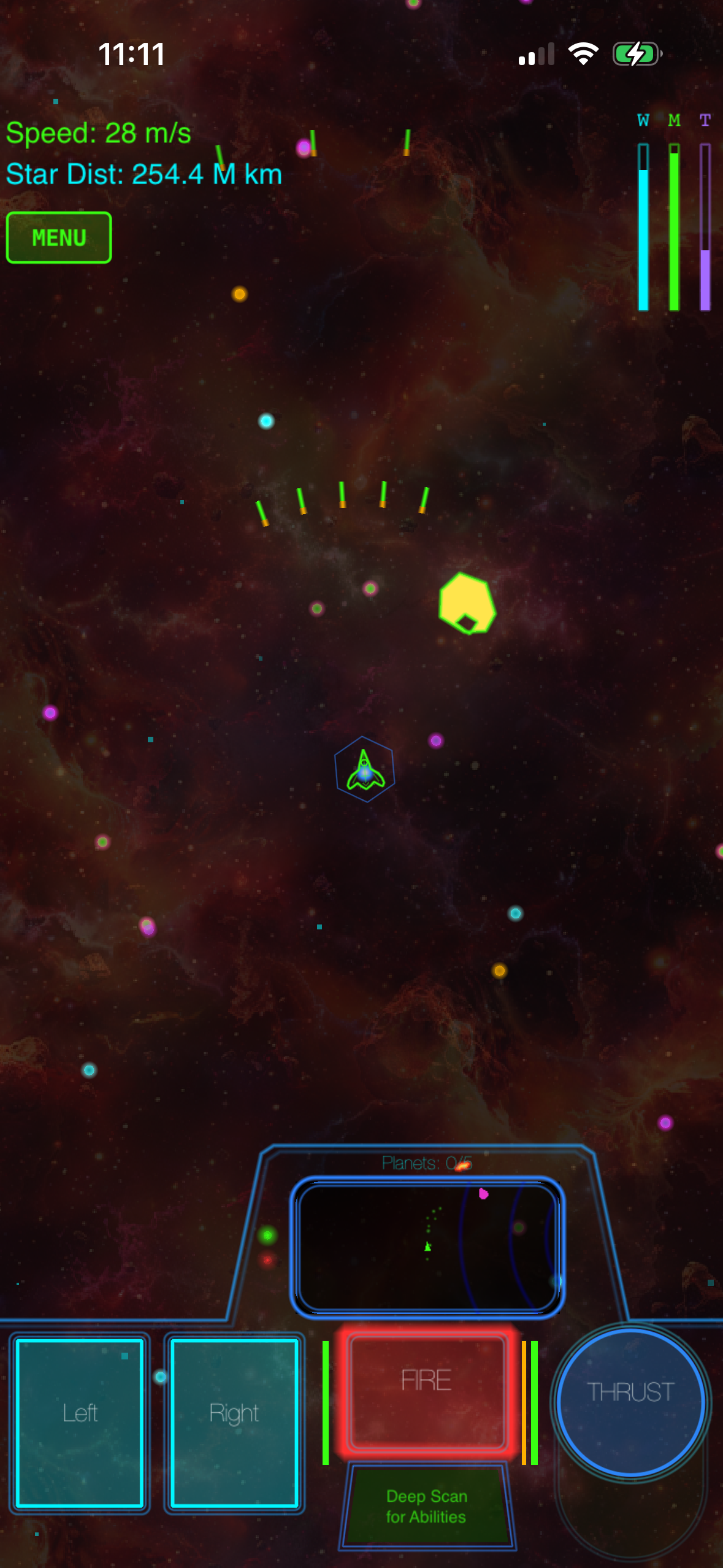
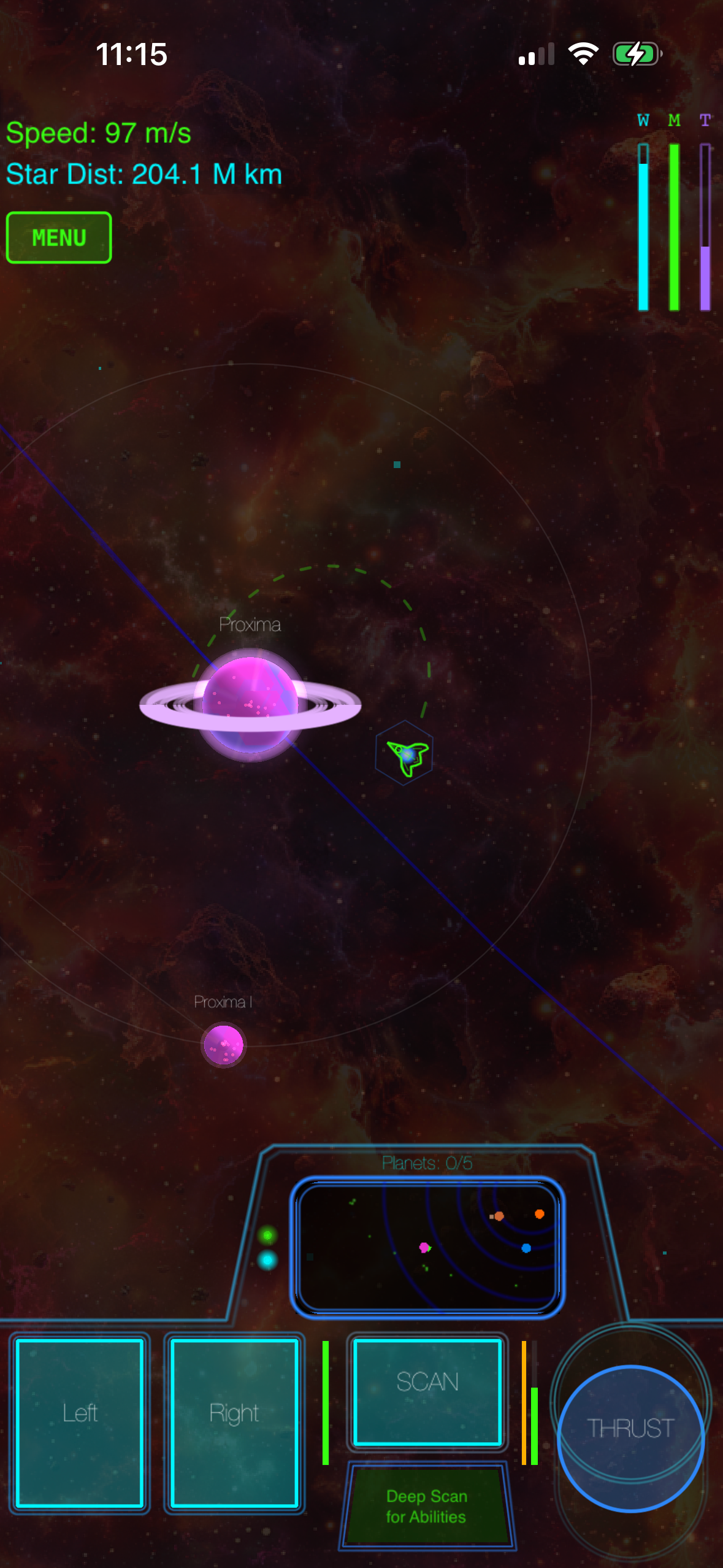
Galaximus ( at launch, App Store) simulates real orbital mechanics with controls expressive enough that players achieve mastery in 30 minutes of focused play. The ship, The New Dawn, is subject to every celestial body’s gravity in real time. Planets orbit suns. Moons orbit planets. Asteroids tumble through gravity wells. Navigation relies on gravity slingshots (free speed boosts around planets), orbital captures (coasting without fuel), and transfer windows that reward patience over twitch reflexes.
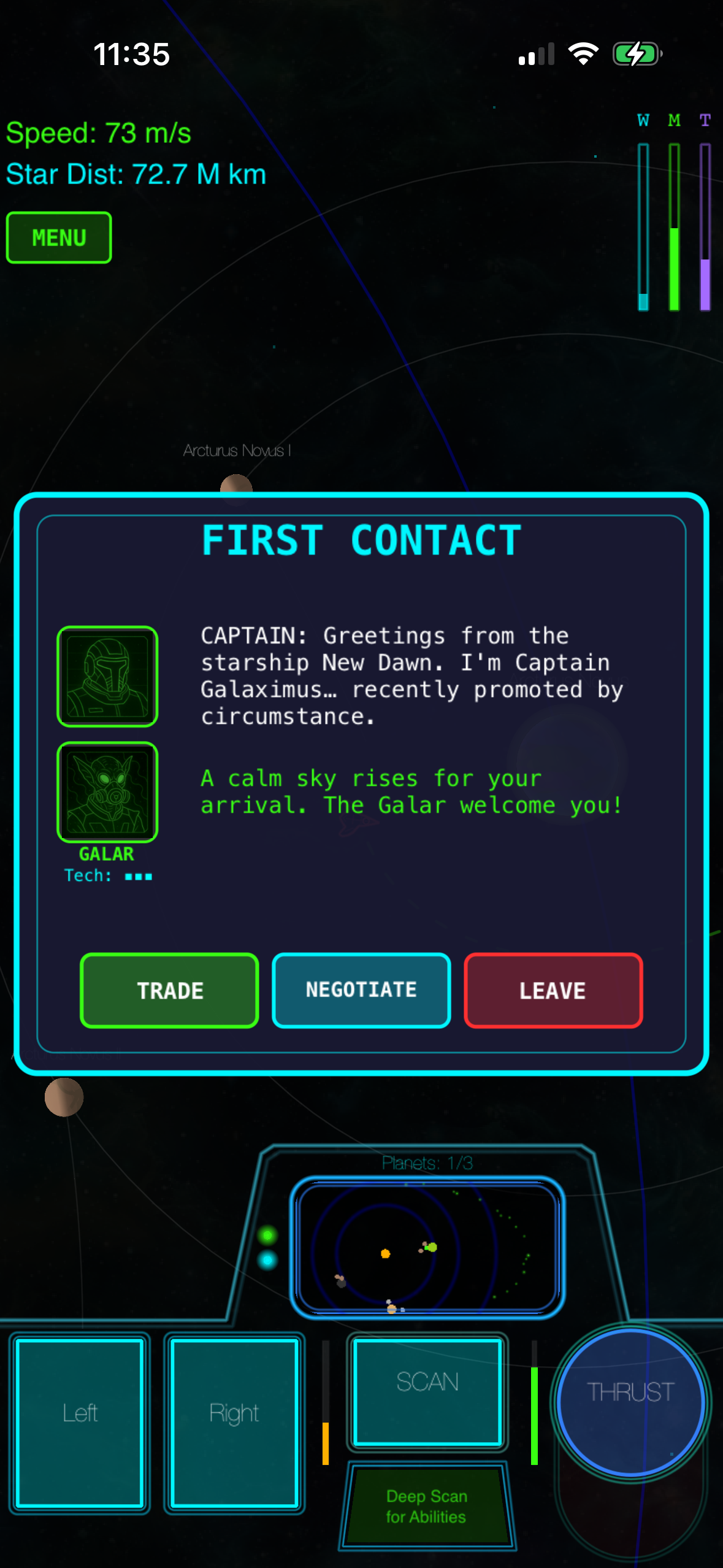
The campaign spans 8 procedurally configured star systems with a full narrative arc. Each playthrough generates unique planet positions, so you’re never flying the same map twice. Scattered through each system are 11 anomalies—spacetime rifts, derelict ships, distress beacons—that break up the core flight loop.
Combat is real-time. Pirate fleets and alien encounters require you to manage thrust, heading, and fire while gravity is actively pulling you. There’s no pause-and-plan option—the physics keeps moving, which means mastery is about reading the gravity well and positioning, not reflexes.
The audio is procedurally synthesized in real time—every laser, explosion, engine burn, and alien voice is generated on the device. No sound files.
Launch-price tier includes Galaximus Infinitum free. A major expansion ships in late 2026 (open-galaxy sandbox, planetary surface exploration, outpost building, faction warfare). Players who buy at the current tier get it at no extra cost. After Infinitum launches, the combined game moves to a higher price tier.
Get Galaximus on the App Store:
Other Premium Space Games Worth Considering
Among the Stars (, Wise Turtle Games, App Store) — a turn-based deck-building game with space colonization. Players build colonies by drafting cards from a shared pool each round. No ads or IAP. Asymmetric factions (Terrans, Evolved, Outsiders) create different strategic approaches. Best for players who want strategy and asymmetric gameplay over real-time flight. Typical session: 30–45 minutes.
Star Realm Mobile (, Wise Turtle Games, App Store) — a faster deck-building game focused on space combat. Players build decks of ships and bases to attack opponents. Lighter learning curve than Among the Stars, good for shorter sessions (15–25 minutes). Same premium-only model with no ads or IAP.
Kerbal Space Program Mobile (, Squad, App Store) — a rocketry and space engineering simulator. You design vehicles from components (engines, fuel tanks, command pods, heat shields) and launch them to reach orbital altitudes, land on moons, or dock with space stations. The learning curve is steeper than Galaximus—expect 5–10 hours before you successfully reach orbit. The payoff is learning to think like a rocket scientist. Different goal than Galaximus; both are legitimate premium experiences.
No Man’s Sky (, Hello Games, App Store) — procedural planet exploration at a scale Galaximus doesn’t attempt. Walking on a planet surface is core to its identity. Significantly larger download (20+ GB). If you want a sandbox with thousands of planets to walk on and mine resources, NMS fits. Galaximus is a tighter campaign experience with a defined ending.
The Premium Model: Why It Matters
The premium model is rare on iPhone in 2026. Most games have pivoted to free-to-play with IAP because it maximizes lifetime value extraction. That means premium games are increasingly a signal of developer intent: we built this to be good, not to be addictive.
When you buy a premium space game, you’re not competing with other players for engagement time. You’re not being A/B tested on monetization. You’re not seeing ads unless you opt into watching one for a minor in-game benefit. The developer’s only incentive is to keep you playing through quality.
For space games specifically, that alignment matters. Learning orbital mechanics requires focus. Mastery requires repeated attempts without interruption. A premium game doesn’t interrupt you.
What to Expect: The Learning Curve
Premium space games with real physics have a learning curve. That’s not a flaw—it’s the point.
Galaximus is designed so that the core mechanic (gravity slingshots) is intuitive within 30 minutes. You’ll crash into planets. You’ll overshoot orbits. You’ll waste fuel. That’s the learning. By the time you’ve cleared the first star system, you’ll understand why gravity is useful and start positioning proactively instead of reactively.
Kerbal Space Program has a steeper curve—expect 5–10 hours before your first successful orbit. The payoff is proportional.
If you want a space game you can play for 2 minutes without thinking, premium physics games aren’t it. If you want a game that rewards focus and teaches you something about how orbits actually work, they’re exactly it.
Procedural Generation: Replay Without Repetition
Premium space games use procedural generation to avoid forcing you to replay identical content.
Galaximus generates new planet configurations each time you start a campaign. You’re always flying the same 8 star systems, but the planets are in different positions, so your slingshot approach, orbital windows, and navigation strategy change. That’s enough variation to keep a campaign fresh on replay without shipping a procedurally generated sandbox.
Kerbal Space Program doesn’t use procedural generation—you’re building the same rockets and flying the same planets. But the engineering sandbox is so deep that each playthrough is mechanically different because you approach the problem differently.
The point: premium games don’t need infinite content. They need enough variation that replaying feels like discovery, not grind.
FAQ
Do I need internet to play these games? No. All four games (Galaximus, Among the Stars, Star Realm Mobile, Kerbal Space Program Mobile) are fully playable offline. Premium games ship complete and don’t require a server for core gameplay.
How long does a typical campaign take? Galaximus: 8–12 hours for a first playthrough; faster runs possible once you understand the physics. Kerbal Space Program: no fixed campaign length—you set your own goals (first orbit: 5–10 hours; landing on the moon: 20+ hours). Among the Stars and Star Realm Mobile: single session is 30–45 minutes and 15–25 minutes respectively, with unlimited replay.
What’s the actual price difference between these games? Galaximus: (launch tier). Star Realm Mobile:. Kerbal Space Program Mobile:. Among the Stars:. No Man’s Sky:. All are one-time purchases with no IAP.
Are premium space games worth the upfront cost? If you want a focused, interruption-free experience with real production quality, yes. If you’re unsure about the genre or the learning curve, try a free-to-play space game first to see if space games appeal to you. But if you know you like space games and you want something that respects your attention, premium is the right tier.
How does Galaximus differ from Kerbal Space Program? Galaximus is a real-time arcade flight game with a narrative campaign and fixed star systems. You navigate using gravity slingshots and orbital mechanics. Kerbal Space Program is an engineering sandbox where you design and build rockets from components. KSP has a steeper learning curve but offers more creative freedom. Both use real physics; they’re different genres.
The Bottom Line
Premium space games are a shrinking category on iPhone, which makes them more valuable when you find one. You’re not competing with monetization systems. You’re not waiting for energy to recharge. You’re not watching ads. You’re just playing.
If you want real gravity, real mastery, and no ads or IAP, these four games represent the current premium space landscape. Galaximus is built for players who want orbital mechanics that work like physics, controls that reward mastery, and a complete campaign with a beginning and an ending. The launch-price tier includes the Galaximus Infinitum expansion free when it ships.