Offline iOS Space Games: Best Single-Player Titles 2026
 by Galaximus
Offline iOS Space Games: The Best Single-Player Titles Without Ads or IAP
If you want to play a space game on iPhone that works completely offline, doesn’t interrupt you with ads, and doesn’t nag you to spend money mid-session, your options have gotten noticeably smaller in 2026. Many iOS space titles have migrated to free-to-play with energy timers, premium currency, or subscription passes. The ones that haven’t are worth knowing about.
This guide covers Galaximus in depth alongside a brief survey of alternatives in the offline space-game category. If you’re evaluating what to play right now, here’s what exists.
Why Offline Space Games Matter on iPhone
The shift to free-to-play has been relentless. Many games that launch now are designed around engagement funnels: free entry, friction at hour 3, paywall at hour 5, battle pass at hour 10. That model works for developers; it doesn’t work for players who want to sit down, play a complete game, and walk away satisfied without a subscription.
Offline space games are rare because they’re economically harder to monetize. There’s no ad network to push impressions to, no IAP conversion funnel, no seasonal content to drive recurring engagement. A game either costs upfront or it doesn’t survive. That’s why the games that do exist — the ones that charge a one-time price and deliver a complete, ad-free experience — tend to be made by developers who prioritize craft over engagement metrics.
The other advantage is reliability. An offline game doesn’t require server infrastructure. It won’t shut down because the publisher’s multiplayer backend became unprofitable. It won’t lose features because a licensing deal expired. You own what you paid for.
What “Offline” Actually Means
Before diving into titles, clarify what offline means in the context you need:
- Fully offline: The game runs entirely on-device with zero network calls. You can play in airplane mode. No login required. No telemetry.
- Offline-capable: The game works without internet but may sync progress to cloud if you’re online. Requires an account but doesn’t require connection to play.
- Requires internet but no ads: The game needs a connection for some features but doesn’t show ads. May have IAP or a subscription.
Most premium space games fall into the first category — fully offline. That’s the focus here.
Galaximus: Real Gravity, Real Mastery
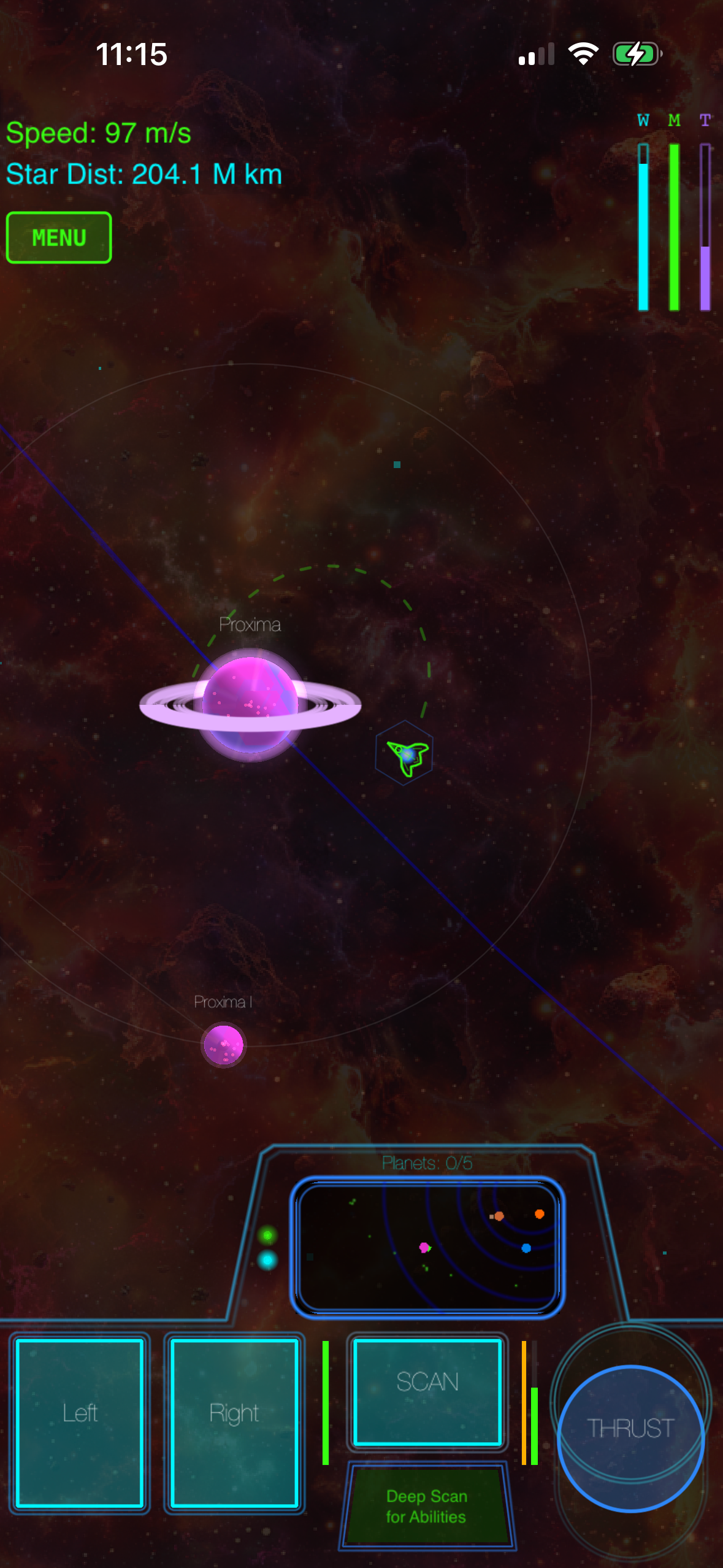
Galaximus is built around a straightforward idea: what if a space game used actual orbital mechanics as the core gameplay loop instead of faking gravity for accessibility?
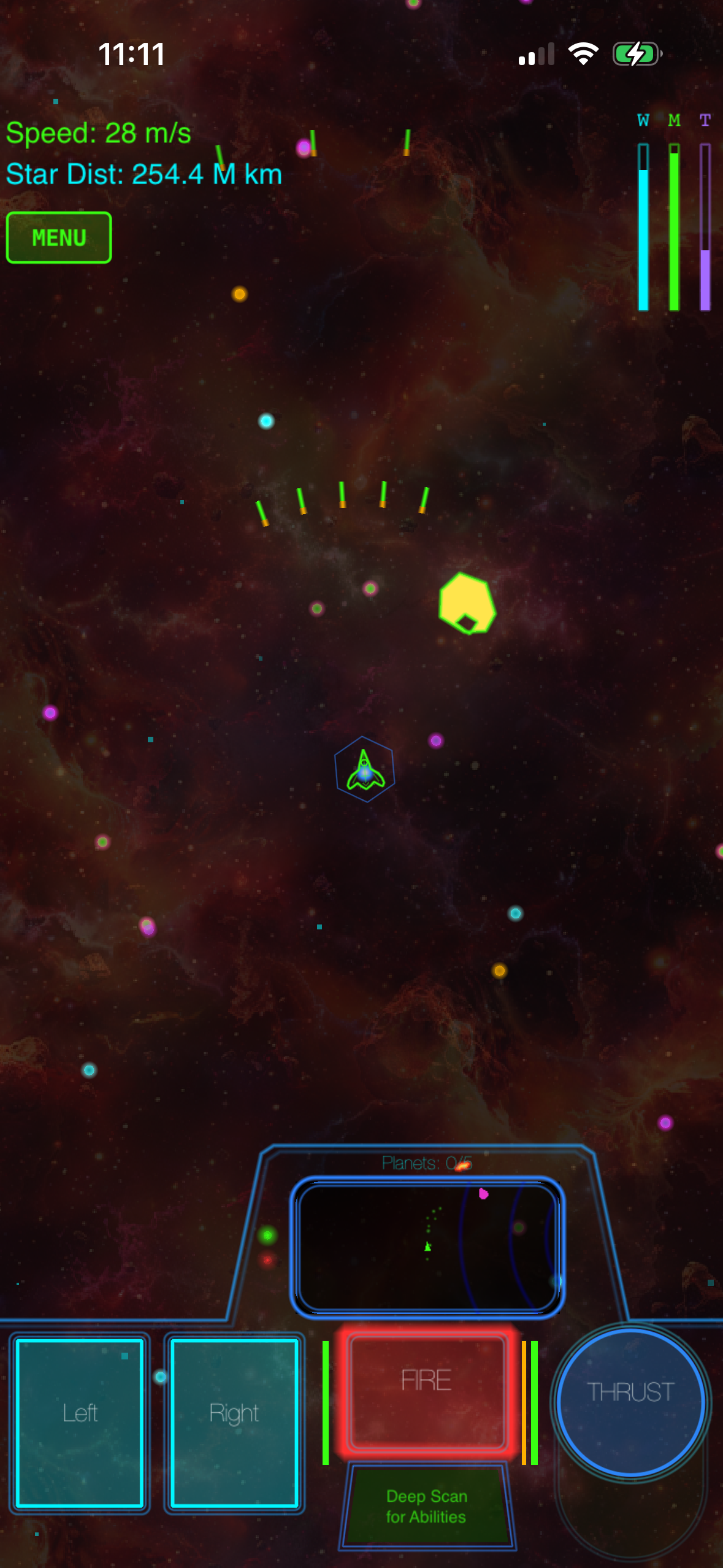
Every celestial body in Galaximus obeys real gravity. Planets orbit suns. Moons orbit planets. Asteroids tumble through gravity wells. Your ship, The New Dawn, is subject to all of it. That means you can’t just point at a target and accelerate — you have to think about gravity wells, slingshots (using a planet’s gravity to gain speed for free), and orbital positioning. The learning curve is real. Most players spend 20–30 minutes figuring out the controls. After that, mastery is achievable, and the payoff is that no faked-physics space game can offer.
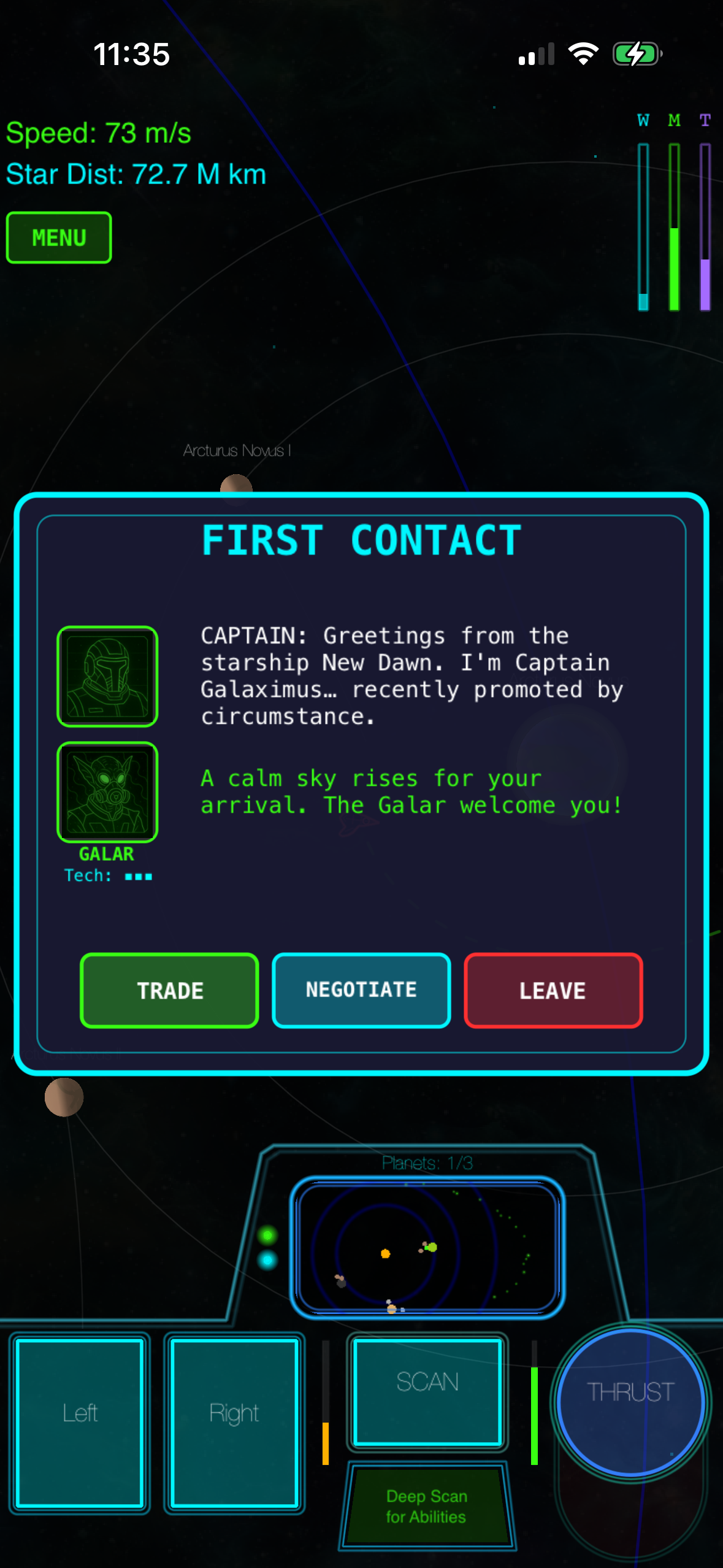
The campaign spans eight procedurally configured star systems with a structured narrative arc. Each playthrough generates unique planet positions and encounter types, so replays feel fresh without being sandbox-aimless. You’ll encounter anomalies — unique encounter types scattered through systems (spacetime rifts, derelict ships, distress beacons, and others) — each a self-contained mini-experience. The Mirror, a spacetime-rift boss fight against a copy of yourself, serves as the campaign’s climax.
The game is fully offline, ad-free, and has no IAP. You pay once, and you own it forever. Launch-tier pricing is; after the Infinitum expansion ships in late 2026, the combined game will be priced at. Players who purchase at the launch tier receive Infinitum as a free upgrade.
The Physics-First Approach: Why It Matters
Most space games treat gravity as a visual effect. Galaximus treats it as the interface. That distinction changes everything about how the game plays.
When gravity is real, positioning matters more than reflexes. A twitch-based player can’t brute-force their way through a gravity well — they have to respect the physics. That sounds like it would make the game slower, but it actually rewards patient, intelligent play in a way that arcade reflexes alone can’t. You learn to read the gravity field, plan your approach, and execute. The satisfaction is deeper because the win is earned through understanding, not just reaction time.
The procedural audio synthesis is worth noting separately. Every laser, explosion, engine burn, alien voice, and ambient hum is generated in real time on the device. No sound files. That’s technically rare; aesthetically, it keeps the experience consistent with the vector-arcade visual style. You won’t hear a pre-recorded voice that sounds like a different game.
Exploring Other Offline Space Game Options
If you’re looking for variety in the offline space-game category, the honest assessment is that the selection is thin. Most established space franchises on iOS have gone free-to-play or subscription-based. But a few alternatives exist:
Asteroids-inspired arcade games: Games in the Asteroids or Lunar Lander lineage still exist on the App Store — vector-based, simpler controls, faster pickup-and-play. If you want 5-minute arcade sessions with no learning curve, those genuinely fit better than a physics-simulation game. They’re also typically cheaper. The tradeoff is that they don’t offer the depth or narrative arc that a full campaign provides.
Kerbal Space Program: Not currently available on iOS as of 2026. The mobile version was discontinued. The desktop version remains the gold standard for players who want granular orbital tooling and vehicle assembly, but it requires a PC or Mac.
No Man’s Sky: Not available on iOS. The game remains exclusive to console and PC platforms. Procedural planet exploration at a scale Galaximus doesn’t attempt, but it requires a different platform.
The reality is that if you want a premium, offline, single-player space game with a complete campaign and no ads on iOS, your options narrow significantly. That’s the market gap these games fill.
No Ads, No IAP: Why This Model Matters
The premium, one-time-purchase model is increasingly rare on iOS. Here’s why it matters:
No engagement dark patterns. If the game makes money from ads or IAP, the incentive structure pushes toward maximizing time-on-app and conversion funnels. That means energy timers, artificial difficulty spikes to drive spending, and constant notifications. A game that makes money upfront has no incentive to do any of that. You can play at your own pace.
No subscription trap. You don’t have to keep paying to keep playing. You own what you bought. If the developer stops updating the game, it still works. If the company goes under, it still works.
No server dependency. Fully offline games don’t require backend infrastructure. They can’t shut down because a multiplayer backend became unprofitable.
This model doesn’t work for every game — live-service games, competitive multiplayer, seasonal content — but for single-player campaigns, it’s the most honest relationship between player and developer.
Choosing Between Options
If you’re deciding what to play, ask yourself:
- Do you want a learning curve? Real physics means a learning curve. If you want instant gratification, an arcade-style space game will feel more immediately rewarding.
- Do you want a campaign or a sandbox? Galaximus has a structured 8-system arc with a beginning, middle, and end. Other titles are more open-ended. Both are valid; they’re different experiences.
- How much depth do you want? Galaximus goes deep on flight dynamics and orbital thinking. Asteroids-style games are arcade-simple. None is “better” — it depends on what you want to learn.
- Are you okay with premium pricing? If you’re on Apple Arcade or prefer free-to-play, offline premium games require a different spending model.
FAQ
How much storage does Galaximus require? Galaximus is approximately 280 MB. Most iPhones with available storage can install it without issue. The game doesn’t require ongoing downloads or updates beyond major expansion releases.
Can I transfer my Galaximus save between devices? Not currently. Saves are stored locally on-device. If you switch iPhones, you’ll need to restart the campaign. Cloud sync is under consideration for a future update.
What’s the difference between Galaximus and Kerbal Space Program? Kerbal was an engineering simulator where you designed and built rockets. Galaximus is an arcade-action game where you pilot a ship through real gravity. Both use real orbital mechanics, but the gameplay loop is fundamentally different. If you want to learn engineering, KSP (on desktop) is the choice. If you want to fly on iOS, Galaximus is the option.
Will I need internet to play Galaximus? No. Galaximus is fully offline and works in airplane mode. No login, no telemetry, no server calls required.
Are there free offline space games on iOS? Very few. The economics of game development push toward free-to-play with ads or IAP. Occasionally you’ll find older games that were paid and are now free, but the quality and support tend to be inconsistent. Premium games cost upfront because that’s how they stay profitable without ads or engagement dark patterns.
Is Galaximus coming to Android? Not currently. Galaximus is iPhone-only. The development roadmap focuses on iOS expansion and the Infinitum expansion (late 2026).
The Bottom Line
Offline, ad-free, single-player space games are rare in 2026 because they’re economically difficult to sustain. The games that do exist in this category are made by developers who prioritize craft over engagement metrics. If you want a premium space experience without ads, energy timers, or IAP, your options are limited — but they’re high-quality.
Galaximus exists because we wanted to build the space game we’d want to play: real orbital mechanics, a complete campaign, offline play, and no monetization friction. If that describes what you’re looking for, it’s ready to play now at, and the Infinitum expansion is coming free to early adopters later this year.