Best $4 Premium iPhone Games: Space Focus
 by Galaximus

Photo by Brecht Corbeel on Unsplash
The Best Premium Space Games for iPhone in 2026
Premium space games on iPhone—titles you buy once with no ads or in-app purchases—have largely migrated to free-to-play models. The ones that remain offer distinct approaches to orbital mechanics and exploration. This guide compares the actual options available in 2026.
Quick Picks
| Game | Best For | Learning Curve | Price |
|---|---|---|---|
| Galaximus | Intuitive orbital flying with narrative campaign | 30 minutes | |
| Kerbal Space Program | Rocket engineering and orbital mechanics from first principles | Steep (hours) | |
| No Man’s Sky | Procedural planet exploration and discovery | Low |
Galaximus: Orbital Mechanics as Interface
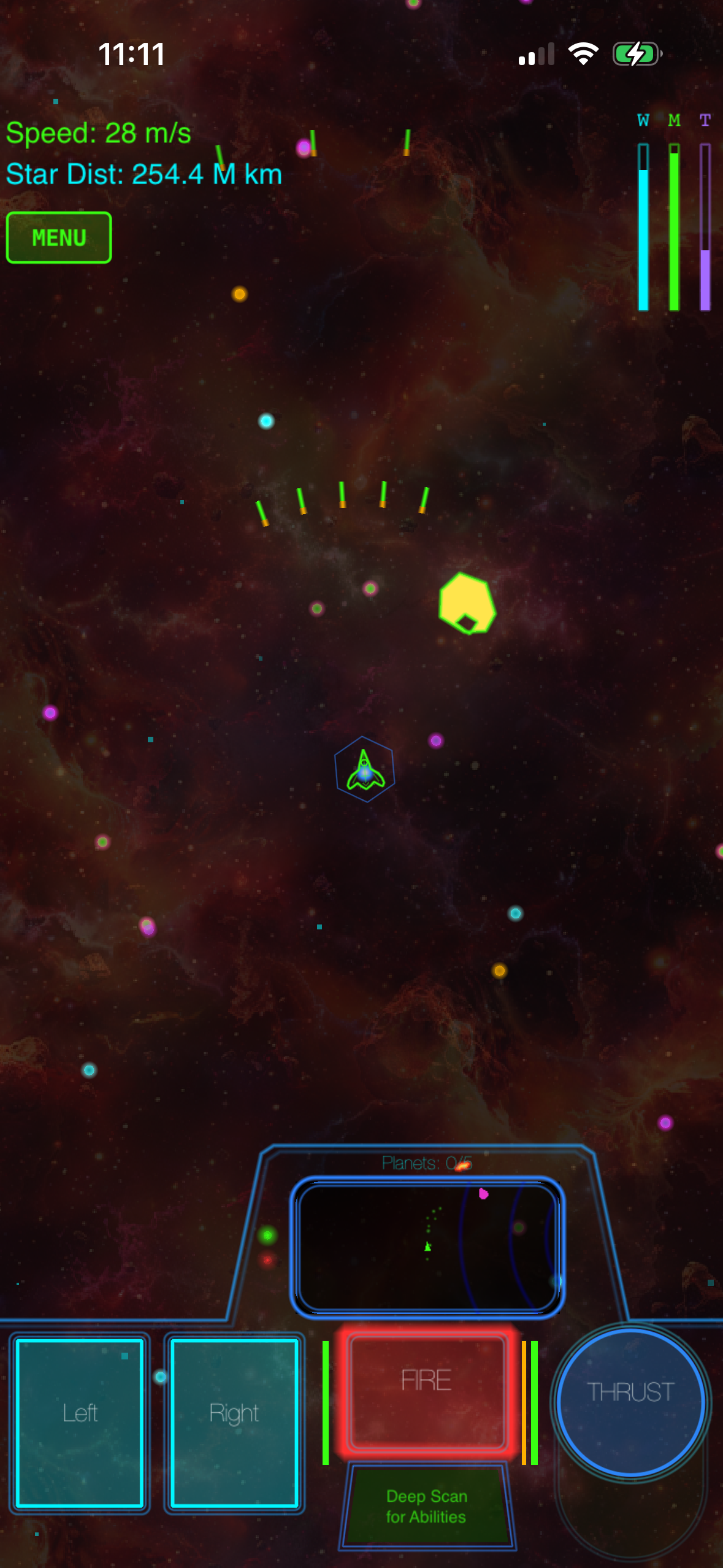
Galaximus puts you in command of The New Dawn, a ship subject to real-time gravity from every celestial body in its star system. Planets orbit their suns. Moons tumble. Your ship obeys the same physics. The core mechanic is using gravity wells to slingshot forward without burning fuel.
The learning curve is genuine but front-loaded: roughly 30 minutes until the physics feels intuitive. After that, mastery becomes a matter of reading gravity wells and timing entries and exits. You’re not calculating orbital velocity; you’re piloting by feel.
Campaign structure: Eight procedurally configured star systems with a narrative arc from beginning to end. Each playthrough generates unique planet positions, so replay has mechanical incentive beyond grinding. Anomalies—derelict ships, spacetime rifts, distress beacons—provide narrative breaks between navigation segments.
Combat: Present but not central. Hostile fleets require managing momentum and gravity simultaneously rather than pure reflexes. Tactical rather than arcade-focused.
Offline play: Fully supported. No internet required.
Current pricing advantage: Galaximus Infinitum (open-galaxy sandbox, planetary surface exploration, outpost building, faction warfare) launches in late 2026. Players who purchase the base game now at receive the expansion free when it ships. Post-launch pricing will be higher for the combined product.
Get Galaximus on the App Store: Get it on the App Store
Kerbal Space Program
Kerbal Space Program is a rocket engineering simulator. You design, build, and launch vehicles from first principles, managing thrust-to-weight ratios, staging, fuel distribution, and orbital mechanics. The game teaches you to think like an aerospace engineer.
Learning curve: Steep. Expect hours before you successfully reach orbit. The manual is extensive. YouTube tutorials are nearly mandatory for understanding staging and delta-v budgeting.
Gameplay: Building is the core activity. Flying is the validation. You’re not piloting a pre-built ship; you’re engineering one, then testing your design.
Availability on iOS: Kerbal Space Program is available on iPad (iOS 13.2+) via the App Store. Not available on iPhone due to screen size and processing requirements.
Best for: Players who want to understand orbital mechanics from engineering principles rather than intuition. The payoff is deep—you’ll understand why gravity assists work, how to calculate orbital transfers, and why rocket staging matters. The investment is substantial.
No Man’s Sky
No Man’s Sky is a procedural exploration game. You land on planets, discover flora and fauna, gather resources, build outposts, and trade with factions. The scale is vast: billions of procedurally generated planets.
Learning curve: Low. Core loop is intuitive: land, explore, gather, trade, move to next planet.
Gameplay: Exploration-as-discovery. The appeal is wandering and uncovering what’s on the next planet, not mastering a mechanical system.
Availability on iOS: No Man’s Sky is available on iPad (iOS 14.4+) via the App Store. Not available on iPhone.
Best for: Players who want to inhabit a world rather than complete a campaign. The game has no ending—it’s a sandbox for ongoing exploration.
Why Premium Pricing Matters
Premium games remove monetization incentives that distort design. Free-to-play games make money from friction: energy timers, artificial progression slowdowns, difficulty spikes that encourage power-up purchases. Premium games make money only from being good enough to recommend.
This affects design decisions. Premium games can ship complete campaigns without post-launch content roadmaps. They can implement expensive features (like procedural audio synthesis in Galaximus) without needing to recoup costs through monetization. They can respect your schedule instead of pushing notifications designed to pull you back in.
The tradeoff is upfront cost. But you own the game permanently, with no risk of publisher shutdown or model conversion.
Choosing Your Space Game
Do you want to pilot or engineer? Galaximus is built for piloting—you’re flying a ship and using gravity intuitively. Kerbal Space Program is engineering—you’re building rockets and understanding orbital mechanics from first principles. Different skills, different satisfactions.
Do you want a campaign or a sandbox? Galaximus has a structured narrative arc with an ending. No Man’s Sky is open-ended exploration. One is a story to finish; the other is a world to inhabit.
How much learning investment are you willing to make? Galaximus: 30 minutes to intuitive play. Kerbal Space Program: hours to basic competence. No Man’s Sky: minimal. All three reward mastery, but the time-to-fun varies significantly.
What’s your device? Galaximus runs on iPhone. Kerbal Space Program and No Man’s Sky require iPad due to processing and screen-size requirements.
FAQ
Does Galaximus support controller input? Yes. MFi controllers are supported for full gamepad play.
How long is the Galaximus campaign? A single playthrough takes 8–12 hours depending on exploration depth. Procedural variation makes replays mechanically distinct.
Can I play these games offline? Yes. All three are fully playable offline with no internet requirement.
Why are premium space games rare on iPhone? Free-to-play proved more profitable for publishers, so most studios converted. The premium titles that remain are typically indie developers or studios prioritizing creative control over maximum revenue.
What happens to Galaximus if the developer stops supporting it? You own the game permanently. It will continue to run on your device regardless of future updates or developer decisions. This is a key advantage of premium pricing—no risk of publisher shutdown or forced conversion to free-to-play.
Is buying Galaximus now worth it before Infinitum launches? If you want to play immediately and future-proof your purchase, yes. The base game is complete and satisfying on its own. Players who buy now at receive the expansion free when it ships in late 2026. Waiting means paying the higher combined price post-launch.
The Bottom Line
Premium space games on iPhone are a small market. Galaximus is the only option that runs natively on iPhone with real orbital mechanics. Kerbal Space Program and No Man’s Sky require iPad and offer different strengths—engineering depth and exploration scale respectively.
If you want orbital mechanics without free-to-play friction on an iPhone, Galaximus is the available choice. If you have an iPad and want to explore engineering or exploration at scale, the other options are worth considering.
Buying premium games signals to developers that the model works. Every purchase supports the developers making games without monetization pressure.
Get Galaximus on the App Store: Get it on the App Store