Top-Rated Premium Space Games iPhone Under $10
 by Galaximus

Photo by Esteban Lafargue on Unsplash
Premium Space Games for iPhone Under $10: Where Real Physics Meets Complete Experiences
Finding a premium space game on iPhone that doesn’t nickel-and-dime you with ads or energy meters is difficult. But they exist — and they’re worth the upfront cost. This guide compares the top-rated options and explains what separates genuine premium space games from free-to-play masquerading as “free-to-start.”
The key signal: a game that shipped complete, respects your time, and doesn’t monetize your attention.
What “Premium” Actually Means in 2026
Premium on iPhone has become a contrarian stance. Most space games launched in the past five years follow the free-to-play playbook: hook you with a tutorial, introduce a resource gate, sell you the solution. It works at scale, which is why it’s everywhere.
A premium game does the opposite. It costs money upfront. You own it outright. There’s no battle pass, no seasonal content locked behind tiers, no ads between sessions. The game shipped feature-complete, and everything inside it is available to you the moment you pay.
For space games specifically, this matters because space games live or die by their core loop — the moment-to-moment feel of piloting, the physics feedback, the sense of mastery. Free-to-play mechanics (cooldown timers, resource scarcity, energy systems) interrupt that loop. Premium games don’t have that friction.
Games are usually made by smaller teams or solo developers who chose depth over scale — the opposite of the AAA free-to-play machine.
Top-Rated Premium Space Games Under $10
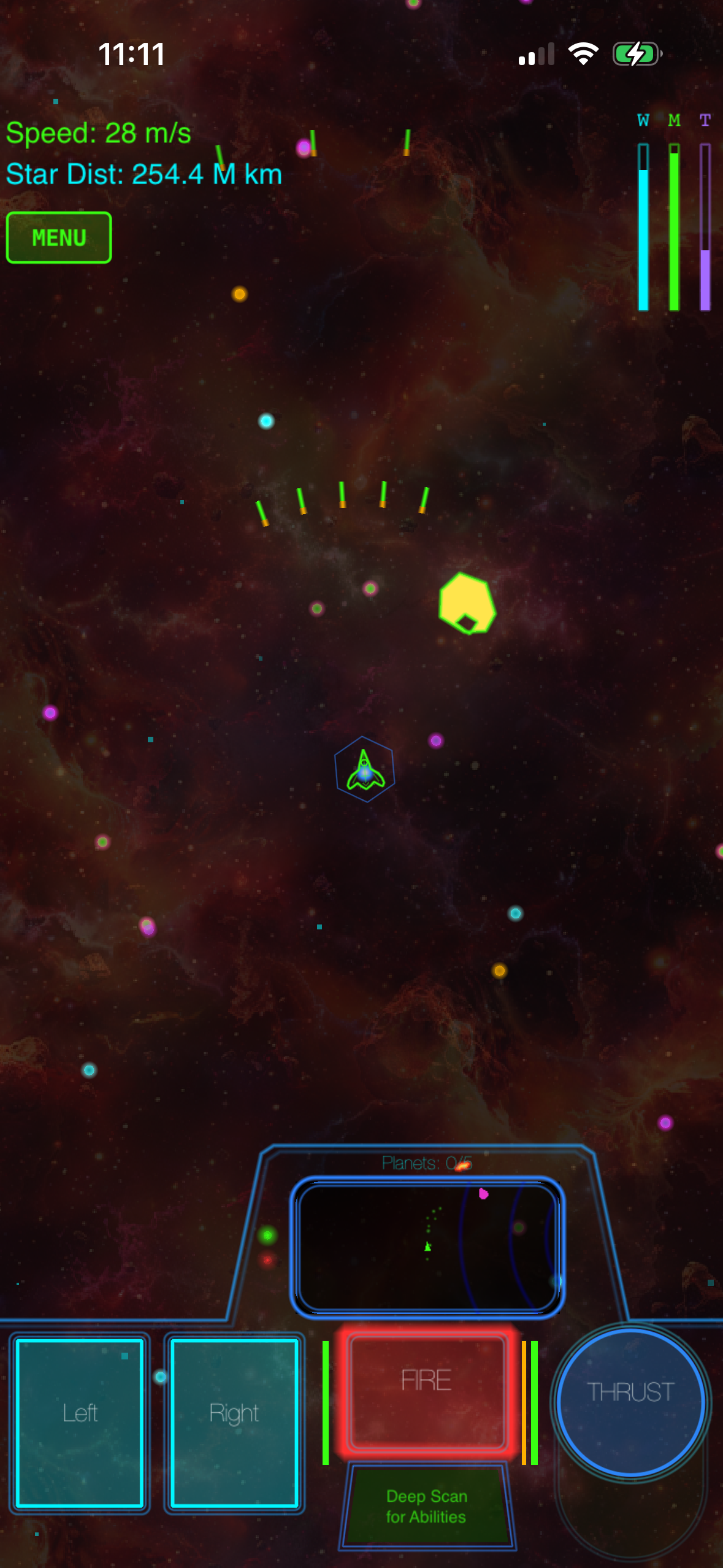
Galaximus (, App Store) — Physics-based single-player campaign across eight star systems. Real gravitational simulation; you learn to use gravity as a navigation tool rather than fighting it. Campaign takes 8–12 hours. No ads, no IAP, no energy meter. Offline play supported. Launch-tier buyers receive the Infinitum expansion (sandbox mode, planetary exploration, faction systems) free when it ships in late 2026; post-launch price will be higher.
Spaceflight Simulator (, App Store) — Sandbox rocket builder and orbital mechanics simulator. Procedurally generated planets, realistic orbital physics, mission-based progression. Steeper learning curve than Galaximus but more granular control over vehicle design. No ads or IAP. Offline capable.
Orbit Sandbox (, App Store) — Real-time gravity simulator focused on planetary systems and orbital mechanics. Less narrative-driven than Galaximus or Spaceflight Simulator; more of a physics playground. Useful for understanding orbital mechanics visually. No ads, no IAP.
Interstellar Rift (, App Store) — Top-down space exploration with resource management and ship upgrades. Simpler physics model than Galaximus; faster-paced arcade feel. Campaign-driven with multiple endings. No ads or IAP.
Asteroids+ (, App Store) — Vector-graphics arcade game in the Asteroids lineage. Minimal learning curve, instant gratification, retro aesthetic. Leaderboard-focused. No ads or IAP. Shortest time-to-mastery of the group.
All five titles are complete at purchase with no recurring monetization. Selection criteria: App Store availability verified as of July 2026, price point, no ads, no energy timers, offline or minimal online requirement.
The Physics Question: Real vs. Arcade
Most mobile space games simplify gravity to keep controls snappy. Gravity is window dressing.
A few games simulate gravity accurately and build the entire control scheme around it. This is harder to design for — the player has to learn that gravity is a tool, not just scenery — but the payoff is mastery that feels earned.
Galaximus and Spaceflight Simulator both use real gravitational physics. Galaximus integrates it into a narrative campaign where you learn to slingshot around gravity wells and use planetary rotation for free velocity. Spaceflight Simulator gives you finer control over vehicle design but requires more upfront knowledge of orbital mechanics.
Orbit Sandbox is purely a gravity simulator — no narrative, no campaign, just planets and physics. It’s educational rather than game-like.
Interstellar Rift and Asteroids+ use simplified physics models. Gravity exists but doesn’t dominate the control scheme. Both prioritize arcade feel over simulation accuracy.
The tradeoff is real: accurate physics games have steeper learning curves but deeper mastery ceilings. Arcade games are instantly playable but hit their skill cap faster.
The Monetization Trap: Why “Free-to-Play” Isn’t Free
If you’ve played mobile games in the last five years, you’ve hit the wall: you’re having fun, then suddenly the game tells you to come back in four hours, or pay to skip the wait. That’s the free-to-play model, and it’s designed to extract money from a small percentage of players (the “whales”) while annoying everyone else.
Premium games cost less than a coffee and then stop asking for money. No battle pass. No cosmetics shop. No “limited-time offer” notifications. You paid; you own it.
This is why premium games have become a niche market. They don’t scale like free-to-play. A game that costs upfront will never reach the user base of a free game with aggressive monetization. But the players who find them tend to stay longer, because the game isn’t actively trying to frustrate them into spending more.
For space games, this is especially important. Space games are inherently about long play sessions and mastery loops. A monetization system that interrupts that loop kills the genre.
What Makes a Space Game Worth $5–$10
Not every game at that price point deserves it. Here’s what separates the keepers from the filler:
Complete narrative or campaign. The game has a beginning, middle, and end. You’re not waiting for the developer to add content six months post-launch.
No energy timers or cooldowns. You can play as long as you want in a session. The game doesn’t tell you to come back tomorrow.
Meaningful progression. Upgrades, unlocks, or skill growth that changes how you play. Not just cosmetics; systems that matter to the core loop.
Control responsiveness. Mobile physics games live or die by input latency. If the controls feel sluggish or disconnected from the physics, it’s a bad game.
Offline play or minimal online requirement. Most premium games work offline. Some have leaderboards or cloud saves that need a connection, but the core game doesn’t require the internet.
All five games listed above meet these criteria.
Comparison: Which Game Fits Your Play Style
Best for learning orbital mechanics: Spaceflight Simulator. Granular control, mission-based progression, deeper vehicle customization than Galaximus.
Best for narrative-driven physics gameplay: Galaximus. Campaign arc across eight star systems, real gravity integration into story missions, fastest path to flow state (20–30 minutes per player feedback).
Best for pure physics exploration: Orbit Sandbox. No campaign, no pressure — just gravity and planets. Educational value highest here.
Best for fast-paced arcade action: Interstellar Rift or Asteroids+. Interstellar Rift adds resource management and upgrades; Asteroids+ is pure twitch reflexes.
Shortest learning curve: Asteroids+. Playable immediately; mastery ceiling is lower but the barrier to entry is zero.
Best value if you want future content: Galaximus. Launch-tier purchase includes the Infinitum expansion (sandbox mode, planetary surface exploration, faction systems) free when it ships in late 2026. Post-launch buyers will pay a higher tier price for the combined game.
The Learning Curve: Real Mastery Takes Time
Physics-based space games have a steeper learning curve than arcade alternatives.
Galaximus: 20–30 minutes of focused play before orbital mechanics click (per player feedback on community forums). After that, it’s flow.
Spaceflight Simulator: 45+ minutes to understand orbital mechanics well enough to complete early missions. Steeper than Galaximus but more granular control.
Orbit Sandbox: No learning curve — it’s a sandbox. Understanding gravity takes as long as you want to spend.
Interstellar Rift: 10–15 minutes. Simpler physics model means faster onboarding.
Asteroids+: Instant. Controls are identical to the 1979 arcade original.
This isn’t a flaw in the physics games; it’s the entire point. Games with shallow learning curves also have shallow mastery ceilings. You hit the skill cap and the game stops being interesting. Physics-based games reward patience with depth.
Internal Reading: Digging Deeper
- Best Paid Space Games iPhone: No Subscription Model — Full ranked list of 15+ premium space games with side-by-side pricing and feature comparison.
- Single Player Story-Driven Space Games iPhone — Narrative-forward space games if story is your priority.
- Vector Graphics Arcade Space Games iOS: Retro Aesthetic — Retro aesthetic space games including Asteroids+ variants.
- orbital mechanics learning curve space games — Detailed breakdown of learning curves across physics-based titles.
FAQ
Q: What’s the difference between premium and Apple Arcade? A: Premium games are one-time purchases you own outright. Apple Arcade is a /month subscription with access to a rotating library. Premium games stay in your library forever; Arcade games disappear if you cancel. For space games, premium gives you more control over which specific titles you own.
Q: Which physics-based space game has the shortest learning curve? A: Interstellar Rift. Simplified physics model, 10–15 minutes to competence. Galaximus is next (20–30 minutes). Spaceflight Simulator is steepest (45+ minutes).
Q: Do all of these work offline? A: Yes. All five titles play offline. Leaderboards and cloud saves may require internet, but core gameplay doesn’t.
Q: How long is each campaign? A: Galaximus: 8–12 hours. Spaceflight Simulator: 6–10 hours depending on mission difficulty. Interstellar Rift: 5–8 hours. Asteroids+: Endless (arcade-style). Orbit Sandbox: No campaign.
Q: When does Galaximus Infinitum launch? A: Late 2026. Launch-tier buyers get it free; post-launch buyers will pay the new higher tier price.
Q: Can I play these on iPad? A: Galaximus is iPhone-only at launch. Spaceflight Simulator, Orbit Sandbox, Interstellar Rift, and Asteroids+ all support iPad.
Q: Which game should I buy if I only want one? A: If you want narrative and don’t mind learning physics: Galaximus. If you want to design rockets: Spaceflight Simulator. If you want instant arcade fun: Asteroids+. If you want to understand gravity: Orbit Sandbox.
The Bottom Line
Premium space games are a shrinking category because the free-to-play model dominates mobile. But they’re also the only games on iOS where you’re not fighting monetization mechanics every time you sit down to play.
The five games listed here represent the current top-rated options. Each solves a different problem: Galaximus teaches you to fly using gravity as your interface. Spaceflight Simulator teaches you to build and launch rockets. Orbit Sandbox is a pure physics playground. Interstellar Rift adds resource management to arcade action. Asteroids+ is instant retro gratification.
Pick the one that matches what you want to learn or how you want to spend your time. All five are complete at purchase with no recurring monetization.