Story-Driven Single-Player Space Games for iPhone
 by Galaximus

Photo by Brian McGowan on Unsplash
Story-Driven Single-Player Space Games for iPhone
Space games on mobile have a reputation for being quick arcade bursts—tap to shoot, watch the score climb, close the app. But some do something different. They pair meaningful mechanics with narrative weight, letting you discover story through exploration and decision-making rather than cutscenes between gameplay sessions. This guide covers what makes story-driven space games work on iPhone and which real options exist.
What Makes a Space Game Story-Driven?
A story-driven space game isn’t just a game with a plot attached. It’s one where narrative and mechanics reinforce each other. You discover the story through what you do, not what you watch.
The best examples share these traits:
- Authored progression. The game has a beginning, middle, and end—not an infinite procedural sandbox. You know when you’ve finished the story.
- World-building through interaction. NPCs, distress signals, derelict ships, or environmental clues reveal who inhabited this space and what happened. You piece it together.
- Mechanics that serve narrative. If the game is about survival, resource management matters. If it’s about first contact, dialogue or negotiation is part of the win condition. Systems aren’t decoration.
- Emotional payoff. The game leaves you with something to think about after you close it—not just “I got a high score,” but genuine questions about the world or characters.
Most casual space games skip this. They’re designed for 2-minute sessions and don’t need narrative depth. Story-driven games ask for patience and investment—and they reward it.
Physics and Immersion
Real orbital mechanics can deepen a space story instead of complicating it. When gravity is faked or absent, space feels like an empty stage. When gravity is real—when bodies affect each other, when you must position yourself to use a planet’s pull instead of burning fuel—space becomes a character in the story. It has rules. It has weight.
Not every story-driven space game needs realistic physics. But the ones that use it well treat it as part of world-building, not a difficulty setting.
Narrative Structures That Work on Mobile
Mobile gaming has constraints. Sessions are shorter, interruptions are common, and the screen is small. Story-driven space games that succeed on iPhone work within those constraints.
The Episodic Arc
A structured campaign split into self-contained missions or systems. Each one is a complete experience (30–60 minutes) but connects to a larger narrative. You finish one mission, learn something about the world, and move to the next. This lets you play in sessions without losing narrative thread.
The Found-Story Model
Instead of being told what happened, you find it. Derelict ships, alien transmissions, environmental clues. The game trusts you to piece together the story. This works well on mobile because it doesn’t require cutscenes or long dialogue sequences.
The Dialogue-Driven Encounter
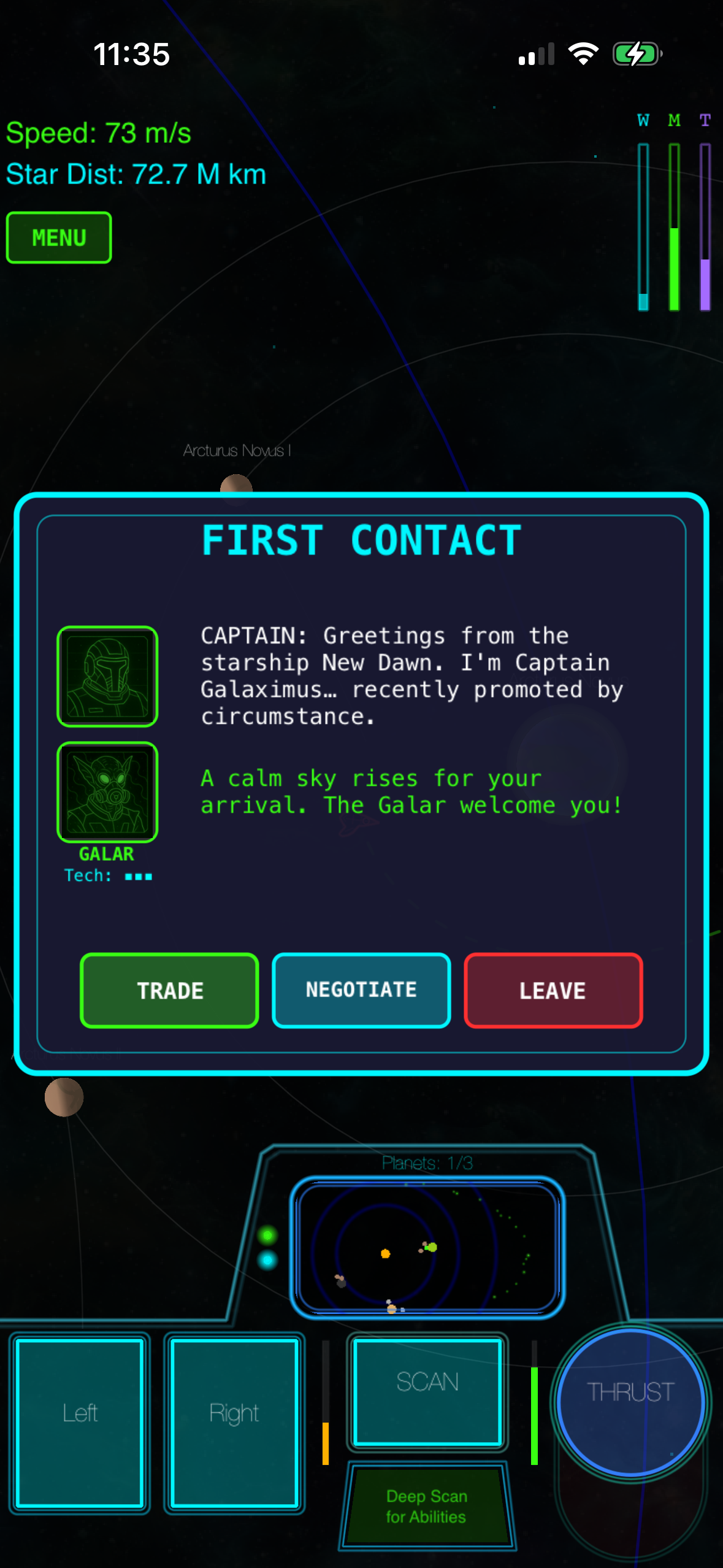
First contact with alien species, negotiations, or moral choices embedded in dialogue. Modern mobile hardware supports synthesized voices, which enables character interaction without large file sizes.
The Premium Model
Story-driven games don’t monetize well through ads or in-app purchases. They ask for focus and time, which conflicts with free-to-play models that interrupt you to sell something.
The best story-driven space games on iPhone are premium—one-time purchase, no ads, no energy meters. You buy it once and own the complete experience. This model is rare, which is why it’s worth seeking out. A game that doesn’t need to interrupt you can actually respect your attention.
The trade-off: premium games have smaller audiences and higher barrier to entry. They also typically receive less post-launch support than free-to-play titles. But they offer complete experiences without monetization pressure.
Pacing and Session Length
Mobile story games live or die on pacing. Too long and you lose players between sessions. Too short and there’s no room for meaningful narrative.
Most successful story-driven space games fit into 30–90 minute sessions, with total campaigns of 4–8 hours. That’s long enough to develop characters and world, short enough that you can complete a meaningful chunk in one sitting.
What to Look For
If you’re hunting for a story-driven space game on iPhone, these are signals of quality:
- Offline-first design. The game works without internet. Story games need focus; network dependency breaks immersion.
- No ads or IAP. If the game interrupts you to sell something, it’s not story-driven—it’s free-to-play with narrative skin.
- Authored campaign with a clear ending. Not an infinite sandbox. You should know when you’ve finished the story.
- Mechanics that reflect the narrative. If survival matters to the story, resource management should matter to gameplay.
- Minimal UI friction. Controls should be intuitive enough that you’re not fighting the interface to experience the story.
Real Story-Driven Space Games for iPhone
Alto’s Adventure (free with IAP, also premium version available) A minimalist endless runner set in a desert landscape. While not explicitly space-themed, it uses procedural generation to create unique journeys, and the visual progression and ambient soundtrack create narrative atmosphere. Sessions are short (5–15 minutes), but the meditative pacing and environmental storytelling appeal to players seeking narrative-driven experiences.
Outer Wilds (premium, ) A puzzle-exploration game where you pilot a spaceship through a solar system trapped in a time loop. The story unfolds entirely through exploration—no dialogue, no cutscenes. You discover what happened to a lost civilization by visiting planets, reading logs, and piecing together clues. The mechanics (time loop, limited fuel, exploration) are inseparable from the narrative. It’s dense and demanding, but it’s a masterclass in story-driven space design. Campaign length: 15–25 hours.
Juno’s Odyssey (premium, ) A narrative-driven space exploration game where you pilot a ship through procedurally generated systems. The game focuses on discovery and resource management as you uncover what happened to a lost colony. It’s shorter than Outer Wilds (3–5 hours) and lighter on puzzle-solving, but it emphasizes the emotional journey of exploration.
Reigns: Her Majesty (premium, ) While not a space game, it’s a story-driven game that uses procedural variation and card-based mechanics to create branching narratives. It demonstrates how mobile games can deliver complex storytelling within short sessions. Relevant for understanding how narrative and mechanics intertwine on iOS.
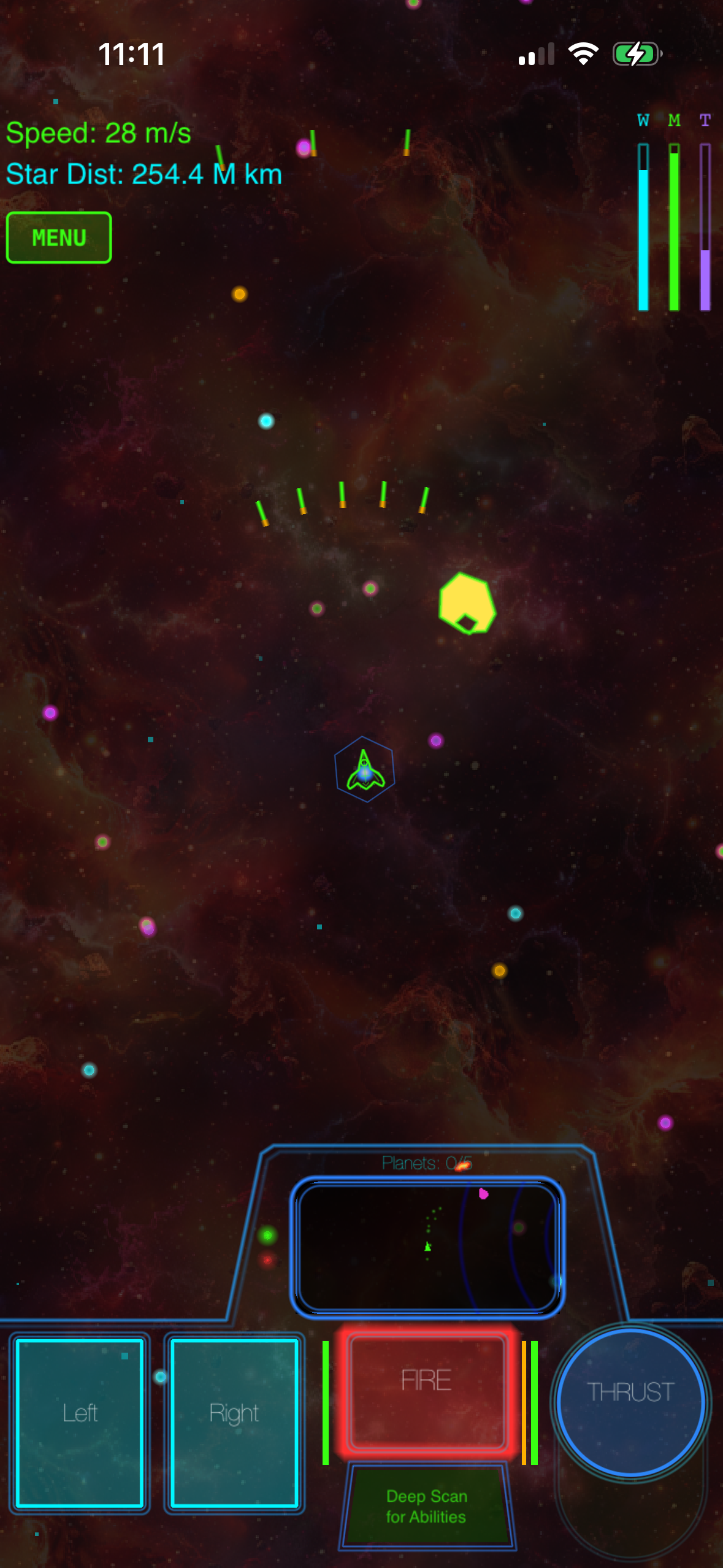
Galaximus (premium, ) A space exploration game built around orbital mechanics and procedural generation. You navigate eight star systems, encountering anomalies and derelicts that reveal the story of what happened in this region of space. The game emphasizes mastery of gravity-based navigation as part of the narrative experience. Sessions run 30–90 minutes; full campaign is 4–8 hours. No ads, no IAP, no internet required.
Comparing Your Options
| Game | Length | Physics | Procedural | Offline | Price |
|---|---|---|---|---|---|
| Alto’s Adventure | 5–15 min/session | No | Yes | Yes | Free or |
| Outer Wilds | 15–25 hours | Yes | No | Yes | |
| Juno’s Odyssey | 3–5 hours | Simplified | Yes | Yes | |
| Reigns: Her Majesty | 10–20 min/session | N/A | Yes | Yes | |
| Galaximus | 30–90 min/session | Yes | Yes | Yes |
Outer Wilds is the most critically acclaimed and offers the deepest narrative experience, but it’s also the most expensive and demanding. Juno’s Odyssey and Galaximus offer similar session lengths and offline play but differ in scope and mechanical focus. Alto’s Adventure is accessible and meditative but shorter-form. Reigns shows how procedural variation can support narrative on mobile.
FAQ
Do I need to understand orbital mechanics to enjoy a story-driven space game?
No. Well-designed space games teach you what you need through play. The learning curve is part of the experience, not a barrier. Most players master basics in 20–30 minutes.
Can a space game be story-driven if it’s procedurally generated?
Yes. Procedural generation handles variation—which planets are where, which anomalies you encounter. The narrative arc can still be authored. Think of it like a choose-your-own-adventure where chapters are fixed but the path through them is unique each time.
What’s the difference between a story-driven space game and a space game with a story?
A story-driven game makes narrative part of the core experience. You discover it through play. A space game with a story bolts narrative onto arcade mechanics as decoration. One respects your attention; the other interrupts it.
Why are premium space games rare on iPhone?
Free-to-play monetization dominates mobile gaming because it’s more profitable per user. But it requires interruption—ads, energy timers, battle passes. Story-driven games need focus, which is incompatible with that model. Premium games are rarer because they’re less profitable, not because they’re lower quality.
How long does a story-driven space game campaign take?
Most well-paced ones take 3–25 hours to complete, depending on scope. Sessions typically run 30–90 minutes. Some games (like Outer Wilds) are longer and more demanding; others (like Juno’s Odyssey) are shorter and more accessible.
Choosing Your Space Game
Story-driven space games on iPhone occupy a specific niche: they prioritize narrative and mechanical depth over monetization. They’re uncommon because they’re less profitable than free-to-play alternatives, not because they’re lower quality.
If you want a space game where exploration reveals story, where mechanics reinforce narrative, and where the game respects your time and attention, the options above offer different entry points. Start with your budget and preferred session length, then match it to the game that fits.