Single Player Story-Driven Space Games iPhone
 by Galaximus
Story-Driven Space Games for iPhone: The Complete Campaign Experience
Most space games on iPhone treat the story as window dressing—a thin narrative wrapped around endless progression loops and monetization hooks. The games worth your time are different. They give you a beginning, a middle, and an ending. A reason to care about what happens next. A campaign that respects your time.
Disclosure: This article is written by the creators of Galaximus. We’ve built a complete story-driven space exploration experience where every system you visit, every encounter you have, and every decision you make feeds into a narrative arc that concludes. No ads. No in-app purchases. No energy meters. Play it once or replay it a dozen times with procedurally different star systems each time—but the story shape is authored, not randomized.
If you’re looking for story-driven space games on iPhone, here’s what actually exists in that category and where Galaximus fits.
What Makes a Space Game Story-Driven?
Story-driven doesn’t mean cutscenes between missions. It means the narrative is integrated into the gameplay loop itself—the story progresses because you’re flying, exploring, and making choices, not because you watched a video.
In a real story-driven space game:
- The setting matters. You’re not just collecting points in an abstract arena. You’re moving through a universe with geography, factions, history, and consequences.
- Characters have stakes. When you encounter another ship or a distress beacon, the interaction isn’t a random loot drop wrapped in flavor text. The character you meet has a reason to talk to you, and your response affects what happens next.
- Progression is narrative. Each star system you visit isn’t a copy-pasted level with a higher difficulty number. It’s the next chapter. The story unfolds as you move through space.
- The ending exists. Not a soft-launched sandbox that dribbles content for years. A real conclusion that gives the campaign shape and meaning.
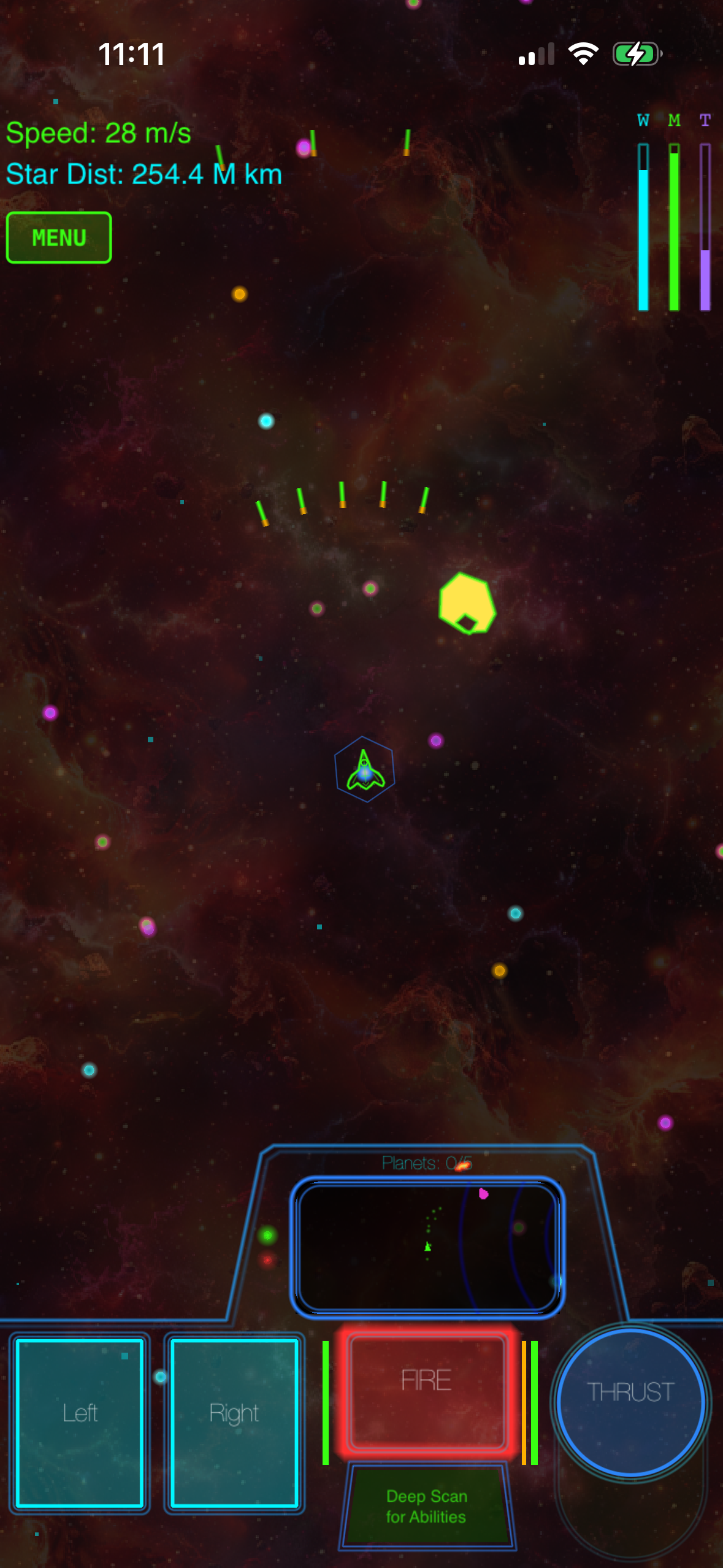
Story-driven space games are rare on iPhone because they’re expensive to build and hard to monetize. A game with a real ending, no ads, and no in-app purchases doesn’t fit the free-to-play playbook that dominates mobile. That’s why most of what you’ll find in the App Store are either arcade-action games with minimal plot, or sandbox titles that use “story” as a euphemism for “we added dialogue to the tutorial.”
How Galaximus Approaches Story in Space
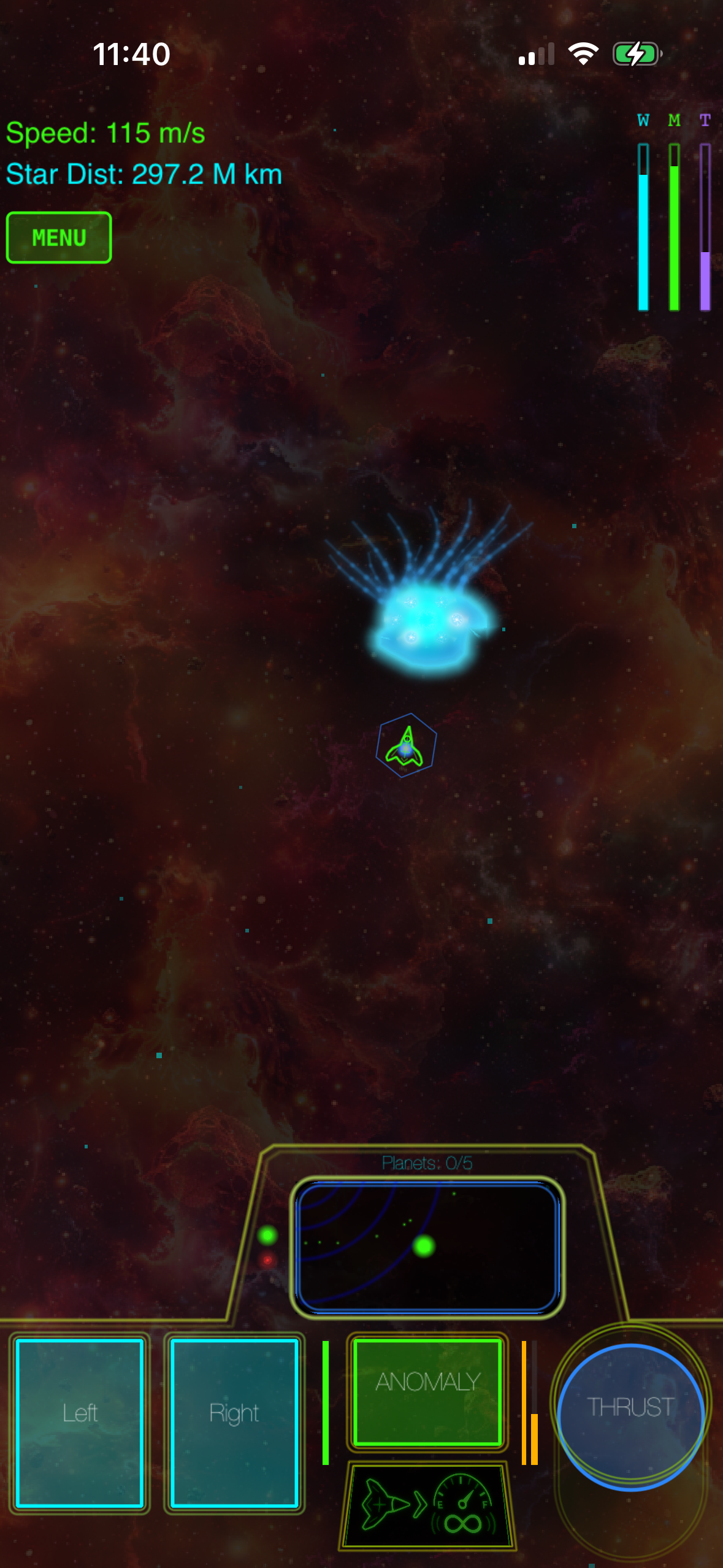
Aboard The New Dawn, your ship, you’re charting a course through eight star systems. Each system is procedurally configured, so the planets, asteroids, and anomalies you encounter are different every playthrough. The narrative arc—the sequence of encounters, the factions you meet, the central conflict that builds—is authored.
The story unfolds through real-time encounters. You’ll receive distress calls. You’ll stumble onto derelict ships. You’ll make first contact with alien captains who want to trade, negotiate, or fight. Some encounters are optional; some are story-critical. Your choices matter: how you respond to a distress beacon, whether you engage in combat or talk your way through, which faction you align with—these shape how the story unfolds and what ending you reach.
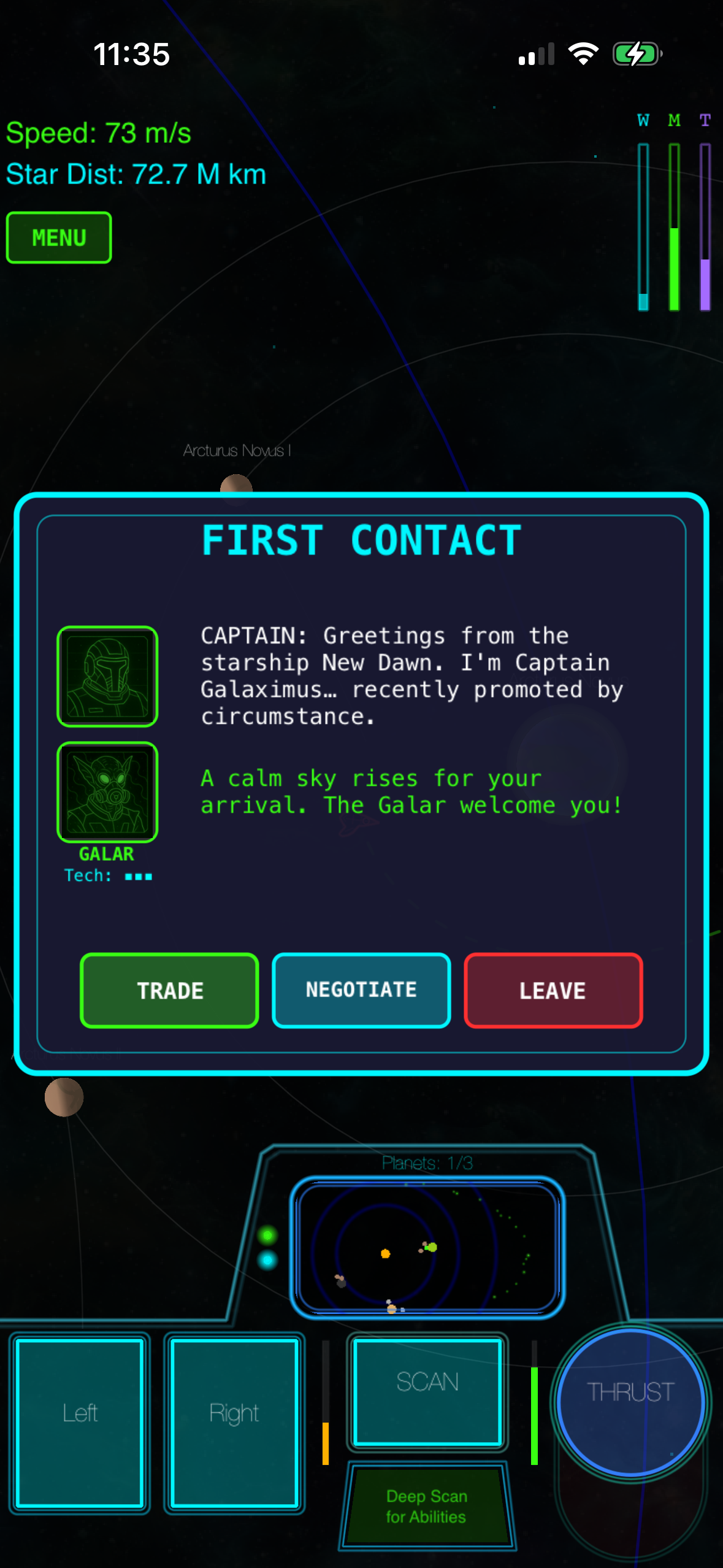
The narrative uses the game’s core mechanic—orbital mechanics—as part of the storytelling. You’re not just learning to slingshot around planets because it’s fun (though it is). You’re learning it because it’s how you survive. The physics is the interface between you and the world.
Character voices are synthesized on-device in real time. This means dialogue can be generated dynamically based on your choices without pre-recording hundreds of voice lines.
The Campaign Arc: Beginning, Middle, End
A story-driven game needs shape. Galaximus gives you that.
The first system is your introduction. You learn the controls, you meet your first contact, and you get a sense of the conflict ahead. The procedural generation means the specific planets and asteroids are unique to your playthrough, but the narrative beat—the setup—is the same.
The middle systems escalate. You encounter more factions. You face harder combat encounters. The stakes rise. Your choices begin to have visible consequences. Other ships remember how you treated them. Factions remember whether you helped them or ignored their distress calls.
The final systems converge on a climax. The central conflict comes into focus. You’re forced to make a choice that shapes the ending. The procedural configuration ensures you’ll never fight the exact same final battle twice, but the narrative shape is authored—you’re heading toward a conclusion, not an endless loop.
The full campaign takes most players between 8 and 12 hours, depending on how thoroughly you explore and how much time you spend mastering the orbital mechanics before pushing forward. That’s a complete experience.
Why Story-Driven Space Games Matter on iPhone
iPhone gaming is dominated by two patterns: free-to-play games with aggressive monetization, and casual games designed to be played in 5-minute bursts. Both have their place. But they’ve crowded out the middle—premium games with real depth, no monetization, and respect for your time.
Story-driven space games sit in that middle. They’re games you can play for hours, but they don’t demand that you play forever. They have narrative weight without being bloated. They’re complete without being endless.
On iPhone specifically, story-driven space games matter because the device is personal. You carry it everywhere. A game with a real story—one that develops over 8-12 hours and concludes—becomes something you think about between play sessions.
How Galaximus Compares to Other Space Games
No Man’s Sky ( multi-platform) is a procedural-generation sandbox with optional narrative elements. You can follow a story arc if you want, but the game’s real identity is exploration and base-building at planetary scale. It’s designed to be played indefinitely. Galaximus is the opposite: a complete narrative arc with procedural configuration layered on top. No Man’s Sky offers significantly more content and longer playtime; Galaximus offers a tighter, story-focused experience.
Kerbal Space Program ( base, expansion, multi-platform) is an engineering simulator. You build rockets, plan missions, and learn orbital mechanics in granular detail. It’s a teaching tool wrapped in a game. Galaximus uses real orbital mechanics, but we’re not trying to teach you engineering. We’re trying to let you fly. The physics is the interface, not the curriculum. KSP has a steeper learning curve and rewards deep technical mastery; Galaximus prioritizes narrative progression.
Alto’s Adventure (, iOS) is a minimalist arcade game with light narrative framing and no ending. It’s designed for repeated short sessions. Galaximus is designed for a complete 8-12 hour narrative arc.
Both No Man’s Sky and Kerbal Space Program are excellent games. They’re just different games, with different goals and price points.
Technical Specifications
System Requirements: - iOS 15.0 or later - iPhone 12 or newer (iPad 7th generation or newer) - Minimum 2GB free storage - Approximately 850MB download size - Estimated 150-200MB RAM during gameplay
Performance Notes: - Optimized for iPhone 14 Pro and newer; playable on iPhone 12 and 13 with occasional frame rate dips during complex orbital calculations - Battery drain: approximately 12-15% per hour of continuous play - Offline play: fully supported - Cloud saves: not available; saves stored locally on device
Pricing and Expansion Timeline
Galaximus is available now at (launch-tier price). This includes the complete 8-system campaign with no ads, no in-app purchases, and no energy meters.
Galaximus Infinitum, a major expansion adding open-galaxy exploration, planetary surface landing, outpost building, and faction warfare, is scheduled for Q4 2026. Anyone who purchases at the current launch-tier price receives Infinitum as a free upgrade. After Infinitum ships, the combined game will move to a higher price tier ( estimated). This is a genuine launch incentive—the expansion is substantial enough to justify a price increase, and we’re committing to deliver it within the stated timeline.
FAQ
What devices does Galaximus work on? iPhone 12 or newer, iPad 7th generation or newer, running iOS 15.0 or later. It will not run on iPhone 11 or earlier.
How much storage do I need? The game is approximately 850MB. You’ll need at least 2GB of free space on your device.
Can I play offline? Yes. Galaximus is fully playable offline with no internet connection required. There’s no multiplayer, no cloud saves, and no live services.
How long is the campaign? Most players finish in 8-12 hours. Replays are faster once you’ve learned the mechanics.
Can I replay with different outcomes? The narrative arc is the same each playthrough, but the procedurally generated star systems, planets, and anomalies are different. Your choices shape which encounters you get and which ending you reach, so replays do feel distinct.
Is there a learning curve? Yes. The first 30 minutes involve learning how to use orbital mechanics as your primary tool for movement and combat. After that, the controls become intuitive.
Will Infinitum be free for people who buy now? Yes. Anyone who purchases Galaximus at the current launch-tier price receives Galaximus Infinitum as a free upgrade when it launches in Q4 2026.
What’s the file size and how much battery does it drain? The download is 850MB. During continuous play, expect approximately 12-15% battery drain per hour.
Can I transfer my save to a different device? Not currently. Saves are stored locally on your device. We’re evaluating cloud save functionality for a future update.
How does it compare to Asteroids or Lunar Lander? Those games are arcade action with minimal story. Galaximus has real orbital mechanics (not simple inertia), a full narrative campaign, and procedural generation. If you want pure arcade simplicity, those classics are still great. If you want arcade action with physics depth and a story, Galaximus is built for that.
Get Galaximus Now at the Launch Price
Story-driven space games on iPhone are rare because they don’t fit the free-to-play model. Galaximus exists because we believed enough players wanted a premium, complete, story-driven space exploration game to justify building it outside that system.
You can play it now, complete it, and when Infinitum launches in Q4 2026, you’ll get the expansion free. After that, the price goes up.
If you’re looking for a space game with a real story, real physics, and no monetization—a game that respects your time and gives you a complete experience—that’s what we built.

