Best Paid iPhone Space Games Under $5: Premium Without the Price Tag
 by Galaximus
Best Paid iPhone Space Games Under $5 in 2026
The premium space game market on iPhone has quietly matured. You can still find quality titles at the sub- price tier — games with real physics, no ad interruptions, no energy meters, no battle passes. Just purchase once and play a complete experience. If you’re tired of free-to-play friction and want actual gameplay depth, the options are smaller than the free catalog but genuinely strong.
Disclosure: We built Galaximus, one of the games featured in this guide. We’ve included it because we believe it’s a strong option in this category, but we recognize our bias. The other titles are evaluated independently.
Why Premium Space Games Still Matter
Free-to-play space games dominate the App Store charts, but they come with a cost that isn’t measured in dollars. Energy timers, ads between sessions, premium currency walls, battle passes that reset — they’re designed to extract time and attention, not deliver a satisfying experience upfront.
Premium games (pay once, own forever) flip that incentive. The developer gets paid when you buy. There’s no reason to frustrate you into spending more. No ads means you’re not the product. No IAP means progression is earned, not purchased. The trade-off is simple: you pay a smaller upfront cost for a complete game.
At the sub- tier, you’re looking at indie developers and smaller studios who chose quality over volume. That’s where the best space games live right now.
Galaximus: Real Gravity, Real Mastery
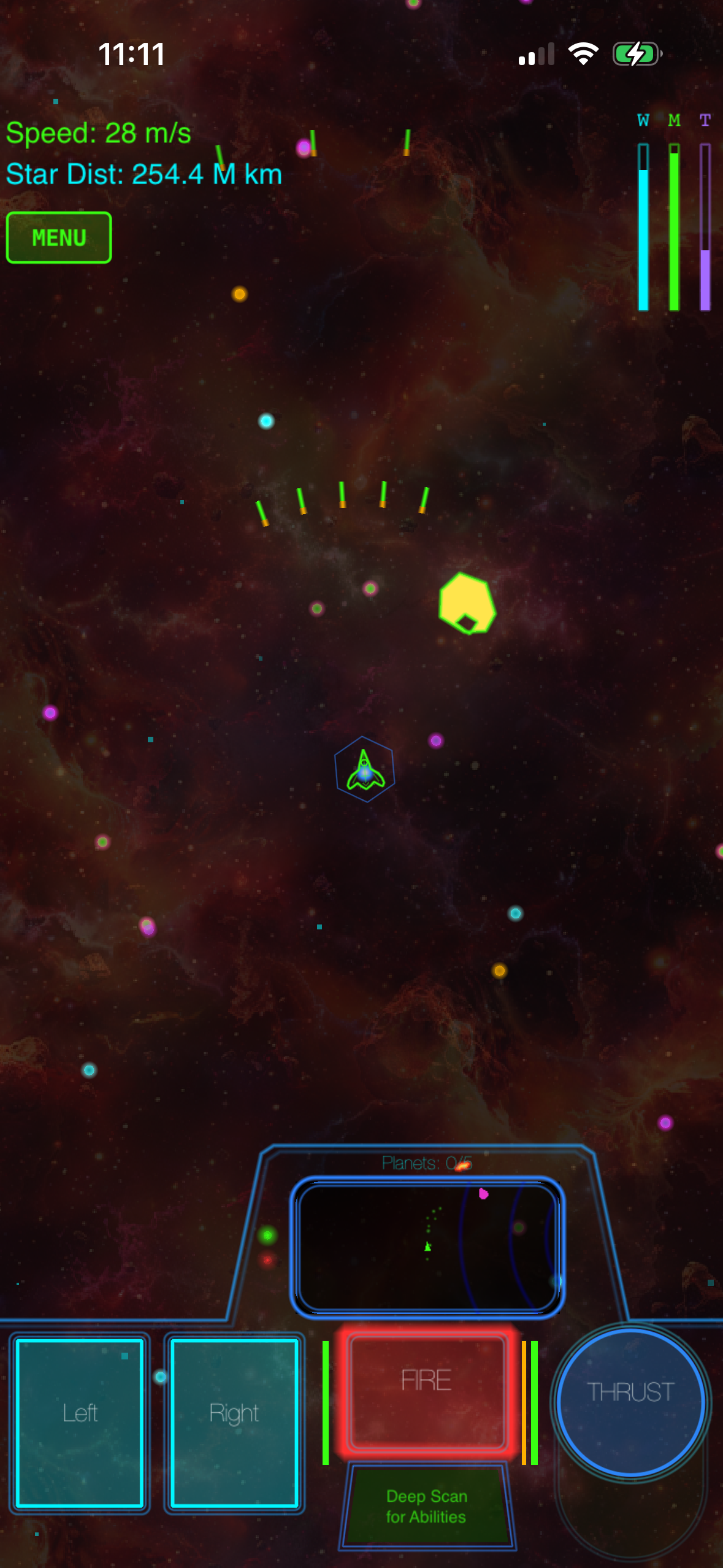
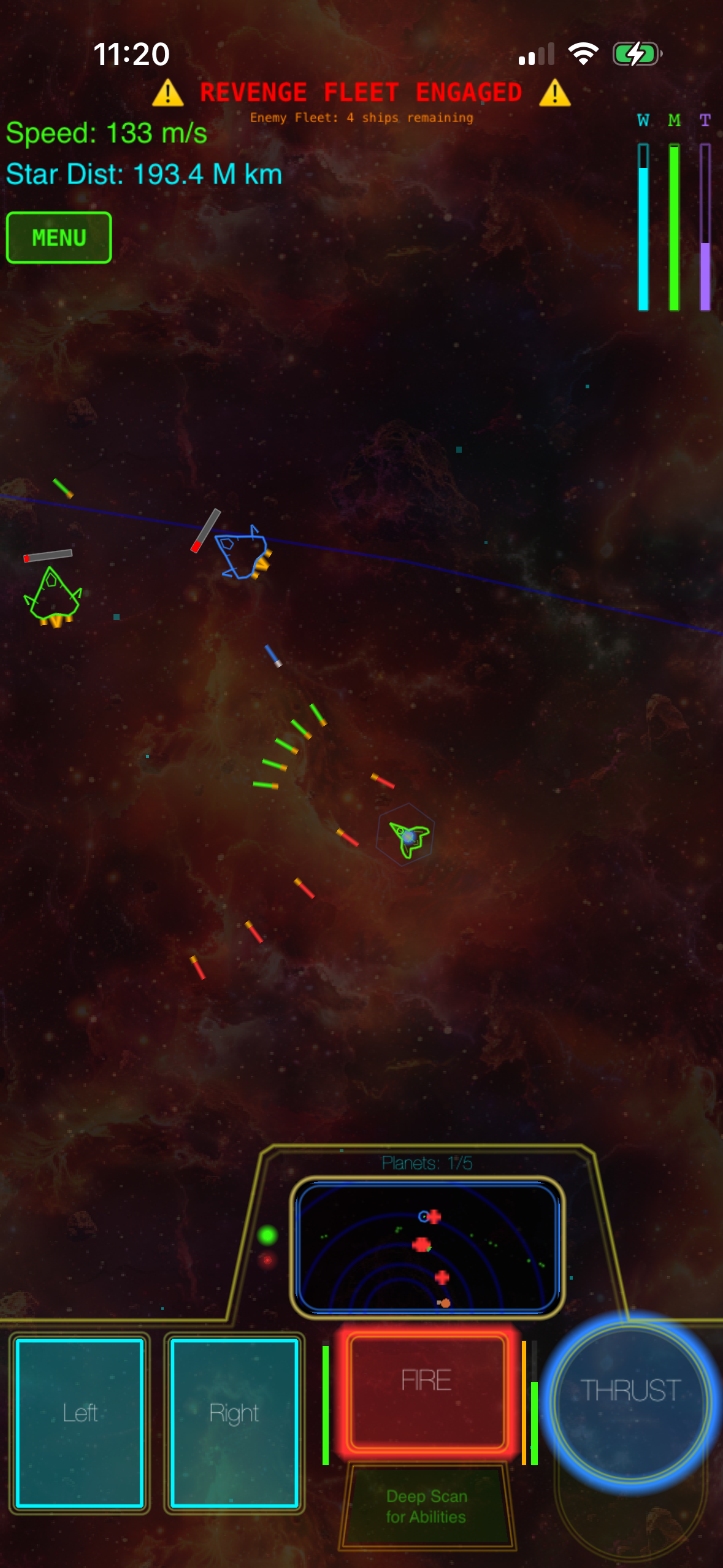
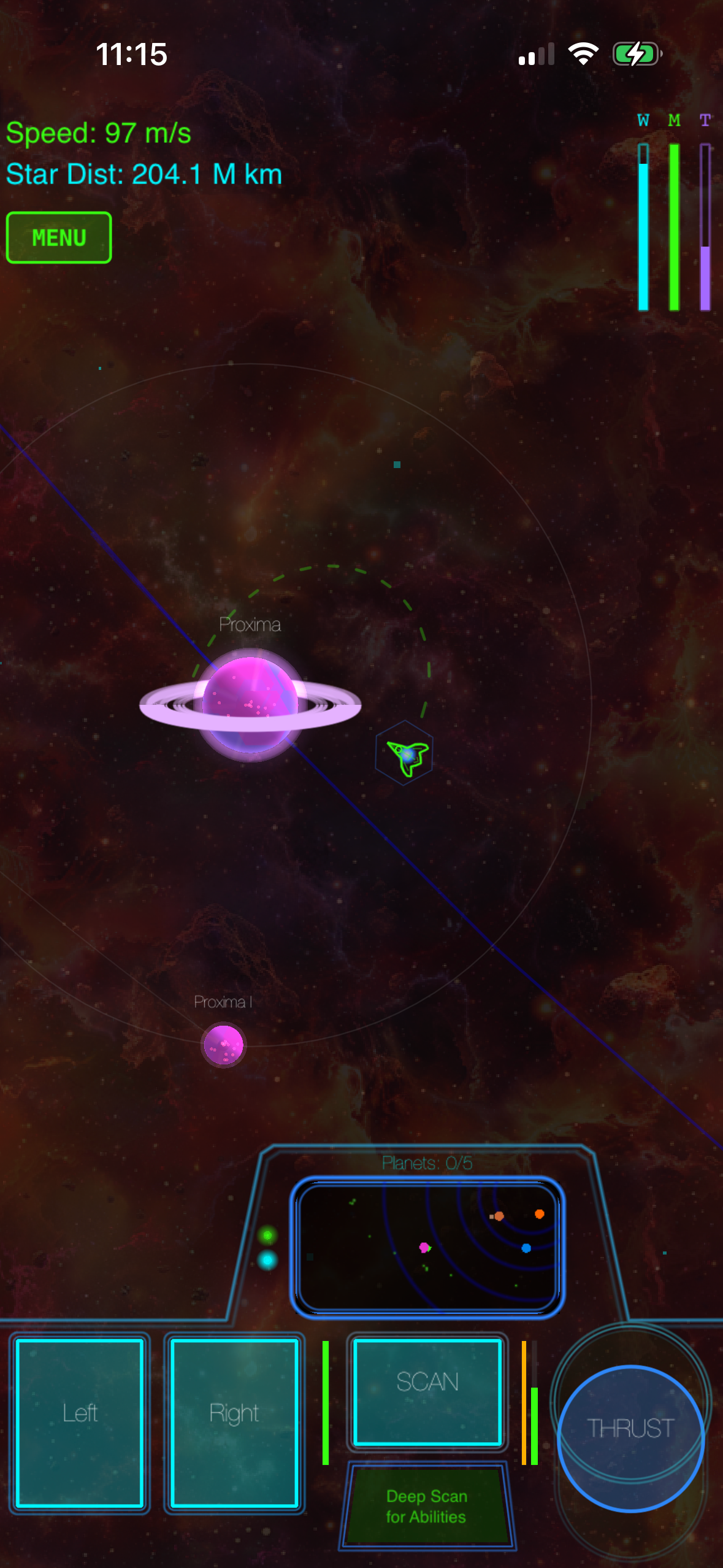
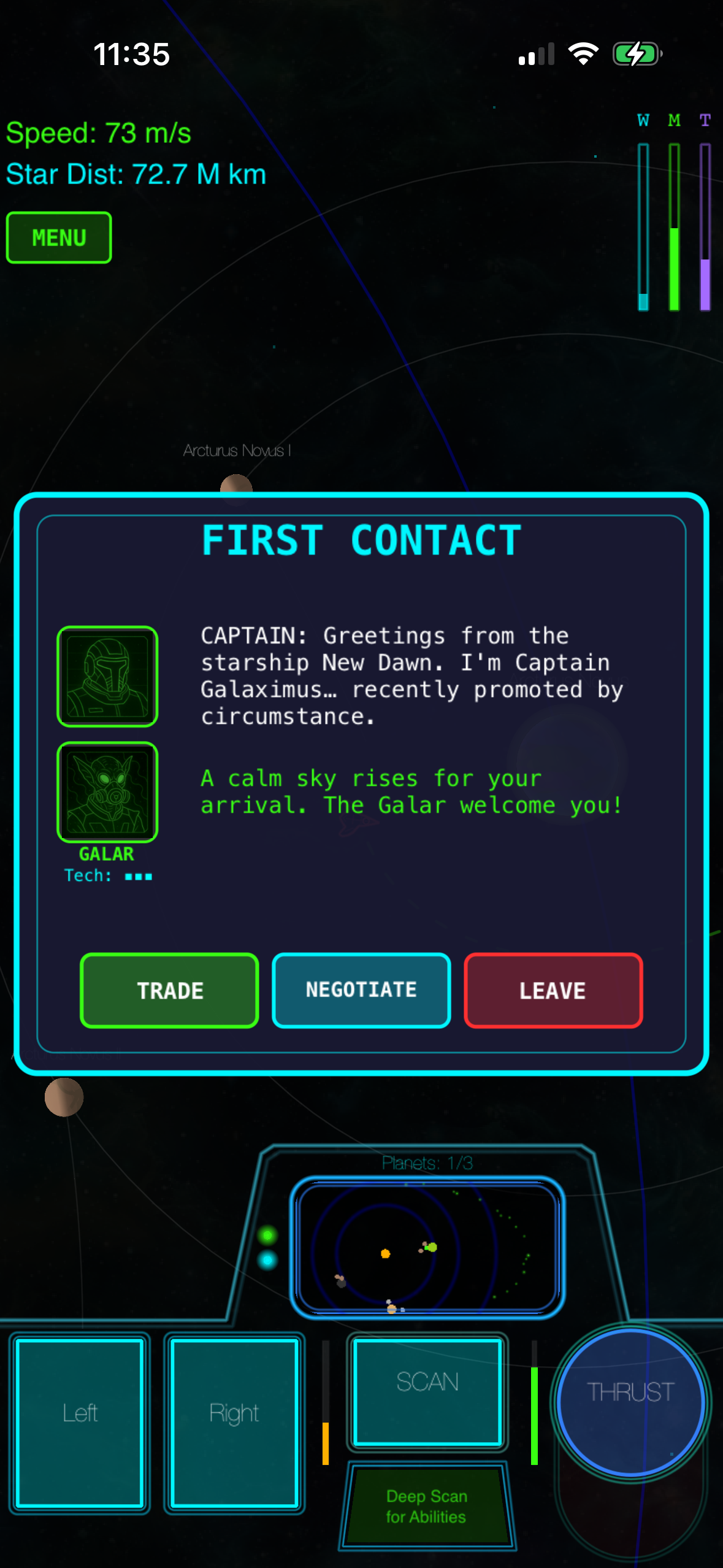
Galaximus is built around a single core idea: what if a space game’s gravity system wasn’t a cosmetic effect but the actual interface you use to fly? Every celestial body’s gravity affects every other body in real time. That means slingshots work — you can use a planet’s gravity well to gain speed for free. It means orbital mechanics matter. It means mastery is possible in 30 minutes of focused play.
The learning curve is real. Galaximus isn’t a casual pickup-and-play title. You’re learning to think in terms of momentum, gravity, and trajectory. But the payoff is that mastery feels earned rather than gated by timers or currency.
The campaign spans 8 procedurally configured star systems with a full narrative arc. Each playthrough is unique — planets orbit in different positions, anomalies appear in different locations — but the story shape is authored. You have a beginning, middle, and ending. Eleven unique encounter types (derelict ships, distress beacons, spacetime rifts, and others) break up pure flight with decision points and tactical combat.
Coming in late 2026: Galaximus Infinitum (open-galaxy sandbox, planetary surface exploration, faction warfare, outpost building) will expand the game significantly. Buyers at the current price tier will receive Infinitum as a free update when it launches. After launch, the combined game will move to a higher price point.
Get Galaximus on the App Store: Get it on the App Store
Kerbal Space Program Mobile: The Rocketry Deep Dive
If Galaximus is about flying a ship, Kerbal Space Program is about building a rocket. KSP lets you assemble vehicles from component parts — engines, tanks, fins, parachutes — then launch them and manage thrust, staging, and orbital maneuvers to reach your destination.
The learning curve is steeper than Galaximus. KSP wants to teach you actual orbital mechanics concepts (transfer windows, inclination changes, gravity assists). You’re not just flying; you’re engineering. The depth is genuinely impressive for a mobile title.
The tradeoff: KSP is less about a narrative campaign and more about sandbox experimentation. There’s no “ending.” You set your own goals (reach the Mun, establish a space station, land on distant planets) and work toward them. If you want a structured story, Galaximus delivers that. If you want to lose yourself in rocket design and orbital problem-solving, KSP is the better fit.
Per user reports and developer specifications, KSP Mobile runs well on current iPhone hardware, though it’s more demanding than lighter titles. Performance is stable on iPhone 12 and newer; older devices may see frame-rate drops in complex scenarios.
No Man’s Sky Mobile: Exploration at Scale
No Man’s Sky on mobile brings procedural planet exploration to iPhone — you can land on planets, walk around the surface (rendered in a stylized wireframe 3D), gather resources, and trade with alien species. The scope is massive: billions of procedurally generated planets, each unique.
The mobile version is streamlined for touchscreen play. Specific features simplified from the desktop version include base building (removed), multiplayer (disabled), and fleet management (reduced scope). The core appeal — the sense of discovery, procedural generation, and alien-encounter narrative — translates well to the smaller screen.
If you want to explore more than you want to master a single system, No Man’s Sky is the standout. Galaximus and KSP keep you in one star system (or a small cluster) for deep engagement. No Man’s Sky lets you hop between star systems and planets at will. Different game, both legitimate.
Star Realm Mobile: Deck-Building in Space
Star Realm Mobile is a card-battler, not a flight sim or exploration game. You build a deck of ships and bases, then duel opponents in turn-based combat. It’s more strategic than action-oriented, more about resource management and deck synergy than reflexes.
Important: Star Realm Mobile is free-to-play with optional IAP. It does not fit the “premium paid” category of this guide and should be evaluated separately if you’re specifically seeking ad-free, one-time-purchase games. The core campaign is playable without additional spending, but the monetization model differs from the other titles listed here.
The appeal is cerebral and replayable, rewarding thinking several turns ahead. Per long-running threads on r/cardgames and r/mobilegaming, the balance between starter decks and advanced strategies is fair enough that you won’t feel forced to spend.
Asteroids+: Arcade Purity
Asteroids+ is a modern take on the 1979 Asteroids arcade game. You pilot a ship, shoot asteroids, and survive waves of increasing difficulty. It’s simple, it’s tight, and it respects the original while adding modern conveniences (touch controls, screen-filling asteroids, progressive difficulty).
If you want a space game that doesn’t require learning orbital mechanics or managing resources, Asteroids+ is the fastest entry point. A single session is 5–15 minutes. No story, no progression systems, just pure arcade action.
The tradeoff: it’s not deep. You’ll master it in an hour. But for what it is — a faithful arcade remake — it’s excellent. And at the sub- tier, the price-to-quality ratio is hard to beat if you just want to unwind with something familiar.
Comparing the Tier
| Feature | Galaximus | Kerbal | No Man’s Sky | Asteroids+ |
|---|---|---|---|---|
| Real physics | ✅ Gravity-based flight | ✅ Orbital mechanics | ✅ Procedural planets | ❌ |
| Story campaign | ✅ 8 systems, narrative arc | ❌ Sandbox | ✅ Exploration focus | ❌ |
| Learning curve | Medium (30 min) | High (hours) | Low (intuitive) | Very low |
| Session length | 30–60 min | 15–120 min | 10–30 min | 5–15 min |
| Replayability | High (procedural systems) | Very high (sandbox) | Very high (infinite planets) | Medium (arcade) |
| No ads, no IAP | ✅ | ✅ | ✅ | ✅ |
| Price |
Why the Sub-$5 Tier Matters in 2026
According to App Store pricing trends, most premium games have migrated to the range over the past three years. The sub- tier is where smaller developers and focused indie titles live — which sounds like a compromise, but it’s actually where some of the most tightly designed games end up.
There’s no room for filler at this price. A game that has to justify itself immediately. You get the core idea, well-executed, without bloat. Galaximus, Kerbal, and the others on this list are all examples: they do one thing (or a tightly integrated set of things) and do it well.
Compare that to many free-to-play titles, which add systems on top of systems to create monetization hooks. Premium games at this tier have the opposite problem: they have to cut features ruthlessly to keep the price down. That discipline often results in better design.
What to Look for When Choosing
If you want to learn something: Kerbal Space Program teaches real orbital mechanics. Galaximus teaches gravity-based flight. Both are educational in the sense that you’ll understand concepts you didn’t before.
If you want a story: Galaximus and No Man’s Sky both have narrative arcs. Galaximus is more structured (8 systems, an ending). No Man’s Sky is more open-ended (you set the pace).
If you want pure arcade fun: Asteroids+ is the fastest, most familiar entry point.
If you want to keep playing for months: Kerbal and No Man’s Sky have the most long-term hooks. Galaximus has high replay value due to procedural generation, and the Infinitum expansion arriving in late 2026 will add even more content.
FAQ
What’s the difference between Galaximus and Kerbal’s learning curve? Galaximus teaches gravity-based flight through direct interaction — you learn by flying and experimenting with slingshots. You’ll grasp the core mechanic in 30 minutes. Kerbal requires understanding rocket staging, orbital mechanics theory, and multi-step problem-solving. Most players need 2–3 hours before they can reliably reach orbit. Galaximus is faster to learn; Kerbal has more to master.
Which game works best on iPhone 13 Mini? All four premium titles run on iPhone 13 Mini. Asteroids+ and Galaximus are optimized for smaller screens. Kerbal Space Program and No Man’s Sky benefit from larger displays but are still fully playable on the Mini — you may want to zoom in on UI elements in Kerbal during complex builds.
Do I need an iPad or will iPhone work? All of these run on iPhone. Some (Kerbal, No Man’s Sky) benefit from the larger screen of an iPad, but they’re designed for iPhone first. Galaximus’s controls are optimized for iPhone’s screen size.
Will these games get updates? Galaximus has Infinitum coming in late 2026 (free to current buyers). Kerbal Space Program Mobile receives periodic balance updates and bug fixes. No Man’s Sky Mobile gets regular content updates tied to the desktop version’s roadmap. Asteroids+ is more stable — fewer new features, more focus on polish.
What if I hate the learning curve of Galaximus? Try Asteroids+ first. It’s arcade-simple and teaches you the control scheme in two minutes. If you then want something deeper, Galaximus’s learning curve is real but not punishing — most players report a solid grasp of slingshot mechanics within 30 minutes of focused play. The physics is the interface, not a barrier.
The Bottom Line
Premium space games are rare and getting rarer. The ones that exist at this price point are there because they’re focused, well-executed, and don’t rely on monetization tricks to survive. Galaximus brings real gravity and a narrative campaign. Kerbal brings engineering depth. No Man’s Sky brings exploration scope. Asteroids+ brings arcade purity.
Pick based on what kind of space experience you want: mastery, engineering, exploration, or arcade action. Any of these will give you a complete, ad-free game that respects your time.
Get Galaximus on the App Store: Get it on the App Store

