Best Paid Space Games iPhone 2026: No Subscriptions
 by Galaximus

Photo by Esteban Lafargue on Unsplash
Best Paid Space Games for iPhone in 2026: No Subscriptions Required
Disclosure: I created Galaximus and benefit financially from its sales. This article compares it to other premium space games on iPhone. Read with that context in mind.
Premium space games on iPhone—titles you buy once and own forever, with no ads or in-app purchases—remain a small but growing category. This guide compares the actual paid options available on iPhone in 2026, with pricing and mechanics clearly laid out so you can choose based on your preferences, not marketing framing.
What’s Actually Available on iPhone Right Now
The premium space-game category on iPhone is narrower than the headline suggests. Here’s what exists:
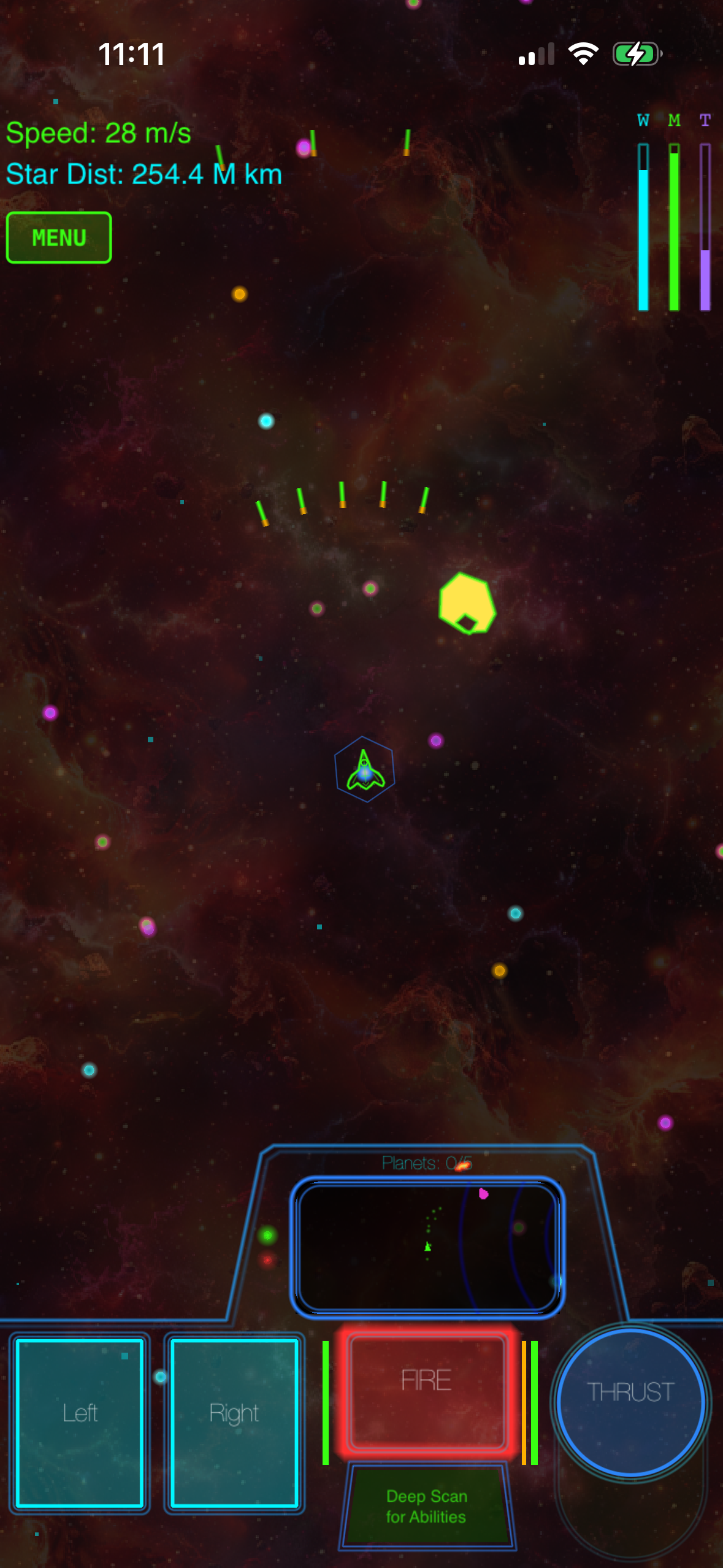
Galaximus — Real orbital mechanics, 8-system campaign, procedurally varied per playthrough. Physics-driven positioning and fuel efficiency are core. One-time purchase, offline play, no ads or IAP. App Store link
Asteroids+ by Noodlecake — Modern take on the 1979 arcade classic. Fast arcade action, no learning curve, 5–10 minute sessions. One-time purchase. App Store link
Lunar Lander+ — Lander-descent arcade game with procedural terrain. Quick sessions, minimal story. One-time purchase. App Store link
Spaceflight Simulator — Vehicle assembly and launch sandbox. Build rockets, manage staging and fuel, execute orbital transfers. Lighter than Kerbal Space Program but similar design philosophy. One-time purchase. App Store link
That’s the paid space-game shelf on iPhone. Games like Kerbal Space Program and No Man’s Sky are not available on iOS. Apple Arcade includes space-themed titles but requires a subscription (/month or bundled).
Quick Comparison: Which Game Fits Your Play Style?
| Game | Price | Learning Curve | Session Length | Best For |
|---|---|---|---|---|
| Galaximus | 30 min to grasp, hours to master | 30–60 min | Physics learners, campaign completionists | |
| Spaceflight Simulator | 20–30 min | 20–45 min | Rocket builders, transfer-window planning | |
| Asteroids+ | None | 5–10 min | Arcade purists, quick sessions | |
| Lunar Lander+ | 5 min | 5–15 min | Casual players, descent challenges |
Galaximus: Gravity as Mechanic
I built Galaximus around a single idea: make gravity the primary tool, not scenery. Every planet and star exerts real gravitational force. Your ship navigates by reading gravity wells, positioning itself in the curve to slingshot for free velocity, and managing fuel as a limited resource.
The 8-system campaign is procedurally configured per playthrough—planet positions vary, so the tactical puzzle shifts each run. You encounter anomalies (derelict ships, distress beacons, rifts) and engage in positioning-based combat where fuel efficiency matters more than firepower.
Price: at launch. After the Infinitum expansion launches (late 2026), adding open-galaxy sandbox, planetary surfaces, outposts, and faction warfare, the combined game moves to. Early buyers get Infinitum free—a real time-limited offer.
Learning curve: 30 minutes to understand slingshots and gravity wells. 10+ hours to master complex scenarios. Not for players who want zero friction.
Ownership: One-time purchase. No ads, no IAP, no subscriptions. Offline play supported.
Spaceflight Simulator: Rocket Assembly on Mobile
Spaceflight Simulator strips down Kerbal Space Program’s complexity but keeps the core loop: design a vehicle from parts, manage staging and fuel, plan orbital transfers, and execute launches.
It’s lighter than KSP—no EVA, no base building, no life support—but the physics are real. You’ll learn transfer windows, gravity assists, and the Tsiolkovsky rocket equation. Sessions run 20–45 minutes depending on mission complexity.
Price:, one-time purchase.
Best for: Players who want rocket-building depth without KSP’s full engineering-simulator scope. Ideal if you enjoy planning and optimization.
Tradeoff vs. Galaximus: Spaceflight Simulator rewards planning and vehicle design; Galaximus rewards real-time piloting and positioning. Different skill sets.
Asteroids+ and Lunar Lander+: Arcade Classics Modernized
These are spiritual successors to 1979’s Asteroids and 1979’s Lunar Lander. They’re fast, require no learning, and deliver satisfying arcade action in 5–15 minute bursts.
Asteroids+ : Shoot rocks, avoid collisions, chase high scores. No campaign, pure arcade.
Lunar Lander+ : Descend procedurally generated terrain with fuel limits. Precision and timing matter.
Best for: Players who want quick sessions without investment in learning curves. Casual play, commute gaming, or warm-up rounds before deeper games.
Tradeoff: Less mechanical depth, no narrative arc, no “mastery” payoff beyond score chasing.
Why Kerbal Space Program and No Man’s Sky Aren’t on iPhone
Kerbal Space Program (desktop/console only) is the gold standard for physics-based space games. It teaches real rocketry through vehicle assembly, staging, and orbital mechanics. The learning curve is steep—40+ hours before you land on the Mun reliably—but the depth is unmatched.
Why not on iPhone? KSP’s UI is dense (hundreds of buttons, readouts, and toggles) and designed for mouse/keyboard or gamepad. Mobile touch controls would require a complete redesign. The developer has not committed to an iOS version.
No Man’s Sky (console/PC only) is a procedurally generated space-exploration sandbox with planetary landing, base building, and open-ended gameplay. Per Metacritic user reviews and Reddit’s r/NoMansSky, post-launch updates transformed it into a feature-rich experience. The sense of scale and discovery is genuine.
Why not on iPhone? NMS’s graphics, procedural generation, and open-world scope demand hardware beyond current iPhones. A mobile version has been rumored for years but never materialized.
Neither game is “better” than what’s on iPhone—they’re answering different questions. KSP teaches engineering; NMS delivers exploration at scale. iPhone’s paid space games prioritize either arcade action or compact physics-based campaigns.
Apple Arcade: Subscription Alternative
Apple Arcade (/month or bundled with Apple One) includes several space-themed games: Spacebase Frontier, Wylde Flowers (partial), and others. The advantage is zero-friction access to multiple titles if you’re already subscribed.
The disadvantage: you pay monthly whether you play or not, and access ends when your subscription lapses. For players who want to own a game indefinitely and play offline, subscription services introduce recurring costs and dependency.
Premium-only titles (Galaximus, Spaceflight Simulator, Asteroids+, Lunar Lander+) sit outside this model. You pay once, own forever, play offline without connection or subscription.
Pricing and Value Analysis
| Game | Price | Campaign/Content Hours | Cost Per Hour | Replayability |
|---|---|---|---|---|
| Galaximus | 10–15 (campaign) | ~ | High (procedural variation) | |
| Spaceflight Simulator | 8–12 (mission-based) | ~ | Medium (sandbox after campaign) | |
| Asteroids+ | Infinite (arcade) | Variable | High (score chasing) | |
| Lunar Lander+ | Infinite (arcade) | Variable | High (score chasing) |
Galaximus costs more upfront but delivers 10–15 hours of structured campaign content plus procedural variation that extends replayability. If you complete the campaign once and never return, the cost-per-hour is higher than arcade games. If you replay it 3–4 times (which the procedural generation encourages), it drops below /hour.
Spaceflight Simulator is cheaper and offers mission-based progression with sandbox play after. Cost-per-hour is lower if you engage with the sandbox deeply.
Arcade games have infinite replayability but no narrative endpoint. Value depends entirely on whether you enjoy score chasing.
The Learning Curve Question
Space games with real physics require upfront learning. Gravity wells, slingshots, orbital mechanics, fuel budgets—none of these are intuitive until you’ve experienced them.
This is intentional. The learning curve is why mastery feels rewarding. But it also means these games aren’t for everyone.
Galaximus: 30 minutes to grasp the core mechanic (gravity wells and slingshots). 10+ hours to master complex scenarios. If you want to learn something and then apply it, the curve is worth it. If you want zero-friction instant gratification, choose Asteroids+ or Lunar Lander+.
Spaceflight Simulator: 20–30 minutes to understand staging and fuel. Ongoing learning as missions increase in complexity. Similar philosophy to Galaximus but lighter.
Arcade games: No learning curve. Instant play.
FAQ
Q: What’s the typical price range for premium space games on iPhone? A: for one-time purchases. Asteroids+ and Lunar Lander+ are budget-tier . Spaceflight Simulator and Galaximus are mid-tier . No premium space games on iPhone exceed at launch.
Q: How do I know if a space game’s learning curve is right for me? A: If you enjoy games that teach you something (like Civilization or Into the Breach), physics-based space games fit. If you prefer zero-friction arcade action, stick with Asteroids+ or Lunar Lander+. Most App Store listings include gameplay videos—watch 2–3 minutes to gauge complexity.
Q: Can I play these games offline? A: Yes. All four games (Galaximus, Spaceflight Simulator, Asteroids+, Lunar Lander+) support offline play. No internet connection required.
Q: Are there ads or in-app purchases in these games? A: No. All four are one-time purchases with no ads, no IAP, no energy timers, no battle passes. You own the full game forever.
Q: Why is Galaximus more expensive than Spaceflight Simulator? A: Galaximus includes a full 8-system campaign with narrative structure and procedural variation. Spaceflight Simulator is mission-based with lighter scope. Both are one-time purchases; the price difference reflects content and design philosophy. Neither is objectively “better”—they reward different play styles.
Q: Is Galaximus worth if I only play once? A: That depends on your tolerance for learning curves and campaign-driven gameplay. If you complete the campaign once and never return, the cost-per-hour is high (~/hour for a 10-hour campaign). If you replay it 3–4 times (procedural generation encourages this), it drops to ~/hour. Watch gameplay videos first to decide if the mechanics appeal to you.
Q: What happens after I finish a game’s campaign? A: Galaximus: Procedural generation means each playthrough has different planet positions and anomalies, encouraging replays. Infinitum (late 2026) adds open-galaxy sandbox play. Spaceflight Simulator: Mission progression ends, but sandbox mode opens for free-form building and exploration. Asteroids+ and Lunar Lander+: No campaign—pure arcade with score chasing as the goal.
Q: Will these games receive updates? A: Galaximus is receiving the Infinitum expansion (late 2026). Spaceflight Simulator receives occasional updates. Asteroids+ and Lunar Lander+ are stable but receive minimal new content. Check each game’s App Store page for update history.
The Case for Premium Space Games
Premium space games represent a philosophy: you pay once, own the game forever, and never see an ad or energy meter. That’s rare on mobile, which makes it valuable.
The games listed here—Galaximus, Spaceflight Simulator, Asteroids+, Lunar Lander+—all embrace that model. They vary in scope, learning curve, and design philosophy, but they share a commitment to ownership and respect for your time.
If you’re tired of free-to-play mechanics and want a space game that respects your wallet, this category is worth exploring. Start with the game that matches your play style: arcade action, rocket building, or physics-driven piloting.