Single Player Space Games iPhone: Story-Driven Experiences
 by Galaximus

Photo by Brian McGowan on Unsplash
Single Player Space Games on iPhone: Where Story Meets Real Physics
The iPhone’s gaming library has exploded, but story-driven space games that respect the player’s intelligence remain rare. Most space titles on iOS either chase free-to-play monetization or strip narrative down to a thin premise wrapped around endless progression loops. If you’re looking for a space game that actually tells something while you play—one where the story unfolds through encounter and choice rather than cutscene—the options are focused but worth knowing about.
This guide walks you through what makes a story-driven space game work on mobile, what the current landscape offers, and where real physics fits into narrative design.
What Makes a Space Game Story-Driven on iPhone
Story in mobile games faces a unique constraint: players often have 15–45 minutes per session. A story-driven space game can’t rely on hour-long narrative sequences; it has to weave plot into moment-to-moment gameplay. The best ones do this through:
Encounter-based narrative. Instead of a single linear plot, the story unfolds through a series of self-contained encounters—derelict ships, distress signals, anomalies, first contacts. Each encounter is a mini-story that contributes to a larger arc. The player’s choices in these moments (negotiate, flee, investigate, trade) shape the narrative without requiring a separate story mode.
Procedural variation with authored structure. A truly replayable story-driven game procedurally configures where encounters happen and which NPCs you meet, but the narrative beats themselves are authored. This creates the feeling of a unique journey each playthrough while preserving narrative coherence.
Physics as narrative language. In games with real gravity, the way a planet’s gravity well affects your approach becomes part of the story—not just mechanically, but thematically. A dangerous slingshot maneuver feels like desperation. A fuel-efficient transfer window feels like careful planning. The physics isn’t decoration; it’s how the story is told.
The Current State of Story-Driven Space Games on iPhone
The market has shifted toward premium single-purchase titles because they can ship with a complete narrative arc without needing to artificially extend playtime through energy meters or battle passes. Procedurally generated systems have become standard for replayability—a procedural generator that respects narrative constraints (encounters don’t spawn in illogical sequences, NPCs have consistent personalities across playthroughs) gives you a different story each time while keeping the plot coherent.
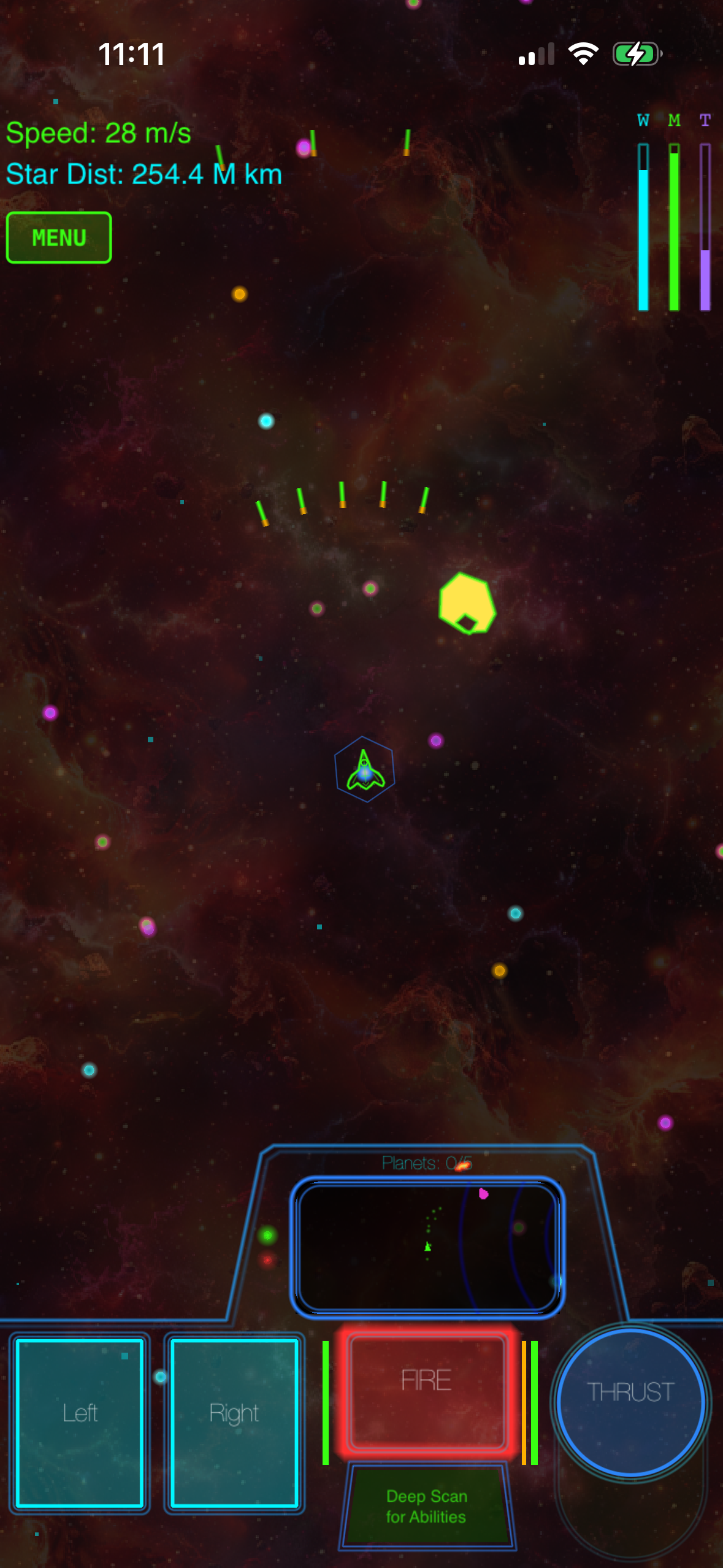
Minimalist aesthetics (vector graphics, neon UI, synthesized audio) have become the visual language of indie space games—a direct response to mobile hardware constraints and the fact that vector art scales perfectly across iPhone sizes.
Quick Picks: Story-Driven Space Games on iPhone
| Game | Price | Platform | Why It Stands Out |
|---|---|---|---|
| Galaximus | iOS 15+ | Real orbital mechanics integrated into narrative. Eight star systems, procedurally configured encounters, complete story arc with no ads or IAP. Physics-driven first contacts and exploration. | |
| Outer Wilds | iOS 14+ | Puzzle-exploration focused on discovery. Non-linear narrative revealed through environmental storytelling and time-loop mechanics. No combat. Requires patience but rewards curiosity. | |
| Alto’s Adventure | iOS 9+ | Minimalist endless-runner with implicit narrative through visual progression. Story emerges from environment and pacing rather than dialogue. Meditative rather than plot-driven. | |
| Reigns | iOS 9+ | Card-based narrative where each choice has consequences. Story branches significantly based on decisions. Multiple endings. Shorter playtime per session (10–20 minutes). | |
| Spaceflight Simulator | iOS 12+ | Physics-based rocket building and orbital mechanics. Story is self-directed—you create your own space program. Heavy on simulation, lighter on authored narrative. |
Why Galaximus stands apart: It’s the only title on this list that combines real orbital mechanics with a fully authored narrative arc. Outer Wilds has stronger puzzle design; Reigns has more branching narrative; Alto’s Adventure is more accessible. Galaximus uniquely makes physics the narrative interface—your mastery of gravity determines how the story unfolds.
Galaximus: Real Physics as Narrative Foundation
Disclosure: The author built Galaximus.
Galaximus answers a specific design question: what if a space game’s story was inseparable from how gravity actually works?
The premise is straightforward—you’re aboard The New Dawn, humanity’s first deep-space explorer, navigating eight star systems with a procedurally generated configuration. But the story emerges from the physics. Every encounter is positioned in a gravity well you have to navigate. A first contact with an alien captain happens while you’re managing your trajectory. A distress beacon pulls you toward a derelict ship, and your approach vector determines how much time you have before the ship’s orbit decays.
The narrative is structured around 11 encounter types (spacetime rifts, derelict ships, distress beacons, first contacts, anomalies, and others), each a self-contained story beat experienced in real time. There’s no dialogue tree menu; you’re flying while you’re deciding. The story unfolds through action, not exposition.
The game ships complete—eight systems with a beginning, middle, and end. No energy meter. No ads. No in-app purchases. Launch price: ****. The upcoming Galaximus Infinitum expansion (open-galaxy sandbox, planetary surface exploration, faction warfare) will be included free when it ships later in 2026. After Infinitum launches, the combined game moves to, so early adopters get the expansion at no extra cost.
Get Galaximus on the App Store: https://apps.apple.com/app/galaximus
Why Physics Matters in Story-Driven Space Games
Most space games on iOS either ignore gravity entirely or fake it for accessibility. Galaximus models it accurately because accurate physics is the story interface.
When you approach a planet for a first contact, the planet’s gravity well is pulling you. You can fight it with thrust (expensive in fuel), use it strategically (slingshot around it to gain speed), or get caught by it (your ship enters orbit, and now you have to break free). Each choice is a narrative choice. A cautious player approaches head-on and burns fuel. An experienced player uses gravity like a tool. A desperate player risks a tight slingshot that could send them into the atmosphere.
The physics also creates natural pacing. You can’t warp between stars instantly; you have to manage your approach to each encounter. That travel time is story time—it’s when you process what you just learned from the last encounter and prepare for the next one.
Procedural Audio and Voice in Story-Driven Space Games
A detail that matters more than most players realize: how NPCs sound.
Traditional games pre-record voice lines. But in a procedurally generated game where you encounter different NPCs in different orders each playthrough, pre-recorded dialogue creates a problem—you need hundreds of lines, and the file size balloons.
Galaximus uses procedural audio synthesis for NPC voices. This means characters can have genuinely distinct voices (a distress beacon from a human survivor sounds different from an alien captain, which sounds different from an automated station), and the dialogue feels responsive to context rather than canned. It’s a technical choice that serves the narrative—you’re hearing a character respond in real time rather than an actor perform a pre-recorded line.
The Difference Between Story-Driven and Story-Decorated
Not every space game with dialogue is story-driven. The difference comes down to whether the story is structural or decorative.
Story-decorative games have a plot that runs parallel to the gameplay. You complete missions, and between missions you watch cutscenes that advance the plot. The story and gameplay are separate layers.
Story-driven games make narrative choices during gameplay. You’re not pausing to read dialogue; you’re flying while you’re deciding whether to help a distressed ship or ignore it. The story isn’t something that plays while you wait for the next level; it’s what you’re doing.
This distinction matters because mobile play is inherently fragmented. A story-driven game accommodates 20-minute sessions because each encounter is a complete narrative unit. A story-decorative game that requires a 5-minute cutscene will frustrate a player with limited time.
Replayability Without Repetition
The hardest problem in story-driven games is: how do you tell a story that changes each playthrough without writing ten different games?
The answer is procedural generation with narrative constraints. You generate what happens (which encounters you encounter, in which order, with which NPCs), but you author how it matters (the narrative significance of each encounter, the character arcs, the ending).
In Galaximus, each playthrough generates a unique configuration of eight star systems. The planets are in different orbits. The encounters spawn in different locations. The NPCs you meet might be different (or the same NPCs in a different sequence). But the narrative arc—the beginning, middle, and end of the story—stays authored. You’re not getting a different story each time; you’re getting a unique path through the same story.
This is why story-driven space games are often premium purchases rather than free-to-play. A game with a complete narrative arc can’t monetize on “wait for content updates.” It ships finished. The replayability comes from procedural variation, not from new story content you have to pay to unlock.
Combat, Exploration, and Narrative Pacing
In a story-driven space game, combat and exploration have to serve the narrative, not distract from it.
Some space games treat combat as a separate mode—you’re exploring, then you trigger a combat encounter, then you’re back to exploring. This creates a rhythm problem: the story stops while you fight.
Others integrate combat into the exploration loop. You’re approaching an anomaly or a derelict ship, and if there’s hostile presence, combat emerges from that encounter naturally. You’re not switching modes; you’re deepening your engagement with the same moment. A pirate fleet isn’t a random spawn; it’s the consequence of where you are and what you’re doing.
Exploration in story-driven space games works similarly. You’re not exploring for the sake of exploration; you’re exploring to understand the world and its story. A scanning mechanic isn’t a minigame; it’s how you learn about a planet’s history or a derelict’s origin. Each piece of information you uncover contributes to your understanding of the larger narrative.
The Premium Model and Complete Narratives
The rise of free-to-play has made premium games feel rare on iPhone, but they’re the natural home for story-driven experiences.
Here’s why: a story has an ending. A complete narrative arc requires an ending. Free-to-play games, by design, have no ending—they’re designed for infinite monetization. This creates an inherent tension. If you’re telling a story and also trying to keep players engaged forever, the story loses.
Premium games (one-time purchase, no ads, no IAP) can ship complete. The story can have an ending. The game can be finished. This is radical on mobile, where the norm is “soft launch and update forever.”
When you buy a story-driven space game on iPhone, you’re buying a complete experience. Not a foundation for future monetization. Not a platform for engagement metrics. A game. With a story. That ends.
FAQ
Q: Do I need to understand real orbital mechanics to play a story-driven space game?
A: No, but you need to be willing to learn. Games like Galaximus teach you the mechanics as you play. The learning curve is real—expect 30 minutes of focused attention to feel competent—but it’s not a physics degree. The payoff is that mastery feels earned, not handed to you after 10 minutes of tutorial.
Q: Can I play a story-driven space game in short sessions?
A: Yes, if the game is designed for it. Encounter-based narrative (where each encounter is a complete story unit) accommodates 15–45 minute sessions. Games that require hour-long sessions or long cutscenes don’t work as well on mobile. Check if the game explicitly supports short-session play and doesn’t require you to finish a sequence before saving.
Q: Are story-driven space games replayable?
A: Absolutely, if they use procedural generation to vary encounters while keeping the narrative arc authored. Each playthrough feels different (new planet configurations, different encounter sequences) while the story remains coherent. This is more replayable than a linear story with a fixed ending, but less replayable than a pure sandbox.
Q: What’s the difference between a story-driven space game and a space RPG?
A: Story-driven games tell a specific narrative arc that changes based on your choices but has a defined beginning and end. RPGs are more open-ended and often focus on character progression and world-building over a single plot. Both can be excellent; they’re just different goals.
Q: Why do so many indie space games use vector graphics and neon UI?
A: Partly aesthetic (it’s a nod to arcade-space-game heritage), partly practical (vector art scales perfectly across different iPhone sizes and uses less storage), and partly technical (neon aesthetics work well with procedural audio synthesis and real-time physics). It’s become the visual language of modern indie space games because it solves real problems.
The Case for Story-Driven Space Games in 2026
Story-driven space games on iPhone are thriving because they solve a problem that free-to-play games can’t: they respect the player’s time and intelligence. They tell a complete story. They reward mastery. They don’t ask you to pay extra for a story that was artificially withheld.
If you want a space game where the narrative emerges from real physics, where each playthrough is unique but the story is coherent, and where you can experience a complete arc in a few hours of play, the premium space-game market has grown up in the last few years.
Galaximus is available now at. Buy at the launch price today and you’ll get the Infinitum expansion free when it ships later this year.
Get Galaximus on the App Store: https://apps.apple.com/app/galaximus