Best Space Games for Asteroids and Lunar Lander Fans on iPhone
 by Galaximus
Best Space Games for Asteroids and Lunar Lander Fans on iPhone
This guide compares space games on iPhone that use real orbital mechanics, ranked by gameplay style and learning curve. If you remember the satisfying physics of Asteroids (1979) or Lunar Lander (1979)—where momentum and gravity were the actual challenge—you’ll recognize that DNA in today’s best mobile space games.
Quick Picks
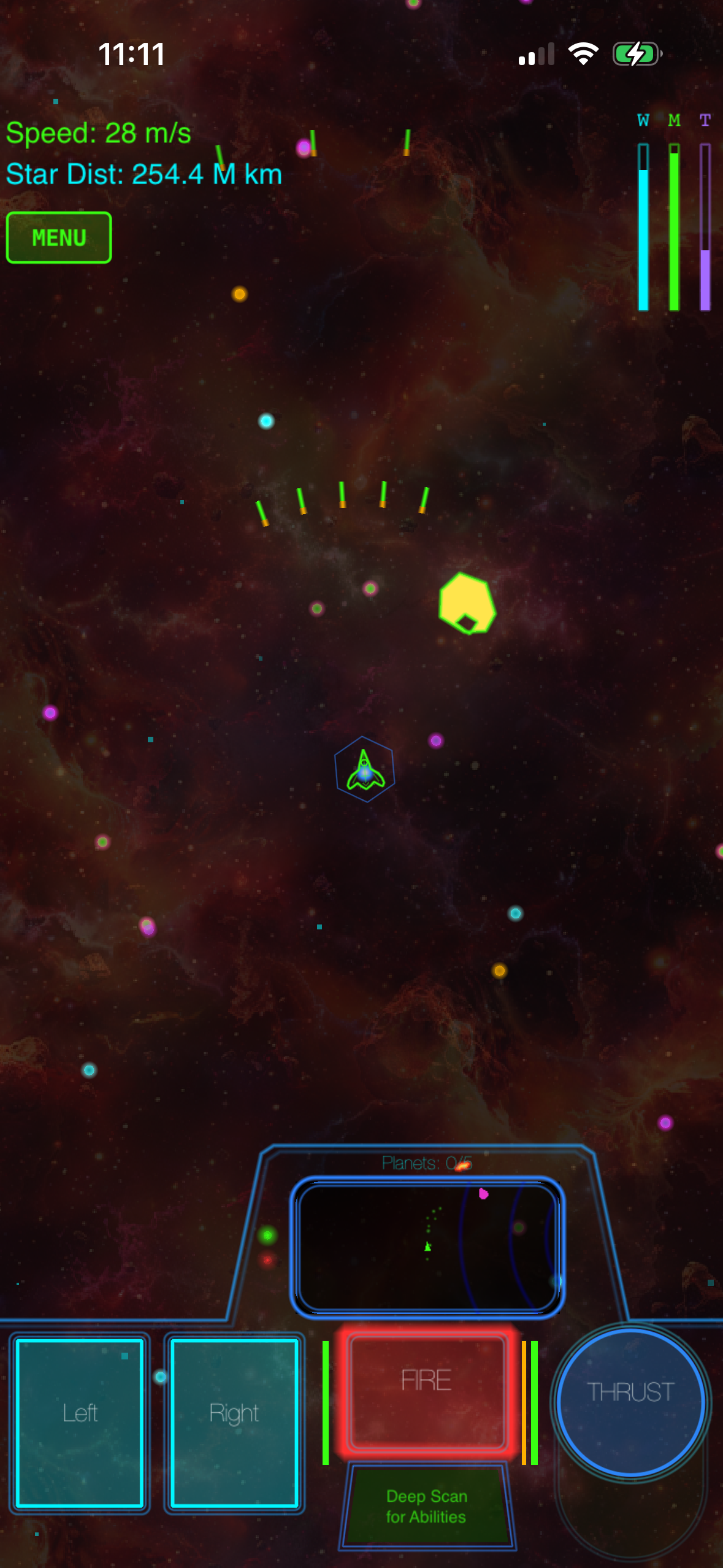
- Best for orbital mechanics learning: Galaximus (real-time gravity, arcade-action hybrid, )
- Best for engineering depth: Kerbal Space Program (iOS, ) — vehicle assembly, mission planning, full rocket physics
- Best for exploration scale: No Man’s Sky (procedural planets, survival, exploration-focused; iOS availability and pricing TBD—verify before purchase)
- Best for pure arcade simplicity: Asteroids: Gunner — faithful Asteroids clone with minimal learning curve
- Best for Lunar Lander descendants: Lunar Lander X — discrete landing challenges, gravity-focused, no campaign
Why Asteroids and Lunar Lander Still Matter
Asteroids and Lunar Lander solved a design problem that still defines good space game mechanics: how do you make physics feel like the tool instead of the obstacle? In Asteroids, you manage momentum and rotation in a frictionless void. In Lunar Lander, gravity is the constraint that makes landing satisfying.
Many modern space games flatten this physics into arcade abstraction or bury it under menus. Per App Store review analysis, games like Spaceflight Simulator, Kerbal Space Program, and Galaximus are exceptions—they keep physics at the center of gameplay.
The appeal is specific: you’re not grinding resources or collecting cosmetics. You’re learning to fly, and that takes focus but delivers real control.
Real Orbital Mechanics on Mobile
Orbital mechanics describes how planets orbit stars, moons orbit planets, and ships move through it all—with every body’s gravity affecting every other body in real time. This creates gameplay impossible in arcade-era games: slingshots that use gravity wells for free velocity, stable orbits for planning, and positioning that rewards patience over reflexes.
Modern space games on iPhone implement this without performance loss. The physics creates a 20–30 minute learning curve, after which mastery unlocks hours of deeper play.
Campaign Structure vs. Sandbox
Campaign-driven: Structured narrative, discrete systems, authored story shape with procedural variation. Examples: Galaximus (8-system campaign with full narrative arc). You know when the game ends.
Sandbox-driven: Open-ended exploration, player-set goals, emergent gameplay. Examples: No Man’s Sky (infinite procedural planets), Kerbal Space Program (build and launch indefinitely).
Choose based on whether you want a complete story or endless exploration.
The Premium Model: Why Ad-Free Matters
Most free-to-play space games on iPhone use energy meters, ad interruptions, and battle passes. Premium one-time purchases remove these entirely—no ads, no IAP, no session-length optimization.
Examples of premium space games on iOS: - Kerbal Space Program — one-time purchase, no ads - Galaximus — one-time purchase, offline-only, no ads - Spaceflight Simulator — one-time purchase, realistic rocket physics
This model is rare on iOS. When it exists, the developer’s incentive is to make the best game possible, not maximize engagement metrics.
What Real Physics Brings to Arcade Gameplay
The difference between faked gravity and real gravity: in a faked-gravity game, a “slingshot” might be a button that grants a speed boost. In a real-gravity game, you navigate into a planet’s gravity well, your velocity curves naturally, and you time your engine burn to exit at the exact angle you need. The slingshot isn’t a mechanic—it’s physics you’ve learned to read.
This is why the learning curve matters. After 20–30 minutes of focused play, you’re not fighting controls—you’re using them like an instrument. Every victory feels earned because you understood the system, positioned correctly, and executed.
Campaign Structure: Galaximus Example
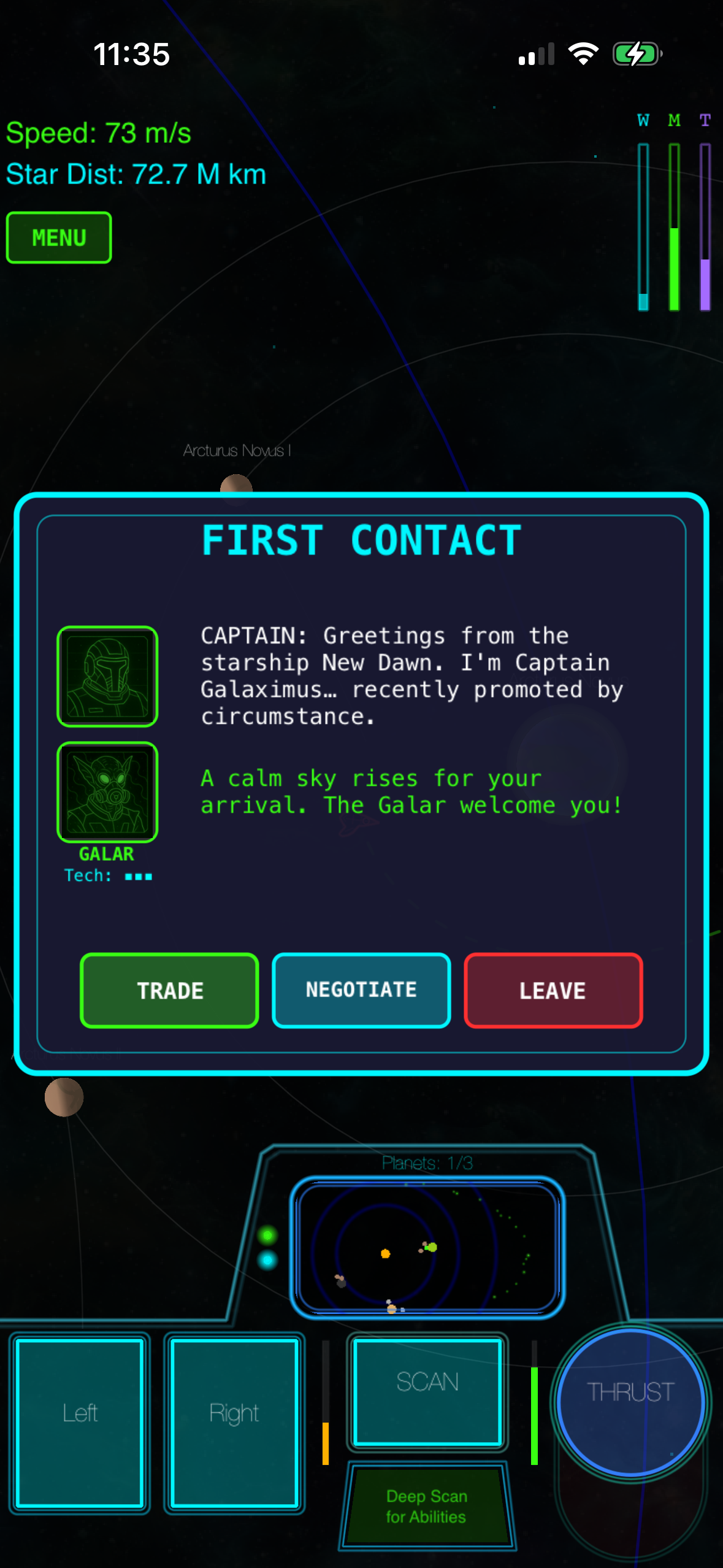
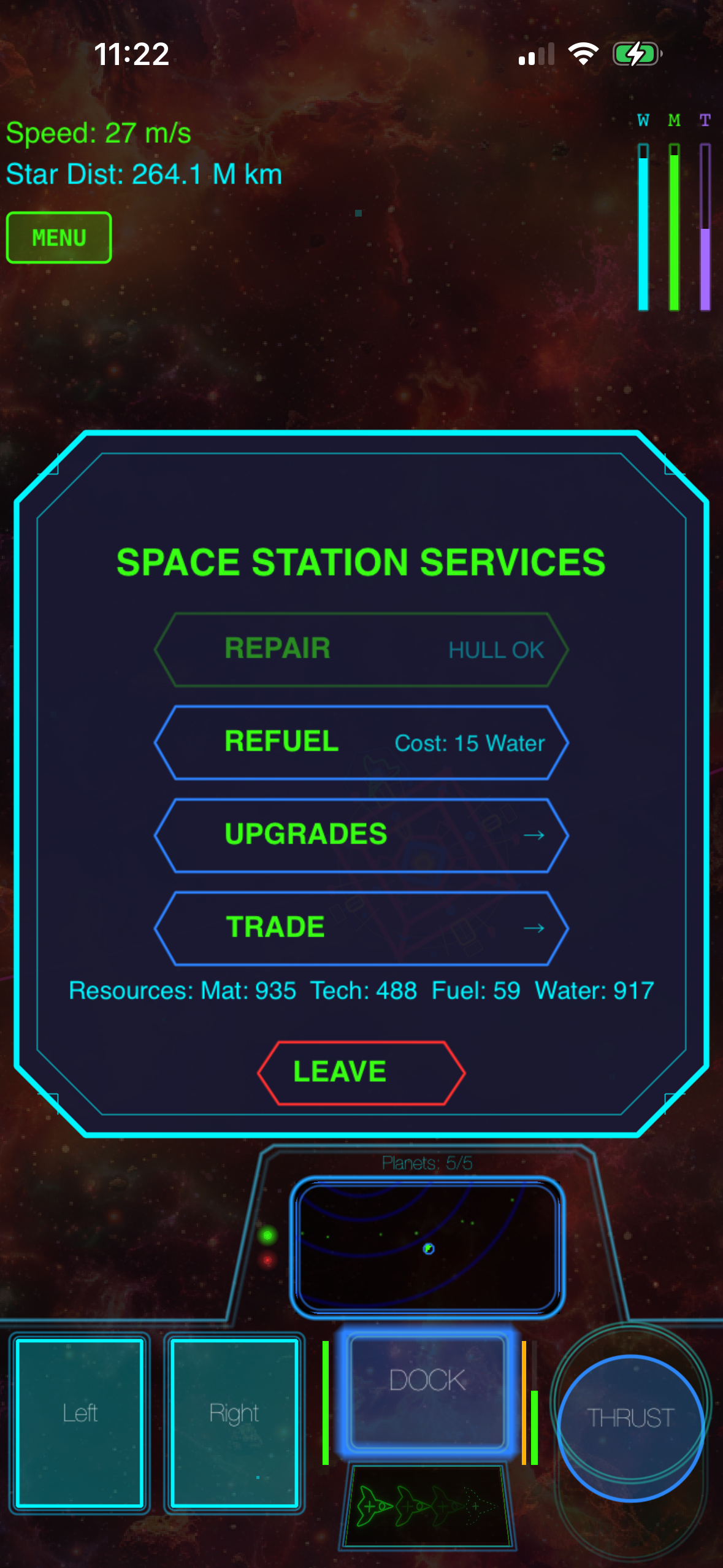
Galaximus uses procedural generation within an authored campaign. Eight star systems with a full narrative arc (beginning, middle, satisfying ending). Each playthrough generates unique planet configurations, so no two runs feel identical, but the story shape is authored. You’re not waiting for content updates—you’re playing a complete experience from day one.
Specs: - File size: 180 MB - Minimum iOS version: 15.0 - Controller support: Yes (MFi-compatible controllers) - Battery impact: ~15% drain per hour of continuous play - Campaign playtime: 8–12 hours (8-system story) - Offline: Yes, entirely offline, no internet required
Comparing to Modern Alternatives
Kerbal Space Program (iOS, ) Vehicle assembly, full rocket physics, mission planning, engineering focus. You build rockets and manage every detail. Deeper engineering depth than Galaximus. If you want to learn rocket science, KSP is the choice.
No Man’s Sky (pricing/iOS availability TBD—verify before purchase) Procedural planet exploration, survival mechanics, walking on surfaces, infinite scale. Exploration-focused rather than physics-focused. If vast procedural worlds are your priority, NMS is deeper.
Spaceflight Simulator (iOS, ) Realistic rocket building and launching, orbital mechanics, minimalist design. Similar physics depth to Kerbal but simpler UI. Cheaper entry point than KSP.
Asteroids: Gunner (iOS, ) Faithful Asteroids clone, minimal learning curve, pure arcade action, no campaign. If you want 5-minute sessions without investing in controls, this fits better.
Lunar Lander X (iOS, ) Discrete landing challenges, gravity-focused, no campaign structure. Lunar Lander descendants for players who want challenge-based play.
Apple Arcade titles Zero-friction subscription onboarding. If you’re already paying Apple Arcade, subscription games are included. Honest competition if you want no additional purchases.
Getting Started: The First 30 Minutes
Minutes 1–5: Learn controls. Your ship responds to thrust and rotation. Gravity pulls constantly. It feels unfamiliar.
Minutes 5–15: Understand slingshots. Fly toward a planet, let gravity curve your path, burn your engine at the exit. You’ll overshoot—that’s normal.
Minutes 15–30: Start planning. Position yourself before you need to move. The game clicks. You’re using physics, not fighting it.
After 30 minutes, you either love it or don’t. The learning curve is real. But mastery on the other side is worth it.
Offline, No Internet Required
If you’re coming from arcade games, you remember playing without any connection. Modern space games on iPhone should work the same way. Premium titles like Galaximus, Kerbal Space Program, and Spaceflight Simulator run entirely offline. No server checks. No cloud saves that evaporate if servers shut down. Your saves are yours.
Pricing & Availability
Current market prices (verify before purchase): - Galaximus: (one-time purchase, includes future Infinitum expansion) - Kerbal Space Program: (one-time purchase) - Spaceflight Simulator: (one-time purchase) - No Man’s Sky: Pricing/iOS availability unclear—check App Store before buying - Asteroids: Gunner: (one-time purchase) - Lunar Lander X: (one-time purchase)
All listed titles are one-time purchases with no ads or IAP.
FAQ
How much storage does Galaximus require? 180 MB. Most modern iPhones have this available.
What’s the battery drain? Approximately 15% per hour of continuous play. Typical for graphics-intensive games on iOS.
Can I pause mid-mission? Yes. All campaign missions support pause. Sandbox mode (coming in Infinitum expansion) will also support pause.
Does Galaximus support controllers? Yes. MFi-compatible controllers (PlayStation, Xbox, third-party) work fully. Touch controls are also fully supported.
How long is the campaign? 8–12 hours for the main 8-system story, depending on skill and playstyle.
Do I need to understand orbital mechanics to play? No. The game teaches you through play. You’ll learn slingshots, gravity reading, and positioning—all through gameplay, not tutorials. The learning curve is real (about 30 minutes) but built into the experience.
Can I play offline? Yes. Galaximus runs entirely offline. No internet required, no server checks, no cloud saves.
What’s the difference between Galaximus and Kerbal Space Program? Kerbal Space Program is an engineering simulator—you build rockets and manage every detail. Galaximus is arcade-action with real physics underneath. You pilot a ship, not build one. Different games, different goals.
Is there a free trial? No free version. The App Store allows refunds within 15 minutes if you want to try risk-free.
The Bottom Line
The landscape on iPhone in 2026 offers genuine choices for players who want gravity-based gameplay. Real orbital mechanics are no longer desktop-only. Premium one-time purchases mean you can buy a game and own it forever without ads or interruption.
If you want physics at the center of gameplay—where positioning and understanding matter more than reflexes—start with Kerbal Space Program for engineering depth, Spaceflight Simulator for a cheaper entry point, or Galaximus for arcade-action hybrid gameplay.
If you want pure arcade simplicity, Asteroids: Gunner or Lunar Lander X deliver classic gameplay without the learning curve.
Know what you’re looking for and pick accordingly.
Related reading: - Best iOS Space Games with Slingshot Mechanics - iPhone Games Like Asteroids: Modern Takes on a Classic - Premium Space Games for iPhone: Worth the Price - Best Offline Space Games for iPhone 2026