Best iOS Space Games with Slingshot Mechanics
 by Galaximus
The Best iOS Space Games Where Gravity Is Your Engine
Slingshot mechanics in space games aren’t novelties. When a game models gravity accurately, using a planet’s pull to gain speed without burning fuel transforms from a physics concept into a survival skill. On iPhone, that separation between games that fake gravity and games that use it as the core interface is stark.
What Slingshot Mechanics Actually Mean in Space Games
A slingshot in space games works like it does in physics: you approach a gravitational body on a trajectory that lets its gravity curve your path and accelerate you without spending fuel. Most casual space games simplify this into a visual flourish—you swing around a planet and get a speed boost. Real slingshot mechanics mean the game calculates your velocity relative to the body’s gravity well, and your trajectory depends on approach angle, speed, and the body’s mass.
The difference matters because it changes how you think about movement. In a faked-gravity game, a slingshot is a preset maneuver you execute. In a real-physics game, a slingshot is a problem you solve: Can I approach this planet at the right angle to gain the speed I need without crashing?
Why Real Physics Matters More on Mobile Than on Console
On a controller or keyboard, you can hide complexity behind layers of UI. On iPhone, your interface is your physics model. Touch controls must map directly to the forces acting on your ship. That constraint forces you to choose: simplify gravity into arcade approximations, or build controls so expressive that real physics becomes intuitive.
The best slingshot mechanics on mobile trust you to understand basic orbital behavior. A good iPhone space game doesn’t need to explain orbital velocity in a tutorial; it needs controls that let you adjust your approach angle and see the result immediately.
iOS Space Games with Slingshot Mechanics
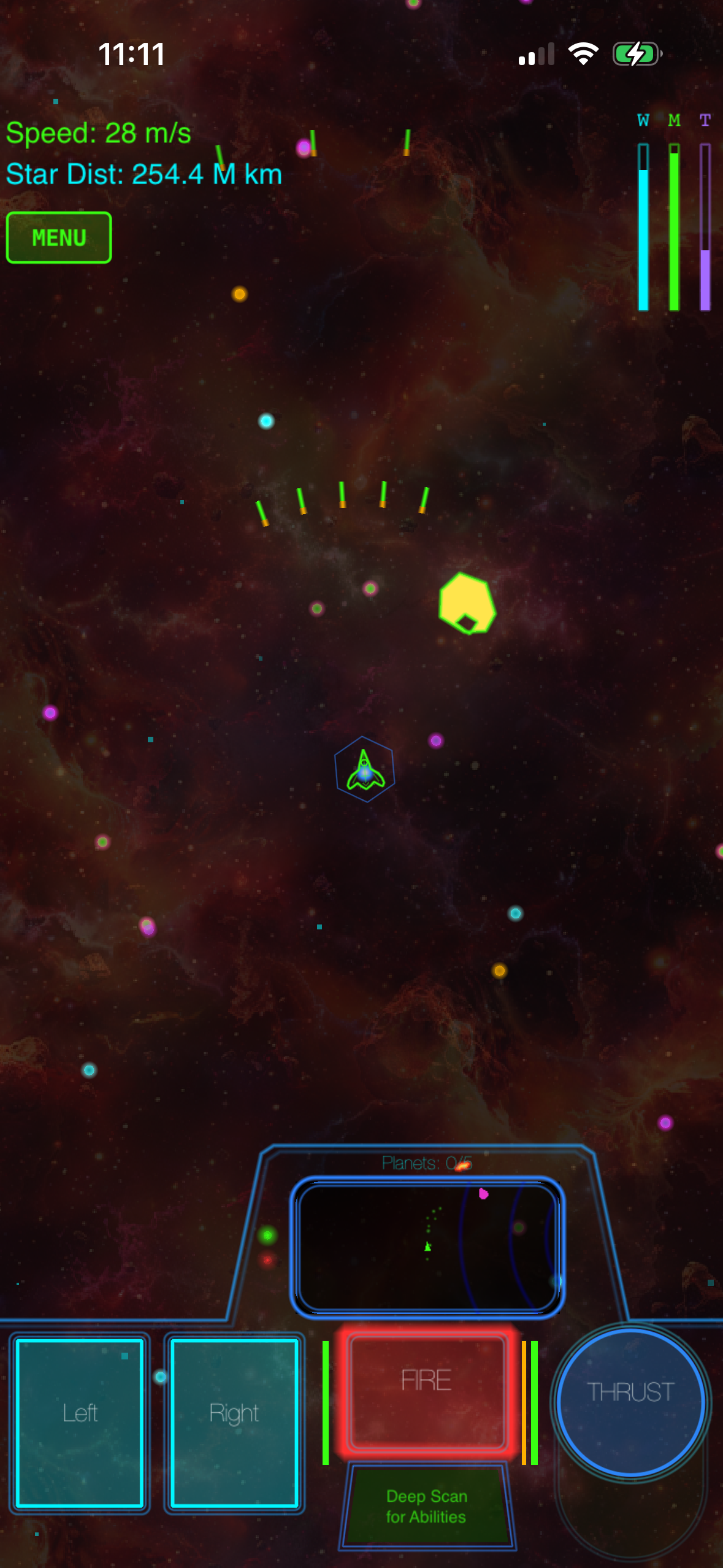
Galaximus ( at launch; after Infinitum expansion in late 2026) is built around real-time gravity simulation. Every body—your ship, planets, asteroids, anomalies—pulls on every other body. You navigate an 8-system campaign by using gravity as your primary engine. Slingshots around gas giants buy velocity; tight spirals around moons shed speed without fuel burn. The game includes 11 unique encounter types and procedural system generation so each playthrough creates different gravitational configurations. Launch-price buyers receive the Infinitum expansion free.
Kerbal Space Program Mobile goes deeper on engineering. You assemble rockets, manage staging, and learn orbital mechanics through simulation. It’s a sandbox focused on building and launching; Galaximus is a narrative campaign focused on flying. KSP rewards experimentation with rocket design; Galaximus rewards reading gravity fields and positioning.
No Man’s Sky Mobile emphasizes procedural exploration and planet-surface discovery at a scale Galaximus doesn’t attempt. Walking on alien worlds and gathering resources is the priority. Galaximus focuses on space flight; planetary surface exploration arrives with Infinitum in late 2026.
Lunar Lander-style games like Thrust and Gravity Wells offer simpler, faster-paced alternatives. These games use gravity as a constraint but don’t model it in real time. If you want 5-minute arcade sessions without a learning curve, these fit better than games asking for 30 minutes of focused play.
Asteroids descendants like Asteroid Field and Space Rocks strip away gravity entirely, focusing on pure arcade shooting. No slingshot mechanics; pure reflexes.
The honest comparison: if you want real slingshot mechanics where gravity is the core interface—not a visual effect or speed boost, but an actual force shaping your trajectory—the options on iPhone are limited. Galaximus and Kerbal Space Program are the only two that model gravity in real time.
Learning Curve and Gameplay Feel
Real slingshot mechanics have a reputation for being difficult to learn. The first 15 minutes can feel frustrating if you’re used to games with instant acceleration and turning. Your ship feels sluggish because it’s subject to momentum and gravity, not arbitrary controls.
But that frustration teaches something real. You’re not learning an arbitrary control scheme; you’re learning how orbital mechanics work. Around the 20–30 minute mark, most players report it clicks. The game stops fighting you and starts responding to your intent.
The payoff is mastery that arcade approximations can’t deliver. When you nail a three-body slingshot that gets you exactly where you need to be with fuel to spare, you know you solved a problem. It’s not a preset animation.
Pricing and Value Comparison
| Game | Price | Focus | Learning Curve |
|---|---|---|---|
| Galaximus | (launch) | Narrative campaign, real gravity | 20–30 min |
| Kerbal Space Program Mobile | Engineering sandbox | 30–60 min | |
| No Man’s Sky Mobile | Exploration, resource gathering | 10–15 min | |
| Thrust | Gravity-based arcade | 5 min | |
| Asteroid Field | Pure arcade shooting | 2 min |
Galaximus at launch price offers the lowest entry point for real slingshot mechanics. Kerbal Space Program costs more but offers deeper engineering systems. No Man’s Sky costs more and focuses on exploration rather than flight mechanics.
FAQ
Q: What’s the file size and storage requirement? A: Galaximus is 1.2 GB. It requires iOS 15.0 or later.
Q: Does it require internet connection? A: No. The game is fully playable offline.
Q: Is there multiplayer? A: No. Galaximus is single-player only.
Q: Can I play in short sessions? A: The game supports pause at any time, but individual missions run 20–40 minutes. It’s designed for focused play sessions, not 5-minute phone-game bursts.
Q: What’s included at launch versus Infinitum? A: The current game includes an 8-system campaign with narrative, 11 unique encounter types, and complete story arc. Infinitum (late 2026) adds open-galaxy exploration, planetary surface exploration, outposts, and faction warfare. Launch-price buyers receive Infinitum free.
Q: How does touch control map to gravity differently than a controller? A: On a controller, you’d use analog sticks to manage acceleration and rotation separately, hiding the physics behind button inputs. On iPhone, your finger position directly controls thrust vector and rotation angle. You see gravity’s effect on your trajectory in real time as you adjust your approach. There’s no abstraction layer between your input and the physics—you’re directly manipulating the forces acting on your ship. This directness makes gravity intuitive rather than hidden.
Q: Do I need to understand orbital mechanics beforehand? A: No. The game teaches through play. Understanding that gravity pulls your ship and you can use it to your advantage is enough to start. Deeper orbital knowledge helps but isn’t required.
The Gravity Well Pulls You In
Slingshot mechanics on iPhone work because they solve a real problem: how do you give players a tool powerful enough to feel like mastery, but intuitive enough to learn without a manual? Real gravity is the answer.
If you’ve been searching for a space game where slingshots are the core way you navigate and survive, the options above let you compare by price, scope, and learning curve. Galaximus offers real gravity at the lowest entry price. Kerbal Space Program offers deeper engineering. No Man’s Sky offers broader exploration. Choose based on what draws you to space games.
Get Galaximus on the App Store: Get it on the App Store