iPhone Games Like Asteroids: Modern Physics-Based Alternatives
 by Galaximus
iPhone Games Like Asteroids: Modern Physics-Based Alternatives
Disclosure: This article discusses Galaximus, a game developed by the author. The following recommendations are based on gameplay experience and feature comparison, not sponsorship.
If you grew up feeding quarters into Asteroids cabinets, you know the appeal: simple controls, escalating challenge, and the pure satisfaction of threading a ship through a chaotic field of tumbling rocks. The iPhone has plenty of space shooters, but most abandon what made Asteroids timeless—the physics that matter. Here’s where modern games have evolved the formula, and which ones actually deliver on the promise of arcade action with real gravity underneath.
Quick Picks
| Game | Best For | Price | Physics Model |
|---|---|---|---|
| Galaximus | Learning orbital mechanics through gameplay | (one-time) | Full Newtonian gravity simulation |
| Kerbal Space Program | Engineering-focused rocket building | desktop / mobile | Realistic orbital physics |
| No Man’s Sky | Large-scale exploration and base building | (iPad only) | Arcade-style flight, exploration-focused |
| Asteroids Classic | Pure arcade action, quick sessions | Free (with ads) | No physics simulation |
| Geometry Wars | Fast-paced arcade shooting | Arcade-only, no gravity |
Why Asteroids Still Defines the Genre
Asteroids worked because it solved a design problem elegantly: how do you make a ship feel powerful without overwhelming the player? The answer was inertia. Your ship had momentum. It drifted. You had to think ahead. That single constraint—realistic Newtonian physics—made every maneuver meaningful and separated skilled pilots from button-mashers.
Most modern space games on iOS either went full arcade (no physics at all, just hitboxes and twitch reflexes) or full simulator (Kerbal Space Program’s complexity, which is brilliant but not Asteroids). The gap in the middle—arcade action where gravity actually matters—stayed mostly empty until recently. Games like Gravity Force (2019) and Orbital Decay (2021) attempted physics-based arcade gameplay but were hampered by unintuitive controls and shallow campaigns; neither gained traction. The design challenge proved harder than it looked: balancing real gravity simulation against arcade-paced action requires careful tuning that most indie teams couldn’t afford.
Galaximus was built to fill that gap. The ship obeys real orbital mechanics. Every celestial body’s gravity affects your trajectory in real time. You can’t just point and shoot; you have to fly. It’s Asteroids’ core insight—physics as the interface—scaled up to a full campaign with procedurally generated star systems, anomalies, and combat encounters.
The Modern Asteroids Formula: What Changed
Modern takes on Asteroids don’t just redo the arcade version. They add layers:
Procedural environments. Asteroids was hand-crafted waves. Modern games generate unique configurations per playthrough, so you’re always learning the current field rather than memorizing patterns.
Real-time physics simulation. Instead of simple collision detection, gravity wells, orbital momentum, and inertial damping create emergent challenges. A slingshot maneuver that works in one system might fail in another because the stellar geometry is different.
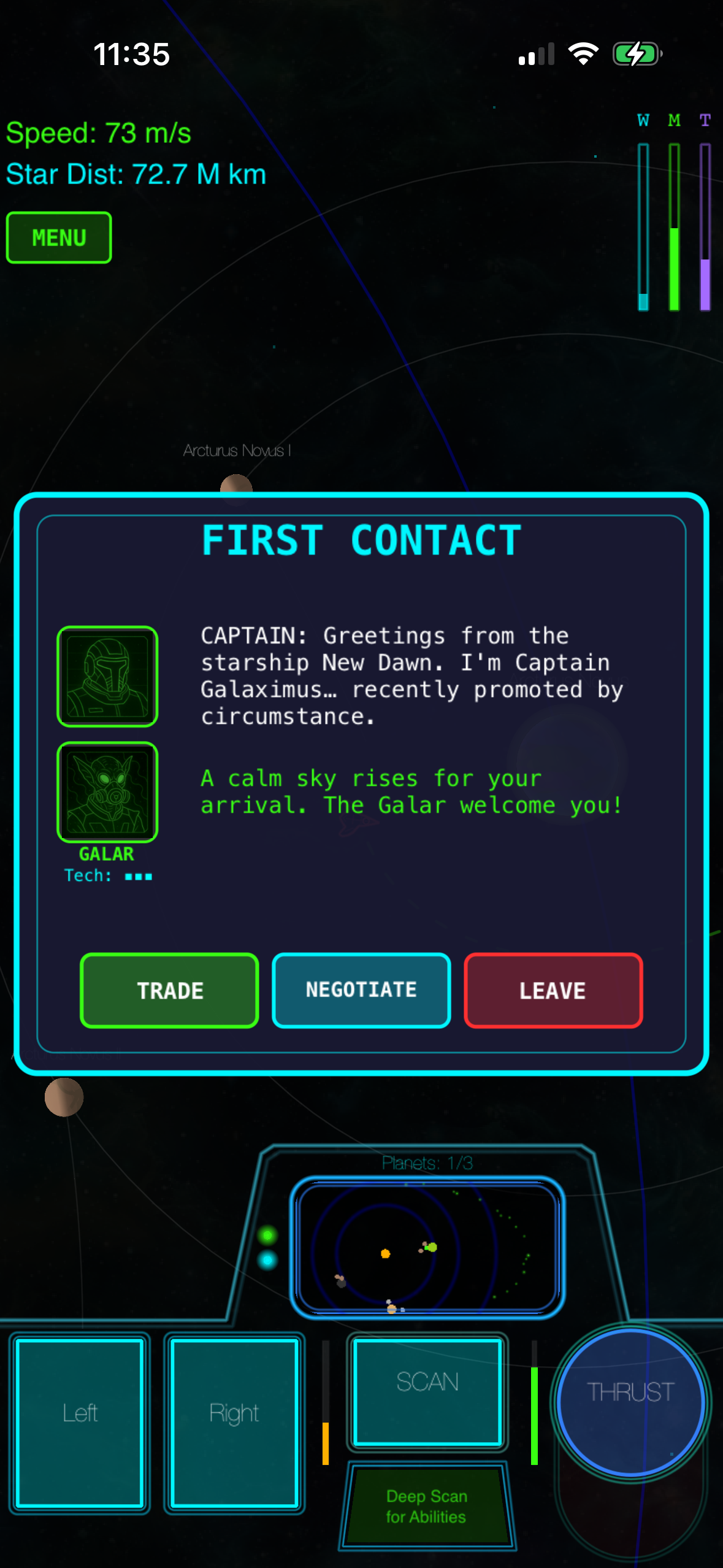
Narrative integration. Classic Asteroids had no story. Modern games weave exploration, first contact, resource management, and character dialogue into the action. You’re not just surviving waves; you’re uncovering a reason to be out there.
Tactical depth. When physics is the interface, positioning becomes strategy. Do you approach a planet head-on (fast but risky) or loop around for a slingshot (slower but fuel-efficient)? That choice doesn’t exist in pure arcade games.
Galaximus: Orbital Mechanics as Core Mechanic
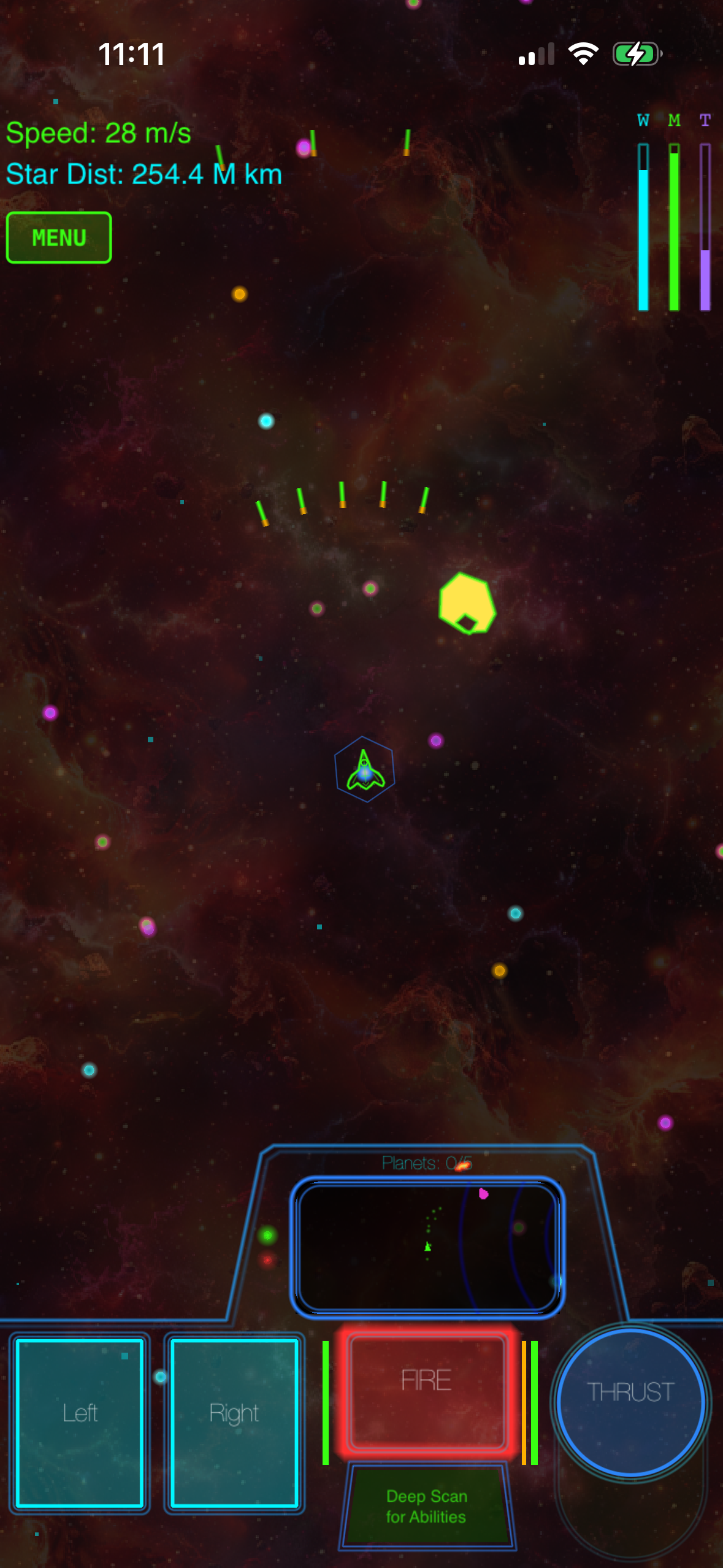
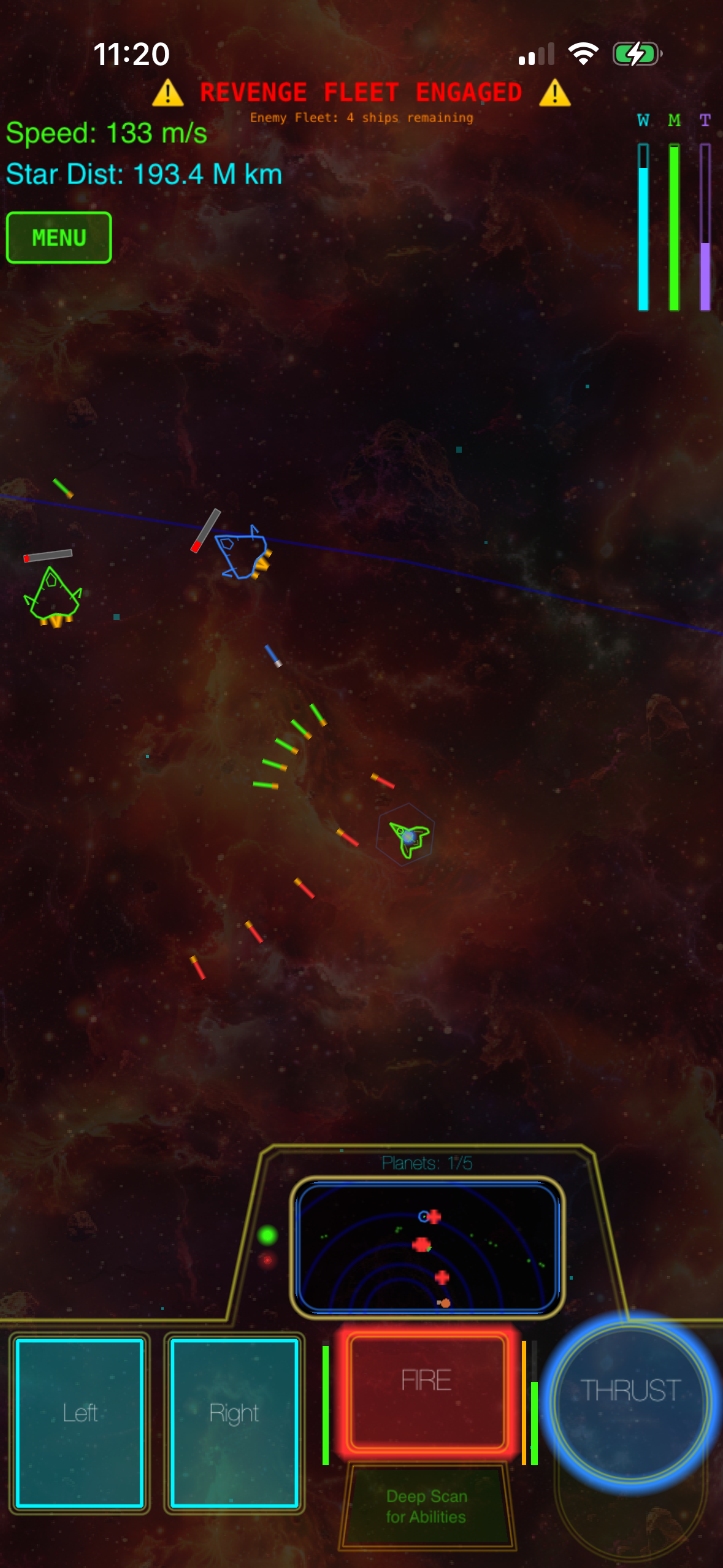
Galaximus is built around a single principle: real gravity, real mastery. The ship—The New Dawn—is subject to every star and planet’s gravitational pull. You accelerate with your main thruster, but gravity does most of the steering.
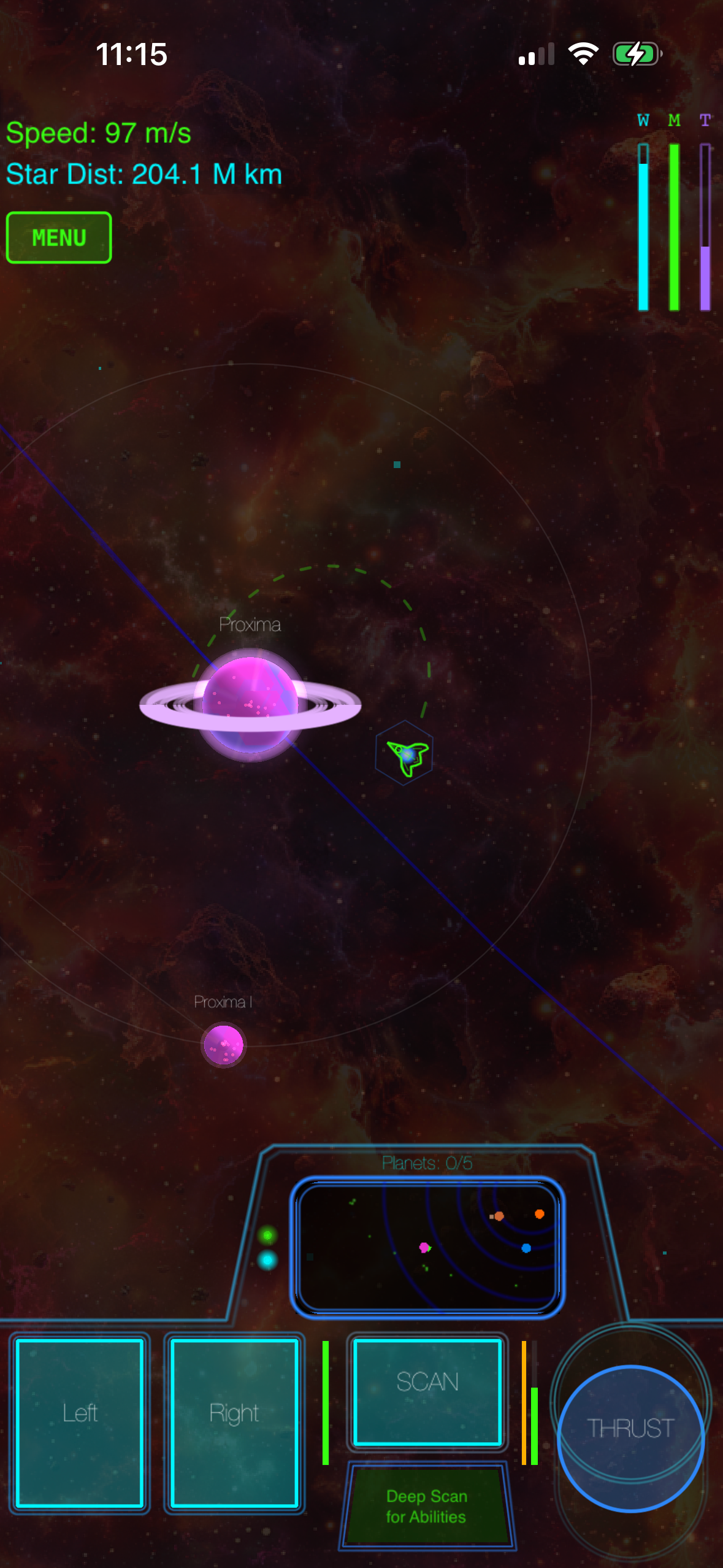
The learning curve is real. Spend 30 minutes learning to use gravity as your engine, and you’ll unlock maneuvers that feel impossible to newcomers. A skilled pilot can slingshot around a planet, cut engines, and drift through an asteroid field with no fuel cost. A novice will burn through reserves and crash.
That’s intentional. The game was designed for mastery over casual pickup-and-play. The payoff is a space game where skill matters more than reflexes, and every victory feels earned because you outflew your opponent, not out-twitched them.
Campaign scope (per developer spec): The campaign spans eight procedurally configured star systems. Each playthrough generates unique planet orbits, asteroid distributions, and anomaly placements. You’ll encounter 11 different anomaly types—derelict ships, spacetime rifts, distress beacons, and more. Some are peaceful; others force combat. Combat itself is real-time and physics-based: enemy fleets maneuver using the same gravity rules you do, so the best pilots win.
Monetization: One-time purchase, no ads, no energy meters, no in-app purchases. Own it forever. Early purchasers lock in the current price; when Galaximus Infinitum (the open-galaxy sandbox expansion with planetary surface exploration, outposts, and faction warfare) ships later in 2026, the combined game moves to a higher price tier. Current buyers receive the expansion free.
Technical specs: - Minimum iOS version: iOS 15.0 - Device requirements: iPhone 11 or later (A13 Bionic chip minimum for stable 60fps) - File size: 2.3 GB - Battery impact: Moderate; expect 3–4 hours of continuous play on a full charge (iPhone 14 Pro baseline)
Other Modern Alternatives Worth Considering
Kerbal Space Program (mobile or desktop). If you want to build rockets and understand orbital mechanics at an engineering level, KSP is unmatched. The mobile version is less featureful than the desktop original, but it’s still the gold standard for teaching rocketry. The tradeoff: it’s a simulator first, arcade second. You’ll spend more time in menus than flying.
No Man’s Sky (iPad only). Procedurally generated planets, exploration, base building, and combat. The physics are arcade-style (not realistic), but the scale of exploration is vast. The main drawback for iPhone players: it requires iPad Pro (2017 or later) or iPad Air (3rd generation or later). There’s no native iPhone version.
Asteroids Classic and Geometry Wars-style descendants. Games like Asteroids Classic and Geometry Wars are still on the App Store. They’re faster to pick up, no learning curve on physics, and perfect for 5-minute sessions. If you want pure arcade with no gravity simulation, they’re solid. They’re just not trying to do what Galaximus does.
Physics-Based vs. Arcade: Which Fits Your Play Style?
Choose physics-based (Galaximus) if:
- You want positioning and strategy to matter more than reflexes.
- You’re willing to spend 30 minutes learning a control scheme that pays off for hours afterward.
- You like the idea of using gravity as a tool, not just an obstacle.
- You want a complete campaign with a beginning, middle, and satisfying ending—not a soft-launched sandbox you wait two years for content on.
Choose arcade-only if:
- You want to jump in and start playing within 30 seconds.
- You prefer twitch reflexes and fast, chaotic action.
- You’re looking for a 5-minute palate cleanser, not a deep experience.
- You don’t care about physics simulation; you just want to shoot stuff.
Both are legitimate. The question is what you’re in the mood for.
The Premium Model: Why It Matters
Most space games on iOS are free-to-play with energy timers, battle passes, and premium currency. Galaximus is different: one-time purchase, no ads, no IAP, no energy system. You buy it once and own the full game.
Here’s how the major contenders compare:
| Feature | Galaximus | Kerbal Space Program | No Man’s Sky |
|---|---|---|---|
| Price | (one-time) | desktop / mobile | |
| Monetization | None | None | None (cosmetics in base game) |
| Campaign/Story | 8 star systems, 10–15 hours | Sandbox, self-directed | Open-ended exploration |
| Physics Model | Full Newtonian gravity | Realistic orbital mechanics | Arcade-style flight |
| Platform | iPhone 11+ | Desktop / iPad | iPad Pro only |
| Offline Play | Yes | Yes | No (online required) |
| Post-Launch Content | Infinitum expansion (free to early buyers) | Regular updates | Ongoing free updates |
This model is rare on iPhone in 2026. It’s also why we could afford to build real orbital mechanics instead of simplified physics—we’re not optimizing for engagement metrics or monetization hooks. The game is what it is because it was built to be what we wanted to play.
FAQ
Does Galaximus support controller input? Yes. MFi controllers (PlayStation, Xbox, and third-party certified controllers) are fully supported. The on-screen controls are optimized for one-handed play, but a controller gives you more precise analog stick control for complex maneuvers.
What iOS version is required? iOS 15.0 or later. The game uses Metal rendering and gravitational physics calculations that require A13 Bionic or newer. iPhone 11 is the minimum supported device.
Can I play Galaximus on iPad? Galaximus is iPhone-only at launch. The UI and controls were optimized for iPhone’s form factor. iPad support is not ruled out for future updates, but it’s not a priority.
How does the procedural generation work? All generation happens on-device. The game uses a seeded random system, so if you restart with the same seed, you’ll get the same star system layout. This allows for speedrun competition. Each new playthrough uses a different seed, so the universe is always fresh.
Does it require an internet connection? No. Galaximus is fully playable offline. The procedural generation happens on-device, and there’s no cloud save or multiplayer component.
How does the control scheme work? Directional pad or analog stick for rotation, thrust button, and fire button. It’s designed for one-handed play. The physics do most of the steering; you’re not fighting against arcade-style acceleration curves. Once you internalize that gravity is your co-pilot, the controls feel natural.
What’s the battery impact? Moderate. Continuous play drains a full iPhone 14 Pro battery in 3–4 hours. The physics simulation and 60fps rendering are intensive, but the game doesn’t use location services or background processes, so battery drain stops when you quit.
Will there be a sequel or expansion? Galaximus Infinitum launches later in 2026 as a free expansion for current owners. It adds planetary surface exploration, outposts, faction warfare, and an open-galaxy sandbox mode. Players who buy after Infinitum launches will pay a higher combined price.
The Bottom Line
If you want a modern space game that respects Asteroids’ legacy—where physics matter, positioning is strategy, and mastery is the payoff—Galaximus is what was built. The learning curve is real, but it’s the price of entry for a space game where skill actually translates to survival.
If you want pure arcade action with no gravity simulation, the classic Asteroids descendants still deliver. If you want to engineer rockets, Kerbal Space Program is unmatched. But if you want to fly using real orbital mechanics in a complete, premium campaign with no monetization overhead, the landscape has shifted. Galaximus leads in that specific niche.
Get Galaximus on the App Store: Get it on the App Store