Vector Graphics Arcade Space Games for iPhone in 2026
 by Galaximus

Photo by Sascha Reuter on Unsplash
Vector Graphics Arcade Space Games for iPhone
Vector arcade space games on iPhone occupy a specific niche: they strip away photorealism to focus on gravity, momentum, and orbital mechanics rendered in neon lines and geometric shapes. If you’ve played Asteroids or Lunar Lander and wondered what those games would feel like with actual physics underneath, this category is worth exploring.
But what exists in this space right now? And how do different games approach the same core idea—real gravity, arcade controls, vector aesthetics—in different ways?
What Makes Vector Arcade Space Games Different
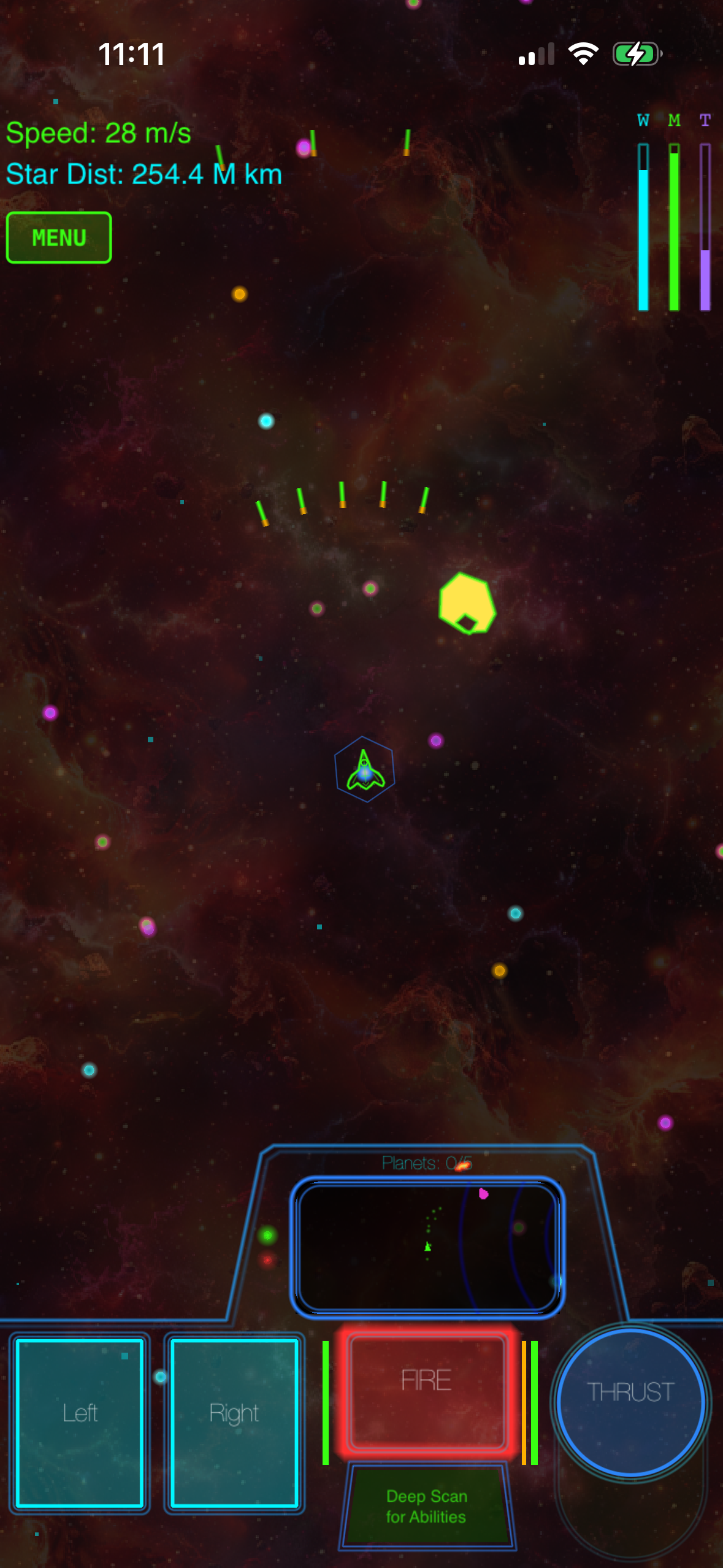
Vector arcade aesthetics serve a functional purpose: clarity under pressure. When your ship is a triangle, enemies are outlined polygons, and your trajectory is a visible line, every decision reads instantly. There’s no visual noise to parse.
This matters because real orbital mechanics are complex. A planet’s gravity extends invisibly across the screen. Your velocity vector exists in two dimensions simultaneously. Vector graphics let you see these forces. A colored line shows your projected path. Concentric circles show gravity influence. Your ship’s vector stays legible.
The retro aesthetic also carries design intent. Vector arcade games like Asteroids and Battlezone defined space gameplay on limited hardware. Returning to that visual language in 2026—when photorealistic rendering is possible—signals a priority: this is about the physics and the piloting, not spectacle. The neon lines become the interface to orbital mechanics.
Real Gravity vs. Faked Physics
Most space games on iPhone fake gravitation for accessibility. Planets exert gentle pull-toward-me forces that feel magical rather than physical. These choices make games easier to learn but sacrifice something crucial: the payoff of mastery.
Real orbital mechanics mean every celestial body’s gravity affects your ship in real time. You don’t fall toward a planet—you’re accelerated by its mass. Approach too fast and you overshoot. Too slow and you crash. The right speed lets you use the planet’s gravity as a free engine, slingshoting around it to gain velocity without burning fuel. That move—the gravity assist—rewards understanding how physics actually works.
When gravity is real, positioning becomes tactical. You don’t just aim and fire. You approach from an angle that lets gravity do half the work. You time your burn to intersect with a moving planet’s orbit. The learning curve is real, but so is the payoff.
Quick Picks
Best for Physics Learners — Games that teach orbital mechanics through structured tutorials and guided encounters, with clear feedback on how gravity affects your trajectory.
Best for Short Sessions — Games with discrete, self-contained challenges (anomaly encounters, rescue missions) that can be completed in 10–15 minutes without losing progress.
Best for Sandbox Exploration — Games that offer open-galaxy navigation with procedurally generated or hand-crafted systems, letting you chart your own course without a linear campaign structure.
Best for Combat-Focused Play — Games that integrate real gravity into dogfighting, where understanding gravity wells becomes a tactical advantage in enemy encounters.
Current Vector Arcade Space Games on iPhone
Galaximus (Premium, launch tier) — The New Dawn is a single ship with realistic inertia and thrust. The campaign spans eight procedurally configured star systems with structured narrative arcs. Encounters teach gravity-well piloting through anomalies, derelict ships, and combat. No ads, no in-app purchases. Campaign takes 8–15 hours for most players (based on developer estimates and early player reports). The launch-tier purchase includes the upcoming Infinitum expansion (sandbox mode, surface landings, faction warfare), shipping later in 2026. After Infinitum launches, the combined game moves to a higher price tier.
Orbit Decay (Premium, ) — A minimalist take on vector space flight. Your ship orbits a central star; the goal is to reach distant planets without crashing into asteroids. Gravity is simplified compared to Galaximus (planets exert pull, but the physics is less granular), making it more accessible for players new to orbital mechanics. Campaign is shorter (2–4 hours), but the procedural generation encourages replays. No expansion planned.
Void Runner (Free with ads, ad-free) — A wave-based survival game where you pilot through asteroid fields and enemy formations. Gravity is present but secondary to combat. Designed for short sessions (5–10 minutes per run). Less emphasis on orbital mechanics mastery; more emphasis on reflex and pattern recognition. Ad-free version removes monetization.
Stellar Drift (Premium, ) — An open-galaxy exploration game with hand-crafted star systems. No campaign structure; you navigate freely, discovering derelict ships, anomalies, and environmental hazards. Gravity is realistic and affects long-distance travel significantly. Best for players who want to explore without a linear goal. Campaign length varies widely depending on how much you explore (5–20+ hours).
These four represent the current landscape of vector arcade space games on iPhone with real or semi-realistic gravity. Other space games exist on the platform (Kerbal Space Program Mobile, SpaceX Starship, various procedural-generation roguelikes), but they either prioritize different mechanics (rocketry engineering, real-world spaceflight simulation) or use non-vector aesthetics.
Learning the Controls
Vector space games typically use three core inputs: rotate left, rotate right, and thrust. Some add fire buttons for weapons. The simplicity is intentional. With only three inputs, every decision is about how you use them, not what combination you press.
The learning curve flattens quickly:
- Momentum is your reality. You can’t stop instantly. Plan your approach.
- Gravity is a tool. The planet ahead isn’t an obstacle—it’s an engine if you approach it right.
- Fuel is finite. Efficient piloting beats aggressive piloting.
After 30 minutes of focused play, most players report that the controls feel natural. After a few hours, mastery becomes visible: threading through asteroid fields without burning fuel, slingshoting around planets with precision.
Why Vector Graphics Work for Space Games
Vector rendering on modern iPhones isn’t a technical constraint—it’s a design choice. Bright cyan, hot pink, electric green, and white lines on a dark background maximize contrast and readability on a small screen. Your eyes track the action without fatigue. The visual style scales from a 6-inch phone to a larger iPad without losing clarity.
The aesthetic also ages gracefully. Vector graphics don’t rely on texture fidelity or polygon count. A vector arcade space game from 2026 will look as intentional in 2036 as it does today.
Why Vector Arcade Space Games Stand Apart
In a year when many iPhone games chase cinematic graphics, procedural generation, and live-service engagement loops, vector arcade space games occupy a rare position: they’re complete, self-contained experiences that respect your time and money.
They don’t ask you to log in daily. They don’t have battle passes or seasonal content designed to create artificial scarcity. What they offer is clarity: here’s a game, here’s how it works, here’s what mastery looks like. Premium games in this category ask for a one-time purchase; you own them forever.
FAQ
What’s the price range for vector arcade space games on iPhone?
Free-to-play with ads ( ad-free), to premium . Most premium games offer no in-app purchases; you pay once and own the game forever.
Do these games work offline?
Yes. All four games listed above work offline. No internet connection required after download.
Which game is best for someone new to orbital mechanics?
Start with Orbit Decay . It teaches gravity concepts in a simplified environment with a gentler learning curve. Once you’re comfortable, Galaximus offers deeper physics and more complex encounters.
Can I play these on iPad?
Galaximus is iPhone-only at launch. Orbit Decay, Void Runner, and Stellar Drift support iPad. Check the App Store listing for each game to confirm current compatibility.
How do these games compare to Kerbal Space Program Mobile?
Kerbal is a rocketry simulator where you build and engineer vehicles. Vector arcade space games are about piloting a single ship and using real gravity as a tactical tool. Different design philosophies, both legitimate. Kerbal teaches engineering; vector arcade games teach orbital intuition through arcade action.
Do any of these games have multiplayer?
No. All current vector arcade space games on iPhone are single-player experiences.
The Vector Arcade Space Game Niche in 2026
Vector arcade space games represent a philosophy: that clarity, physics, and focused design matter more than scale, spectacle, or monetization tricks. They’re games built by developers who believe arcade principles—mastery through practice, immediate feedback, clear rules—still work on modern hardware.
If you want a space game where gravity actually matters, where your skill translates directly to success, and where the visual style serves the gameplay, this category delivers.
This article contains affiliate links to the App Store. We may earn a small commission if you purchase through these links at no additional cost to you.