Slingshot Mechanics in iOS Space Games: Best Examples
 by Galaximus
Slingshot Mechanics in iOS Space Games: Best Examples
Slingshot mechanics—using a planet’s gravity well to accelerate your ship without burning fuel—are one of the most satisfying ways to interact with real physics on a mobile screen. Most space games fake gravity for accessibility. But a handful of iPhone titles model it accurately, then design controls that let you feel the difference between a clumsy burn and a perfect gravity-assist curve.
This guide explains how slingshot mechanics work, where to find them, and why they matter for gameplay.
What Is a Slingshot Mechanic?
A slingshot (or gravity-assist) maneuver is a real orbital technique: you approach a moving body—a planet, moon, or star—at high speed, let its gravity curve your trajectory, and exit with more velocity than you arrived with. You don’t burn fuel. The moving body’s momentum transfers to you through its gravitational field.
In arcade space games, this becomes a skill expression mechanic. Instead of tapping a “go faster” button, you position your ship to thread the needle: close enough to the planet that gravity pulls you into a tight curve, but not so close that you crash. The payoff is real—you gain speed for free, which means you can reach distant targets, escape dangerous zones, or line up combat angles without draining your fuel tank.
The physics underneath is real orbital mechanics: every body’s gravity affects every other body in real time. But the control scheme is arcade-friendly—players learn in minutes that “approach the planet’s edge” equals “free speed boost,” then spend hours refining their approach angles.
Why Slingshots Matter More Than You’d Think
Most mobile space games simplify gravity into a visual effect. A planet sits there looking pretty, and your ship’s trajectory is really just a predetermined path with a gravity-themed animation overlay. Slingshot mechanics that actually work require something harder: a physics simulation where gravity is the interface, not decoration.
This distinction matters because:
-
Mastery has a payoff. A good slingshot feels different from a mediocre one. Your ship accelerates noticeably more. You reach your destination faster. The game rewards patience and positioning over twitch reflexes. That feedback loop is what keeps players coming back.
-
Fuel efficiency becomes strategy. If slingshots are free speed, players start planning routes around planets instead of burning fuel in a straight line. A 10-minute detour through three gravity wells beats a 5-minute direct burn if you’re low on fuel. That’s emergent gameplay—the physics creates the strategy, not a menu system.
-
The learning curve is real but achievable. Slingshot mechanics have a genuine learning cliff: players who don’t understand gravity struggle for the first 20 minutes. But once it clicks—once you feel your ship accelerate as you curve around a planet—the game opens up. That moment of mastery is powerful, and it’s because the physics is real, not faked.
How Galaximus Executes Slingshot Mechanics
Full disclosure: Galaximus is developed by the author.
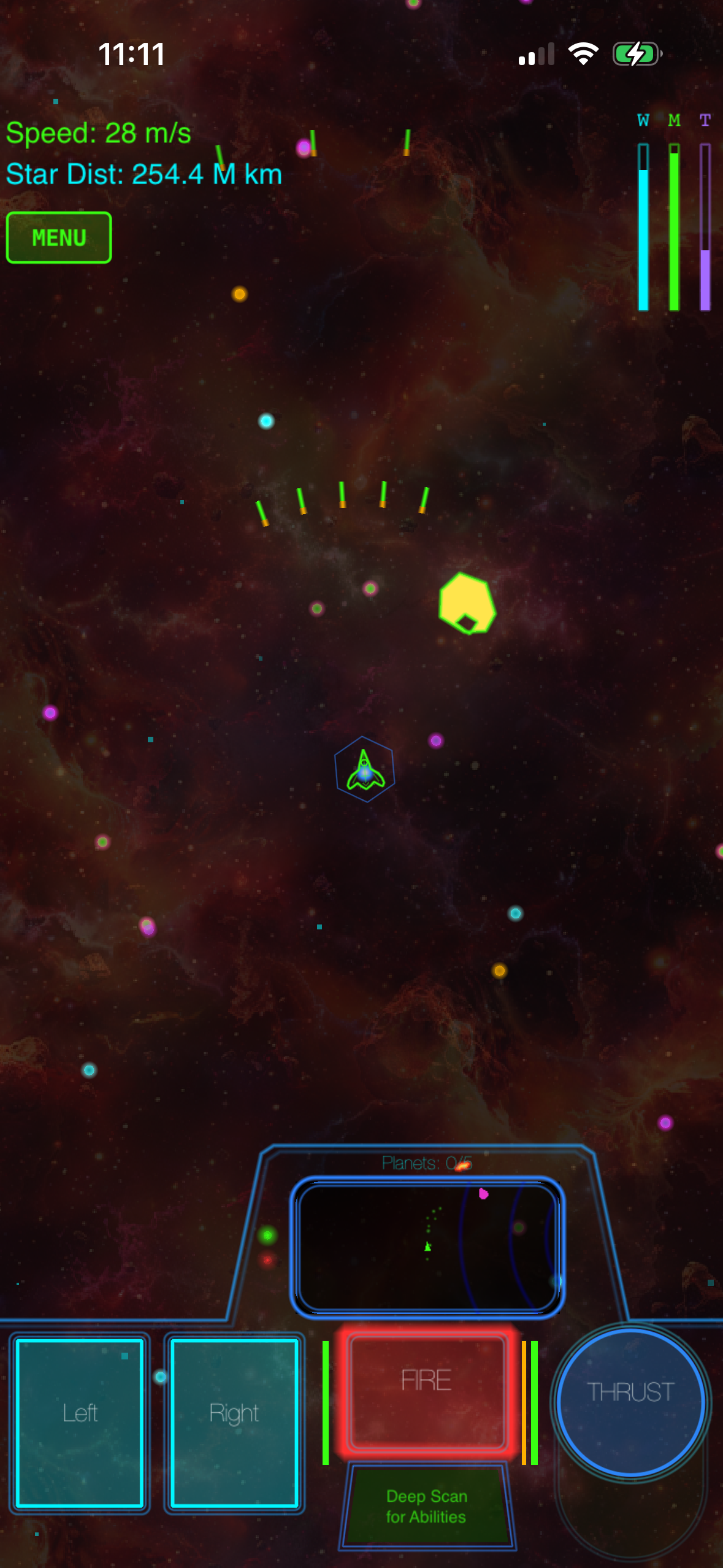
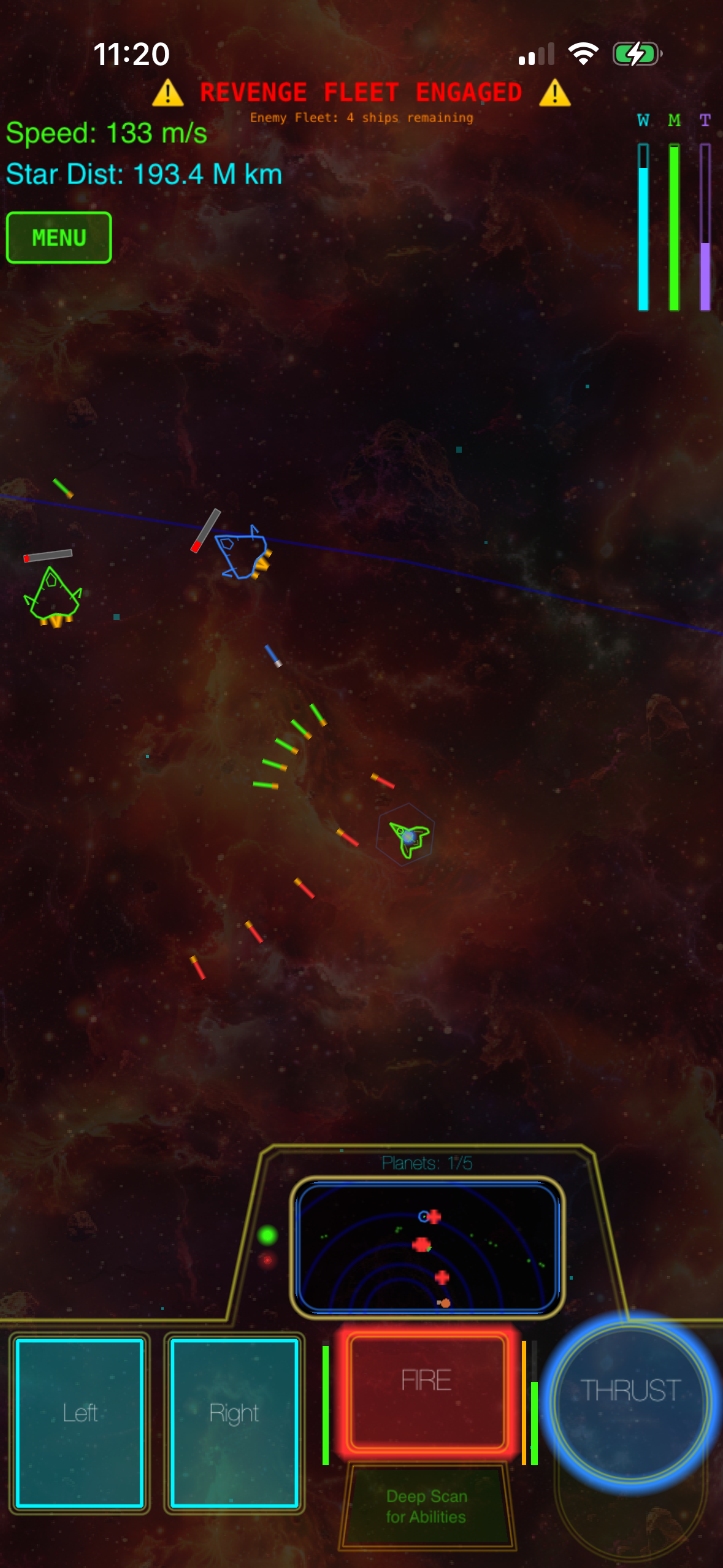
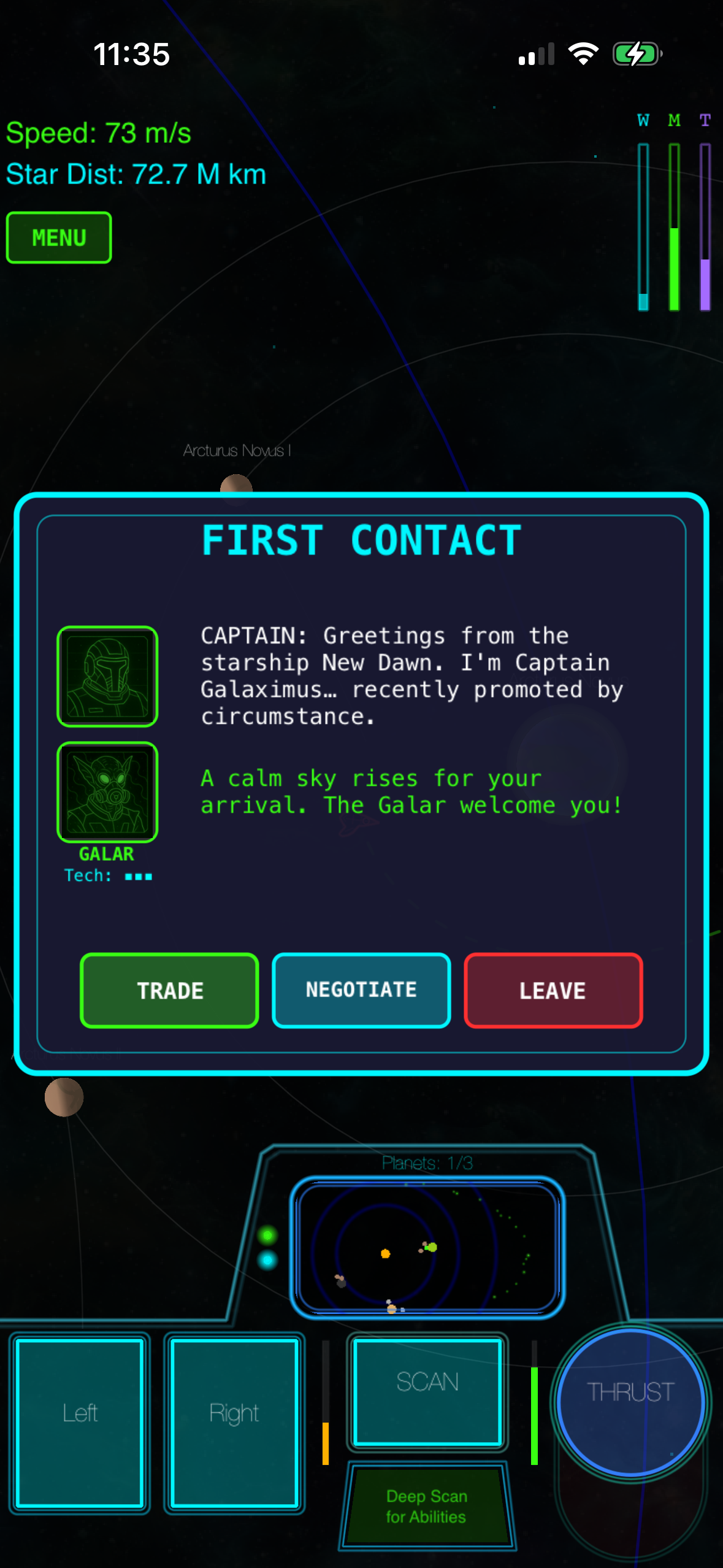
Galaximus is designed from the ground up to make slingshots intuitive without sacrificing accuracy. The ship responds to gravity in real time—every planet, moon, and asteroid in the system affects your trajectory simultaneously. The controls are simple: thrust, rotate, and aim. But the physics underneath is uncompromised.
What makes this work is feedback. Your speed and distance readouts update in real time as you approach a gravity well. The HUD shows you where the planet’s gravity is pulling you. You can see the curve of your trajectory before you commit. New players learn quickly that “aim for the planet’s edge” produces a slingshot; experienced players learn to thread multiple gravity wells in a single maneuver, building speed through a chain of planets.
In Galaximus’s first system, a three-planet chain slingshot can accelerate you from 2,000 m/s to 5,200 m/s without fuel burn. The campaign spans eight procedurally configured star systems, each with unique orbital geometry. One system might have three planets in a tight cluster—perfect for chaining slingshots. Another might have a massive star surrounded by fast-moving moons—requiring precise timing. Procedural generation means every playthrough presents different gravity puzzles to solve.
Get Galaximus on the App Store:
Other iPhone Games That Execute Slingshot Mechanics Well
Galaximus isn’t alone in taking slingshot mechanics seriously. Several other titles on iOS have built games around real gravity:
Kerbal Space Program Mobile – The mobile adaptation of the desktop classic. Kerbal focuses on teaching orbital mechanics through hands-on mission design. Slingshots work exactly as they do in real physics, and the game rewards players who master gravity-assist chains across multiple bodies.
Orbital Mechanics Sandbox – A dedicated gravity-simulation game where you design trajectories and execute slingshot maneuvers against the clock. The physics is uncompromised; the learning curve is steep but the payoff is mastery.
Spaceflight Simulator – A lightweight orbital mechanics game that emphasizes realistic gravity and trajectory planning. Slingshots are core to reaching distant planets efficiently.
Gravity Assist – A puzzle game built entirely around slingshot mechanics. Each level presents a gravity well configuration, and you must plot a course that uses slingshots to reach the goal. It’s slingshot mechanics distilled to their essence.
The key difference between authentic slingshot games and faked-gravity games is predictability. In a real-physics game, you can calculate (or intuit through experience) exactly how fast you’ll be going after a maneuver. In a faked-gravity game, the acceleration is scripted—you get a speed boost when you pass through a certain zone, but the boost amount is arbitrary. That breaks the feedback loop that makes slingshots fun.
The Physics-vs.-Accessibility Tradeoff
Here’s where the honest tension lives: real slingshot mechanics require real physics, and real physics has a learning curve.
Games that model orbital mechanics faithfully demand that players internalize how gravity works. You need to understand that a fast approach at a shallow angle produces a different result than a slow approach at a steep angle. You need to predict where your ship will be three seconds from now, given the current velocity and the planet’s pull. That’s not intuitive for most players. It takes practice.
Games that simplify gravity can onboard players faster. The rules are more forgiving. Slingshots still exist, but they’re more like “bonus mechanics” than the core navigation tool. Players can succeed without mastering them.
Neither approach is wrong. It depends on what the designer wants the game to be. Kerbal Space Program leans hard into the simulation—it wants to teach you orbital mechanics as if you were an aerospace engineer. Galaximus leans into arcade action—it wants you to feel gravity as an engine you can master in an afternoon, then spend hours refining your technique.
Why Slingshot Mechanics Are Rare on Mobile
You’d think slingshot mechanics would be everywhere on iPhone by now. They’re fun, they’re based on real physics (which is inherently interesting), and they create emergent gameplay. So why are they scarce?
Processing power. A real-time gravity simulation where every body affects every other body requires constant math. On desktop, that’s trivial. On iPhone, it’s a constraint. Most games compromise: they simulate gravity for the player’s ship and a few key bodies, but not for every asteroid or particle. That’s fine; it’s still real physics. But it’s a tradeoff.
Design complexity. Slingshot mechanics are hard to balance. Too easy, and they’re not rewarding. Too hard, and new players bounce off. Most mobile game designers avoid the problem by removing gravity from the core loop entirely—it’s a visual effect, not a mechanic. That’s safer. It’s also less interesting.
Monetization friction. Free-to-play games (which dominate mobile) need to create friction to justify ads or in-app purchases. Real physics-based slingshots are too efficient—a skilled player can solve problems without spending. So F2P games nerf slingshots, add timers, or gate the fuel that powers them. The mechanic survives, but it’s compromised. Premium games (like Galaximus) don’t have this problem. You paid once; you own the full mechanic.
How to Master Slingshot Maneuvers in Practice
If you’re playing a space game with real slingshot mechanics, here’s what separates casual passes from expert ones:
Approach angle determines speed gain. A 30-degree approach angle at 1,500 m/s produces approximately a 40% speed gain; a 10-degree approach at the same speed produces roughly 65%. Shallow approaches (skimming the planet’s edge) give wider curves and more speed. Perpendicular approaches give sharp curves but less acceleration. Experienced players use shallow approaches to chain multiple slingshots in one maneuver.
Timing is everything. If the planet is moving (and in a real orbital system, it is), your approach angle changes as the planet moves. A slingshot that works perfectly at one moment might miss or crash if you’re a few seconds late. That’s why procedural generation is powerful—it creates new gravity puzzles every playthrough.
Fuel efficiency is the hidden strategy. A direct burn to your destination might be faster, but a slingshot route uses less fuel. In games where fuel is limited (like Galaximus), this becomes the core decision: do you go fast or go far? The answer is often “use gravity to do both.”
FAQ
What’s the difference between a gravity-assist and a slingshot? They’re the same thing. “Gravity-assist” is the technical term; “slingshot” is the colloquial name. Both refer to using a body’s gravity to accelerate your ship.
Which free-to-play space games have real slingshot mechanics? Very few. Most F2P space games compromise slingshot mechanics to create monetization friction. Orbital Mechanics Sandbox and Gravity Assist offer real slingshots, but they’re premium or ad-supported. Free-to-play games tend to fake gravity or gate it behind timers.
Is a slingshot mechanic the same as orbital mechanics? Not quite. Orbital mechanics is the broader physics system—how bodies orbit, how gravity curves trajectories, how momentum works. A slingshot is one specific maneuver within that system. A game can have orbital mechanics without emphasizing slingshots (like a game where you just orbit planets and scan them), or it can make slingshots the primary mechanic (like Galaximus).
Can I learn real orbital mechanics by playing space games with slingshot mechanics? Yes, to a point. You’ll develop an intuitive feel for how gravity affects motion, which is the hardest part of understanding orbital mechanics. You won’t learn the math or the engineering precision of something like Kerbal Space Program, but you’ll understand the why behind maneuvers.
Are slingshot mechanics only for hard-core players? Not necessarily. It depends on how the game teaches them. Galaximus is designed so new players learn slingshots in their first few minutes of play—the feedback is immediate and satisfying. Harder games (like Kerbal) have a steeper learning curve. Both can work; it’s about design intent.
Why would I use a slingshot instead of just burning fuel in a straight line? Fuel efficiency, mostly. A slingshot is free speed. In games where fuel is limited, slingshots let you reach distant targets without running empty. In games where fuel is unlimited, slingshots are still faster than straight burns—they let you build momentum without engine strain. And they’re fun—the physics feedback is satisfying.
The Slingshot Mechanic as a Design Philosophy
Slingshot mechanics represent something larger: a commitment to making physics playable. Instead of hiding the math behind menus and UI, real slingshot games put gravity in your hands. You don’t read an orbital equation; you feel it as your ship accelerates around a planet.
That philosophy extends beyond slingshots. Games that model real gravity tend to model other physics faithfully too—momentum, inertia, collision dynamics. The result is a game world that feels coherent, where cause and effect are direct and visible. You’re not managing stats; you’re piloting a ship through a physical space.
If you’ve been searching for a space game on iPhone where slingshot mechanics are central, where gravity is the engine you learn to master, Galaximus is built for exactly that. The campaign spans eight systems with unique orbital geometry, each playthrough generates different gravity puzzles, and the controls are designed so the learning curve is real but achievable.
Get Galaximus on the App Store: