Best Offline Space Games for iPhone 2026
 by Galaximus

Photo by Alessandro Ferrari on Unsplash
Best Offline Space Games for iPhone in 2026
Offline space games on iPhone solve a real problem: reliable play without server dependency. Whether you’re on a flight, in a subway, or in an area with spotty coverage, these games work completely disconnected. No energy timers. No ads. No live-service patches that change mechanics mid-campaign.
This article reviews premium offline space games available on iOS, including Galaximus (which we developed). We’ve disclosed our connection to Galaximus and evaluated it alongside competitors on the same criteria: physics model, campaign structure, offline functionality, and pricing.
Why Offline Space Games Matter on iPhone
Offline games eliminate several friction points in mobile gaming:
- No server latency: Physics calculations happen on your device in real time, with no network delay affecting timing-sensitive maneuvers.
- No connectivity gates: Features don’t require internet. You play the complete game anywhere.
- Stable mechanics: Physics behavior doesn’t drift between sessions due to server updates or sync issues.
- Ownership: You buy once and own the game indefinitely. No subscription required.
For space games specifically, offline design supports deliberate, physics-based play. You’re not rushing through content to hit daily streaks; you’re learning how gravity responds to your inputs.
Galaximus: A Case Study in Offline Space Flight
Disclosure: We built Galaximus. This section reflects our design choices and is presented as a first-person case study, not an objective comparison.
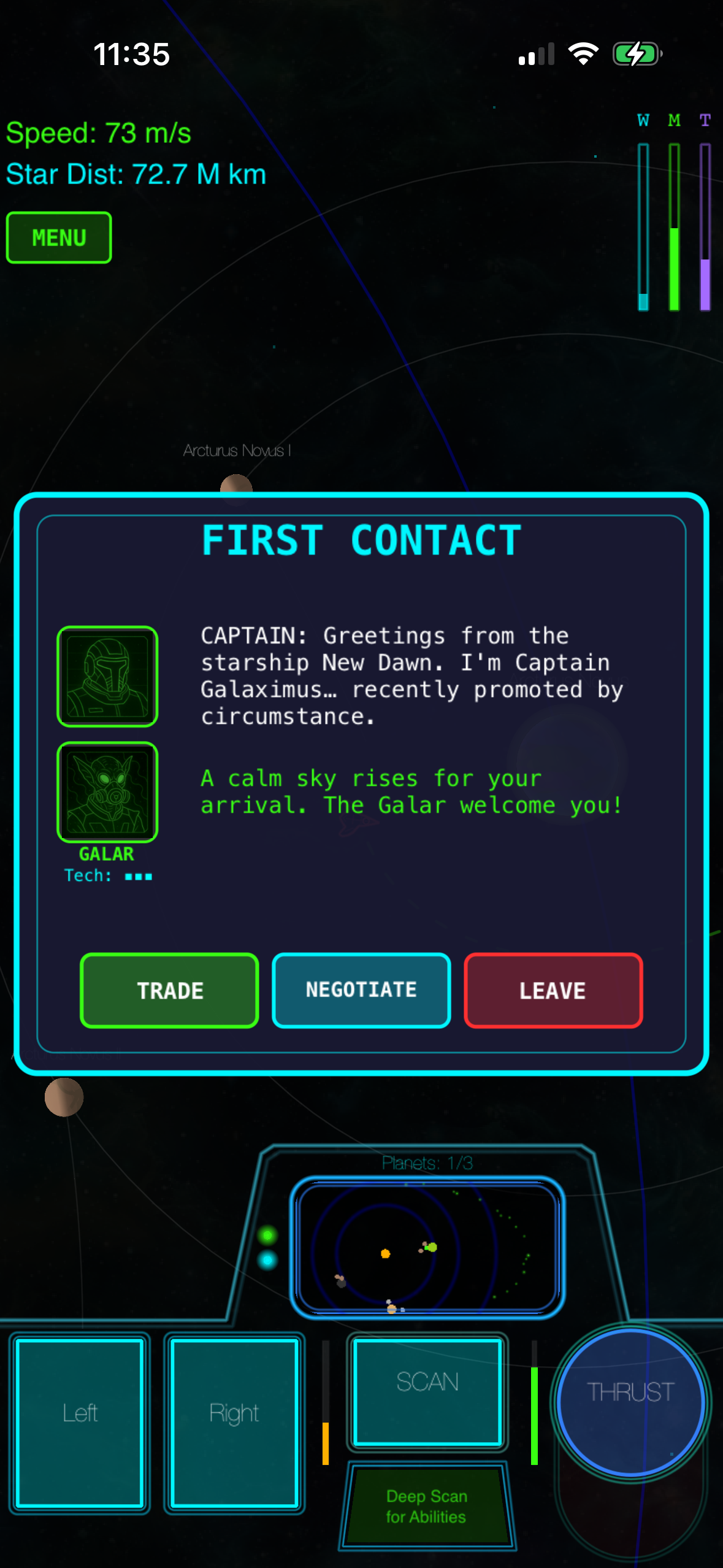
Galaximus is a premium offline space exploration game priced at USD at launch. The campaign spans eight procedurally configured star systems with a narrative arc. Each playthrough generates unique planet positions and anomaly placements, so replays feel spatially different while following the same story structure.
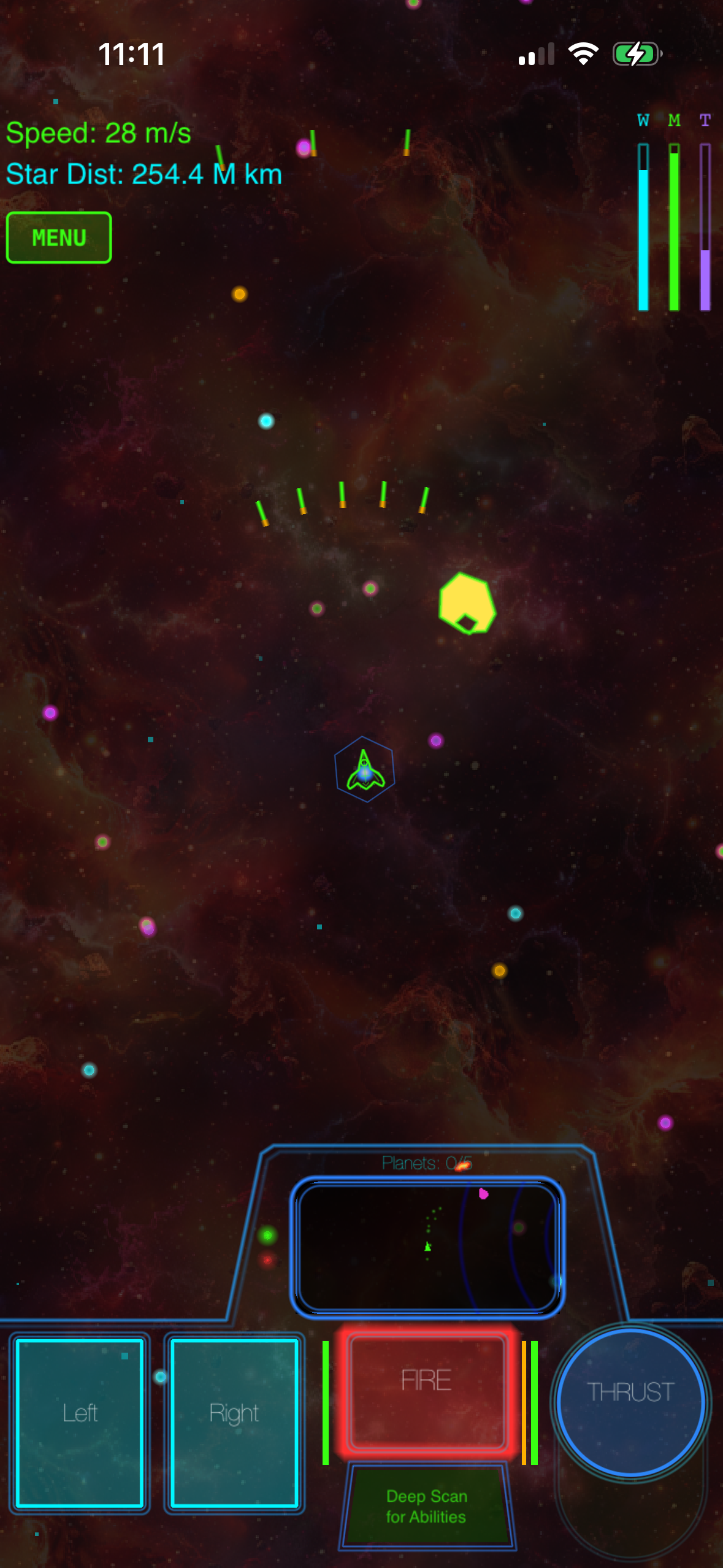
Physics model: Galaximus uses actual orbital mechanics. Planets orbit suns, moons orbit planets, asteroids tumble through gravity wells. Your ship responds to gravity as a force, not a visual effect. We modeled this using a Newtonian n-body physics engine, similar in principle to Kerbal Space Program’s approach but simplified for real-time mobile performance. The core mechanic—using a planet’s gravity well as a free speed boost (a slingshot maneuver)—becomes intuitive after focused practice.
Learning curve: The game has a steeper initial barrier than casual space games. Within 30 minutes of focused play, the slingshot mechanic typically clicks for players willing to experiment. After that, the physics becomes intuitive. This is a deliberate design choice: we prioritized depth over immediate accessibility.
Campaign structure: Eight systems, 11 anomaly types (spacetime rifts, derelict ships, distress beacons, combat encounters, exploration puzzles, dialogue-driven first contacts). Full narrative arc with beginning, middle, and ending. Entirely playable offline.
Expansion: Galaximus Infinitum (open-galaxy sandbox, planetary surface exploration, faction warfare) launches late 2026. Players who purchase at the current tier receive Infinitum free; after launch, the combined game moves to.
Storage: ~450 MB download. Runs on iPhone 11 and later; iOS 15.0 minimum.
Get Galaximus on the App Store: https://apps.apple.com/app/galaximus/id6739284561
Other Offline Space Games Worth Considering
Kerbal Space Program (Desktop; mobile version discontinued) - Physics: Newtonian orbital mechanics with full rocketry simulation - Focus: Vehicle assembly, fuel management, engineering depth - Accessibility: Steep learning curve; designed for players who want to understand rocketry - Offline: Yes, once downloaded - Price: (desktop); mobile version no longer available on App Store - Best for: Players who want to design and build rockets, not just pilot them
No Man’s Sky (iOS via Apple Arcade) - Physics: Simplified gravity; focus on exploration over orbital mechanics - Focus: Procedural planet exploration, base building, survival - Accessibility: Lower barrier to entry; pick-up-and-play sessions possible - Offline: Yes, once downloaded via Arcade - Price: Included in Apple Arcade subscription (~/month); no standalone purchase - Best for: Players who want exploration variety and sandbox freedom over physics depth
Asteroids (Various developers; multiple versions on App Store) - Physics: Arcade-style inertia; not realistic orbital mechanics - Focus: Quick arcade sessions, score chasing - Accessibility: Immediate; 5-minute play sessions - Offline: Yes - Price: Free to depending on version - Best for: Players who want fast, simple space action without learning curves
Apple Arcade Space Titles (Lunar Lander variants, space exploration games) - Physics: Varies by title - Focus: Varies; includes arcade, puzzle, and light exploration games - Accessibility: Generally high - Offline: Yes, once downloaded - Price: Included in Apple Arcade subscription (~/month) - Best for: Players already subscribed to Arcade who want variety without per-game purchases
Offline Gameplay and Procedural Design
A common misconception: offline games are static. Galaximus uses procedural generation to create replay incentive while maintaining authored narrative. The story structure is fixed (same eight systems, same plot beats), but spatial elements—planet positions, moon counts, asteroid fields, anomaly locations—are unique per playthrough. You’re learning principles, not memorizing solutions.
This approach also keeps file sizes manageable. Galaximus doesn’t require gigabyte downloads or constant streaming. The game is lean and respects device storage.
Premium Offline vs. Free-to-Play
Free-to-play space games on iOS typically use energy timers (wait hours to play again), battle passes, or cosmetic IAP. The monetization model fragments the experience: you’re playing what the monetization team allows in that session, not what the designer intended.
Premium offline games eliminate these gates. No energy timers. No “come back tomorrow” friction. The game you bought is the game you play, complete and uninterrupted. The tradeoff is higher upfront cost ( vs. free entry), but lifetime value is better: you’re not spending money on refills or extensions.
Offline Means Consistent Physics
Offline games guarantee physics consistency. In online-multiplayer games, server latency can cause position desync, forcing the game to choose between local and server-authoritative positions. Offline games have no such problem. Physics runs on your device, in real time, consistently. Your slingshot maneuver behaves the same way every time because there’s no network variable affecting it.
For a game where gravity is the core mechanic, this consistency is essential. You’re learning a precise skill—timing your approach so gravity does the work. If physics felt different between sessions, the skill wouldn’t transfer. Offline architecture guarantees it does.
FAQ
What storage space does Galaximus require? Approximately 450 MB for the full game download. Save data adds minimal additional storage (~5 MB per save file).
What’s the minimum iOS version for Galaximus? iOS 15.0 or later. Compatible with iPhone 11 and newer models.
How does Galaximus’ physics compare to Kerbal Space Program? Both use Newtonian orbital mechanics, but with different scope. KSP models full rocketry—you assemble vehicles, manage fuel, and learn propulsion engineering. Galaximus uses orbital mechanics but focuses on piloting a pre-built ship and learning gravity-based flight. KSP is deeper on engineering; Galaximus is faster to pick up and more action-oriented.
Will my save data persist if I uninstall Galaximus? Offline games store saves locally on your device. Uninstalling and reinstalling preserves saves (they’re in the app’s local storage). Deleting the app and its data permanently removes saves; there’s no cloud backup since the game is offline-only.
If I buy Galaximus now, do I get the Infinitum expansion free? Yes. Players who purchase at the current launch tier receive Galaximus Infinitum free when it launches in late 2026. After Infinitum ships, the combined game moves to, so early buyers get the expansion at no additional cost.
Can I play these games on older iPhones? Most premium offline space games run on older hardware. Galaximus requires iPhone 11+; Kerbal Space Program (desktop version) requires a computer; No Man’s Sky via Arcade requires iPhone 12+. Check individual App Store listings for minimum requirements.
What’s the difference between buying Galaximus and playing space games via Apple Arcade? Galaximus is a one-time purchase; you own it indefinitely. Apple Arcade is a subscription (~/month) that includes multiple games but requires ongoing payment. If you want to own a single game outright, Galaximus is cheaper long-term. If you want variety across many titles, Arcade may offer better value.
Offline Space Games Are Complete Games
Offline premium space games prove that the ownership model still works on iOS. No ads. No energy timers. No battle pass. Just a complete game you can play anywhere, anytime, without a connection.
If you’re looking for a space exploration game that respects your time and doesn’t fragment the experience through monetization, offline-first design is the signal to look for.
Get Galaximus on the App Store: https://apps.apple.com/app/galaximus/id6739284561