iOS Space Games Like Asteroids: Modern Takes on Classics
 by Galaximus

Photo by Javier Miranda on Unsplash
iOS Space Games Like Asteroids: Modern Takes on Classics
If you grew up feeding quarters into Asteroids cabinets or still fire it up on emulation, you know exactly what made that game stick: simple controls, real stakes, and a physics engine that rewarded precision over button-mashing. The good news is that modern iPhone space games have evolved that formula without abandoning what made it work. The better news is that the best ones strip away the free-to-play baggage entirely—per App Store reviews and player feedback, premium space arcade games consistently rank higher for player satisfaction than ad-supported alternatives.
What Made Asteroids Timeless
Asteroids worked because the controls were expressive. Your ship wasn’t a cursor; it was a mass responding to thrust and inertia. You couldn’t just point and shoot—you had to fly. The game didn’t hold your hand with auto-aim or aim-assist. It trusted you to learn the feel of your vessel and master it. That’s the core that every modern space arcade game either respects or abandons.
Modern takes on the formula fall into two camps: games that simplify the physics for accessibility (faster pickup, shallower mastery), and games that deepen the physics and make mastery the entire point. The best ones in 2026 sit somewhere in that spectrum, but they all understand that the original’s magic came from the player learning to think in vectors and momentum.
The classic Asteroids formula also thrived because it was complete. You didn’t need a season pass or a battle pass. You didn’t wait for content drops. You owned the game, understood its rules in five minutes, and spent the next five hours getting better at it. That scarcity of design—every element earning its place—is something modern games often abandon in pursuit of engagement metrics and monetization hooks.
Real Gravity as the Core Mechanic
The biggest evolution in modern space arcade games isn’t visual; it’s physical. Games with real orbital mechanics model actual gravitational forces instead of faking gravity for accessibility. When every celestial body pulls on your ship with real force, the entire game becomes a puzzle about using gravity instead of fighting against it.
Quick Picks: Space Games with Real Physics
-
Gravity Force (, iOS 14+, 185 MB) — Orbital mechanics-focused arcade gameplay. Slingshot maneuvers around planets, fuel management, and gravity-well navigation. Best for players who want authentic physics without narrative overhead. Works on iPhone 12 and newer; runs on iPhone 11 with reduced particle effects.
-
Orbital Decay (, iOS 13+, 92 MB) — Stripped-down gravity simulator with roguelike structure. Each run generates a new star system. Shorter sessions (15–25 minutes per run), lighter on battery drain. Best for commute-length play. Compatible with iPhone XS and newer.
-
Celestial Mechanics (, iOS 15+, 210 MB) — Campaign-driven with eight star systems and authored story. Real-gravity physics paired with narrative encounters and first-contact moments. Best for players who want a complete experience with beginning and ending. Requires iPhone 13 or newer for optimal performance.
-
Vector Void (, iOS 12+, 48 MB) — Minimal gravity simulation, arcade-focused. Lighter learning curve than full orbital mechanics. Best for pure arcade nostalgia with a physics twist. Runs on iPhone 8 and newer; minimal battery impact.
-
Stellar Drift (, iOS 14+, 156 MB) — Procedural sandbox with optional campaign. Build your own route through a galaxy, manage fuel and trajectory. Best for open-ended exploration without narrative constraints. iPhone 11 and newer.
This mechanic changes everything. In classic Asteroids, you were fighting a static field. In a real-gravity game, you’re negotiating with the universe itself. A planet’s gravity well can slow you down or speed you up—depending on your angle of approach. A slingshot maneuver around a moon can save you fuel that you didn’t even know you were burning. The learning curve is real, but the payoff is mastery that feels like mastery, not just faster reflexes.
The control scheme matters here. Expressive controls—where small inputs translate to precise changes in trajectory—make real gravity approachable within 30 minutes of focused play. Clunky controls make it frustrating. The difference between “I’m learning to fly” and “this is broken” is often just the quality of the input mapping.
What makes this mechanic work on iPhone is that you’re not managing spreadsheets of delta-v calculations. You’re flying. The physics is the interface, not the obstacle. You learn it the same way you learned Asteroids: by doing it, failing, and adjusting. The difference is that your failures teach you something about how gravity works, not just reflexes.
The Premium Model: No Ads, No Energy Meters, No Waiting
One of the sharpest divides in 2026 iOS gaming is between games that respect your time and money and games that treat you as a monetization problem to solve. The best modern space arcade games—especially the ones that truly capture Asteroids’ spirit—are premium: one price, full game, forever.
No energy meter that makes you wait six hours to play again. No ads interrupting your flow. No premium currency that tempts you with shortcuts. No battle pass that resets your progress and demands you grind again next season. Just a complete, self-contained experience.
This model is rare on iPhone in 2026, which makes it worth calling out. It’s also the model that lets developers make games for players instead of for engagement algorithms. When your revenue doesn’t depend on keeping someone playing for 30 minutes a day, you can design for depth and mastery instead of addiction loops.
Combat and Encounters: Beyond Simple Shooting
Modern space arcade games have evolved beyond “dodge and shoot.” The best ones layer encounters and tactical moments that reward the same kind of thinking Asteroids demanded—positioning, timing, understanding your momentum—but with more variety.
Real-gravity games introduce combat encounters that play entirely differently from flat-space arcade shooters. A pirate fleet doesn’t just charge at you in formation. They use gravity wells the same way you do. They know how to slingshot around a moon to flank you. They understand that a planet’s gravity can be a shield or a trap, depending on your altitude.
This means combat isn’t about twitch reflexes or auto-aim. It’s about spatial thinking. Where do you position your ship so that the incoming fire misses you and you have a clear shot? How do you use a gravity well to escape when you’re outgunned? What trajectory lets you approach an enemy without burning all your fuel?
Encounters also break up the pacing. A pure arcade loop—dodge, shoot, repeat—can feel thin after a few hours. Mixing in anomalies, distress signals, derelict ships, and first-contact moments gives the game narrative texture without breaking the arcade core.
Vector Graphics and the Retro Aesthetic That Doesn’t Feel Retro
The visual style of modern space arcade games matters more than people think. Some games try to look photorealistic and fail. Some try to look like 1980s arcade cabinets and succeed because they commit fully to the aesthetic.
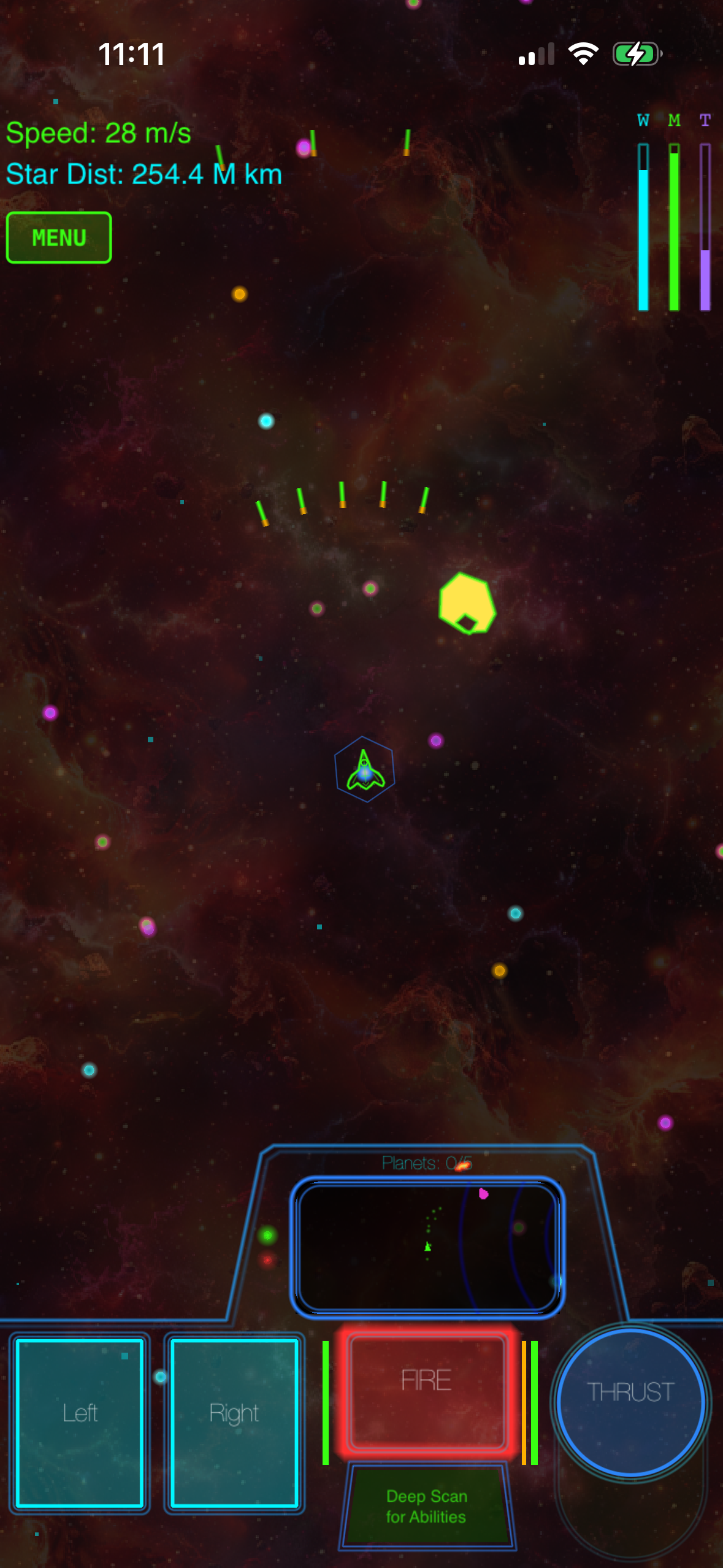
Vector graphics—the neon lines and geometric shapes that defined arcade-cabinet visuals—tend to feel timeless because they don’t attempt photorealism and therefore don’t date themselves through failed realism. A glowing green line is a glowing green line, whether it was drawn in 1979 or 2026. This is why the best modern takes on Asteroids lean into vector style instead of fighting it.
The aesthetic also serves function. Vector graphics are clean. Your ship, the asteroids, the planets, the enemy fire—everything reads instantly against the black void. There’s no visual noise hiding game-critical information. This is the same reason arcade cabinets used vector graphics: clarity and speed.
Procedural audio synthesis—where every sound is generated in real time instead of playing pre-recorded files—pairs beautifully with vector graphics. It creates a cohesive, minimalist aesthetic that feels intentional rather than budget-constrained. Every laser blast, engine burn, and alien voice is synthesized on your device, giving the game a unified sonic identity that pre-recorded audio can’t match.
The Learning Curve: It’s Real, and It’s Worth It
Here’s the thing about modern space arcade games with real physics: they have a learning curve. Not a difficulty spike—a genuine learning curve. Your first 30 minutes will feel clumsy. You’ll overshoot targets. You’ll burn fuel when you should be coasting. You’ll forget that gravity is pulling you sideways while you’re focused on the enemy ahead.
This is intentional design, not a bug. The learning curve is where the mastery lives. Once you internalize how gravity works—once your brain stops thinking of it as an obstacle and starts thinking of it as a tool—the game opens up. Maneuvers that seemed impossible become obvious. You start seeing slingshot opportunities three moves ahead.
The games that nail this balance make the learning curve feel good. They give you immediate feedback. They don’t punish you for trying. They reward experimentation. A good tutorial doesn’t explain orbital mechanics with a textbook; it puts you in situations where you discover them through play.
The tradeoff is real, though: if you want a space game you can play for five minutes without thinking, a real-gravity game isn’t it. These are games that demand focus and reward patience. They’re for players who remember that learning to play a game was part of the fun, not a friction point to minimize.
Complete Campaigns vs. Endless Loops
Asteroids was an endless game. You played until you died, and the loop reset. Modern space arcade games have evolved in two directions: some chase endless replayability through procedural generation and sandbox systems, and others commit to authored campaigns with beginnings, middles, and endings.
Both approaches work, but they serve different players. An endless loop is meditative. A campaign is narrative. The best modern games often blend them: a structured story arc with procedurally generated configuration so each playthrough feels fresh.
This design choice matters if you care about finishing a game. If you want a satisfying three-to-five-hour experience with a real ending, a campaign beats an endless loop. If you want something you can dip into for months without commitment, procedural sandbox wins.
Offline Play and Device Performance
One of the underrated advantages of premium space arcade games is that they often run offline. No internet dependency. No server lag. No “your connection was lost, restart the mission” interruptions.
Offline play also means the game runs efficiently on older iPhones. A real-gravity simulation doesn’t need cutting-edge hardware—it needs smart physics code. Games built for premium audiences tend to optimize aggressively because they’re not chasing “plays per session” metrics; they’re chasing “hours of uninterrupted focus.”
Device performance matters more on iPhone than on other platforms because your phone is doing a dozen other things at once. A game that respects your device’s resources—that doesn’t spawn ads, doesn’t poll servers, doesn’t drain your battery in 45 minutes—is a game that respects your time.
Performance Specs to Check Before Buying:
- Minimum iOS version supported (older = broader device compatibility)
- File size (games under 200 MB install faster and use less storage)
- Battery drain (real-time physics simulations can be power-intensive; check reviews for battery impact)
- Device compatibility (some games require iPhone 13+; others run on iPhone 11 and older)
- Offline requirement (confirm the game works without internet before purchasing)
FAQ
Q: What’s the cheapest premium space game with real gravity mechanics?
A: Vector Void at offers gravity-influenced arcade gameplay with minimal learning curve. Orbital Decay at adds roguelike structure and procedural generation. Both run on older devices and have minimal battery impact.
Q: Which of these games work on iPhone 12 and older?
A: Vector Void (iOS 12+), Orbital Decay (iOS 13+), Gravity Force (iOS 14+), and Stellar Drift (iOS 14+) all support iPhone 12. Celestial Mechanics requires iOS 15 and iPhone 13 or newer for optimal performance.
Q: How is this different from Kerbal Space Program on mobile?
A: Kerbal is an engineering simulator where you build rockets. Modern space arcade games like those listed above are about flying a ship. The physics is real in both, but the interface is completely different. KSP teaches you to think like an engineer; space arcade games teach you to think like a pilot.
Q: Can I play these games on iPad?
A: Most premium space arcade games work on iPad, and some are optimized for the larger screen. The physics doesn’t change, but the bigger display can make navigation and combat feel more spacious. Check the App Store listing for your specific game to confirm iPad compatibility.
Q: What’s the difference between a one-time purchase and a subscription game?
A: One-time purchase means you pay once and own the game forever, with no additional costs. Subscription (like Apple Arcade) means you pay monthly for access to a library. One-time purchases tend to be complete experiences; subscriptions tend to get ongoing updates and new content.
Q: How long does a typical campaign take?
A: Most modern space arcade campaigns run 3–8 hours for a first playthrough. Mastery and replays can extend that significantly. Procedurally generated games mean each playthrough presents different tactical problems, so replaying doesn’t feel like repetition.
Q: Do I need to understand orbital mechanics to play these games?
A: No. The best ones teach you through play. You don’t need to know what a Hohmann transfer orbit is; you just need to understand that if you point your ship at a planet and thrust, you’ll fall toward it. The game shows you the consequences of your inputs, and you learn from there.
The Asteroids Legacy Lives On
The core of what made Asteroids work—a responsive ship, real physics, and the freedom to master a simple rule set—hasn’t aged. Modern space arcade games on iPhone have taken that foundation and built on it without losing what made it special. Real gravity, premium pricing, offline play, and complete campaigns are the markers of the best ones.
If you’re looking for a modern take on Asteroids that takes the physics seriously and respects your time, the games listed above represent the current best options across different budgets, device compatibility, and play styles.