Premium iPhone Space Games With No Ads or IAP (2026)
 by Galaximus
Premium iPhone Space Games With No Ads or No In-App Purchases
If you want a space game on your iPhone that you pay for once and then own — no banner ads, no energy timer, no premium-currency store, no battle pass — the category exists, it’s just smaller than it used to be. This piece covers what “premium, no ads, no IAP” actually means in 2026, what to look for on a store listing before you pay, and which titles handle the model honestly.
What “no ads, no in-app purchases” really means on the App Store
The App Store’s product page gives you most of what you need before you tap Buy. Three signals matter:
- Price tag, not “Get.” A dollar amount where the install button usually says “Get” means it’s a paid app. “Get” plus an “In-App Purchases” note underneath almost always means free-to-play with a monetization layer.
- The “In-App Purchases” disclosure. Apple is required to list this if any exist. A truly premium title shows no IAP section at all. Some paid games still include cosmetic IAP — read carefully; that’s not always a dealbreaker, but it’s not “no IAP.”
- The age rating sheet → “Unrestricted Web Access” and “Digital Purchases.” If both are absent and there’s no IAP listed, you’re looking at a closed, finished game.
A subtler tell: read the most recent reviews, not the all-time top-rated ones. Free-to-play conversions of formerly-premium games are a common pattern, and the most recent reviews will mention it before the listing copy catches up.
Why the space genre got hit hardest by F2P
Space games are particularly vulnerable to the free-to-play pattern because the genre’s natural progression loops — unlocking ships, upgrading weapons, traveling between systems — map directly onto the things free-to-play designers love to gate. Anecdotal reports from iOS gaming communities suggest “former premium space game went free-to-play” is one of the more common complaints in the category.
The result is that finding a space game on iPhone where you genuinely pay once and own the whole experience now takes more work than it should. The titles that hold the line tend to share a few traits:
- A single developer or small studio with stated philosophical opposition to F2P
- A finished, bounded campaign rather than an open service-game structure
- Distribution through Apple Arcade or a one-time App Store purchase, never a mixed model
- Recent updates that add content rather than monetization hooks
What to look for in any premium iOS space game
These are the criteria that separate honest premium titles from F2P games wearing a price tag:
-
No “In-App Purchases” section on the App Store listing. Non-negotiable. Cosmetic-only IAP is a softer case, but for a true premium experience, look for zero. Example: Kerbal Space Program Mobile is a clean one-time purchase with no IAP layer; by contrast, titles like Star Trek Fleet Command list “Get” plus a long IAP table and are structurally F2P despite the space-game framing.
-
A finished, bounded campaign. Service games with a “Season 1” structure tend to drift toward monetization even when they start premium. Example: Out There: Ω Edition is a paid, bounded roguelike with a real ending; EVE Echoes, even where it offers paid bundles, is built around an open-ended service loop that pulls toward spending.
-
Offline play. If the game needs a server to function, the publisher controls whether you can keep playing it. Example: FTL-style paid titles run fully offline once installed; many “premium” space MMOs require a constant connection and stop working entirely when the publisher sunsets the servers.
-
Honest performance claims. Real physics, not “realistic” physics. The vocabulary on the listing tells you whether the developer respects technical readers. KSP Mobile is upfront about its simplified patched-conic physics; be skeptical of listings that claim “realistic gravity” without specifying the model.
-
Recent updates that add, not extract. Check the version history. Patch notes that mention new content, bug fixes, and device support are good signs. Patch notes that introduce currency systems are the warning shot.
One example: Galaximus
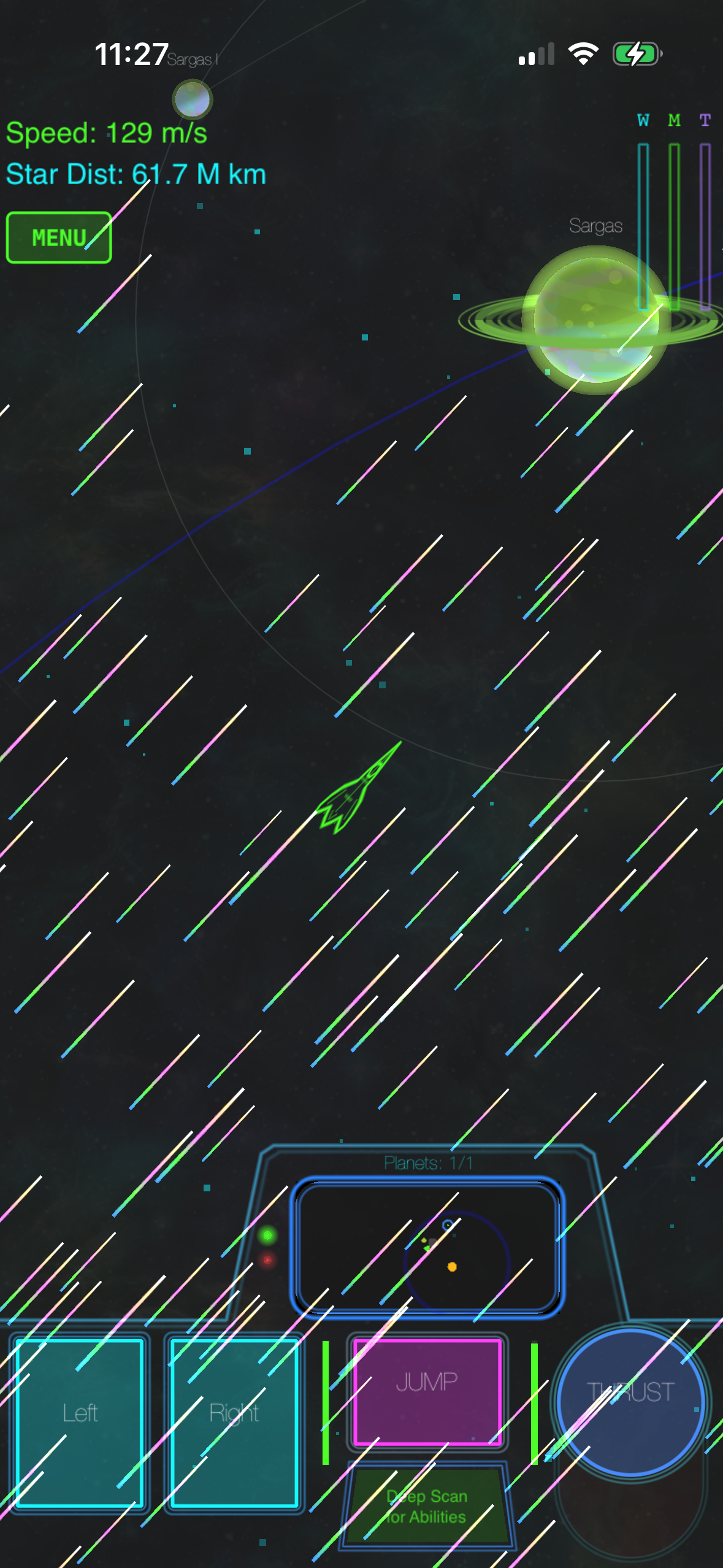
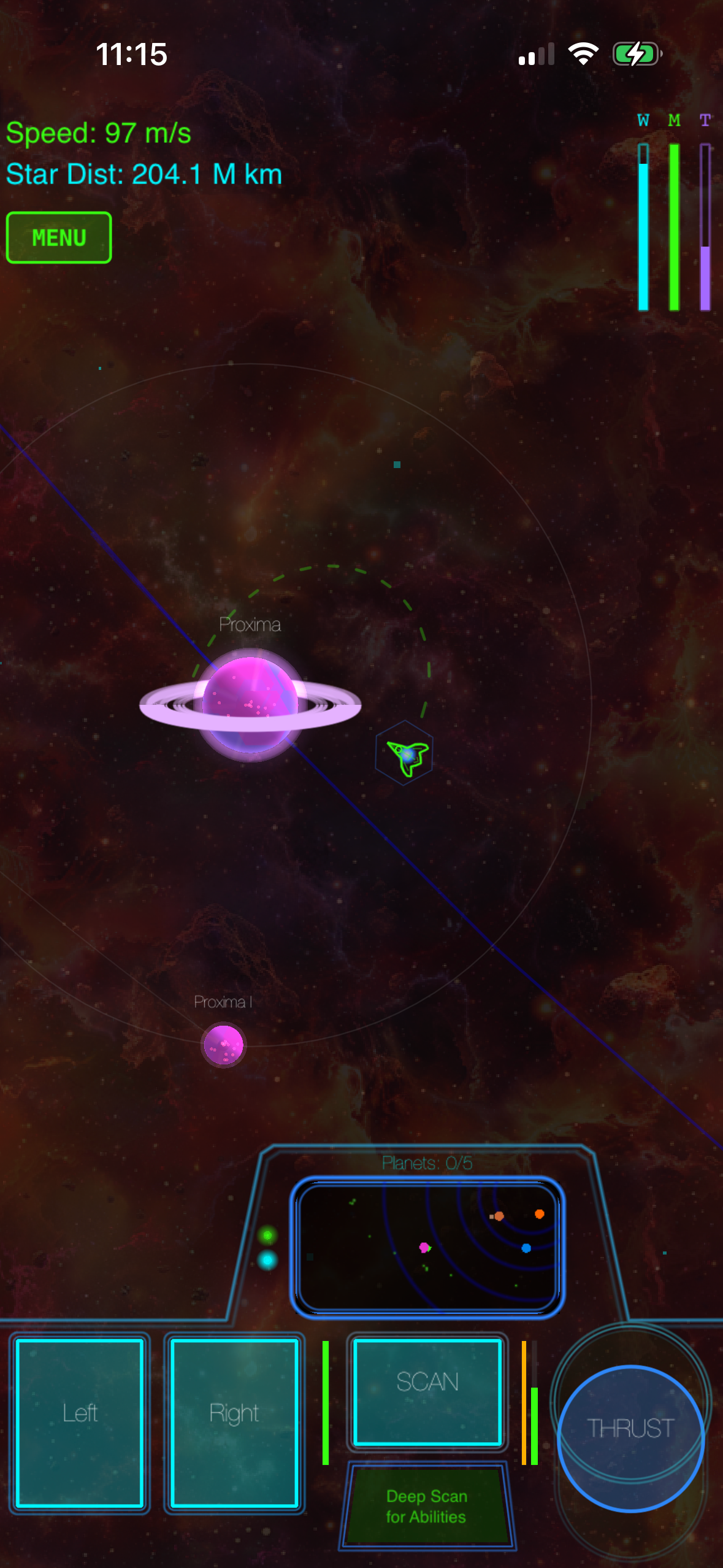
Galaximus is one title that fits the criteria above: one-time purchase, no ads, no IAP, no subscription, offline-capable, with a bounded 8-system campaign. The hook is gravity-driven flight — slingshots around planets, orbital capture, transfer windows — wrapped in an arcade-action shell. There’s a brief learning curve (roughly 30 minutes of focused play) because gravity isn’t a button; it’s a system.
A note on the physics claim, since “real orbital mechanics” gets thrown around loosely: Galaximus runs an n-body integration where every body’s gravity affects every other body each tick, on-device at 60fps on iPhone 12 and newer. That’s a narrower model than Kerbal Space Program’s patched-conics-plus-vehicle-assembly approach (KSP gives you more rocketry depth but resets to two-body simplifications for performance) and well short of what desktop tools like Orbiter simulate. The point isn’t to out-simulate KSP; it’s that slingshots behave consistently because they’re computed, not scripted.
A major expansion (Galaximus Infinitum) is planned for late 2026 and is included as a free upgrade for anyone who buys at the current price tier. After it ships, the price moves up. That’s worth knowing before you buy, but it’s not the whole reason to buy.
Get Galaximus on the App Store:
A note on procedural audio, since the listing mentions it: every sound is synthesized on-device rather than played from sample files. Why it matters in practice: it keeps the install size small, sounds scale naturally with in-game events (an engine burn’s pitch tracks actual thrust, a laser’s timbre varies with charge) instead of triggering one of a handful of pre-recorded clips, and there’s no audio-asset degradation when the same sound plays a thousand times. Whether that’s a buying criterion is taste; it’s a real gameplay-feel difference, not just a spec sheet line.
Other directions worth exploring
If Galaximus doesn’t sound like your fit, a few related reads on the site:
- Best Premium iOS Space Games 2026: No Ads, No IAP — the pillar roundup for this cluster, covering 10+ titles across sub-genres with App Store status notes for each.
- Best Paid Space Games iPhone 2026: No Subscriptions — narrower list focused on one-time-purchase games, explicitly excluding Apple Arcade.
- Single Player Story-Driven Space Games iPhone — narrative-first picks, including Out There and similar bounded-campaign titles.
- iPhone Games Like Asteroids: Modern Space Arcade Games — short-session arcade picks if a learning curve isn’t what you want.
FAQ
Can I refund a premium iPhone game if I don’t like it?
Yes, through Apple’s standard refund process (reportaproblem.apple.com), not the developer. Apple generally honors refund requests made within 14 days of purchase, especially for games played for under an hour or two, though approval is at Apple’s discretion and repeat requests get scrutinized. Developers can’t issue App Store refunds directly, so don’t email them asking — go through Apple.
Do premium space games get abandoned?
Sometimes. A one-time-purchase title with no server dependency keeps working on your device even if the developer stops updating it, which is the main structural advantage of premium-offline over service games. The risk to watch is iOS version compatibility: a game last updated three years ago may stop launching after a major iOS release. Check the “last updated” date and the listed iOS requirement before buying anything that hasn’t seen a patch in 18+ months.
How do I know if a game’s “no IAP” claim is real?
Don’t trust the marketing copy — trust the App Store listing. Scroll to the “Information” section on the product page. If there’s no “In-App Purchases” row at all, there are none. If the row exists, tap it; it lists every purchasable item and price. Listing copy that says “no IAP” while the product sheet shows a “starter pack” is the contradiction to watch for, and the product sheet wins.
Is Apple Arcade the same as “no ads, no IAP”?
Functionally similar from the player’s side — Arcade games have no ads and no IAP — but it’s a subscription model rather than a one-time purchase. If you stop paying for Arcade, the games stop working. If you want to pay once and own a specific game forever, a paid App Store title is the structural fit.
Does Galaximus work offline?
Yes. Once installed,


