Story-Driven Single Player Space Games on iPhone
 by Galaximus
Story-Driven Single Player Space Games on iPhone
iPhone’s App Store has 2,000+ space games; fewer than 20 have a complete narrative arc. Most are arcade loops or endless procedural sandboxes. Finding one that commits to a structured story—with characters, escalation, and a finale—is genuinely rare.
This guide covers what makes story-driven space games work on mobile, how to evaluate them, and which ones are worth your time and money.
Disclosure: We built Galaximus, one of the games discussed below. This article evaluates it alongside competing titles.
What Makes a Story-Driven Space Game Work on Mobile
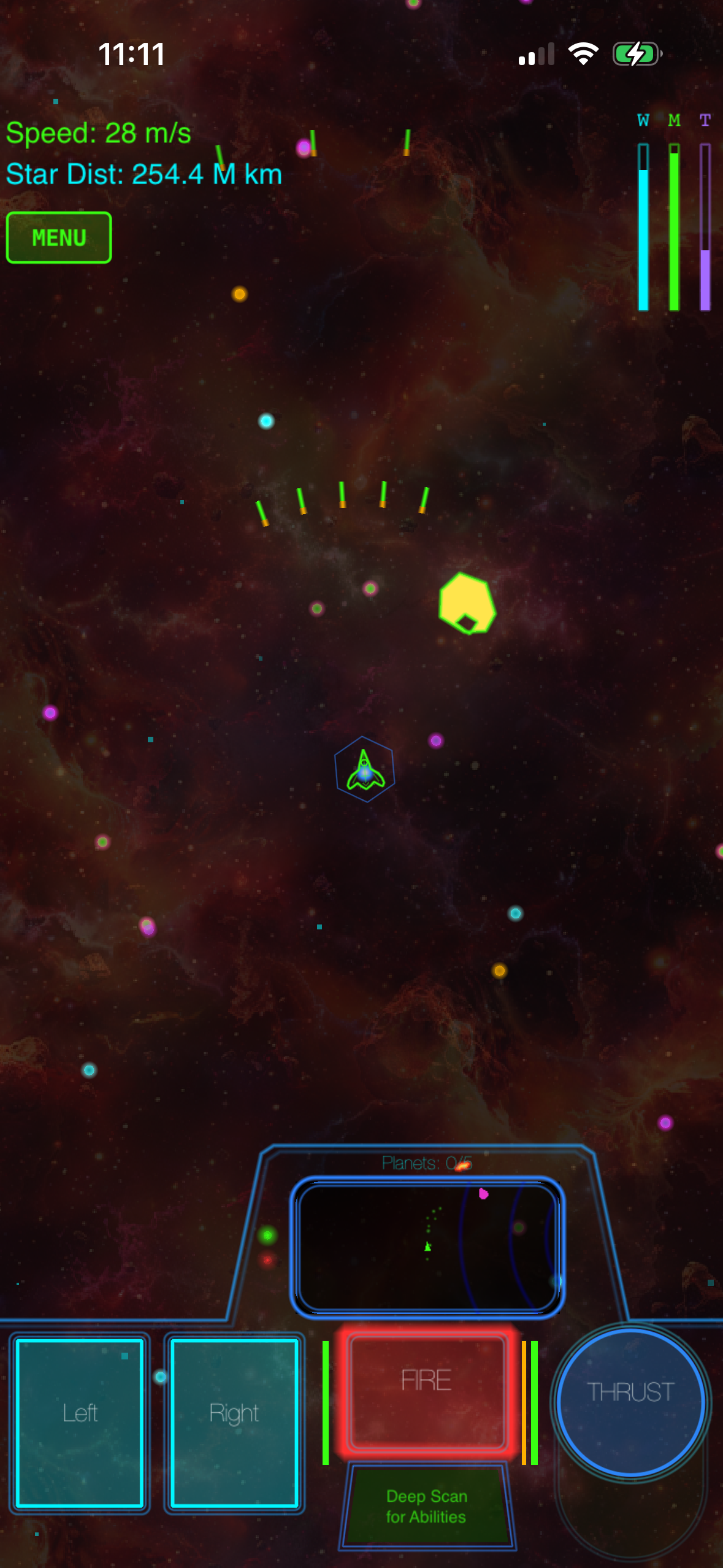
Story and gameplay have to reinforce each other in space games, especially on a screen the size of your palm. The best narrative space games use mechanics to tell the story—your fuel running low as you limp toward a distress beacon, gravity pulling you into an ambush, a first contact where your choice to trade or flee shapes what comes next.
Real-time physics helps here. When gravity is an actual force you navigate, not a visual effect, tension builds naturally. You’re not watching a story unfold; you’re living it through the controls.
Characters also matter. A silent protagonist staring at text boxes doesn’t land the same way on mobile as it does in a 40-hour console RPG. The best story-driven space games use brief, high-impact dialogue—alien captains with personality, distress calls with urgency, mission briefings that set up what’s about to happen.
Campaign Structure vs. Sandbox
Campaign games give you a fixed narrative arc with chapters and escalation. You know roughly where the story is going, but procedural generation changes the obstacles you face on each playthrough. Galaximus follows this model: eight systems, a narrative spine holding them together, and a final encounter that resolves the arc.
Sandbox games let you define the narrative through exploration. The story emerges from what you find and how you interpret it. This feels more open-ended, but it requires more patience—you’re not guaranteed payoff the same way a campaign promises it.
For iPhone specifically, campaigns work better. The smaller screen and shorter play sessions favor narrative momentum over open-ended wandering.
Real Physics as Narrative Tool
In games with faked gravity (most mobile games), physics is window dressing. You tap to move, and the ship goes where you want. The story happens around the gameplay.
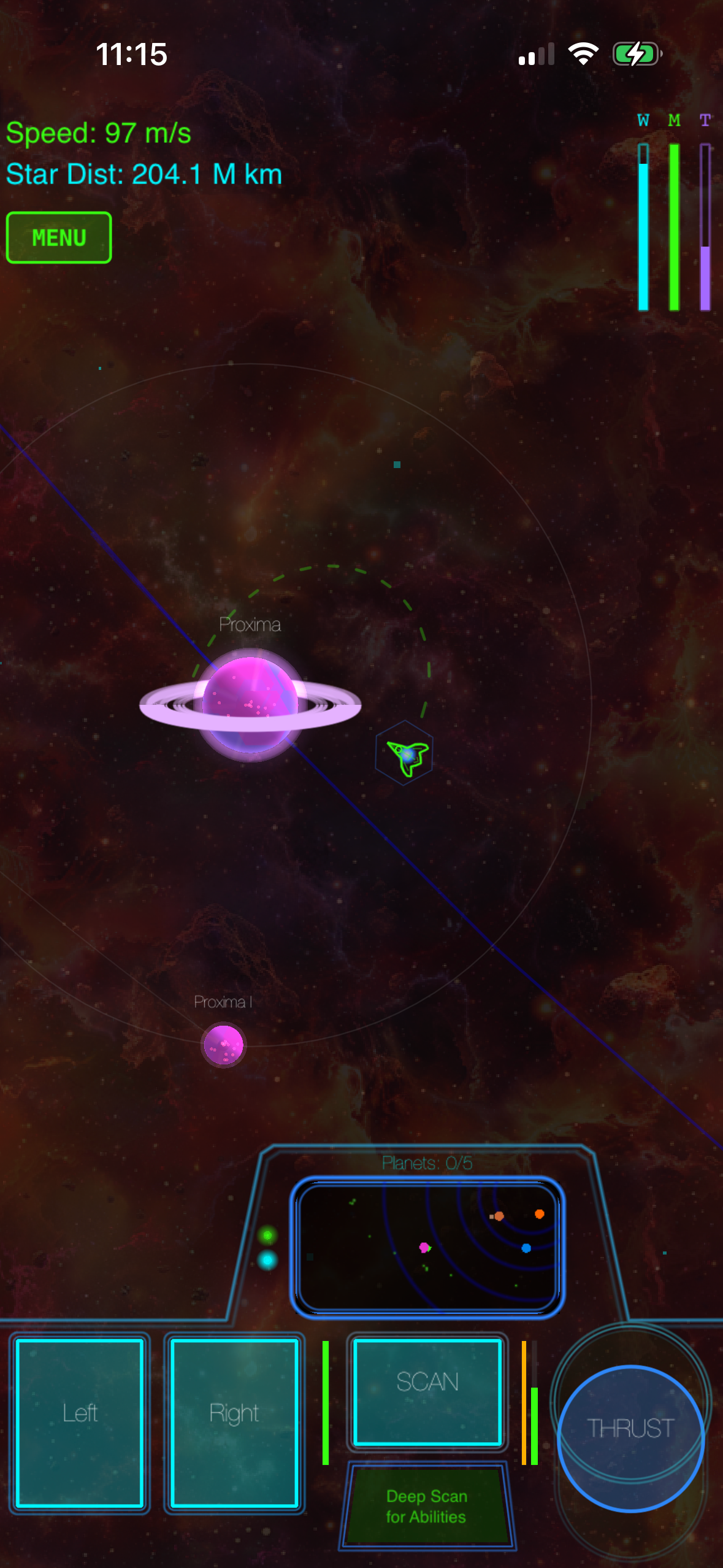
In games with real orbital mechanics, gravity is the interface. Every planet’s gravity affects your trajectory. When a story moment asks you to escape a collapsing star system or slingshot around a black hole to reach a distress beacon, you’re solving the problem with your hands on the controls, not watching a cutscene.
Anomalies and Encounters
The best story-driven space games break their campaigns into discrete encounters—moments that are self-contained but part of a larger arc. On iPhone, each encounter is a 5-to-15-minute play session, which fits how people actually play mobile games.
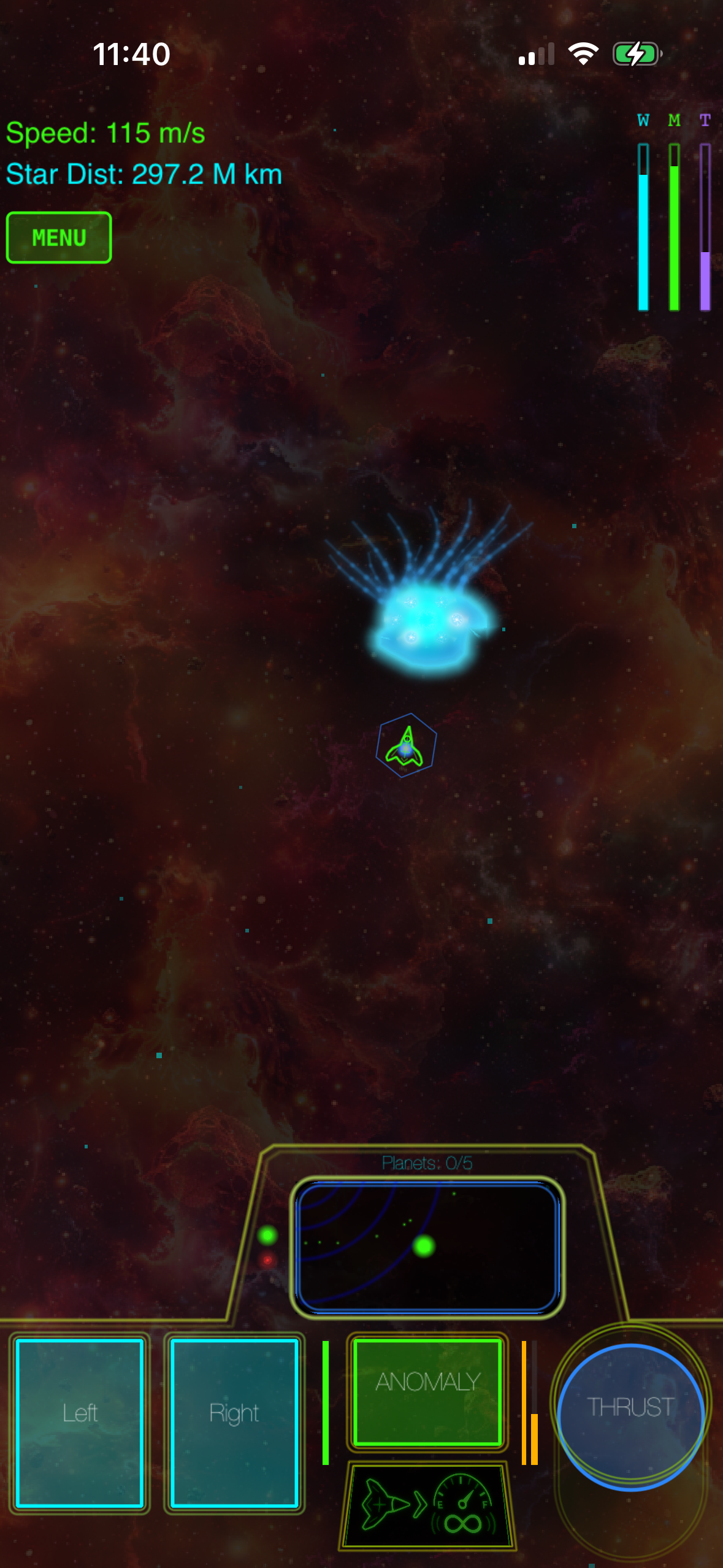
Galaximus uses anomalies as narrative building blocks: derelict ships with recorded messages, spacetime rifts that warp perception, first contacts with alien civilizations, distress beacons from stranded explorers. Each is a mini-story; together, they form the campaign.
Character and Voice
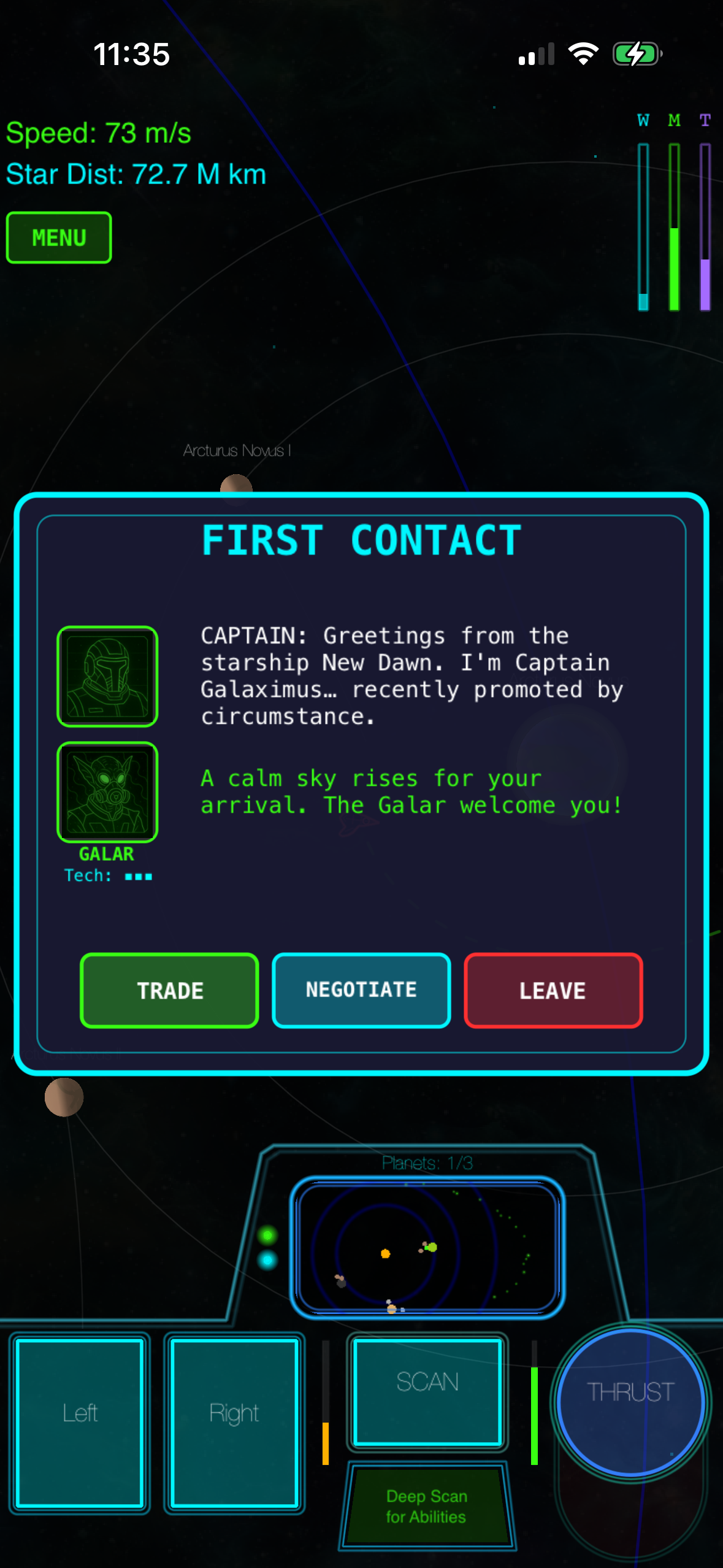
Synthesized voices—where every character is generated in real time on the device—have a specific aesthetic. They sound alien and strange, which works perfectly for sci-fi. Galaximus uses procedural audio synthesis for every voice, giving the game a cohesive sound and unique-sounding characters on each playthrough.
Recorded voices are more naturalistic but take up storage space. Text-only dialogue works if it’s excellent writing—sparse, punchy, full of personality—but risks feeling slow on mobile.
The sweet spot is brief, high-impact dialogue: a line or two per encounter that tells you who this character is and what they want.
Procedural Generation and Replay
Story-driven space games using procedural generation face a tension: how do you tell a coherent story when the world is different every playthrough?
The answer is procedural configuration, not procedural content. The story structure stays the same—same sequence of encounters—but the planets, asteroids, and anomaly placements change. You replay the same narrative arc with new obstacles, extending the campaign’s life without diluting the narrative.
Premium vs. Free-to-Play
Most story-driven space games on iPhone are premium—you pay once, own the game forever, no ads, no energy timers. Story games don’t monetize well through free-to-play mechanics (you can’t sell “energy to read the next chapter”), and developers who care about narrative usually care about player experience.
Galaximus is premium: no ads, no IAP, no battle pass. The Infinitum expansion launches in late 2026 and is free to anyone who buys at the launch-tier price; after Infinitum ships, the combined game moves to a higher price tier.
The Best Story-Driven Space Games on iPhone in 2026
Galaximus (our game): Eight procedurally configured star systems, real orbital mechanics, procedural audio synthesis for every voice, and a complete narrative arc with a memorable finale. One purchase, full ownership. ~6–8 hours per playthrough. Infinitum expansion free to launch-tier buyers.
Out There (Stateless Games): A minimalist space exploration game where you manage fuel and resources while uncovering an alien mystery through text-based encounters. Shorter playthroughs (~2–3 hours), heavy on atmosphere and choice. No real physics; focuses on survival tension and narrative discovery.
Reigns (Nerial): A card-based narrative game where you swipe left or right to make decisions as a monarch. While not strictly a space game, its sequel Reigns: Her Majesty includes space-themed chapters. ~1–2 hours per playthrough. Excellent writing, high replay value from branching paths.
Alto’s Adventure (Snowman): A minimalist endless runner with a contemplative tone and subtle narrative progression through visuals and ambient storytelling. ~30 minutes to 1 hour per session. No explicit story, but the world-building is elegant. Works offline.
Jelly Shift (Shift Games): A physics-based puzzle game with a sci-fi setting and narrative framing. Shorter than campaign-driven games (~2–3 hours) but uses mechanics to reinforce story beats. Real physics, minimal dialogue.
Comparison: - For real physics + narrative: Galaximus and Jelly Shift prioritize mechanics-driven storytelling. - For choice-driven narrative: Out There and Reigns let your decisions shape the story. - For atmospheric exploration: Alto’s Adventure and Out There emphasize mood over explicit plot. - For playtime: Alto’s Adventure and Reigns fit 15-minute sessions; Galaximus and Out There reward longer play.
Accessibility Features
Text size: Galaximus supports system-level text scaling (iOS Settings > Display & Brightness > Text Size). Out There and Reigns also respect system settings.
Colorblind modes: Galaximus includes a colorblind-friendly palette option in settings. Check individual game descriptions for others.
Button remapping: Galaximus supports custom control mapping via iOS Accessibility settings. Some games (Reigns, Alto’s Adventure) use swipe-only controls, which are accessible but may not suit all players.
Offline play: Alto’s Adventure and Jelly Shift work fully offline. Galaximus and Out There work offline after initial download. Reigns requires internet for cloud saves but plays offline.
Pause support: All listed games support pause mid-session, crucial for mobile interruptions.
How to Evaluate a Story-Driven Space Game Before You Buy
Read reviews mentioning narrative and pacing. “Great story” is vague; “the middle section drags but the ending pays off” is useful. Look for mentions of whether the game respects your time.
Check for choice. Some story games let you make decisions that change outcomes; others are linear. Both can be excellent, but know which you’re getting.
Watch a gameplay video. Are the mechanics part of the story, or separate from it? Does the player spend most of their time in menus or flying and solving problems?
Confirm the game has an ending. A complete campaign with a finale is rare on mobile and worth paying for.
Check device compatibility. Does it run on your iPhone model and iOS version? Read the App Store requirements.
FAQ
Do I need to understand orbital mechanics to enjoy a story-driven space game with real physics?
No. The best physics-based story games teach you as you play. You don’t need to know what a Hohmann transfer is; you just need to understand that planets pull on you and you can use that pull to your advantage. Galaximus teaches this in the first 30 minutes.
Can I pause mid-encounter?
Yes. All the games listed here support pause. This is crucial on mobile, where you might get interrupted.
Can I transfer my save between devices?
Galaximus supports iCloud save sync across your devices. Out There and Reigns also support cloud saves. Check the App Store description for each game.
Does this game work on older iPhone models?
Check the App Store listing for minimum iOS version and device requirements. Galaximus requires iOS 14.0 and iPhone XS or later. Simpler games like Alto’s Adventure and Reigns work on older devices.
Is there a demo or trial?
Most premium space games don’t offer demos. Some games (like Reigns) offer a free lite version with limited content. Check the App Store for “free” or “lite” versions.
How long does a campaign take to finish?
- Galaximus: 6–8 hours for a single playthrough
- Out There: 2–3 hours
- Reigns: 1–2 hours per playthrough
- Alto’s Adventure: 30 minutes to 1 hour per session
- Jelly Shift: 2–3 hours
If I replay, will I see the same story?
Galaximus: Same narrative arc, different obstacles and encounters via procedural generation. Out There: Different story paths based on your choices; replay reveals new branches. Reigns: Completely different outcomes on replay; designed for multiple playthroughs. Alto’s Adventure: Same world, different runs; narrative emerges from exploration.
What’s the learning curve?
Real-physics games (Galaximus, Jelly Shift): 30 minutes to 1 hour before controls feel natural. Choice-based games (Out There, Reigns): Immediate; learn as you play. Exploration games (Alto’s Adventure): Minimal; designed for accessibility.
Galaximus is available on the App Store. Buy at the launch-tier price and the Infinitum expansion is included free when it launches in late 2026.