Paid iOS Games Under $4: Space Games Ranked
 by Galaximus
The Best Premium Space Games Under $4 on iPhone
Finding a space game on the App Store that doesn’t nickel-and-dime you is harder than navigating an asteroid field. Most titles lean into free-to-play mechanics—energy meters, battle passes, cosmetic shops—which means the real game starts after you’ve sunk money into convenience unlocks. But a handful of premium titles still exist: games you buy once and own forever, no ads, no in-app purchases, no subscriptions.
Disclosure: We built Galaximus. This article compares it directly with three alternatives so you can decide which fits your play style.
Premium Space Games: Quick Comparison
| Game | Price | Learning Curve | Campaign Length | Physics Model | Offline |
|---|---|---|---|---|---|
| Galaximus | (increases to after Infinitum launches Aug 2026) | 20–30 min | 8–12 hours | Real orbital mechanics | Yes |
| Kerbal Space Program Mobile | 1–2 hours | 15+ hours (engineering-focused) | Real orbital mechanics | Yes | |
| Asteroids Reborn (Radiangames) | Immediate | 2–4 hours | Arcade (no physics) | Yes | |
| Spacewar! Classic Arcade (Atari Vault) | Immediate | 1–2 hours | Arcade (no physics) | Yes |
Galaximus: Real Gravity, Real Mastery
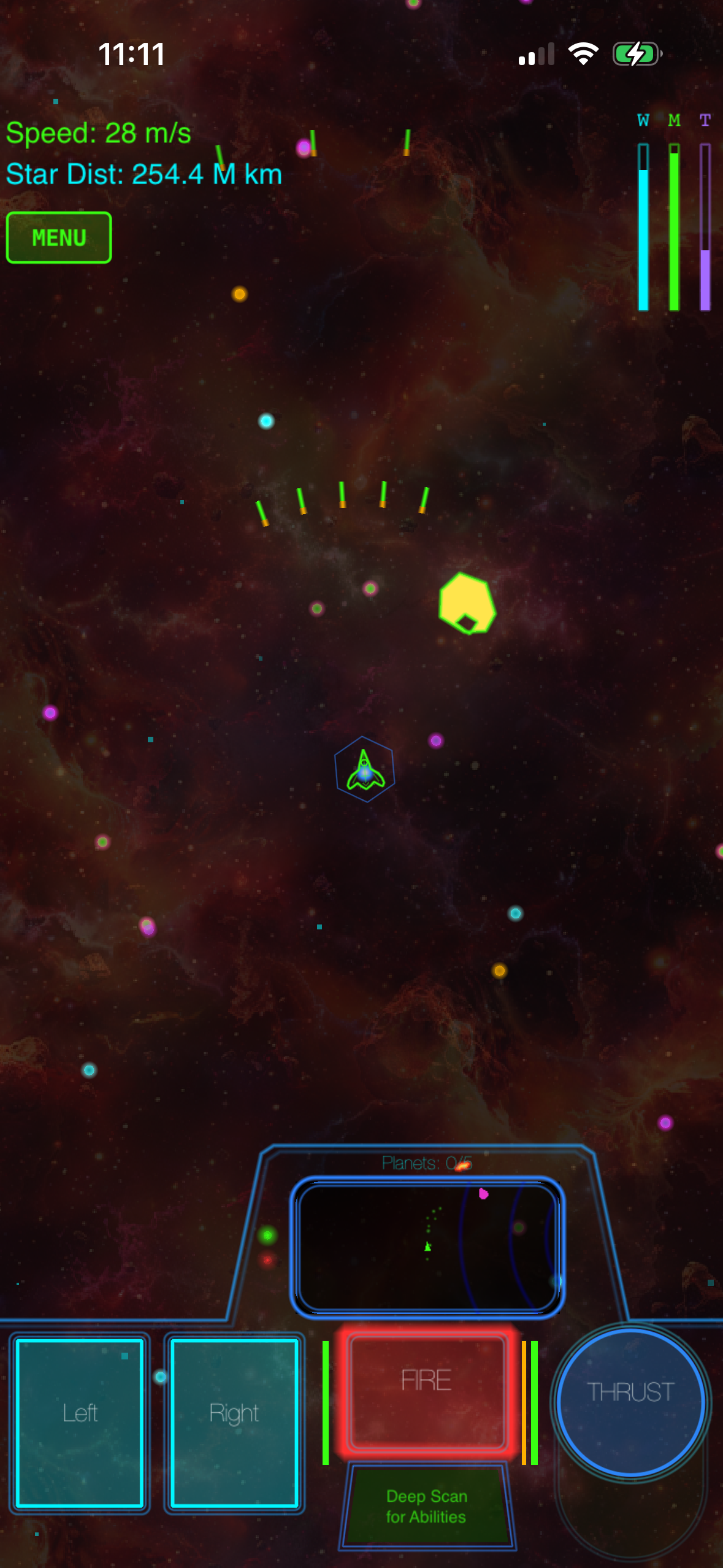
Galaximus is a space exploration and combat game built on actual orbital mechanics. Every celestial body’s gravity affects every other body in real time. That means you don’t pilot a ship that ignores physics—you pilot one that uses physics as its engine. Want to approach a planet without burning fuel? Use its gravity well to slingshot your velocity in a new direction. Need to escape a pursuing fleet? Position yourself so a moon’s gravity pulls you away faster than they can follow.
The learning curve is real. Most players spend the first 20–30 minutes adjusting to a control scheme where patience and positioning matter more than reflexes. But that curve pays off: once you understand how gravity works, you can pull off maneuvers that no faked-physics space game can offer. Mastery becomes physical intuition, not button-mashing.
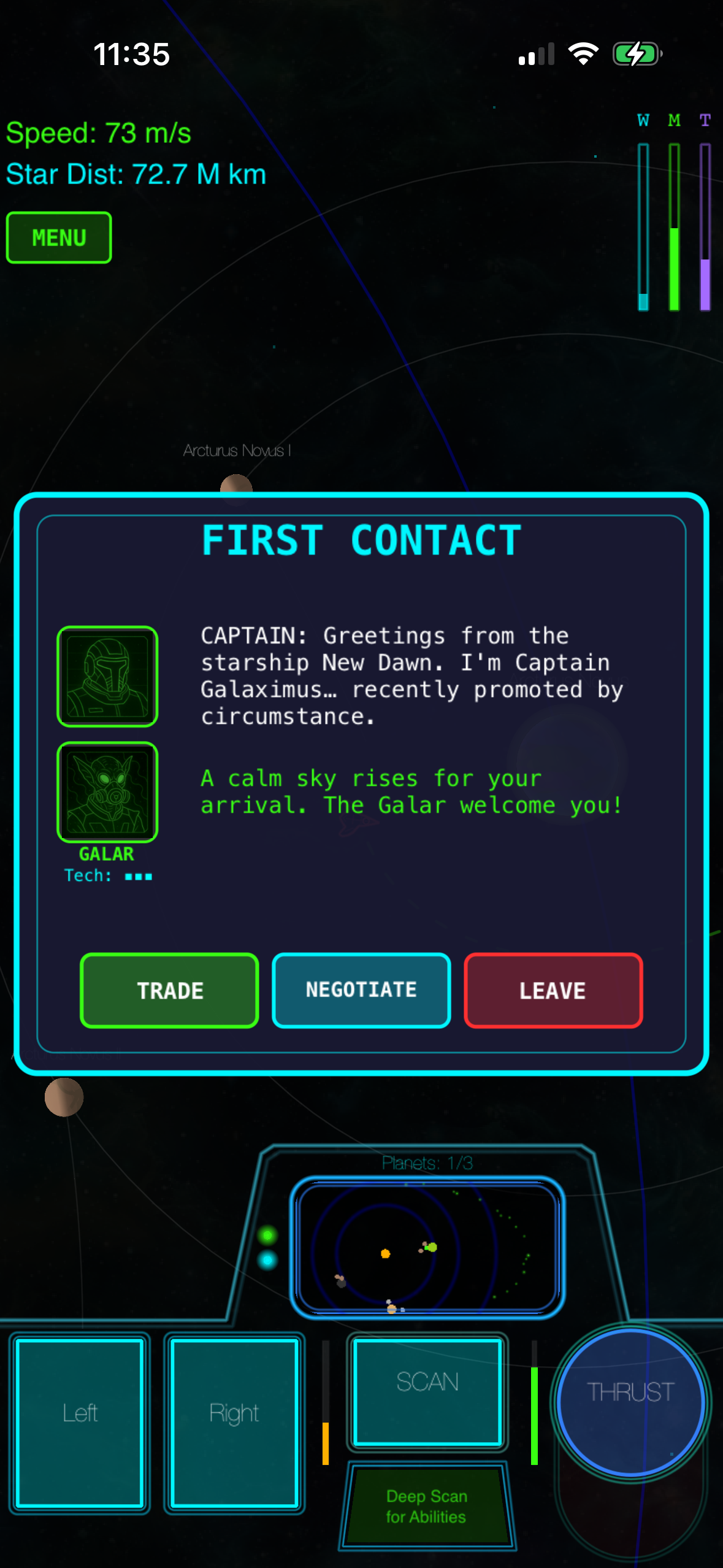
The campaign spans eight procedurally configured star systems with a full narrative arc—beginning, middle, and ending. The game is complete at launch. Each system throws new challenges at you: anomalies (derelict ships, distress beacons, spacetime rifts), first-contact dialogue with alien factions, real-time combat against pirate fleets, and environmental hazards that reward careful flying.
Pricing: Galaximus is currently. When Galaximus Infinitum (an open-galaxy sandbox expansion with planetary surface exploration, outpost building, and faction warfare) launches in August 2026, the price increases to. If you purchase now, you receive Infinitum free when it releases.
Other Premium Space Games Worth Considering
Asteroids-Style Arcade: Asteroids Reborn
Developer: Radiangames Price: App Store: Search “Asteroids Reborn” by Radiangames Learning curve: Immediate (rotate, thrust, shoot) Campaign: 2–4 hours of arcade sessions Offline: Yes
Asteroids Reborn modernizes the 1979 arcade cabinet with vector graphics and tight controls. No gravity simulation. No narrative. But it’s fast. If you want a 5-minute arcade session without a learning curve, this genuinely fits better than a game that rewards 30 minutes of focused attention. The tradeoff is real: simplicity means less depth. But depth isn’t always what you want.
Spacewar! Classic Arcade: Atari Vault
Developer: Atari Price: App Store: Search “Atari Vault” Learning curve: Immediate Campaign: 1–2 hours of arcade play Offline: Yes
Atari Vault bundles classic arcade games including Spacewar!, one of the earliest space combat games (1962). It’s historically significant and genuinely playable on modern iPhones. Like Asteroids Reborn, it’s arcade-focused, not physics-focused. Useful if you want retro authenticity alongside modern performance.
Orbital Mechanics Simulator: Kerbal Space Program Mobile
Developer: Squad / Private Division Price: App Store: Search “Kerbal Space Program” Learning curve: 1–2 hours Campaign: 15+ hours (engineering-focused progression) Offline: Yes
Kerbal Space Program is the gold standard for orbital-mechanics education. The mobile version is premium (no IAP). But it’s more of an engineering simulator than an action game. You build rockets, plan burns, manage staging. The appeal is designing and calculating your way to orbit, not flying your way there in real time.
Galaximus and KSP are not competitors—they’re different games with different goals. KSP teaches you to be a rocket scientist. Galaximus makes you feel like a pilot who understands gravity. If the appeal of space games is the engineering puzzle, KSP is deeper. If it’s the visceral experience of flying, Galaximus is the move.
Why Premium Space Games Matter in 2026
The free-to-play model has dominated mobile gaming for over a decade. It works financially for publishers, but it creates a friction problem for players: you download something, hit a paywall after 20 minutes, and decide whether the game’s core loop is worth the ongoing spend.
Premium games flip that equation. You pay upfront—usually in the budget-friendly to mid-tier range—and the developer’s incentive is to make the game itself good, not to engineer artificial scarcity. No energy timers. No “watch an ad to continue.” No seasonal battle pass that expires.
On iPhone, that’s increasingly rare. So when you find a premium space game that’s actually polished, it’s worth knowing about.
FAQ
Q: How does Galaximus compare to No Man’s Sky Mobile? A: No Man’s Sky Mobile is a free-to-play title with procedural exploration and base building. Galaximus is premium, physics-driven, and narrative-focused. No Man’s Sky rewards exploration and collection; Galaximus rewards mastery of orbital mechanics. They appeal to different players.
Q: Why is Kerbal Space Program so much more expensive than Galaximus? A: KSP is a full engineering simulator with decades of development on desktop and a massive feature set (part-based rocket building, multiple celestial bodies, career mode, sandbox mode). Galaximus is a more focused experience: action-oriented, physics-based, single-player campaign. Price reflects scope and development cost.
Q: Can I play these games offline? A: Yes. All the premium space games discussed here run entirely on your device. No internet required.
Q: How long is the Galaximus campaign? A: Most players complete the eight-system arc in 8–12 hours of focused play. Procedural configuration and multiple difficulty settings add replay value, but it’s not an infinite sandbox. It’s a complete, authored story.
Q: Are there multiplayer or competitive modes? A: Galaximus is single-player only. All the premium space games discussed here are solo experiences.
Q: Do I need an iPad, or does this work on iPhone? A: Galaximus is iPhone-only. Kerbal Space Program is universal (iPhone and iPad). Asteroids Reborn and Atari Vault are also universal. Check the App Store listing for each title.
The Bottom Line
Premium space games on iPhone are rare because the business model doesn’t align with App Store incentives. But they exist, and they’re worth seeking out if you’re tired of energy meters and battle passes.
Galaximus sits at the intersection of arcade action and real physics. It’s not Kerbal (not a simulator), not No Man’s Sky (not a procedural sandbox), and not Asteroids (not a twitch game). It’s its own thing: a space exploration and combat game where gravity is the interface you learn to master, and mastery unlocks hours of flow.
If that sounds like what you’re looking for, it’s available now at —and the Infinitum expansion is included free when it ships in August 2026.
Get Galaximus on the App Store: Get it on the App Store

