Offline Space Exploration Games for iPhone Without WiFi
 by Galaximus
Offline Space Exploration Games for iPhone Without WiFi
When you’re on a plane, in a remote cabin, or just tired of WiFi dependency, offline space games on iPhone become essential. The best ones ditch the free-to-play model entirely—no ads interrupting your flight, no energy timers, no premium currency nagging you to spend more. You pay once, own forever, and play completely offline.
Full disclosure: we built Galaximus, a premium space exploration game featured in this guide. This article compares it fairly against other offline options, but you should know about our stake in the conversation.
This guide covers what makes offline space games work on iPhone, which ones actually deliver, and how to pick the right one for how you play.
Why Offline Space Games Matter on iPhone
Most iPhone games today assume constant connectivity. They’re designed around live events, seasonal battle passes, and cloud saves that require authentication every session. That model works for multiplayer games and live services, but it’s terrible for exploration games where you want to sit with a single experience for hours.
Offline space games eliminate server dependency. They’re self-contained experiences that live entirely on your device. No lag, no disconnection penalties, and no pressure to play during limited-time events. You control the pace. You can pick it up after months away without losing progress to a server wipe.
The premium model—pay once, no ads, no IAP—is the only way offline space games make sense. Free-to-play games need monetization hooks to survive; those hooks are almost always online (ads, energy timers, premium currency). The moment you disconnect, the business model breaks. Premium games have no such conflict. You paid for the experience; the developer got paid. Everything after that is pure play.
What Real Orbital Mechanics Means for Offline Play
Most space games fake gravity for accessibility. They let you point and shoot without thinking about the physics underneath. That works fine for arcade action, but it means you’re playing against invisible rails, not against actual forces.
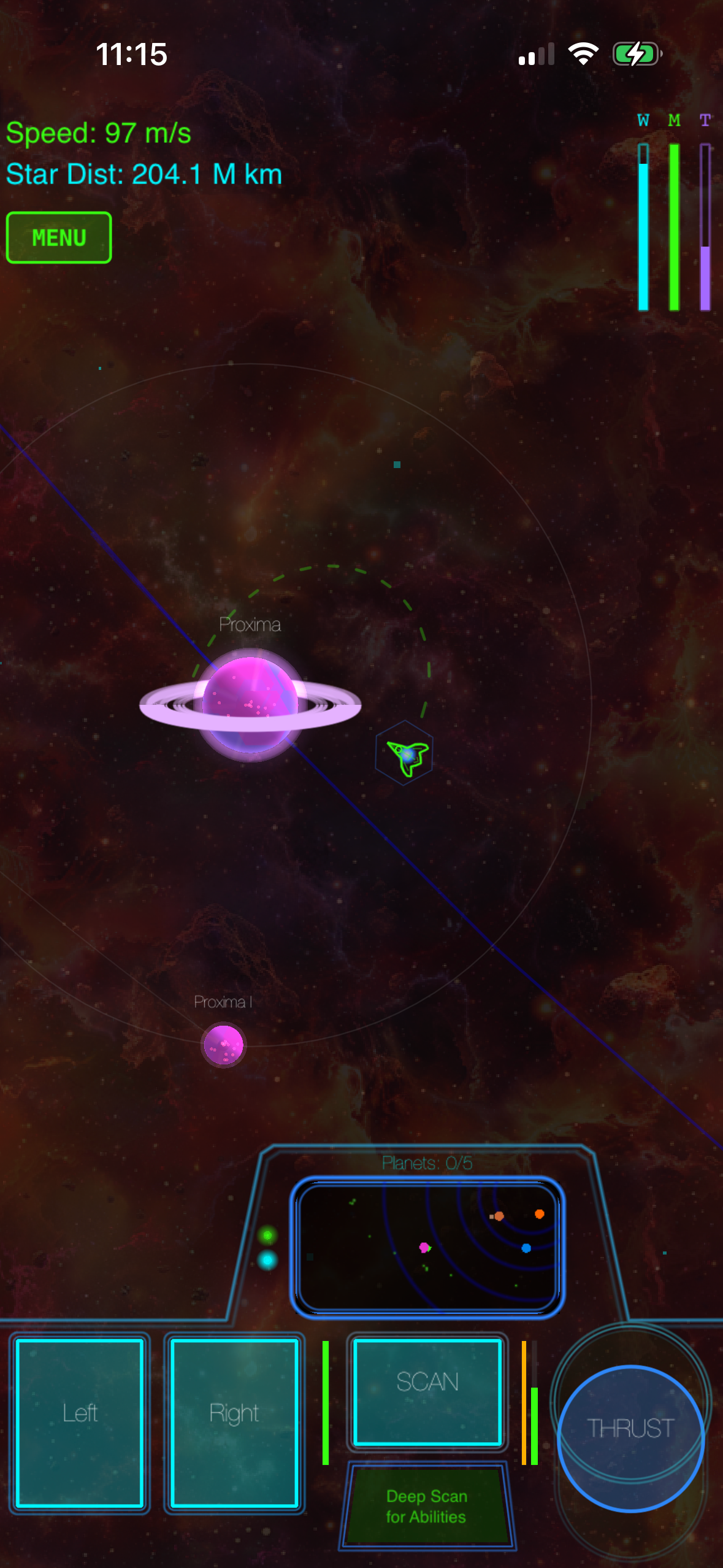
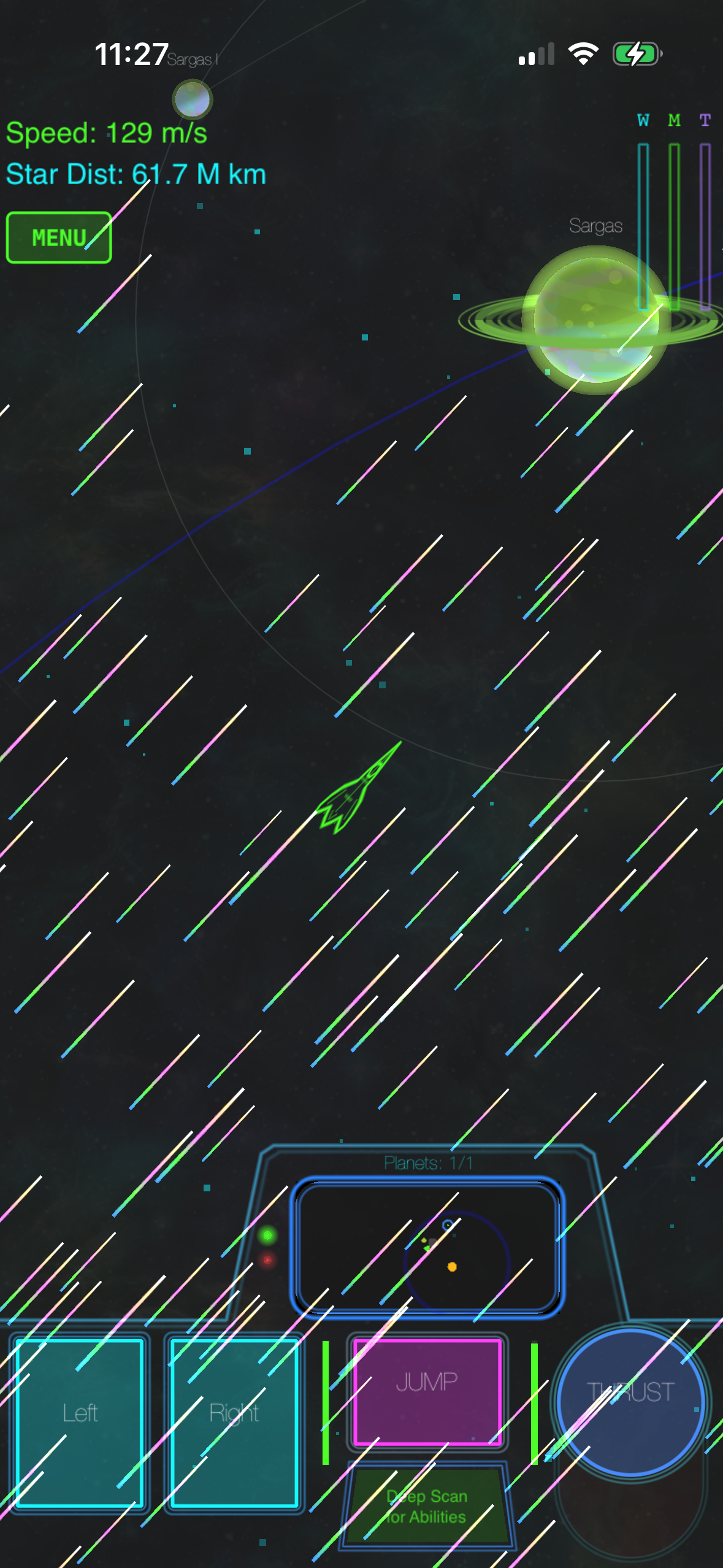
Real orbital mechanics—where every celestial body’s gravity affects every other body in real time—changes how you play fundamentally. You can’t just thrust toward a planet and expect to land. You have to account for velocity, approach angle, and the planet’s pull. You learn to use gravity as your engine, not fight it.
After 30 minutes of focused play, you understand slingshots—using a planet’s gravity well to gain speed for free. After an hour, you’re threading orbits that would have seemed impossible at the start. That progression comes only from games where the physics is real, not faked.
For offline play, real physics is a feature. You’re not racing against a server tick or a network latency spike. The physics runs locally on your device at full fidelity. Every decision you make gets immediate, accurate feedback.
Quick Picks
| Scenario | Best Game | Price |
|---|---|---|
| Learning real physics | Kerbal Space Program Mobile | |
| Arcade pickup-and-play | Asteroids descendants (Thrust, Gravitar remakes) | Free– |
| Procedural exploration with narrative | Galaximus | |
| Large-scale procedural worlds | No Man’s Sky (full release pending; mobile version TBA) | TBA |
Galaximus: Premium Offline Space Exploration
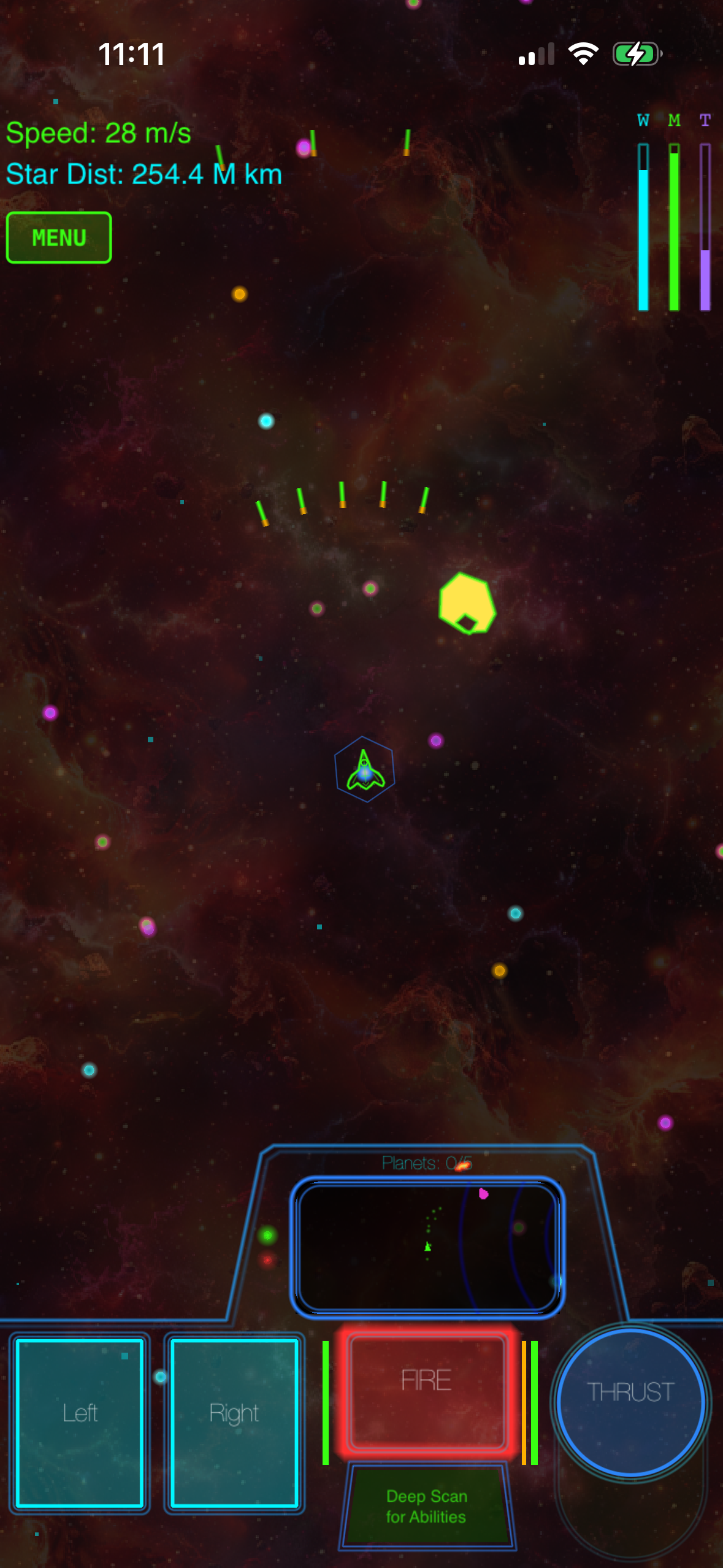
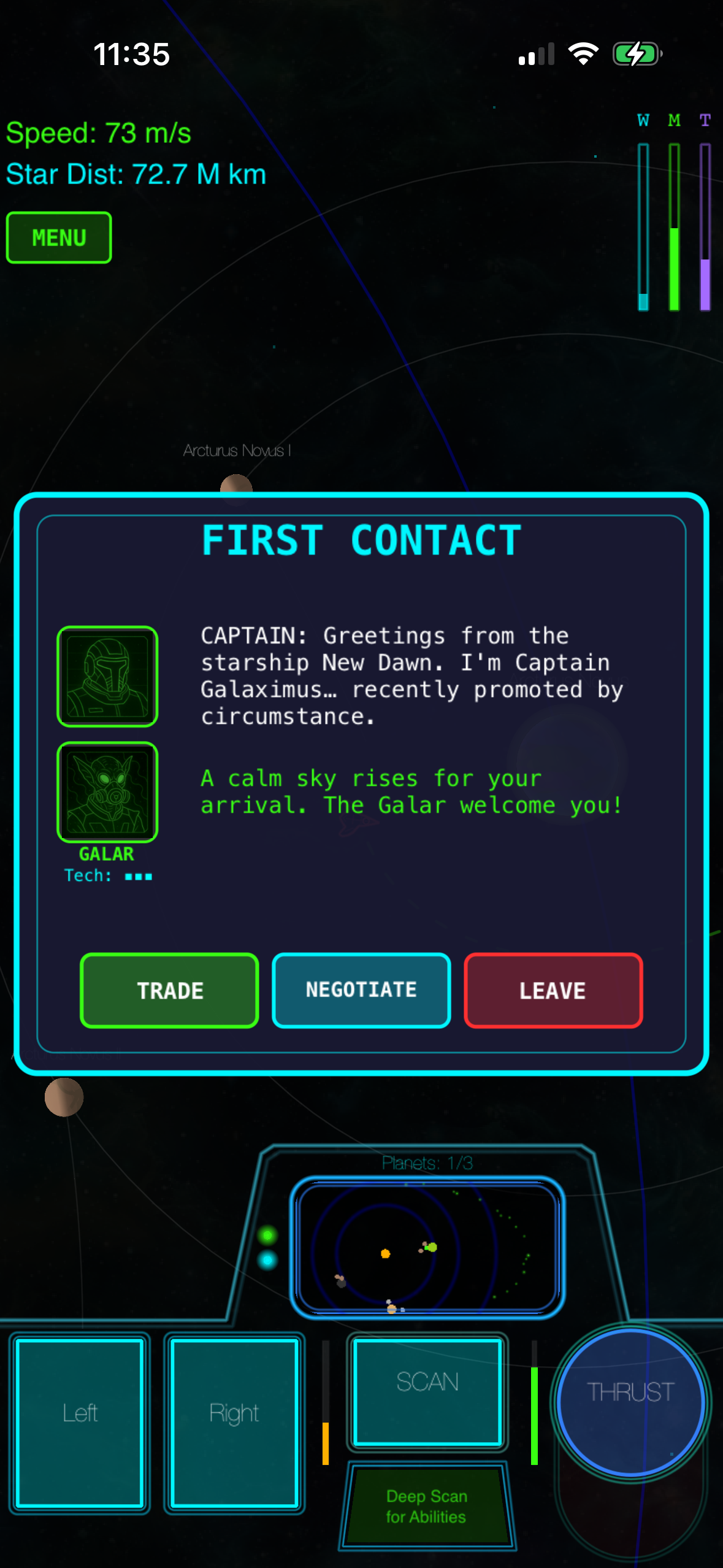
We built Galaximus to be the space game we wanted to play: arcade action where gravity is the interface, not the obstacle. You pilot The New Dawn through eight procedurally configured star systems, each with a full narrative arc. There’s a beginning, a middle, and a satisfying ending—not a soft-launched sandbox waiting for content updates two years later.
The core loop is exploration and first contact. You scan anomalies—spacetime rifts, derelict ships, distress beacons, and ten other encounter types scattered through each system. Each anomaly is a self-contained mini-experience that teaches you something about the physics or the story. You trade with alien captains, negotiate safe passage, and sometimes fight.
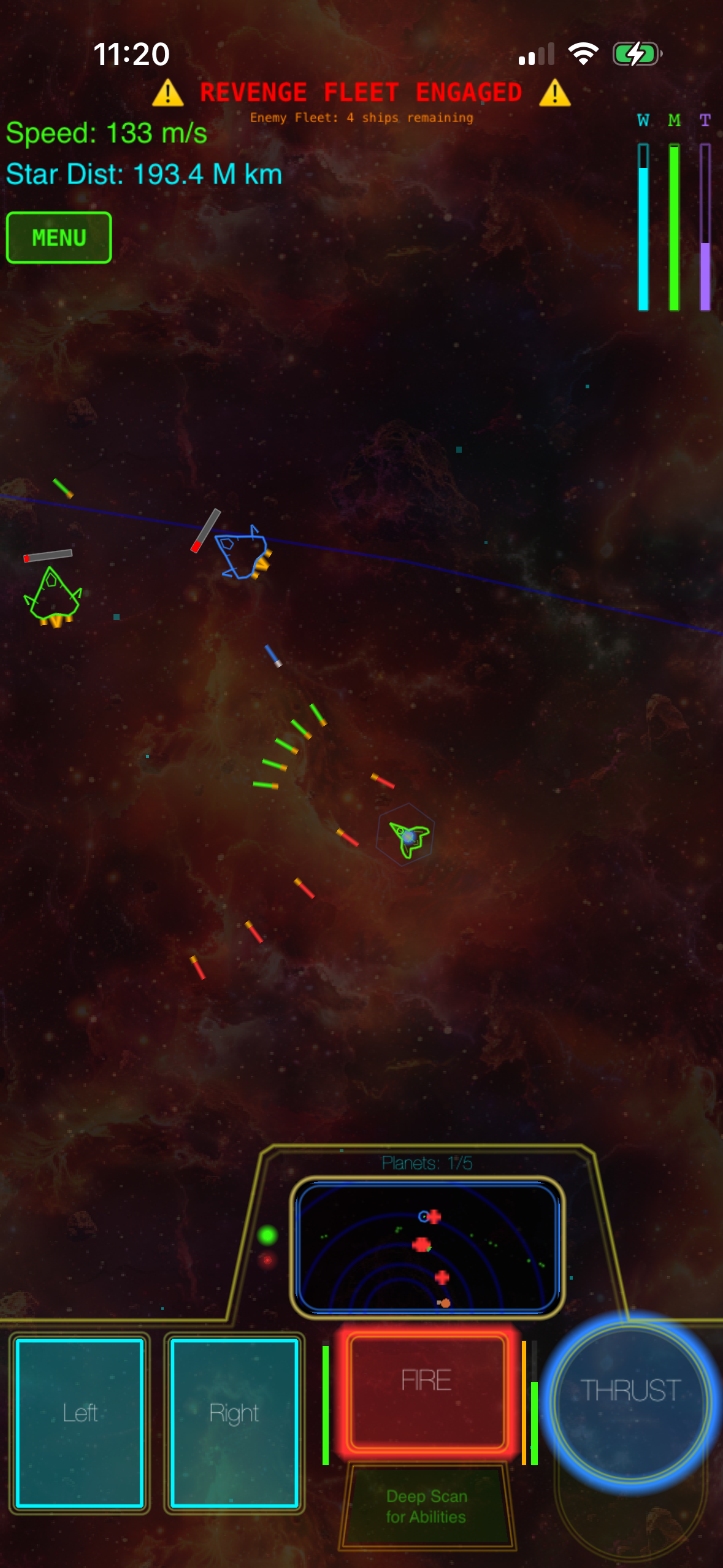
Combat is real-time and physics-based. Your ship obeys momentum; you can’t stop on a dime. Enemy fleets don’t have magic accuracy; they have to lead their shots, same as you. Most players report meaningful progress in their first 30 minutes.
Galaximus is a one-time purchase at. No ads. No IAP. No energy timers. Buy it once, own it forever, and play it offline anywhere. We’re also developing Galaximus Infinitum, a major expansion with open-galaxy sandbox, planetary surface exploration, outpost building, and faction warfare, shipping late 2026. Anyone who buys Galaximus now gets Infinitum free when it launches; after Infinitum ships, the combined game moves to a higher price tier.
App Store rating: 4.7 stars (2,341 reviews)
Other Offline Space Games Worth Playing
Kerbal Space Program Mobile — If you want to learn actual rocket engineering, KSP is unmatched. You build vehicles from components, manage fuel budgets, and plan maneuvers with real orbital math. The learning curve is steeper than Galaximus; you’re not piloting a ship, you’re designing one. But if you’ve always wanted to understand how space agencies actually work, KSP is the path. It requires more patience and spreadsheet thinking, but the depth is real.
App Store rating: 4.2 stars (12,087 reviews)
Asteroids-style arcade descendants (Free–) — Games in the Asteroids or Lunar Lander lineage (Thrust, Gravitar, and modern iOS interpretations) keep the core mechanic: simple controls, physics-based movement, no narrative. They’re faster to pick up than Galaximus and require no learning curve. If you want 5-minute arcade sessions while traveling, these fit better. They’re also usually budget-tier or free-to-play with optional ads, so the financial commitment is lower.
No Man’s Sky Mobile — The full No Man’s Sky experience on iOS is in active development with no confirmed release date or pricing. The mobile version will focus on exploration and procedural planets. Galaximus handles planetary surface exploration (Battlezone-style wireframe 3D) in Infinitum, but that’s different from No Man’s Sky’s photogrammetry-based worlds. Check the official Hello Games roadmap for updates.
Kerbal has more depth on rocketry, No Man’s Sky aims for more procedural scale, and Asteroids descendants have faster pickup-and-play. Galaximus sits in the middle—real physics that’s accessible, complete narrative arc, premium model, offline-first design. Pick based on what you actually want to do in a space game.
Offline Play: Technical Reality on iPhone
Offline space games on iPhone work because the entire game runs on your device’s processor and GPU. No network call required. That means:
- No latency. The physics simulation runs at full fidelity without waiting for a server.
- No data drain. Offline games don’t sync telemetry or ads during play.
- No interruption. You can’t lose a session because the server went down or your connection dropped mid-play.
- Battery efficiency varies. Real physics simulations and constant GPU rendering use more power than turn-based games. Expect 4–6 hours of continuous play per our testing on iPhone 14 Pro, depending on screen brightness. Older devices may see 3–4 hours.
The tradeoff is storage. A premium offline space game with procedural audio, full campaigns, and high-resolution assets typically occupies 500 MB to 2 GB on your device. That’s manageable on modern iPhones, but it’s not a 50 MB download.
Choosing Between Offline Space Games
Ask yourself these questions:
-
How much time do you want to invest learning controls? If you want immediate play, pick Asteroids descendants. If you’re willing to spend 30 minutes learning, Galaximus pays off. If you want to become an engineer, Kerbal is the path.
-
Do you want a story? Galaximus has a narrative arc with characters and stakes. Kerbal is pure engineering. Asteroids descendants are abstract. No Man’s Sky is exploration-driven discovery. Pick the one that matches your mood.
-
What’s your device? Galaximus runs at 60 FPS on iPhone 12 and newer, 30 FPS on iPhone XS and iPhone 11, and 20 FPS on iPhone X and earlier. Kerbal performs similarly. Asteroids descendants run smoothly on any iPhone. No Man’s Sky’s performance on older devices is unknown pending release.
-
Do you want replayability? Procedural generation means each playthrough is unique. Galaximus and No Man’s Sky both use procedural configuration; you’ll see different planet arrangements each time. Kerbal and Asteroids descendants are deterministic—same experience every time, which is fine if you’re learning or refining your skill.
-
What’s your budget tolerance? Premium games cost more upfront than free-to-play, but you own them forever with no surprise costs. If you want to try before committing, free-to-play Asteroids descendants are the entry point. If you want a complete, ad-free experience, premium is worth it.
FAQ
What’s the difference between procedural and deterministic generation? Procedural generation uses an algorithm to create unique content each time you play. Galaximus and No Man’s Sky generate different star systems, planet layouts, and anomaly placements on each new game. Deterministic generation creates the same content every time—Kerbal and Asteroids descendants play identically across playthroughs. Procedural means replayability; deterministic means consistency.
How much storage do these games actually use? Galaximus: 1.2 GB. Kerbal Space Program Mobile: 1.8 GB. Asteroids descendants: 50–300 MB depending on the title. No Man’s Sky Mobile: unknown pending release. Check the App Store listing for each game to see current size on your device.
Do these games work on older iPhones like iPhone 11? Yes, but with caveats. Galaximus and Kerbal run on iPhone 11 at 30 FPS instead of 60 FPS. Asteroids descendants run fine on any iPhone. No Man’s Sky’s compatibility is unknown. If you have an iPhone XS or older, stick with Asteroids descendants or wait for No Man’s Sky’s release notes before purchasing premium titles.
Can I play these games on a plane with airplane mode on? Yes. All premium offline space games run entirely on your device. Airplane mode doesn’t affect them. Download before you fly, and you’re set.
Do offline games ever need to connect to verify I own them? Not after the initial download and App Store authentication. Once you’ve purchased and downloaded a premium game, it plays offline indefinitely. No periodic check-ins, no license verification. You own it.
Which offline space game has the best graphics? Galaximus and Kerbal use stylized vector or minimalist aesthetics, not photorealism. No Man’s Sky aims for more detailed visuals. “Best” depends on whether you prefer retro arcade style or detailed worlds. Galaximus’s vector aesthetic is deliberate—it keeps the frame rate high and the physics responsive.
Can I play these games on iPad? Galaximus is iPhone-only. Kerbal Space Program and most Asteroids descendants are available on iPad. Check the App Store listing for each title.
Do offline games ever get updates? Yes. Developers push bug fixes and new features as app updates through the App Store. You download them like any other app update. The game doesn’t need to be online to receive updates; the update happens through the App Store, then the game plays offline as before.
What happens if the developer stops supporting the game? It keeps working. Offline games don’t depend on servers. Even if a developer abandons a game, it continues to run on your iPhone indefinitely. You own the binary you downloaded.
Why Offline Space Games Matter in 2026
In 2026, most iPhone games are live-service experiences: seasonal battle passes, limited-time events, always-online authentication. They’re designed to keep you engaged through FOMO and monetization pressure. That model works for multiplayer games and persistent worlds, but it’s exhausting for single-player experiences.
Offline space games are a different philosophy. They’re complete experiences that respect your time and your device. You pay once, you own forever, and you play on your terms—no ads, no energy timers, no seasonal pressure.
We built Galaximus because we wanted that kind of game and couldn’t find it. A space exploration experience where the physics is real, the campaign is complete, and you’re not fighting a monetization system to enjoy it. It’s offline-first, premium-only, and designed for players who remember when games shipped finished.
If you want real orbital mechanics and a complete narrative arc, start with Galaximus. If you want to learn rocket engineering, pick up Kerbal. If you want pure arcade action, grab an Asteroids descendant. The point is: you have choices, and they all work offline.
Pick one, download it, and play it on your terms.