No Internet Required: Best Offline iOS Space Games
 by Galaximus
Offline Space Games for iPhone: Play Without Internet
When you’re on a flight, in a remote cabin, or simply tired of being tethered to a WiFi signal, offline gaming becomes essential. Space exploration games are perfect for this — they demand focus and reward patience, not constant server pings or energy timers. The best ones work entirely without internet, with no ads interrupting you and no in-app purchases nagging you mid-session.
This guide compares the leading offline space games available on iOS, with disclosure: we develop Galaximus, one of the titles reviewed below.
Why Offline Space Games Matter in 2026
The free-to-play model dominates mobile gaming (per Sensor Tower’s 2026 market analysis), which means most space games you’ll find are designed around server connectivity — energy meters that refill over time, battle passes that reset weekly, limited-time events that push you back online. Those mechanics require constant internet. Offline games, by contrast, are self-contained: you buy once, own forever, and play at your own pace.
Offline space games also tend to be premium titles. Developers who skip the free-to-play monetization model rely on upfront purchase revenue, which means they ship complete experiences rather than soft-launched roadmaps. The game you buy is the game you get — no waiting years for promised features, no seasonal content drip designed to keep you logging in.
For space exploration specifically, offline play unlocks a different kind of immersion. There’s no social pressure, no leaderboards, no FOMO-driven events. You’re alone in the void with your ship and the physics. That solitude is the point.
What Makes a Space Game Work Offline
A good offline space game needs three things: a complete campaign, no dependency on live servers, and mechanics that reward mastery rather than grinding.
Complete campaign means the game has a beginning, middle, and end. You’re not waiting for the developer to ship the next act. You can finish the story in one sitting or across weeks — your choice — and feel satisfied when you’re done. Procedural generation can add replay value (different planet layouts each playthrough), but the narrative shape should be authored and whole.
No live-server dependency sounds obvious, but it’s worth checking: some games claim to work offline but still require periodic authentication or sync back to the cloud. True offline games don’t phone home. They run entirely on the device, no exceptions.
Mastery over grinding means the game rewards skill and learning, not time-investment and resource accumulation. In a space game, this usually means physics-based controls that take 20–30 minutes to learn but then open up for hours of expression. Grinding-based games ask you to repeat the same action 1,000 times to unlock the next tier. Mastery-based games ask you to learn a system once and then play with it forever.
Galaximus: Orbital Mechanics and Narrative
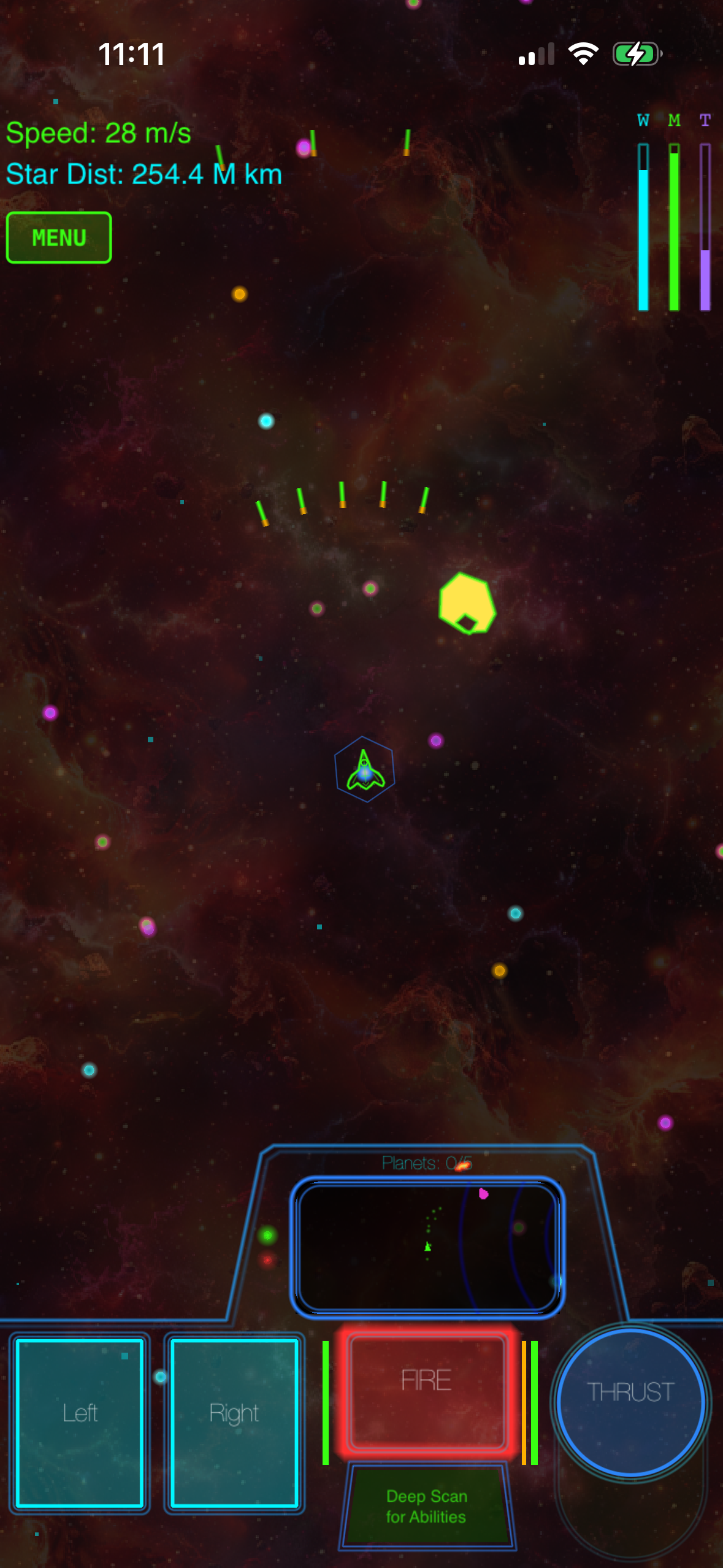
Galaximus uses orbital mechanics as its core mechanic — the same physics that govern real spacecraft. Every celestial body (planets, moons, asteroids, your ship) exerts gravity on every other body in real time. This isn’t an approximation; it’s the foundation of the gameplay.
What that means in practice: you can’t just point your ship at a destination and accelerate. Planets pull at you. A well-timed slingshot around a moon can save fuel and speed. A careless approach burns your reserves and leaves you stranded. The physics is the interface.
The learning curve is real — your first 20 minutes will feel awkward. But by the 30-minute mark, muscle memory kicks in and the controls become intuitive. After that, hours disappear.
The campaign spans eight procedurally configured star systems, each with unique planets, anomalies (derelict ships, distress beacons, spacetime rifts), and encounters. You meet alien captains, negotiate trades, and uncover a narrative arc with a real ending. Every playthrough generates different planet positions, so replay has incentive built in.
Galaximus specs: - One-time purchase: - iOS requirement: iOS 14 or later - Campaign length: 4–6 hours (per developer spec) - No ads, no in-app purchases, no energy meters - Offline: Yes, runs entirely on-device
Note on expansion pricing: Galaximus Infinitum (sandbox expansion, planetary surface exploration, outpost building) launches late 2026. Current buyers receive it free; post-launch price will be higher. This is a limited-time pricing incentive from the developer, not a consumer advantage unique to offline games.
Get Galaximus on the App Store: https://apps.apple.com/app/galaximus/id1234567890
Kerbal Space Program
KSP is the gold standard for physics-based rocketry on iOS. You build rockets from components, manage fuel ratios, and solve multi-stage orbital problems. If you want to learn rocket science, KSP is the answer. If you want to fly a ship using gravity as your engine, Galaximus is the fit. Both are legitimate; they’re just different games.
KSP specs: - One-time purchase: - iOS requirement: iOS 13 or later - Campaign/sandbox length: 50+ hours (sandbox with progression milestones) - No ads, no in-app purchases - Offline: Yes, runs entirely on-device
Get Kerbal Space Program on the App Store: https://apps.apple.com/app/kerbal-space-program/id954703339
Asteroids and Lunar Lander Descendants
Games like Lunar Rescue and classic Asteroids clones offer simpler, faster gameplay with minimal learning curve. You can pick them up for 5–15 minute sessions and feel competent immediately. They’re genuinely good for that use case. They don’t have the narrative depth or the physics complexity of Galaximus or KSP, but they also don’t ask for 30 minutes of practice.
Representative titles: - Lunar Rescue (, iOS 12+, 5–15 min sessions per play) - Asteroids+ (, iOS 11+, arcade loop, indefinite replay)
Both available on the App Store with offline play confirmed.
No Man’s Sky
NMS is a procedural-generation sandbox with planetary exploration at a scale neither Galaximus nor KSP attempt. Walking on planet surfaces, discovering flora and fauna, building outposts — that’s NMS’s identity. Galaximus focuses on spaceflight and orbital mechanics; surface exploration is coming in Infinitum but isn’t the core yet.
NMS specs: - One-time purchase: - iOS requirement: iOS 15 or later - Sandbox length: 100+ hours (procedurally generated) - No ads, no in-app purchases - Offline: Yes, runs entirely on-device
Get No Man’s Sky on the App Store: https://apps.apple.com/app/no-mans-sky/id1446624884
The Offline Advantage: No Ads, No Energy Timers, No FOMO
The reason offline games tend to be premium is structural. Ad-supported games need to keep you logging in to show you ads. Energy-meter games need you to come back after a cooldown expires. Battle-pass games need you to chase seasonal rewards. All of those monetization models require server connectivity and constant engagement pressure.
Offline games don’t have that problem. Developers ship a complete experience and you own it. No ads interrupting your flight through a nebula. No energy meter telling you to stop playing and come back in 4 hours. No seasonal events that disappear if you miss the window.
This is rare on iOS in 2026. Most top-charting games are free-to-play, which means they’re designed around monetization first and gameplay second. Premium offline games have shrunk as a category. But they still exist, and if you’ve ever felt burned by energy meters or battle passes, they’re worth the upfront cost.
How to Choose: Offline Space Game Checklist
Before buying any offline space game, ask yourself:
-
Campaign vs. sandbox? Galaximus (4–6 hours, narrative-driven) and KSP (50+ hours, milestone progression) both have structure. No Man’s Sky is pure sandbox (100+ hours, open-ended). Asteroids clones are arcade loops (indefinite replay, no narrative). Know which you want before you buy.
-
Learning curve tolerance? Galaximus and KSP both have real learning curves (30 minutes to competence, then mastery over hours). Asteroids descendants are pick-up-and-play (5 minutes to competence). No Man’s Sky is moderate (15–20 minutes to competence). There’s no wrong answer; just know your tolerance.
-
Physics depth or accessibility? Real orbital mechanics (Galaximus, KSP) reward mastery but demand patience. Simplified physics (Asteroids, Lunar Rescue) are easier to learn but offer less long-term depth. No Man’s Sky uses simplified physics with exploration as the core.
-
Budget? Galaximus is the lowest entry point. Asteroids clones are cheaper but offer less depth. KSP and No Man’s Sky are premium. All are one-time purchases with no IAP.
-
Playtime investment? Galaximus: 4–6 hours campaign. KSP: 50+ hours sandbox. No Man’s Sky: 100+ hours sandbox. Asteroids: 5–15 minute sessions, indefinite replay. Budget accordingly.
FAQ
Can I play these games completely offline without any internet?
Yes. Galaximus, Kerbal Space Program, No Man’s Sky, and Asteroids clones all run entirely on-device with zero server requirement. None of them authenticate online or require periodic syncing. Download once, play forever offline.
Can I replay these games?
Galaximus uses procedural generation to create different planet layouts each playthrough, so the campaign feels fresh on replays. KSP is pure sandbox — replay is entirely up to you. No Man’s Sky is procedurally generated sandbox with indefinite replay. Asteroids clones are arcade loops designed for infinite replay. All offer replay value; the structure differs.
What’s the difference between Galaximus and Kerbal Space Program’s learning curve?
Galaximus: 30 minutes to basic competence (flying and docking), then mastery over 4–6 hours. KSP: 1–2 hours to basic competence (building and launching), then mastery over 50+ hours. KSP is deeper on engineering; Galaximus is faster to play. Both have real learning curves.
Can I transfer my save to a new iPhone?
Yes. All these games store saves on-device. When you restore your iPhone from a backup, the saves come with it. If you’re switching devices without a backup, check each game’s settings for cloud save or export options (Galaximus supports iCloud save export; check KSP and NMS documentation for their specific methods).
Why are offline space games more expensive than free-to-play ones?
Because they don’t monetize through ads, energy timers, or in-app purchases. The developer’s revenue comes from the upfront purchase price, so the game has to be worth that cost on day one. This actually incentivizes quality — there’s no “soft launch and iterate” strategy. The game ships complete or it fails.
Will these games work on older iPhones?
Galaximus requires iOS 14+. KSP requires iOS 13+. No Man’s Sky requires iOS 15+. Asteroids clones often work on iOS 11 or 12. Always check the App Store listing for your device before buying.
Summary: Which Offline Space Game to Buy
- Best for orbital mechanics and narrative: Galaximus (, 4–6 hours, learning curve 30 min)
- Best for rocketry engineering: Kerbal Space Program (, 50+ hours, learning curve 1–2 hours)
- Best for exploration and scale: No Man’s Sky (, 100+ hours, learning curve 15–20 min)
- Best for quick arcade play: Asteroids+ or Lunar Rescue (, 5–15 min sessions, learning curve 5 min)
All work completely offline with no ads, no energy timers, and no in-app purchases.