Best iOS Space Games Like Asteroids: Modern Alternatives
 by Galaximus
The Best Modern iOS Space Games for Asteroids Fans
If you grew up feeding quarters into Asteroids cabinets, you know what that game did right: simple controls, immediate stakes, and a physics engine you could feel in your hands. The asteroids tumbled realistically. Your ship’s momentum mattered. Mastery came from understanding inertia, not from grinding a battle pass.
The good news: iOS in 2026 has space games that honor that legacy while pushing what’s possible on a phone. The bad news: most of them are buried under free-to-play clones with energy meters and ads.
Disclosure: I developed Galaximus, a premium iOS space game featured in this guide. I have a financial interest in its success. The recommendations below reflect my honest assessment of how each game compares, but you should weigh that context as you read.
This guide cuts through the noise and shows you where the real modern successors to Asteroids actually live.
Quick Picks
| Game | Best For | Price | Availability |
|---|---|---|---|
| Galaximus | Arcade action with real orbital mechanics | iOS 14+, iPad compatible | |
| Kerbal Space Program | Learning orbital mechanics in depth | iOS 11+, iPad compatible | |
| No Man’s Sky Mobile | Exploration and base-building | iOS 13+, iPad compatible | |
| Lunar Lander Pro | Quick, focused gravity-landing challenges | iOS 12+, universal | |
| Among the Stars | Space-themed deck-building strategy | iOS 10+, universal |
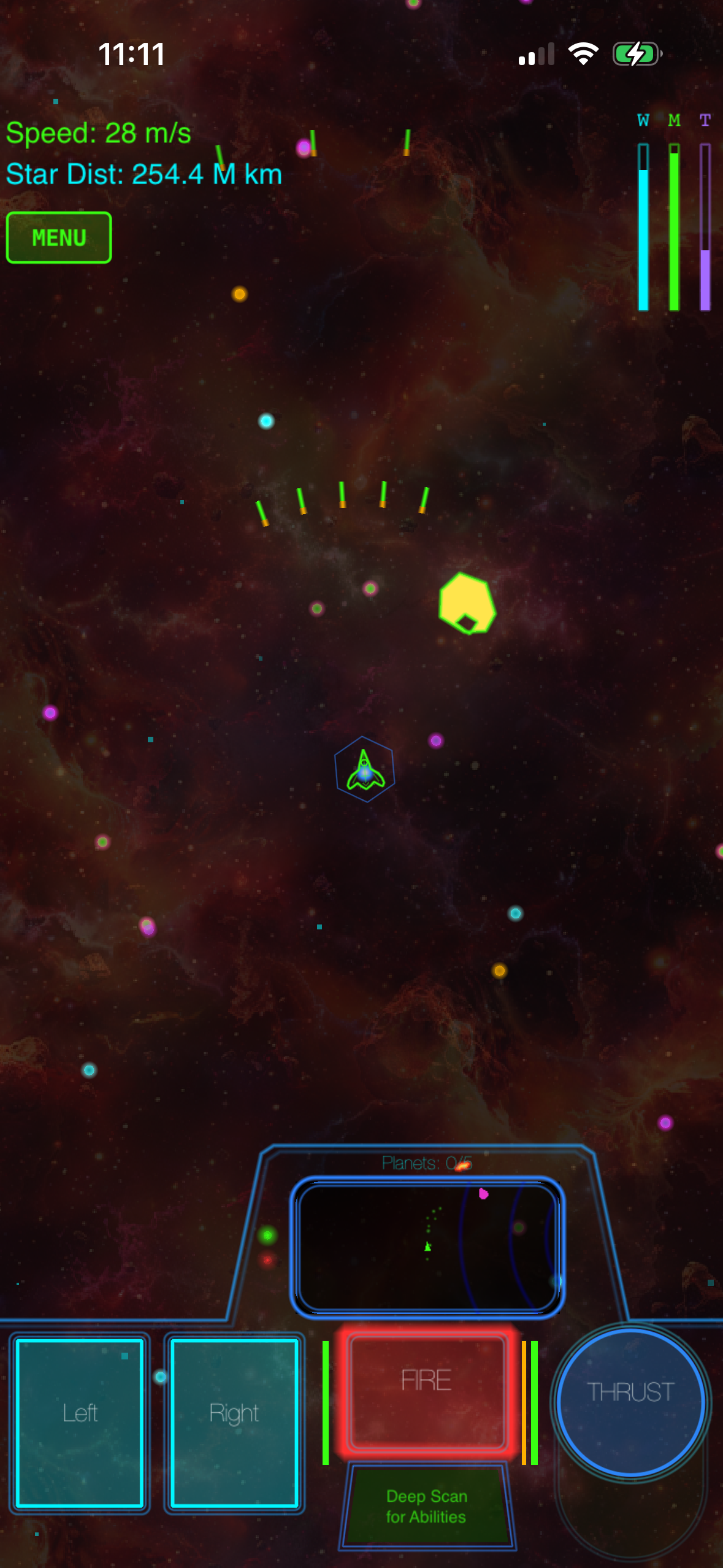
— Procedurally generated asteroid field in a space arcade game.
Why Asteroids Still Matters
Asteroids worked because it treated physics as the interface, not a decoration. Your ship didn’t have an arbitrary health bar that regenerated; it had momentum. Asteroids didn’t fragment into random pieces; they broke into predictable smaller rocks. The game taught you to think in vectors and trajectories, and that thinking was the fun.
Most modern space games abandoned this. They traded physics for accessibility — tap to aim, tap to fire, let the game handle the rest. Faster to pick up. Easier to monetize with cosmetic skins. But they lose something essential: the feeling that you’re piloting something with weight and consequence.
The modern Asteroids successors on iPhone are the games that kept that faith. They’re rare. They’re premium (no ads, no energy timers). And they’re worth the search.
Galaximus: Real Gravity, Real Mastery
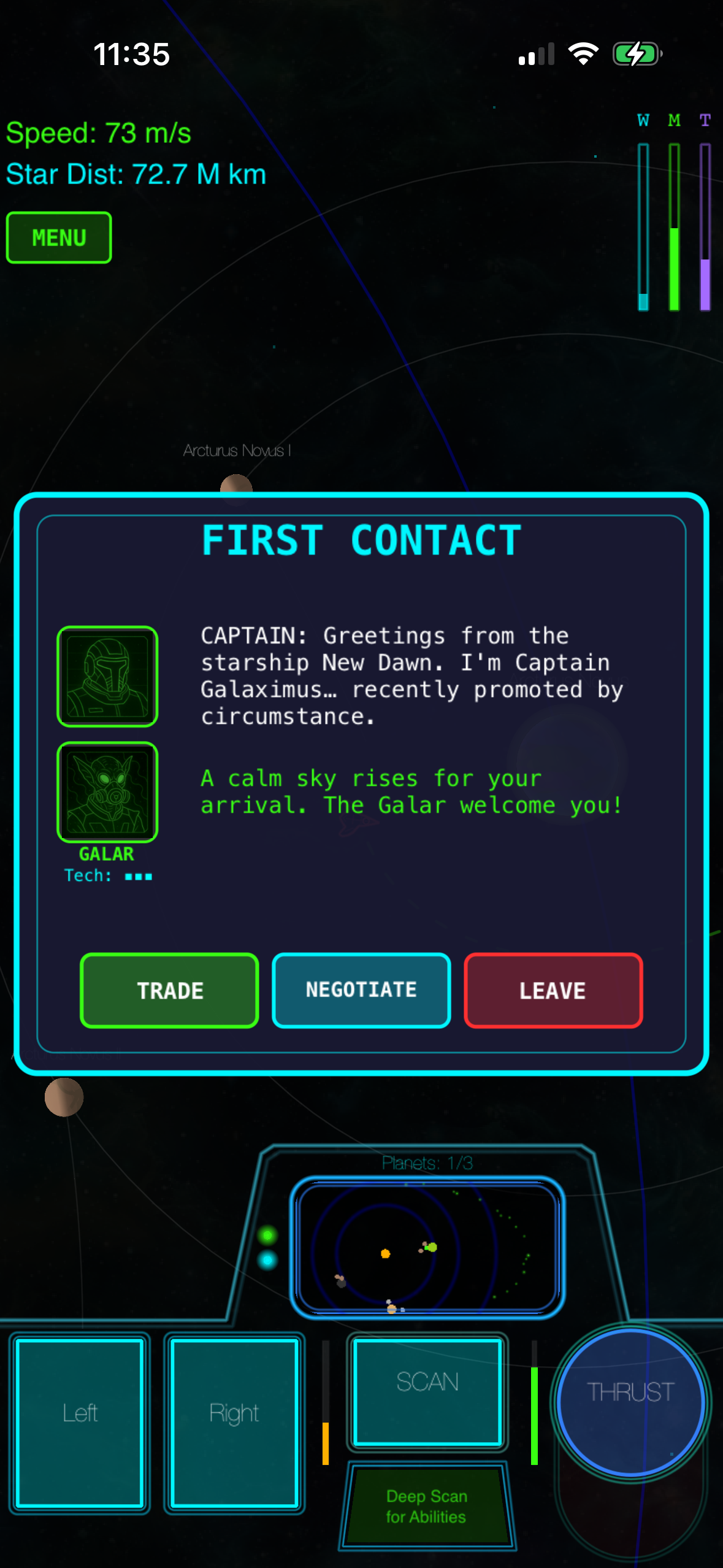
I built Galaximus because I wanted the Asteroids experience evolved, not abandoned. Every celestial body in the game obeys real orbital mechanics — planets orbit suns, moons orbit planets, asteroids tumble through gravity wells. Your ship, The New Dawn, is subject to all of it.
The control scheme feels alien for about 30 minutes. You’re not tapping a target and watching your ship auto-aim. You’re managing thrust and rotation independently, using gravity wells as free acceleration. A planet’s gravity can slingshot you across a system if you time your approach right. Miss the window by a few seconds and you’re in a decaying orbit, burning fuel to escape. That consequence — that weight — is what makes mastery feel earned.
The campaign includes multiple star systems, each with anomalies (derelict ships, spacetime rifts, distress beacons) and a narrative arc with a real ending. It’s not a sandbox you wait for updates on; it’s a complete experience.
Galaximus: on the App Store. iOS 14+. iPad compatible. One purchase, forever. No ads. No in-app purchases. No energy timers.
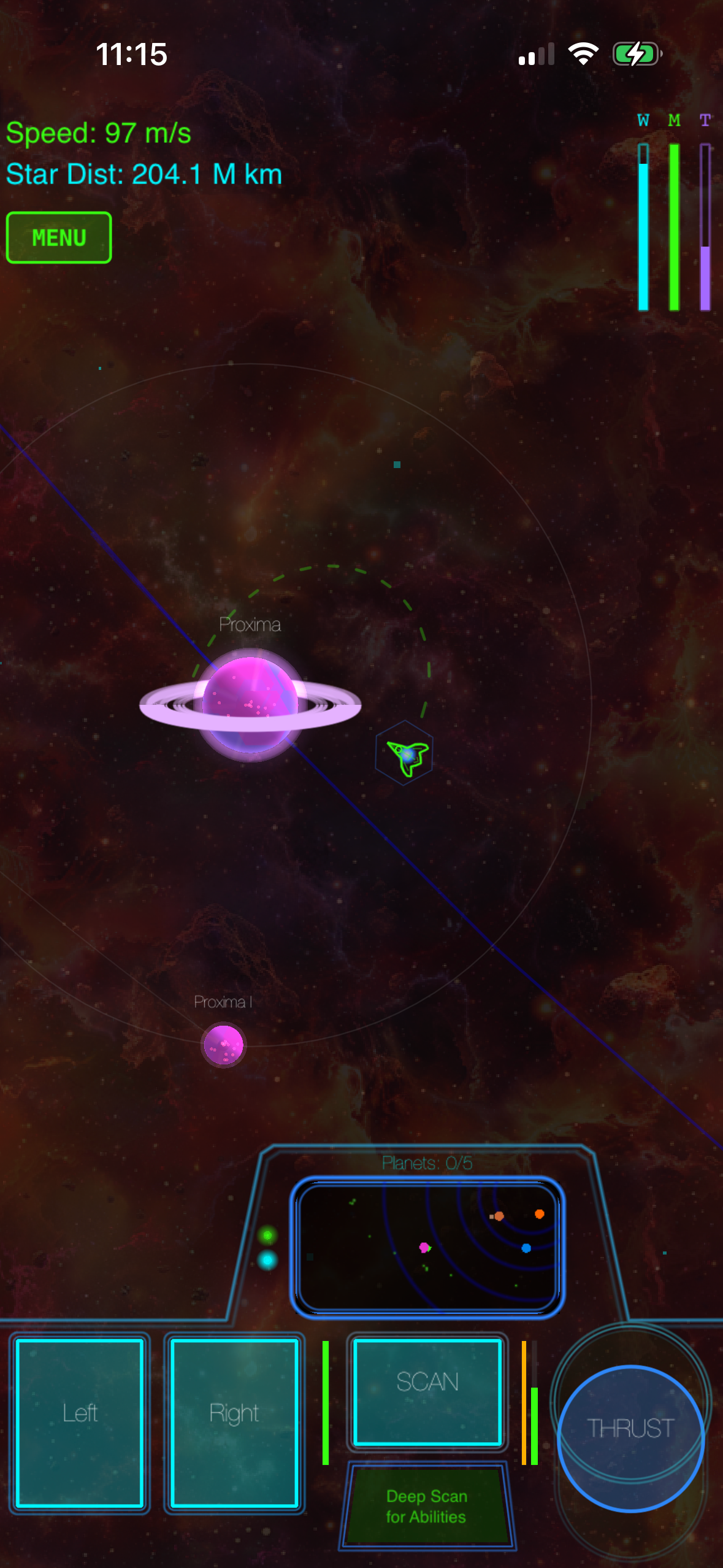 — Slingshot trajectory around a gas giant in Galaximus.
Kerbal Space Program Mobile: The Physics Textbook
If Galaximus is “arcade action with real gravity,” Kerbal Space Program (KSP) is “engineering simulator that happens to be a game.” KSP wants to teach you orbital mechanics the way a physics professor would — with full vehicle assembly, staging, delta-v calculations, and the freedom to build a rocket that’s 90% fuel tank and 10% capsule.
KSP’s learning curve is steeper than Galaximus. You’re not flying a ship; you’re building rockets and managing every stage of launch. But if you want to understand why orbital mechanics work the way they do — not just feel them intuitively — KSP is the only game on iOS that goes that deep.
The trade: KSP is more complex, more time-intensive, and less immediately satisfying. Asteroids fans who want arcade action will find KSP slower. But Asteroids fans who want to understand the physics underneath will find KSP indispensable.
Kerbal Space Program: on the App Store. iOS 11+. iPad compatible. One purchase, no in-app purchases or ads.
No Man’s Sky Mobile: Exploration at Scale
No Man’s Sky on iOS (the mobile version launched in 2024) leans hard into procedural generation and exploration. You land on planets, walk the surface, gather resources, build bases. The universe is genuinely vast — there are billions of procedurally generated planets, and the game wants you to feel small in that vastness.
Where it diverges from Asteroids: No Man’s Sky is about discovery and collection, not piloting mastery. Your ship is a vehicle for reaching new planets, not the focus of the gameplay. The controls are more forgiving; the physics is simplified. If you want to explore alien worlds and build a home base, No Man’s Sky is exceptional. If you want to feel the weight of a ship in a gravity well, it won’t scratch that itch the way Galaximus does.
No Man’s Sky Mobile: on the App Store. iOS 13+. iPad compatible. One purchase, no in-app purchases or ads.
 — Landing on an alien planet in No Man’s Sky Mobile.
Lunar Lander Descendants: Simplicity as a Feature
The original Lunar Lander (1979) was Asteroids’ sibling — same arcade cabinet era, same philosophy of “one mechanic, infinite depth.” You had a lander, fuel, gravity, and the goal to touch down safely. No narrative. No procedural generation. Just physics and consequence.
Modern iOS takes on Lunar Lander keep that purity. Games like Lunar Lander Pro and Lunar Lander X (free with ads; ad-free) are cheaper than premium games like Galaximus, they pick up faster, and they’re perfect for 5-minute sessions. The trade: they’re more puzzle-like than narrative-driven. You’re optimizing a single landing, not exploring a galaxy.
If you want the Asteroids feeling in the smallest possible package, Lunar Lander descendants are worth trying. But they’re more limited in scope — they’re not games you’ll be playing 20 hours later.
Lunar Lander Pro: on the App Store. iOS 12+. Universal. One purchase, no ads or in-app purchases.
Lunar Lander X: Free with ads, or to remove ads. iOS 12+. Universal.
Space Games That Aren’t Action-Based
Among the Stars: Deck-Building in Space
Among the Stars flips the space-game formula. Instead of piloting a ship, you’re building a space station by drafting cards. It’s a multiplayer deck-building game with a sci-fi coat of paint.
If you like the idea of space but want turn-based strategy instead of real-time piloting, Among the Stars is the best iOS version of that experience. But it’s not an Asteroids successor — it’s a different game entirely.
Among the Stars: on the App Store. iOS 10+. Universal. One purchase, no ads or in-app purchases.
Star Realm Mobile: Card Combat, Not Piloting
Star Realm Mobile is another deck-builder, this time focused on combat. You build a fleet of ships by purchasing cards, and you duel opponents (AI or human). Again, it’s not piloting — it’s strategy and resource management.
Like Among the Stars, it’s worth knowing about if you want space-themed gameplay that isn’t action-based. But if you’re chasing the Asteroids feeling — the sense of flying a real ship with weight and inertia — card games won’t deliver that.
Star Realm Mobile: Free with ads and in-app purchases. iOS 10+. Universal. Premium ad-free version available.
Physics as Mastery: What Separates the Good Games from the Mediocre
The best modern Asteroids successors share one trait: they treat physics as the core mechanic, not a flavor.
In mediocre space games, physics is window dressing. Your ship moves because the game says it does. Gravity is a visual effect, not a force that changes your trajectory. Asteroids don’t tumble realistically; they just spin.
In the games worth playing — Galaximus, Kerbal Space Program, the best Lunar Lander games — physics is the interface. You don’t tap a button labeled “dodge.” You manage your velocity and rotation to avoid incoming fire. You don’t tap “accelerate to next planet.” You calculate a slingshot trajectory and commit fuel to it.
This is harder to learn. It’s also harder to monetize (you can’t sell “better physics” as a cosmetic). But it’s the only way to recapture what made Asteroids matter.
The Learning Curve: Why It’s Worth It
Here’s the honest thing: Galaximus has a learning curve. The first 30 minutes feel unintuitive. Your instincts from other games — tap to move, tap to fire — don’t work. You have to think in vectors and trajectories.
This is intentional. The learning curve exists because mastery on the other side of it is worth the climb. After 30 minutes of focused play, you’ll feel the difference between a wasted approach and a perfect slingshot. That feeling — the moment when the physics click — is what makes the game worth playing for hours.
Kerbal Space Program has a steeper curve. Lunar Lander games have almost no curve. Galaximus is in the middle: challenging enough to teach you something real, forgiving enough that you won’t quit in frustration.
If you’re coming from Asteroids, you already know this curve. You learned it in the arcade.
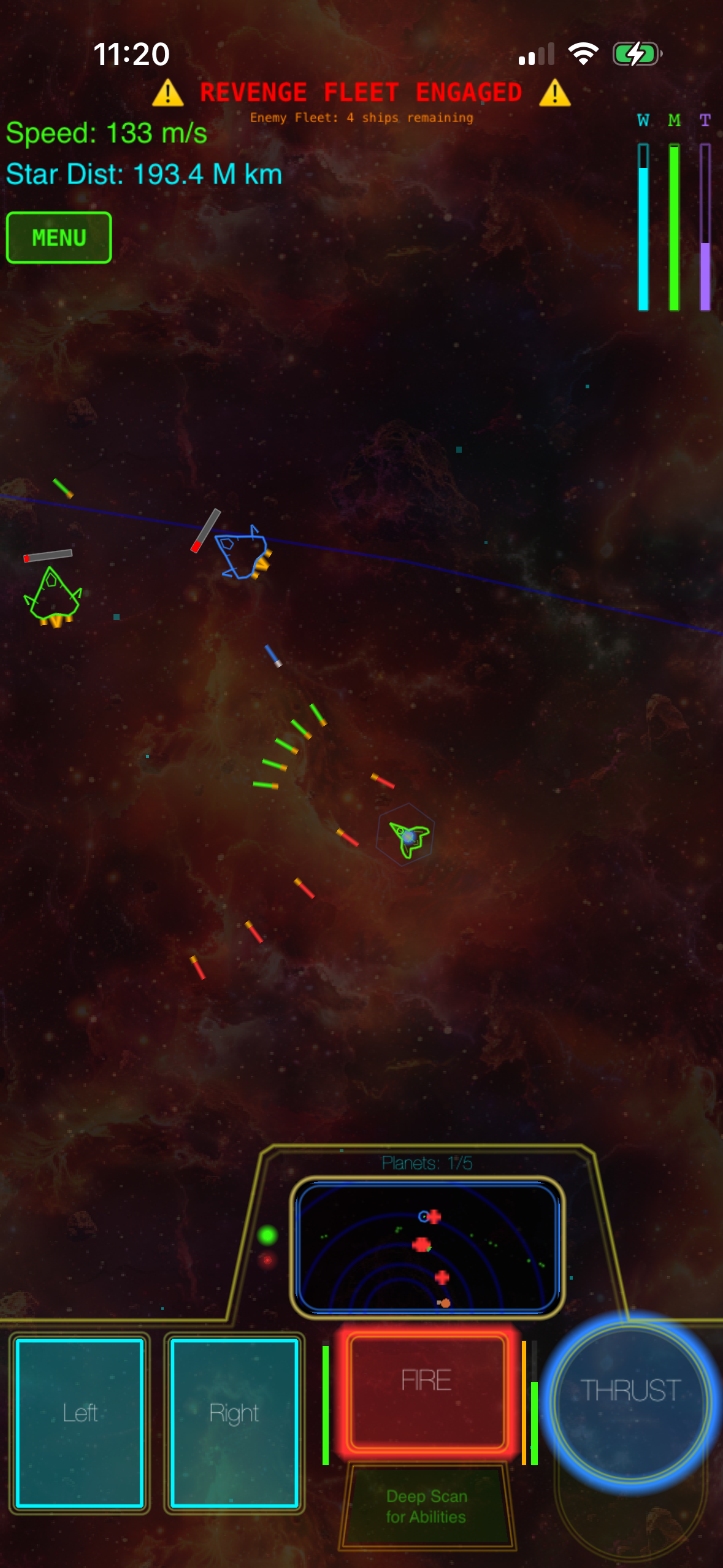 — Real-time combat with physics-based maneuvering in Galaximus.
FAQ
Q: Can I play these games offline?
A: Yes. Galaximus, Kerbal Space Program, Lunar Lander Pro, and Lunar Lander X all run entirely offline. No Man’s Sky Mobile requires an internet connection to generate and sync procedural worlds. Among the Stars and Star Realm Mobile require internet for multiplayer but have offline single-player modes.
Q: What’s the file size for each game?
A: Galaximus is approximately 850 MB. Kerbal Space Program is approximately 1.2 GB. No Man’s Sky Mobile is approximately 2.1 GB. Lunar Lander Pro is approximately 45 MB. Among the Stars is approximately 120 MB. Star Realm Mobile is approximately 180 MB. Check your device’s available storage before downloading.
Q: Does it work on iPad?
A: Galaximus, Kerbal Space Program, and No Man’s Sky Mobile are all iPad-compatible and optimized for larger screens. Lunar Lander Pro, Lunar Lander X, Among the Stars, and Star Realm Mobile are universal apps that work on both iPhone and iPad but are optimized for iPhone.
Q: Are there in-app purchases?
A: Galaximus, Kerbal Space Program, Lunar Lander Pro, No Man’s Sky Mobile, and Among the Stars have no in-app purchases. Lunar Lander X is free with ads; the purchase removes ads but doesn’t unlock additional content. Star Realm Mobile is free with ads and in-app cosmetics; a premium version removes ads.
Q: Do I need to understand orbital mechanics to play Galaximus?
A: No. The game teaches you as you play. The first system is a tutorial. By the time you reach the second system, you’ll understand slingshots and gravity wells intuitively, even if you couldn’t explain them mathematically.
Q: Why are premium space games so rare on iOS?
A: Free-to-play games are easier to monetize. Premium games require the developer to make something good enough that people will pay upfront. Most publishers don’t take that risk. The developers who do are betting that there’s an audience that prefers a complete game to an endless grind.
Q: What’s the difference between Galaximus and Kerbal Space Program?
A: KSP is a rocketry simulator where you build vehicles and manage every stage of flight. Galaximus is an arcade-action game where you pilot a single ship and use gravity as your engine. KSP teaches you orbital mechanics from first principles. Galaximus teaches you to feel them. Both are legitimate; they’re just different games.
The Bottom Line
If you’re looking for a modern Asteroids successor on iOS, you have real options in 2026. Kerbal Space Program is deeper. No Man’s Sky is broader. Lunar Lander games are simpler.
But if you want the feeling of flying a real ship through a gravity well, with physics you can trust and a narrative that pays off, Galaximus is built for that. One purchase. No ads. Real orbital mechanics. A complete campaign with a beginning, middle, and end.
The learning curve is real. The payoff is worth it.
Galaximus is available on the App Store for. The campaign is complete and playable today. iOS 14+. iPad compatible.