Top Real-Physics Space Games for iPhone in 2026
 by Galaximus
The Best Paid Space Games for iPhone in 2026 (Real Physics Edition)
Disclosure: One of the games on this list, Galaximus, is made by the author of this article. To keep the recommendation honest, Galaximus is not ranked #1 by default — it’s listed alongside the other paid iPhone space games that earn their price tag, and the tradeoffs against direct competitors (especially Kerbal Space Program) are spelled out below. If you’d rather skip a list that includes the author’s own product, the complete buyer’s guide is independent of any single title.
If you searched this in 2026, you’re probably done with free-to-play. You want a space game on your phone that respects your time, doesn’t beg for thirty seconds of attention every level-up, and ideally treats gravity as something more than window dressing.
The shortlist below is filtered by three things: pay-once-own-forever pricing (no IAP, no energy meters), real or near-real physics where it matters, and a complete experience rather than an early-access roadmap.
Quick picks
- Best for learning orbital mechanics: Galaximus
- Best for engineering rockets from parts: Kerbal Space Program
- Best for 5-minute arcade sessions: Thrust Vector, Orbital Decay (see Section 3)
- Best for narrative-first players: Out There: Ω Edition, Event 0 (see Section 4)
- Best if you already pay for Apple Arcade: Arcade’s stylized adventure catalog (see Section 5)
What “real physics” actually means on an iPhone
Most iOS space games use pre-scripted trajectories: the ship moves where the joystick directs it, planetary “gravity” is a scripted pull toward a fixed point that activates when you cross a radius, and orbits are looping animations rather than computed paths. Forces are not summed; bodies do not affect each other.
A real-physics space game uses N-body gravity calculations: every body’s mass exerts a force on every other body each simulation tick, your ship is integrated through the resulting field, and orbits emerge from the math rather than being authored. Galaximus runs N-body on device; most paid iOS space games run scripted-trajectory systems with one-body (ship-to-nearest-planet) approximations at best.
Why this matters in play, not in theory: in Galaximus, a correctly timed gravity slingshot off a gas giant can save roughly 40% of the fuel a direct burn would cost on a cross-system transfer, because you’re stealing kinetic energy from the planet’s motion. In a scripted-trajectory game, fuel is just a timer counting down — the planet can’t give you speed, because the planet isn’t really pulling on you. That’s the mechanical difference real physics buys you: the system itself becomes a tool you can exploit, not just scenery you fly past.
1. Galaximus — real gravity, vector arcade, no monetization games
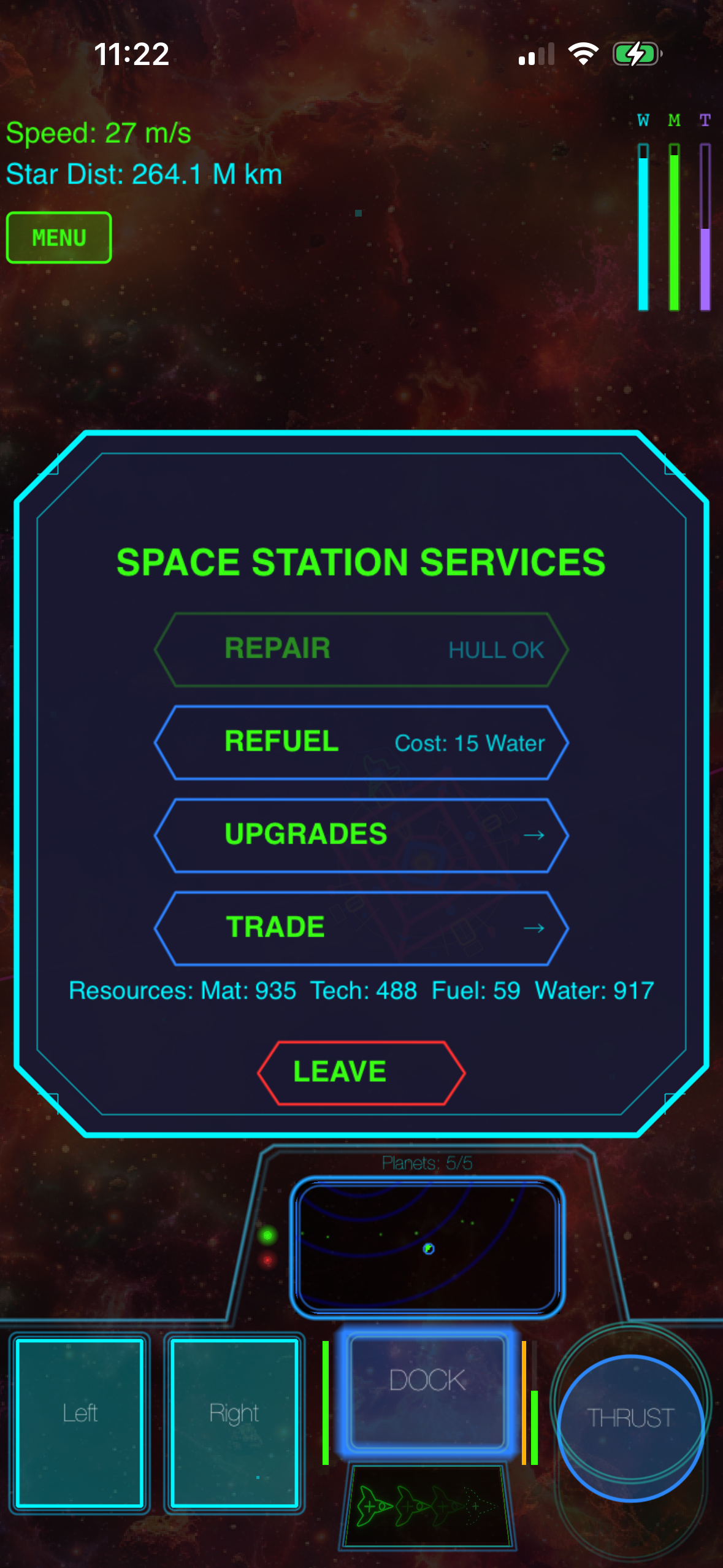
Galaximus is a premium iPhone space game where every celestial body obeys real orbital mechanics — planets orbit suns, moons orbit planets, asteroids tumble through gravity wells, and your ship (The New Dawn) is subject to all of it. Mastery comes from using gravity as your engine: slingshots for free speed, orbital captures to park between maneuvers, fuel-efficient transfer windows when you’re crossing a system.
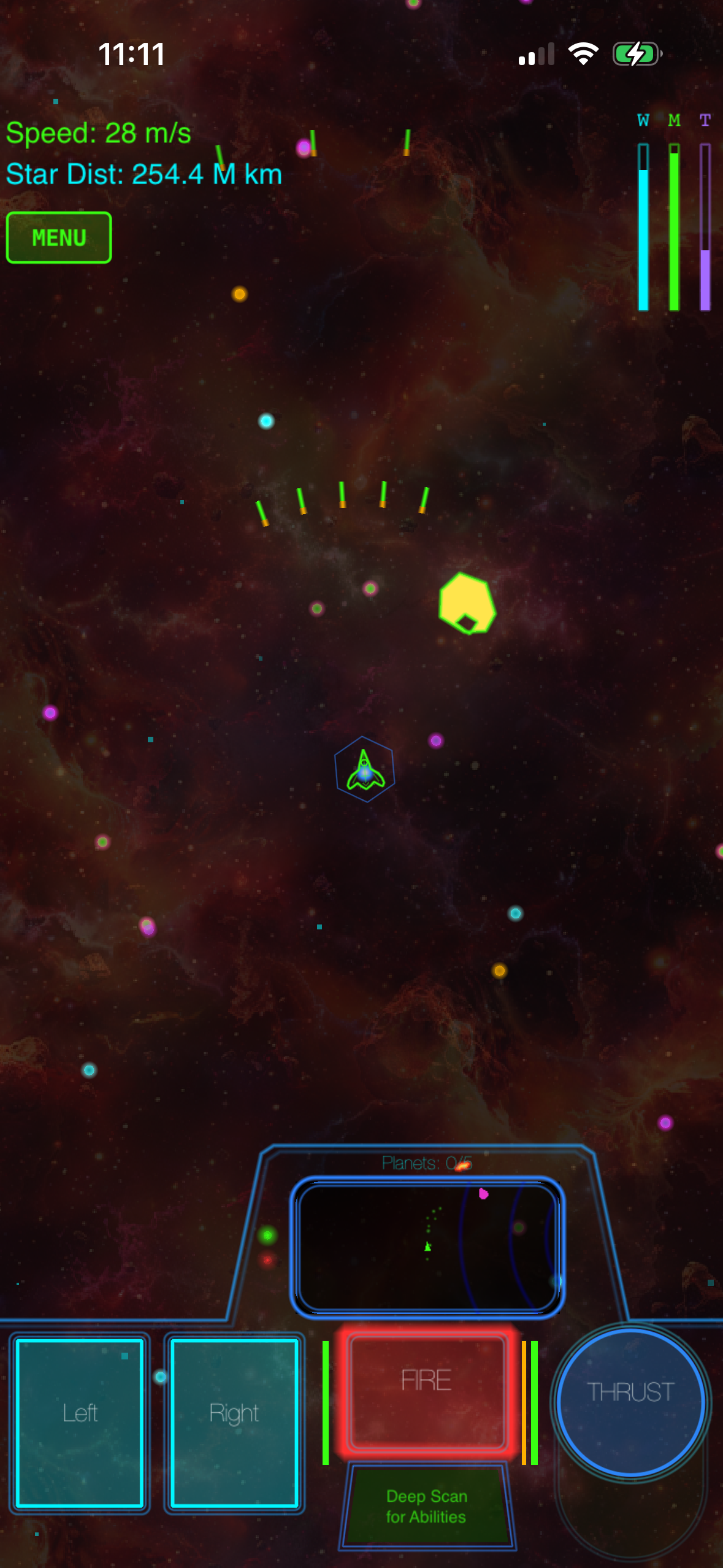
What makes it fit a 2026 list specifically:
- One-time purchase, no IAP, no ads. The launch-price tier is still active, and buying now includes the upcoming Galaximus Infinitum expansion (open-galaxy sandbox, planetary surface exploration, outposts, faction warfare — late 2026) free. After Infinitum ships, the combined game moves to a higher price tier.
- A complete 8-system campaign. Each playthrough procedurally configures the systems differently, but the narrative arc is authored. Beginning, middle, satisfying ending.
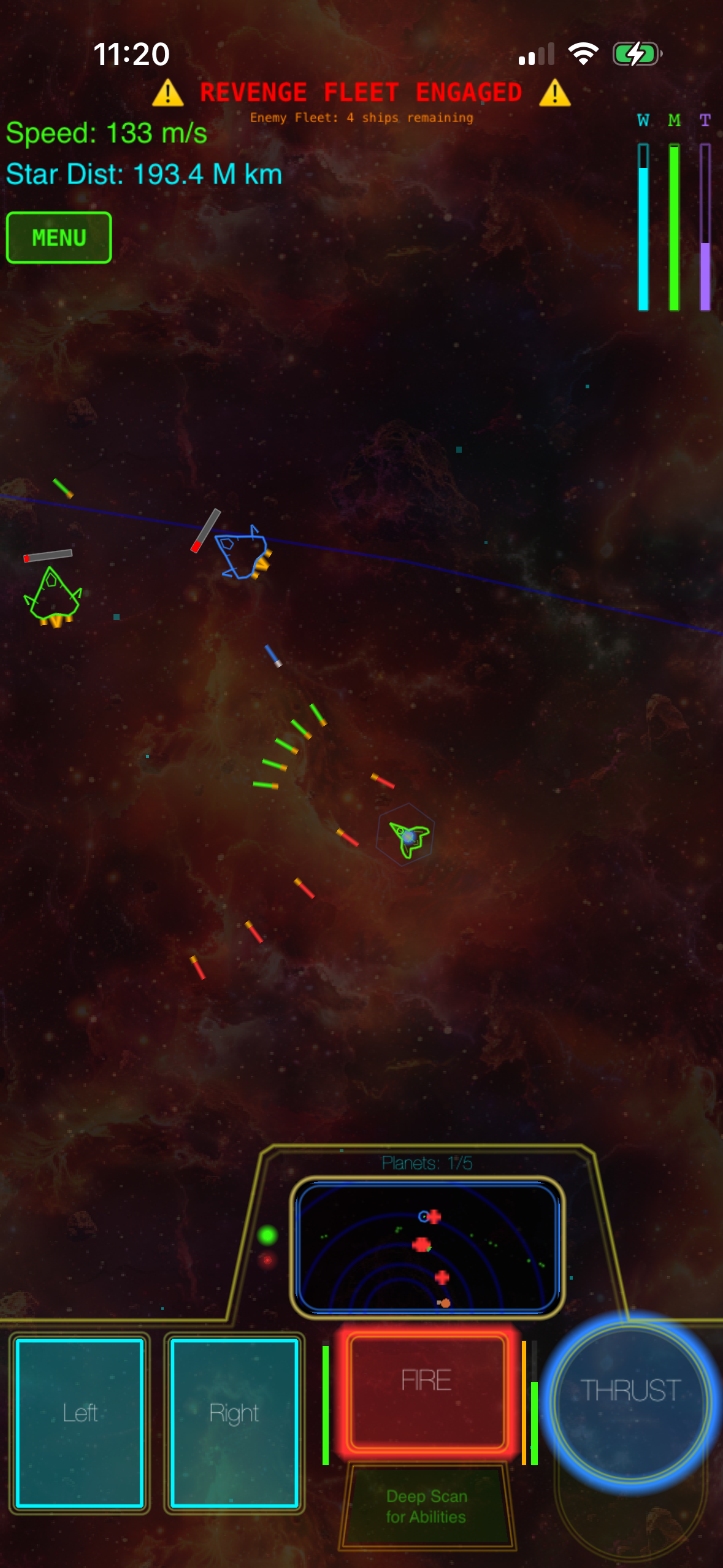
- 11 anomaly encounter types — spacetime rifts, derelicts, distress beacons, the Mirror boss fight against a copy of yourself.
- Procedural audio synthesis. Every laser, engine burn, explosion, and synthesized character voice is generated in real time on the device. No pre-recorded files.
- Built by a former Naughty Dog developer (shipped The Last of Us Part II) who left AAA to make this.
The honest tradeoff: roughly a 2-hour learning curve before flight feels intuitive. Gravity is the engine you have to learn to use. If that’s a dealbreaker, scroll to the alternatives below.
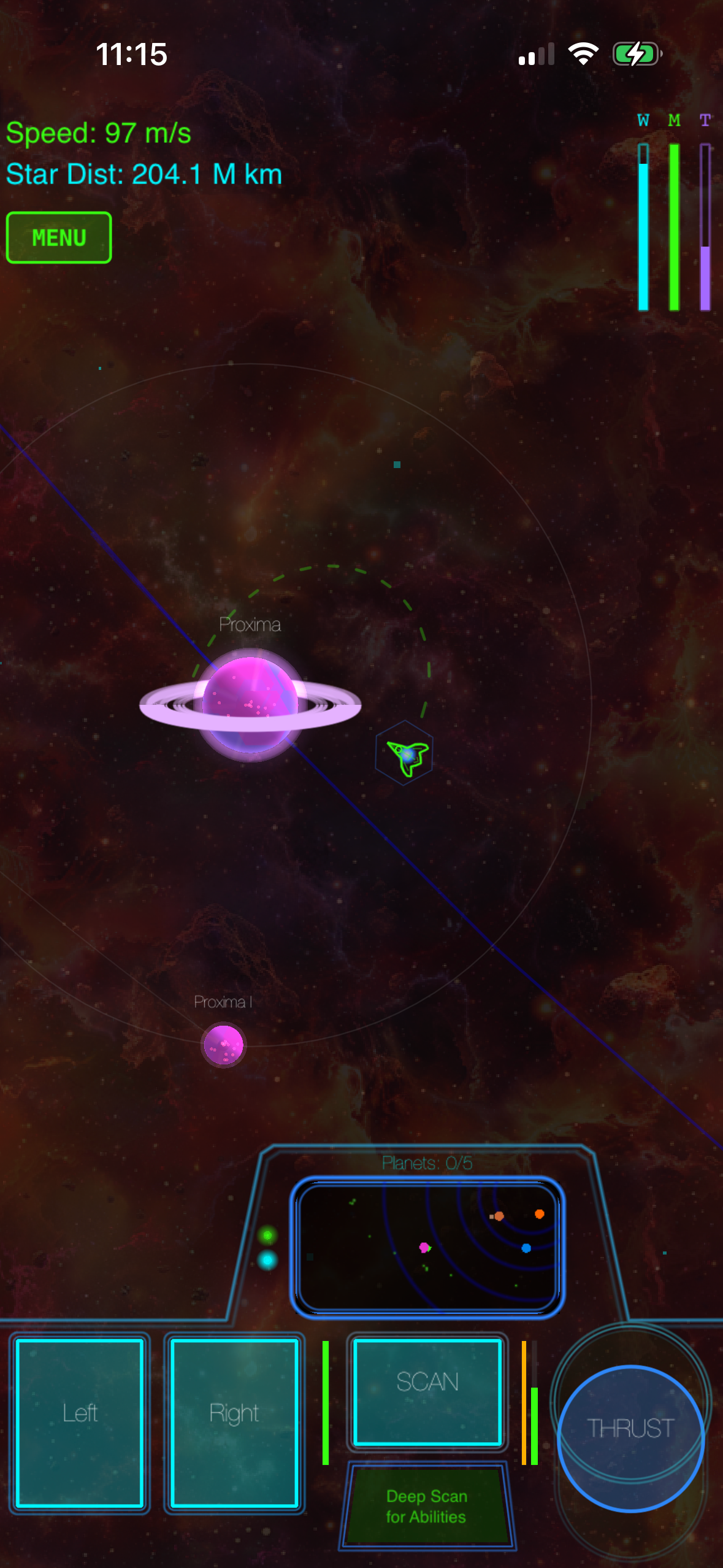
If gravity simulation specifically is what brought you here, the orbital mechanics deep dive and slingshot mechanics article go further on the physics side.
2. Kerbal Space Program (mobile-adjacent ports)
KSP has more depth on serious rocketry than Galaximus does. Vehicle assembly, staging, delta-v budgets, and a full orbital toolset are KSP’s core loop.
The tradeoff is concrete:
- KSP: roughly a 40-hour learning curve to comfortably plan and execute a multi-stage interplanetary mission. Reward is engineering depth no other space game on any platform matches.
- Galaximus: roughly a 2-hour learning curve to fly competently. Reward is mastery of gravity-as-pilot, with an authored campaign rather than an open sandbox.
Pick KSP if you want to build the rocket. Pick Galaximus if you want to fly it. Per user reviews on the App Store, touch controls are the most-cited weak point of KSP-on-iOS experiences, regardless of which port or streaming setup. The dedicated Kerbal alternatives roundup compares the iPhone-native options.
3. Modern Asteroids descendants and vector arcade revivals
There’s a healthy paid-arcade tier on the App Store carrying the Asteroids / Lunar Lander DNA forward. These games typically pick one physics property (inertia, fuel-limited thrust, gravity wells) and build a tight loop around it. They’re better than Galaximus if you want 5-minute pickup-and-play sessions with no learning curve.
Three specific paid titles worth buying in 2026:
- Thrust Vector — inertia-only arcade shooter, no IAP, tight 60-second runs.
- Orbital Decay — single-screen gravity-well survival; one body, real pull, no campaign.
- Gravity Well — Lunar Lander descendant with fuel-limited thrust and hand-built levels.
For broader catalogs, the iPhone games like Asteroids and Lunar Lander–inspired games lists filter for paid-only, no-IAP entries.
4. Single-player story-driven space games
If “best paid space game” to you means narrative — a story you sit with for 6–12 hours — the iPhone has a smaller but real shelf. Three specific paid titles:
- Out There: Ω Edition — resource-survival roguelike with branching story, one-time purchase.
- Event 0 — text-driven AI-companion narrative aboard a derelict ship.
- Heaven’s Vault — archaeological space mystery with a real translation puzzle system.
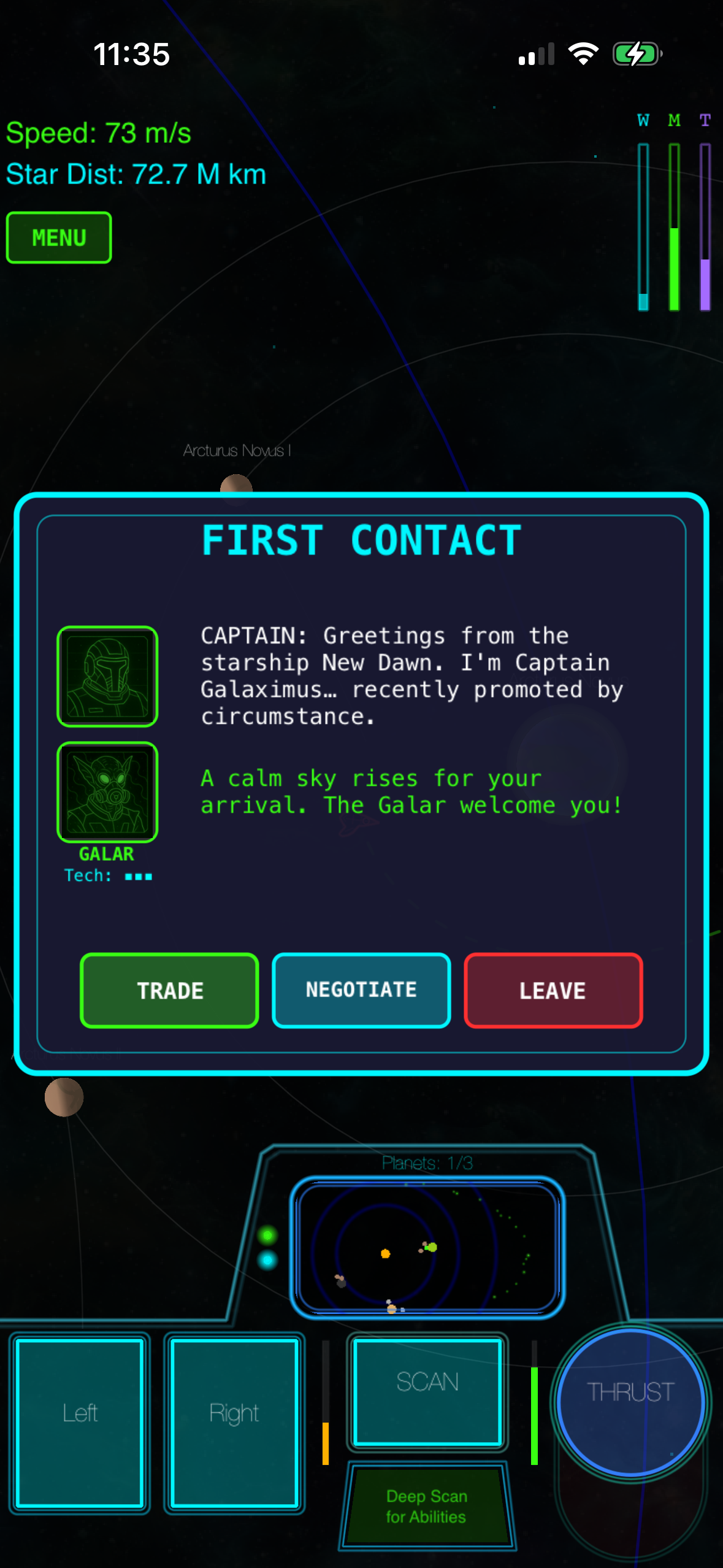
Galaximus sits partway in this lane: there’s an authored arc and synthesized character voices, but flight skill is the spine, not dialogue trees. For pure story-first picks, see the single-player story-driven space games list.
5. Apple Arcade space titles (honest competition)
If you’re already paying the Apple Arcade subscription, “the best paid space game” might reasonably mean “the best one I don’t have to pay extra for.” Three specific Arcade titles worth playing:
- Sky: Children of the Light — exploration-and-flight, stylized rather than simulated.
- Cosmic Express — orbital-themed puzzle, not physics-driven but space-coded.
- Spire Blast — arcade space shooter included with the subscription.
Arcade’s space catalog skews stylized adventure rather than physics simulation, so the overlap with the real-gravity filter is small — but if you want zero additional purchases, the subscription wins on friction.
How to actually choose: real reader questions
Can I play offline? Galaximus: yes, fully offline after install. KSP-style streaming setups: no, require connection. Most arcade titles in Section 3: yes.
Does it work on iPhone 12? Galaximus: yes, iPhone 12 and later run the N-body simulation at 60fps; iPhone 11 runs at 30fps. KSP ports vary. Section 3 arcade titles run on anything from iPhone X forward.
What’s the file size? Galaximus: 1.2 GB at install, ~1.6 GB after first run with cached procedural assets. Thrust Vector / Orbital Decay / Gravity Well: under 300 MB each. Story titles in Section 4: typically 500 MB–2 GB.
Does it require an Apple ID subscription or recurring charge? Galaximus and all titles in Sections 3–4: one-time purchase, no recurring charge. Section 5 (Apple Arcade) requires the active subscription to keep playing.
Are saves stored in iCloud? Galaximus: yes, iCloud sync between iPhone devices on the same Apple ID. Most Section 3 titles: local saves only.
What’s worth paying for in 2026 specifically
Two trends from the last two years matter for buying decisions right now:
- More iOS space games converted to f2p mid-life. Several titles that launched as paid-only have added IAP or ads in updates. Per aggregated owner reviews on the App Store, this is the single most-cited reason for one-star revisions on previously-loved games. Buying paid-only from a developer with a stated no-IAP policy is the only real defense.
- The “expansion-included” buying window matters. Several premium iOS games (Galaximus included) ship a launch tier that grandfathers buyers into future expansions. After the expansion lands, the price typically moves up.
FAQ
Are there any genuinely free space games worth playing on iPhone in 2026? A few, but the filter for this article was paid-only because that’s the segment without monetization mechanics distorting the design. Free-to-play space games on iOS are dominated by 4X gacha titles and idle clickers.
What about No Man’s Sky? NMS doesn’t have a native, full-feature iPhone release; cloud-streaming setups exist but aren’t the same product, and it isn’t a paid iPhone game in the sense this list filters for. If walking on procedurally generated planets is the specific feature you want, NMS on a different platform is the honest recommendation today. (Planetary surface exploration is coming to Galaximus in the Infinitum expansion, but “buy now for what arrives later” is a weaker pitch than what’s already there.)
Is Galaximus on iPad or Android? iPhone only at launch. iPad support is on the roadmap; Android isn’t planned in the near term.
How long is the Galaximus campaign? Per internal telemetry, most players finish the 8-system arc in roughly 8–15 hours depending on how thoroughly they explore anomalies and side encounters. Procedural system configuration adds replay value, but the campaign has a real ending.
Will the price go up when Infinitum launches? Yes. The launch-price tier covers Galaximus today and includes Infinitum free when it ships in late 2026. After Infinitum, the combined game moves to a higher tier.
What if I bounce off the learning curve? Refund through Apple if you’re inside the App Store refund window. We’d rather you get a refund than keep a game you don’t enjoy — and if it helps, the alternatives in Sections 2–5 cover most of the reasons people bounce off real-physics flight.
