Best Paid iPhone Space Games Under $5 in 2026
 by Galaximus
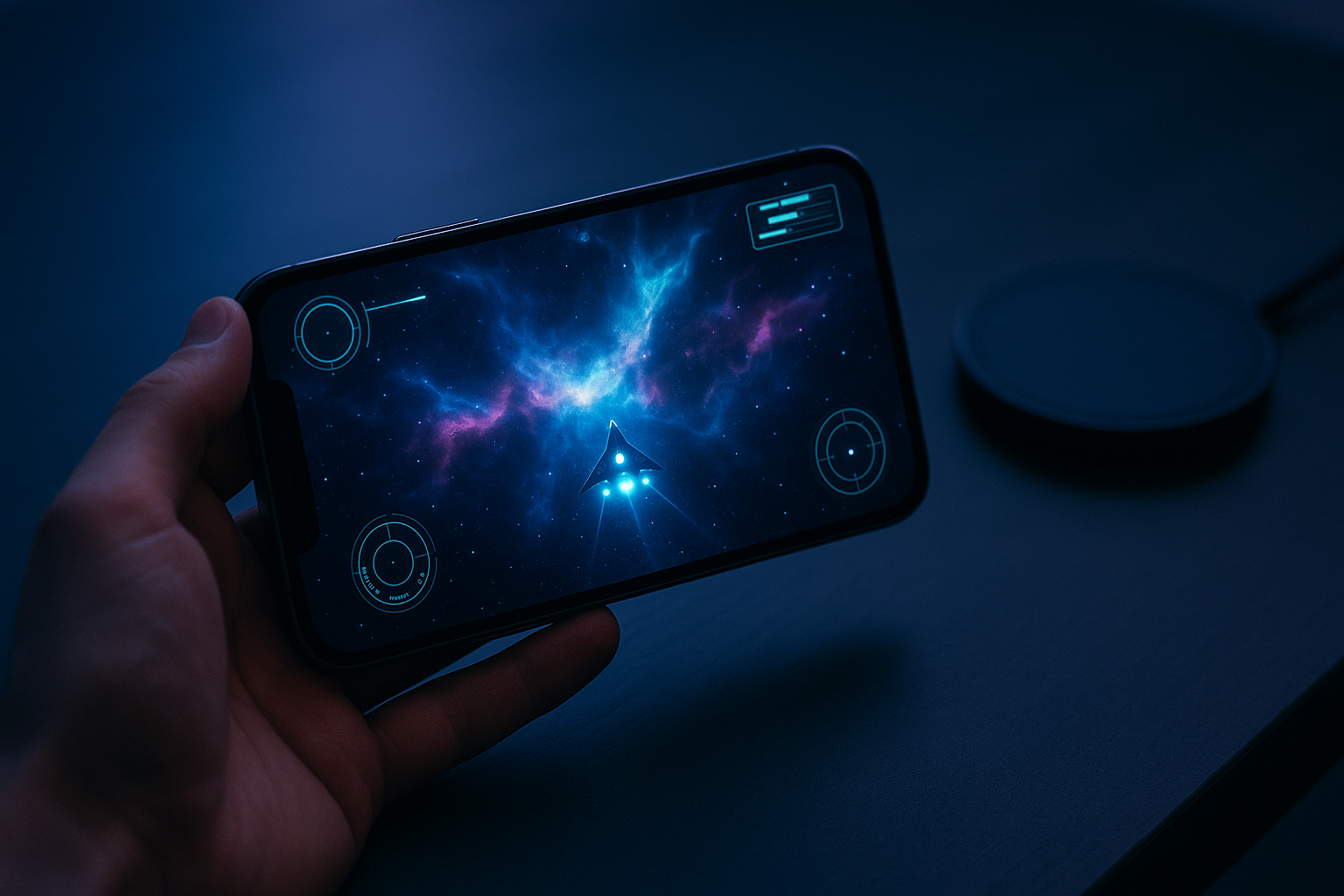
Best Paid iPhone Space Games Under $5 in 2026
The premium mobile game market has contracted. Free-to-play dominates storefronts, battle passes stretch across every genre, and energy meters gate progression. But a small category of space games still ships complete: no ads, no in-app purchases, no energy timers. Just pay once and own forever.
If you’re hunting for a space game that respects your time and money, the 2026 lineup is smaller than it was five years ago—but what remains is genuinely worth playing. Here’s what you should know.
What Makes a Space Game Worth $5?
The price point matters less than the promise. A game that nickels you with IAP and ads isn’t a deal—it’s a trap with a premium price tag slapped on. A true premium space game at or delivers:
- A complete campaign. Beginning, middle, end. Not a soft launch waiting for content patches.
- No monetization after purchase. No ads between sessions. No premium currency. No battle pass.
- Physics or mechanics that reward mastery. Something that takes 20–30 minutes to learn and hours to master.
- Replayability built in. Procedural generation, branching outcomes, or multiple paths through the same world.
By those standards, the sub- premium space-game shelf is lean but honest.
Galaximus: Real Gravity, Real Mastery
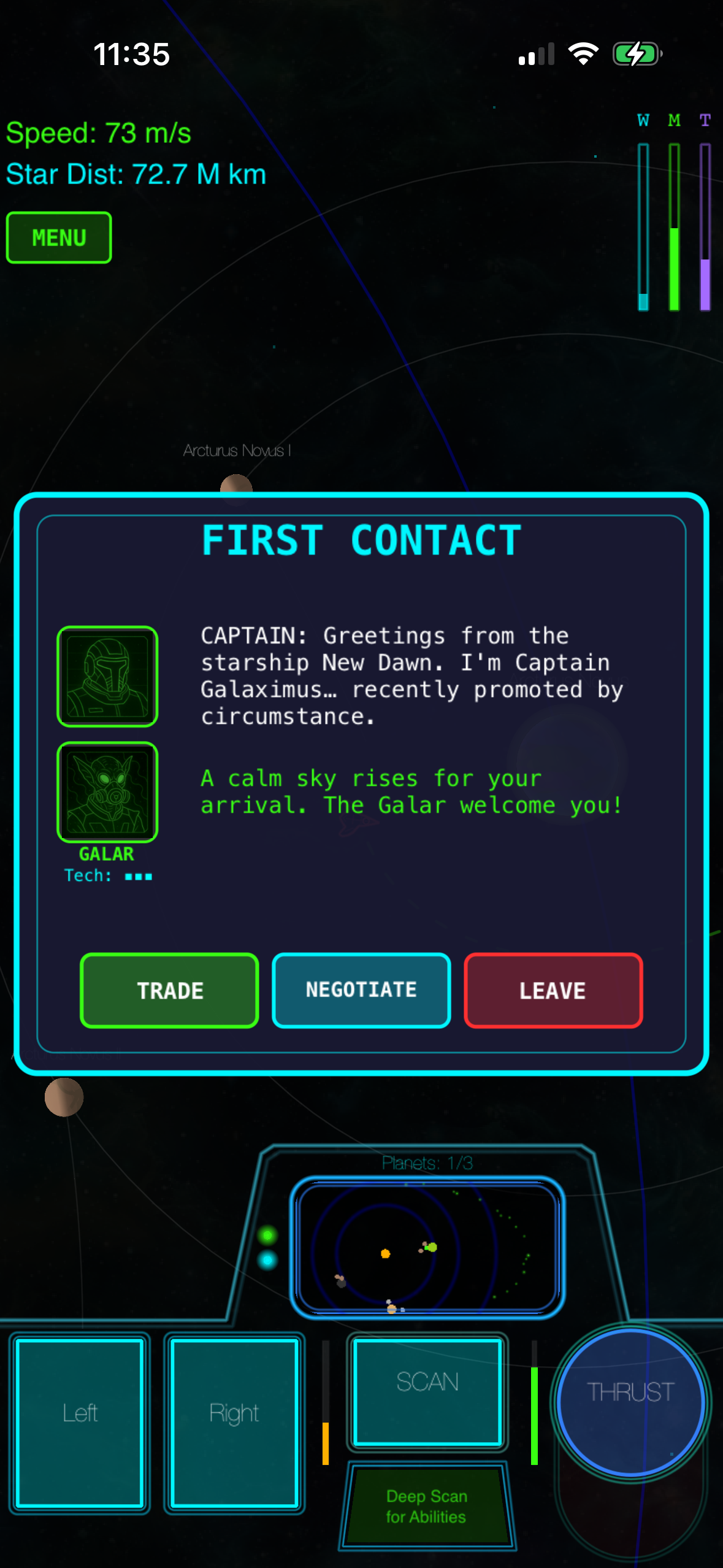
Galaximus centers on a single mechanic: every body’s gravity affects every other body in real time. Your ship, The New Dawn, is subject to the same physics as planets, asteroids, and star systems. Slingshots work. Orbital captures work. Fuel-efficient transfer windows work. The physics is the interface you use to fly.
The campaign spans eight procedurally configured star systems. Each playthrough generates unique planet positions, moon orbits, and asteroid fields. You’ll encounter anomalies—derelict ships, distress beacons, spacetime rifts—that serve as mini-experiences within the larger arc. The Mirror, a boss fight against a copy of yourself, punctuates the narrative at the midpoint.
The learning curve is honest. If you want a game you can play while half-watching TV, Galaximus will frustrate you for the first 30 minutes. If you want a game that rewards understanding how gravity works, it’s built for you.
Galaximus runs on iPhone 13 and later, iPad Pro (2017 and later), and iPad Air 2 and later. System requirements for competing games vary—see individual entries below.
Kerbal Space Program Mobile: The Engineering Route
Kerbal Space Program Mobile is the engineering simulator. You assemble rockets from component parts, manage fuel ratios, and plan orbital transfers with precision tools. The learning curve is steeper—it’s genuinely a game about teaching you rocket science—but the payoff is depth.
KSP Mobile runs on iPad and iPhone (iOS 14.4+), though iPad is the intended experience. The controls are dense and the UI assumes screen real estate. On iPhone, it’s playable but cramped.
The honest comparison: KSP wants to teach you to be an engineer. Galaximus wants you to fly. Both are legitimate goals. KSP has more depth on the engineering side; Galaximus has faster feedback loops and a structured narrative arc.
Among the Stars: Card-Driven Space Exploration
Among the Stars is a digital adaptation of the board game—deck-building, turn-based, no real-time pressure. You’re colonizing star systems by drafting cards representing space stations, research labs, and defense platforms. The campaign spans 15 scenarios with escalating difficulty. It’s more puzzle than action, more cerebral than kinetic.
No ads, no IAP. The replayability comes from randomized card draws and multiple paths to victory. The game plays well on iPhone. The card-based interface scales to smaller screens better than KSP’s dense menus. If you’re commuting or have pockets of 10–15 minutes, Among the Stars fits better than a game requiring sustained focus.
Runs on iPhone XS and later, iPad (5th generation and later).
Star Realm Mobile: Deck-Building Combat
Star Realm Mobile is a competitive deck-builder where you’re buying cards to build a space fleet and attack your opponent. The single-player campaign faces you against AI opponents with escalating decks. Each run is a fresh deck-building puzzle that takes 5–10 minutes.
No ads, no IAP. The gameplay is tight and genuinely pick-up-and-play. The learning curve is gentle compared to Galaximus or KSP.
The trade-off: it’s not about space exploration or piloting. It’s about resource management and card synergy. The space theme is flavor; the game is about deck construction. If that appeals to you, it’s a solid spend.
Runs on iPhone 11 and later, iPad (7th generation and later).
Asteroids: The Arcade Ancestor
Asteroids (multiple premium versions available, typically ) is the arcade ancestor. Destroy asteroids, avoid collisions, manage a limited fuel supply. No story, no progression, just pure arcade reflex.
Modern Asteroids remakes often add procedural generation, power-ups, or endless-mode scoring. Some are free with ads; some are premium. Look for versions explicitly labeled “premium” or “paid” with no in-app purchases mentioned.
Asteroids is faster to pick up than Galaximus or KSP, and that’s a feature. If you want a game you can play in a dentist’s waiting room without cognitive load, Asteroids fits. If you want mastery and depth, it won’t satisfy you for long.
Lunar Lander Descendants: Physics-Based Precision
Several premium Lunar Lander-inspired games exist on the App Store: Lunar Lander+ , Lunar Lander Pro , and others. These are gravity-based landing puzzles where you manage thrust and fuel to touch down safely on multiple planets with escalating difficulty. Most campaigns include 20–50 levels.
These games live in a sweet spot: simpler than KSP (you’re not building rockets, just piloting), faster than Galaximus (single-landing puzzles rather than multi-system campaigns), but still rewarding mastery. The quality is consistent across premium versions—check the App Store description to confirm “no ads” and “no in-app purchases” before buying.
What to Look for When Evaluating a Space Game
Before you spend, ask yourself:
- Do I want action or strategy? Real-time piloting (Galaximus, Asteroids, Lunar Lander) or turn-based planning (Among the Stars, Star Realm Mobile)?
- How much learning curve am I willing to accept? Instant gratification (Asteroids) or 30 minutes of focused play to unlock mastery (Galaximus)?
- Do I want a campaign or a sandbox? A structured story with a beginning and end (Galaximus, KSP’s career mode), or endless play (Asteroids, Star Realm Mobile’s endless runs)?
- What’s my session length? Quick bursts (Star Realm Mobile, Asteroids) or 1–2 hour campaigns (Galaximus)?
Honest answer: Galaximus isn’t the right choice for everyone. If you want a game you can play in three-minute sessions without thinking, it will frustrate you. If you want a physics sandbox where you can build and experiment endlessly, KSP is deeper. If you want pure turn-based strategy, Among the Stars and Star Realm Mobile don’t have the real-time pressure.
But if you want a space game where gravity is the engine you learn to use, where a complete campaign has a narrative arc, and where the physics rewards patient positioning over twitch reflexes, Galaximus is built for that.
FAQ
What’s the actual price of Galaximus? at launch. After the Infinitum expansion releases in late 2026, the combined game moves to. If you buy now, you get Infinitum free when it ships.
Is Galaximus harder than Kerbal Space Program? Different kind of hard. KSP is harder to understand (rocketry is complex). Galaximus is harder to execute (gravity is the interface, and you need to learn it). KSP teaches you physics; Galaximus lets you use physics.
Can I play these games offline? Yes. Galaximus, KSP Mobile, Among the Stars, and Star Realm Mobile all support offline play with no server dependency.
Will these games run on my iPhone? Galaximus requires iPhone 13 and later. KSP Mobile requires iOS 14.4+. Among the Stars requires iPhone XS and later. Star Realm Mobile requires iPhone 11 and later. Asteroids and Lunar Lander variants vary—check the App Store listing for your device.
Does Galaximus have multiplayer? No. Galaximus is single-player campaign only. Star Realm Mobile has asynchronous multiplayer (play against AI or pass-and-play with friends).
Why are some games more expensive than others? Price reflects development scope and monetization model. Galaximus and KSP Mobile are complete with no ongoing extraction. Cheaper games like Among the Stars and Star Realm Mobile are smaller in scope or adaptations of existing designs. All are premium with no ads or IAP.
The Premium Space Game Still Exists
The premium space game is a relic of an older mobile-gaming era, but it hasn’t died. Galaximus, Kerbal Space Program Mobile, Among the Stars, and Star Realm Mobile prove that there’s still an audience willing to pay for complete experiences. The shelf is smaller than it was a decade ago, but what’s on it is honest.
If you’ve been waiting for a space game that doesn’t nickel-and-dime you, that doesn’t interrupt your gameplay with ads, and that respects your time as much as your money, 2026 is the year to buy one.