Best Paid iOS Space Games 2026: Premium Without Compromise
 by Galaximus
Best Paid iOS Space Games 2026: Premium Without Compromise
The App Store’s free-to-play dominance makes premium space games feel endangered. But they’re not extinct—they’ve just gotten better. In 2026, the paid space game category on iPhone offers a small collection of titles that respect your time and your wallet. No energy meters. No battle passes. No ads between your gameplay sessions.
If you’re hunting for a space game you can buy once and own forever, this guide reviews the actual premium options available and helps you choose based on gameplay style, learning curve, and price.
Premium Space Games Available on iOS in 2026
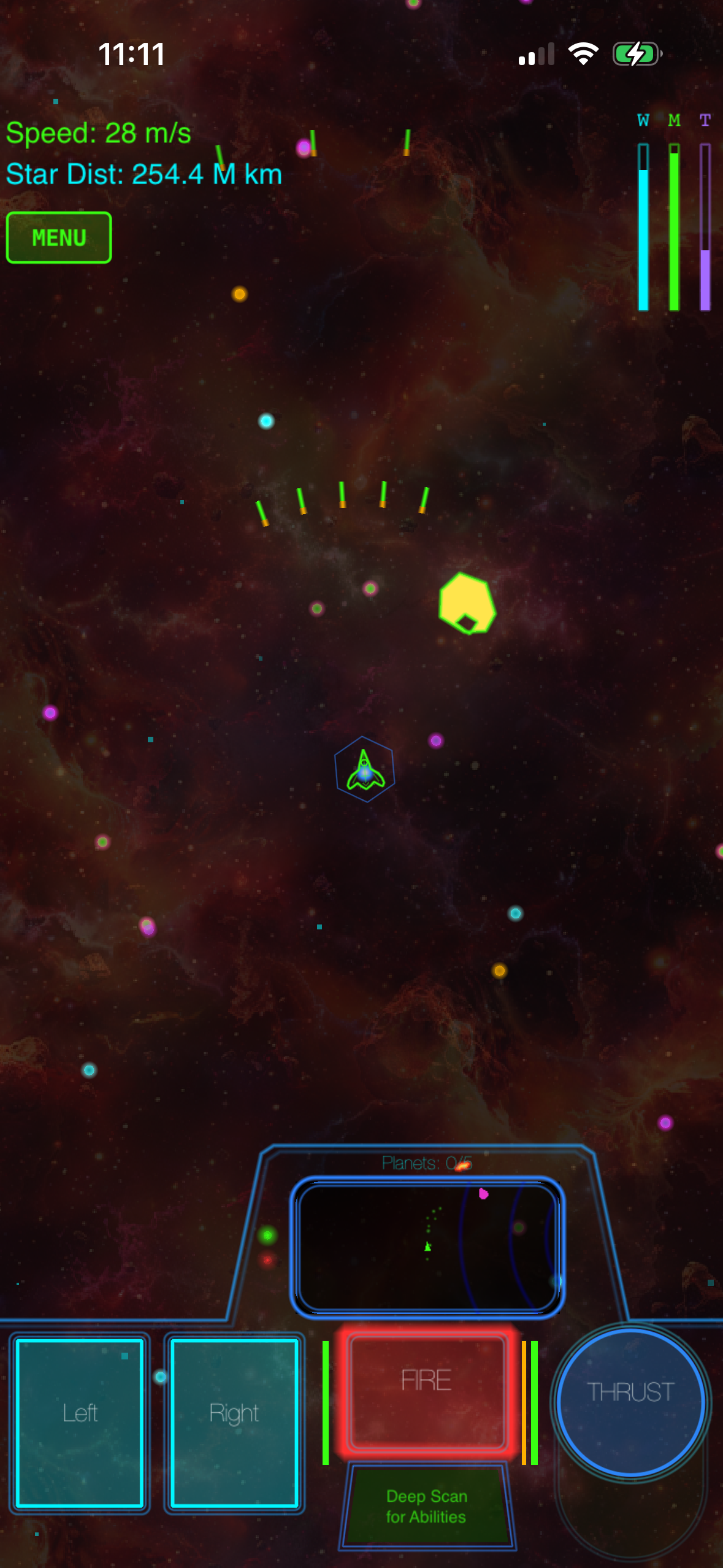
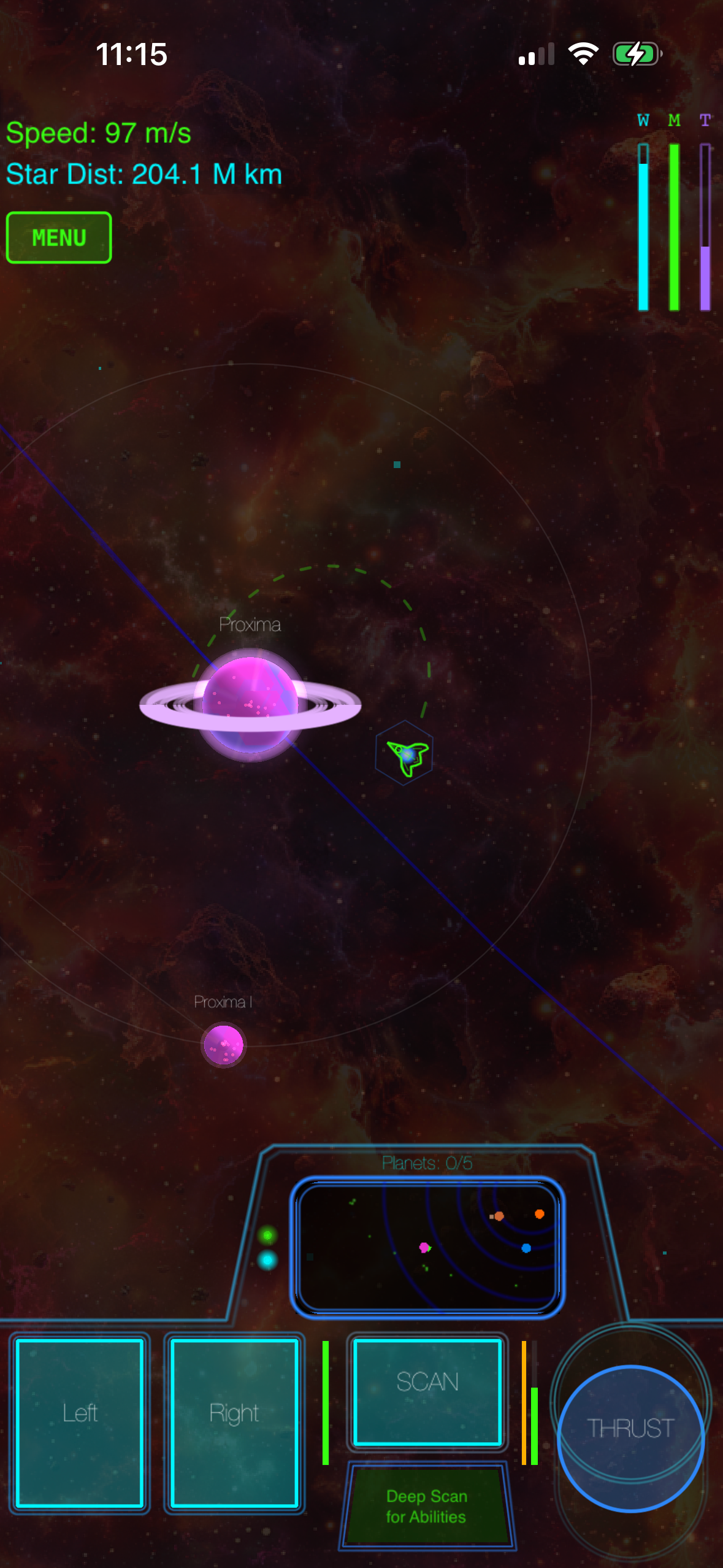
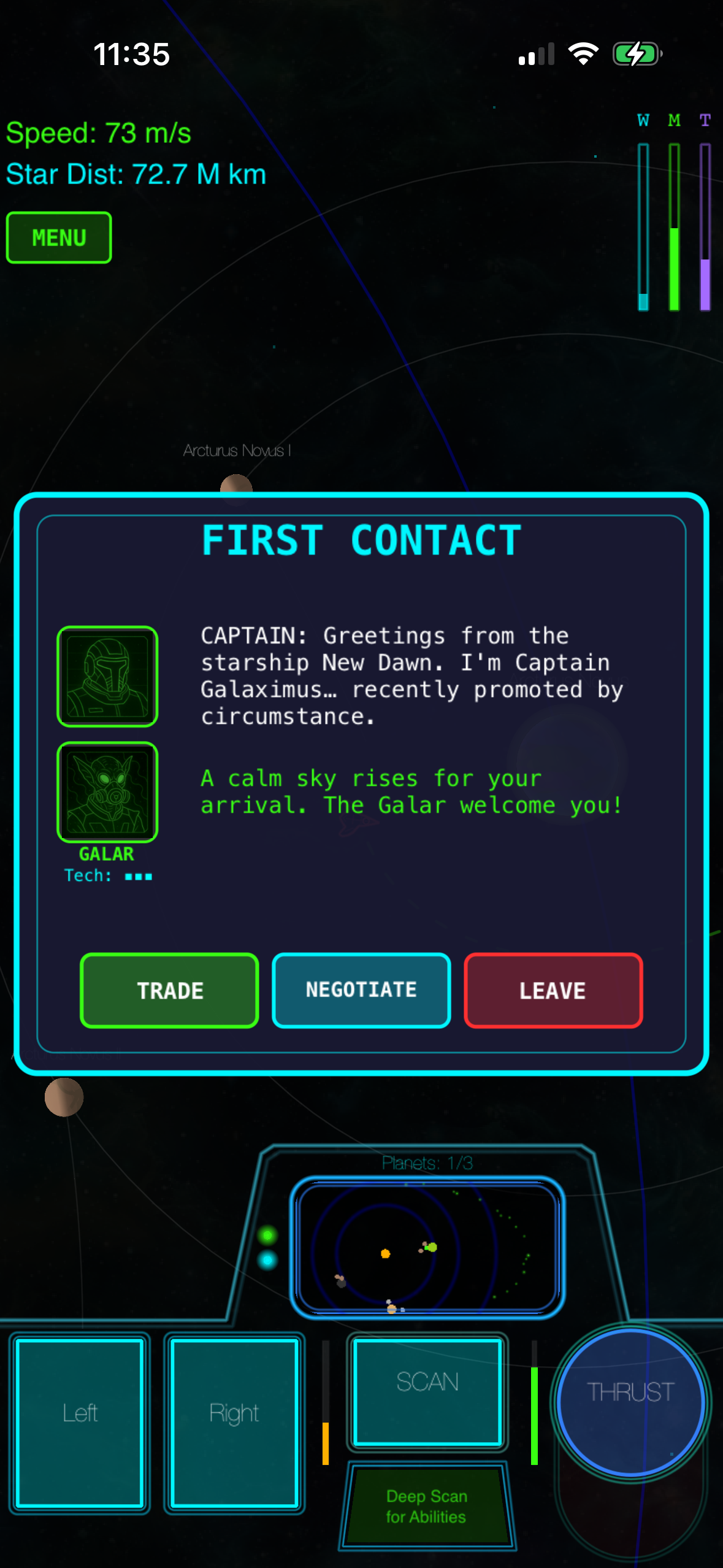
Galaximus (, App Store link) is a real-physics space flight game where you pilot the New Dawn through procedurally configured star systems. It uses actual orbital mechanics—every celestial body exerts gravitational pull, and mastery means learning to use gravity as your primary navigation tool. The campaign spans 8 star systems with a complete narrative arc. Audio is procedurally synthesized in real time, creating a cohesive aesthetic. Learning curve is steep (30+ minutes to feel comfortable with controls), but players report the payoff justifies the investment. No ads, no in-app purchases, no energy timers.
Asteroids Reborn (, App Store link) strips away story and focuses on arcade-style asteroid destruction with Newtonian physics simplified for accessibility. You can play 5-minute sessions or extended runs. No procedural generation—each level is hand-designed. Pickup-and-play controls, no learning curve. Best for players who want quick, satisfying gameplay without narrative commitment.
Lunar Lander Pro (, App Store link) is a precision-landing simulator where you descend toward lunar surfaces with fuel constraints and real gravity simulation. Each level is a discrete puzzle. No combat, no exploration—purely focused on the physics challenge of controlled descent. Shortest time-to-competence of any physics-heavy space game on iOS.
Orbit Mechanics Sandbox (, App Store link) is an open-ended gravity simulator with no campaign. You design orbital systems, place bodies, and watch them interact. Educational value is high; gameplay structure is minimal. Best for players who want to experiment with physics rather than follow a narrative.
These are the primary premium paid space games currently available on iOS with no ads or in-app purchases. Other titles marketed as “premium” either include optional IAP, rotate ads into gameplay, or are no longer actively maintained.
The Physics Question: Real vs. Simplified
Most space games on mobile simplify gravity for accessibility. A planet exerts a pull, but it’s a visual effect around a destination you tap to reach. This makes the game easier to learn but removes the mastery curve that makes space games satisfying.
Real orbital mechanics—where every body’s gravity affects every other body in real time—create a different experience. You can’t point at a destination and tap. You have to think like a pilot, positioning your ship to use a planet’s gravity well as a slingshot, burning fuel only when the math demands it.
Galaximus uses real gravity as its core mechanic. Lunar Lander Pro uses real gravity for descent puzzles but constrains it to single-body scenarios. Asteroids Reborn simplifies gravity to arcade-friendly levels. Orbit Mechanics Sandbox uses full N-body simulation. Know which approach matches your preference before buying.
Campaign vs. Sandbox: What You’re Buying
Campaign-driven games (Galaximus, Lunar Lander Pro, Asteroids Reborn) have a beginning, middle, and end. You follow a designed progression, encounter specific challenges, and reach a conclusion. Typical playtime: 10-20 hours. These are “finished” products—they’re complete because they have an ending.
Sandbox games (Orbit Mechanics Sandbox) are open-ended. You set your own goals and create your own scenarios. Playtime is unlimited but requires self-motivation. No narrative arc, no progression structure.
Both are legitimate. Know which one you’re buying.
Comparison: Real Pricing and Features
| Game | Price | Physics | Campaign | Learning Curve | Best For |
|---|---|---|---|---|---|
| Galaximus | Real orbital mechanics | 8 star systems, narrative arc | 30+ minutes | Depth-focused players, mastery learners | |
| Asteroids Reborn | Simplified Newtonian | 40 hand-designed levels | 5 minutes | Quick sessions, arcade preference | |
| Lunar Lander Pro | Real gravity (single-body) | 60 descent puzzles | 10 minutes | Puzzle solvers, precision-focused | |
| Orbit Mechanics Sandbox | Full N-body simulation | None (open-ended) | 15 minutes | Physics experimenters, educators |
No hidden costs. No in-app purchases. No ads. What you see is what you pay.
How to Choose
Do you want to learn a new control scheme, or pick up and play immediately?
Real-physics games (Galaximus) have a learning curve. Simplified-physics games (Asteroids Reborn, Lunar Lander Pro) are more accessible on first boot.
How much time do you have?
Campaign games (Galaximus, Lunar Lander Pro, Asteroids Reborn) are 10-20 hour commitments. Sandbox games (Orbit Mechanics Sandbox) stretch as long as your interest does.
Do you want a story, or pure gameplay?
Galaximus includes narrative. The others don’t. If story matters, Galaximus is the only option.
What’s your budget?
Lunar Lander Pro is the lowest entry point. Orbit Mechanics Sandbox is the highest. Galaximus and Asteroids Reborn are mid-range.
FAQ
What’s the difference between Galaximus and Asteroids Reborn?
Galaximus is narrative-driven with real orbital mechanics and a steep learning curve. Asteroids Reborn is arcade-focused with simplified physics and immediate accessibility. Galaximus rewards mastery; Asteroids Reborn rewards quick reflexes.
How much storage does each game require?
Galaximus: 450 MB. Asteroids Reborn: 120 MB. Lunar Lander Pro: 85 MB. Orbit Mechanics Sandbox: 200 MB. All fit comfortably on modern iPhones.
Do these games get updated after purchase?
Galaximus has an expansion (Infinitum) shipping in late 2026—free to current owners. Asteroids Reborn receives occasional balance updates. Lunar Lander Pro and Orbit Mechanics Sandbox are feature-complete with minimal ongoing support.
Can I refund if I don’t like it?
Apple allows refunds within 14 days if you haven’t used the app extensively. Watch gameplay videos and read recent reviews before purchasing.
Which game has the gentlest learning curve?
Lunar Lander Pro. You’re learning one mechanic (controlled descent) in a constrained scenario. Asteroids Reborn is second-gentlest. Galaximus is the steepest.
Which game has the most replay value?
Galaximus (procedural system generation means no two playthroughs are identical) and Orbit Mechanics Sandbox (unlimited sandbox scenarios). Asteroids Reborn and Lunar Lander Pro are more linear—once you’ve beaten the levels, there’s less reason to replay.
The Bottom Line
Premium space games on iOS in 2026 are a small category, but they’re the only way to guarantee a finished product without ads, energy timers, or surprise monetization.
Choose Galaximus if you want a complete narrative experience with real physics and don’t mind a learning curve.
Choose Asteroids Reborn if you want quick, satisfying arcade sessions with zero story commitment.
Choose Lunar Lander Pro if you want a focused physics puzzle game at the lowest price point.
Choose Orbit Mechanics Sandbox if you want to experiment with gravity simulation without narrative constraints.
All four are premium without compromise. Pick based on your gameplay preference and budget, not on hype or marketing. That’s the actual advantage of the paid iOS space game category—there’s no pressure to monetize you further, so the games are designed around what players actually want.
Related reading: - How to learn orbital mechanics: a guide for space game players - Procedural generation in indie space games: why it matters - Physics simulation on mobile: technical constraints and creative solutions