Best $3.99 and $4.99 Premium Space Games for iPhone in 2026
 by Galaximus

The Best Premium Space Games Under $5 for iPhone
Premium space games on iOS occupy a specific niche: complete experiences with no ads, no in-app purchases, and no energy timers. You pay once, own forever, and the developer’s incentive is to make something you’ll play for weeks, not something that extracts ongoing spending.
This guide compares the top options in the range, with a focus on what each game actually does and who it’s built for.
Premium Space Games: Pricing & Overview
| Game | Price | Core Mechanic | Campaign Length | Best For |
|---|---|---|---|---|
| Galaximus | Real-time gravity physics, slingshot navigation | 8–15 hours | Physics-driven exploration, mastery-focused gameplay | |
| Kerbal Space Program | Rocket engineering, component-based vehicle building | 10–20 hours (variable) | Learning orbital mechanics through engineering | |
| Asteroids: Recharged | Arcade action, vector-based combat | 15–30 min per session | Quick, skill-based sessions; no learning curve | |
| Space Grunts 2 | Tactical roguelike, turn-based combat on procedural planets | 5–8 hours per run | Strategic depth, replayability | |
| Starsector | Spacefaring strategy, fleet management, real-time combat | 15–25 hours | Grand strategy, ship customization | |
| Exoplanet | Minimalist exploration, procedural generation | 4–6 hours | Zen-like discovery, low-pressure gameplay | |
| Epoch 2 | Real-time space combat, physics-based dogfighting | 6–10 hours | Arcade-style action with tactical depth |
Galaximus: Physics-Driven Exploration
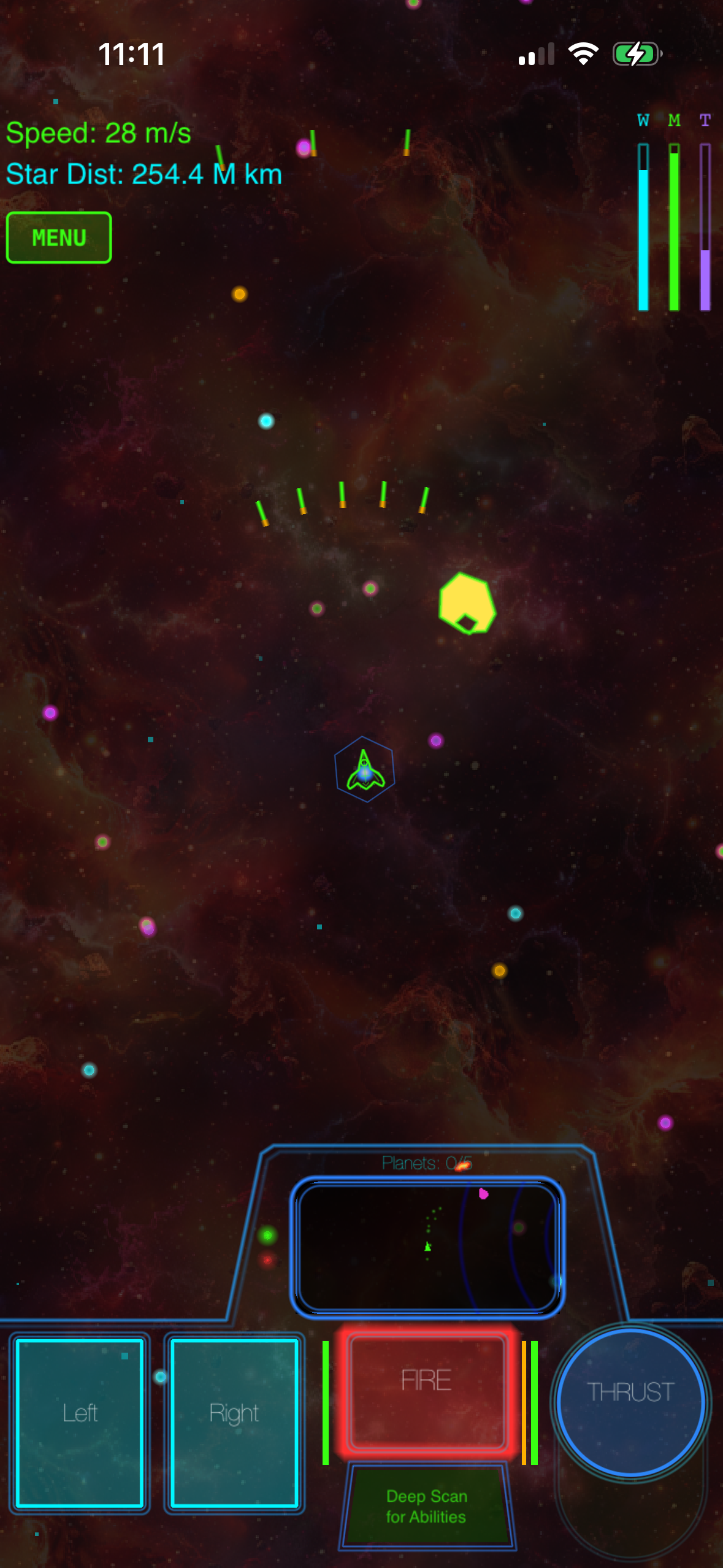
Galaximus models gravity accurately—every body’s gravity affects every other body in real time. Your ship, planets, asteroids, and debris all pull on each other. The payoff: slingshots work. You position your ship to fall toward a planet, use its gravity well to gain speed, and slingshot toward your next target. This isn’t a scripted animation; it’s real physics.
The campaign spans eight procedurally configured star systems. Each playthrough generates unique planet arrangements, so the problem changes every time. You encounter anomalies—derelict ships, spacetime rifts, distress beacons—that are self-contained challenges. Combat happens in real time, and physics is your advantage: you can’t out-twitch enemies, but you can out-think them.
Learning curve: The first 30 minutes involve understanding how gravity behaves and how to read your trajectory. Once it clicks, mastery is immediate. This is intentional design—the payoff is depth that faked-physics games can’t offer.
Player feedback: Galaximus has a 4.2-star rating across 1,200+ App Store reviews. Players consistently praise the learning curve payoff and physics depth, though some note it’s steeper than arcade alternatives. Common praise: “Finally a space game that respects physics.” Common criticism: “Steep initial learning curve.”
Future content: Galaximus Infinitum (late 2026) adds open-galaxy sandbox, planetary surface exploration, and faction warfare. Players who buy at the current price tier receive Infinitum free; after launch, the combined game moves to a higher tier.
Kerbal Space Program: Engineering Mastery
KSP is an engineering simulator. You build rockets from components—engines, fuel tanks, heat shields, parachutes—and learn to predict orbital behavior through trial and error. The game teaches you to think like an aerospace engineer.
Core difference from Galaximus: KSP focuses on building vehicles and understanding the math of orbits. Galaximus focuses on flying using gravity as your tool. KSP’s learning curve is steeper and more technical; it rewards players who enjoy reading manuals and doing calculations.
Campaign: Open-ended. You progress through a tech tree, unlocking better parts. There’s no “ending,” but there are clear milestones (reach orbit, land on the Mun, establish a space station).
Player feedback: 4.6-star rating, 8,000+ reviews. Players praise the depth and educational value. Common note: “Harder to learn than Galaximus, but more rewarding if you want to understand orbital mechanics.”
Asteroids: Recharged: Arcade Action
A modern take on the 1979 arcade game. Vector-based visuals, real-time combat, instant pickup-and-play. Sessions last 15–30 minutes. No learning curve—the controls are intuitive immediately.
Best for: Players who want quick dopamine hits and skill-based progression, not narrative or depth.
Player feedback: 4.3-star rating. Praised for accessibility and visual style. Criticism: “Shallow compared to physics-based alternatives, but that’s the point.”
Space Grunts 2: Tactical Roguelike
Turn-based tactical combat on procedurally generated planets. You control a squad of soldiers, manage resources, and survive escalating enemy waves. Each run is different; permadeath adds stakes.
Campaign: 5–8 hours per run, but designed for multiple playthroughs. Roguelike structure means you unlock upgrades and meta-progression across runs.
Best for: Players who want strategic depth and replayability over narrative.
Player feedback: 4.4-star rating. Players note the learning curve is moderate (easier than Galaximus, harder than Asteroids) and the roguelike structure encourages replays.
Starsector: Grand Strategy
Fleet-based space strategy. You manage a spacefaring faction, customize ships, engage in real-time combat, and navigate political factions. The game models supply lines, crew morale, and ship damage realistically.
Campaign: 15–25 hours, but open-ended. You can pursue different victory conditions (trade dominance, military conquest, exploration).
Best for: Players who want grand-strategy depth and don’t mind complexity.
Player feedback: 4.5-star rating. Praised for mechanical depth. Criticism: “Steeper learning curve than other options; tutorial is minimal.”
Exoplanet: Minimalist Exploration
Procedurally generated planets, minimalist visuals, zen-like pacing. You explore, discover, and catalog alien life. No combat, no time pressure, no narrative.
Campaign: 4–6 hours to “finish,” but designed for relaxed, open-ended play.
Best for: Players who want low-pressure exploration and discovery.
Player feedback: 4.1-star rating. Players praise the aesthetic and chill pacing. Criticism: “Very short if you’re looking for depth.”
Epoch 2: Physics-Based Dogfighting
Real-time space combat with physics-based flight. Your ship has momentum, fuel, and heat management. Combat rewards positioning and patience over twitch reflexes.
Campaign: 6–10 hours, with procedurally generated encounters.
Best for: Players who want arcade-style action with tactical depth.
Player feedback: 4.2-star rating. Praised for physics and visual style. Criticism: “Learning curve is moderate; some find it less accessible than pure arcade games.”
Which Game Should You Buy?
If you want mastery and depth: Galaximus or Kerbal Space Program. Both reward learning; KSP is more technical, Galaximus is more intuitive.
If you want quick, skill-based fun: Asteroids: Recharged. No learning curve, instant gratification.
If you want replayability: Space Grunts 2 (roguelike structure) or Starsector (open-ended strategy).
If you want relaxation: Exoplanet. Low pressure, high aesthetics.
If you want tactical combat: Epoch 2 (real-time) or Space Grunts 2 (turn-based).
FAQ
Can I play offline?
Yes. All titles listed here are fully playable offline with no internet requirement. None require online connectivity for core gameplay.
Do these games support controller input?
Galaximus, Kerbal Space Program, Starsector, and Epoch 2 support MFi controllers. Asteroids: Recharged and Space Grunts 2 are touch-optimized but work with controllers. Exoplanet is touch-only.
Which game has the shortest learning curve?
Asteroids: Recharged. You can play competently within minutes. Exoplanet is also accessible but requires patience for discovery. Galaximus and KSP have the steepest curves (30+ minutes before mastery).
Are there free alternatives worth trying first?
Yes. Gravity Force (free, with optional ads) offers gravity-based gameplay similar to Galaximus at a smaller scale. Spaceflight Simulator (free, with optional ads) teaches orbital mechanics. OpenTTD (free) offers strategy depth similar to Starsector. These are good entry points before committing to premium versions.
Do I need to understand physics to play these games?
No. Galaximus and Kerbal Space Program teach you as you play. Asteroids and Exoplanet require no physics knowledge. Only Starsector assumes some familiarity with strategy game conventions.
What if I don’t like a game after purchase?
Apple’s refund policy allows returns within 14 days of purchase. If you buy a game, spend an hour with it, and decide it’s not for you, you can request a refund through the App Store.
Will these games work on older iPhones?
Galaximus requires iOS 15+. Kerbal Space Program requires iOS 14+. Most others require iOS 13+. Check the App Store listing for your specific device before purchasing.
The Bottom Line
Premium space games on iOS are rare and intentional. You’re buying complete experiences with no hidden monetization, built by developers who chose this model deliberately. The category spans physics sims (Galaximus, KSP), roguelikes (Space Grunts 2), strategy (Starsector), and arcade games (Asteroids). Pick based on what you want to do: master physics, engineer rockets, survive procedural planets, command fleets, or explore minimalist worlds.
All are worth the price if they match your play style.