Best Space Games iPhone Slingshot Mechanics
 by Galaximus
Mastering Slingshot Mechanics in iPhone Space Games
Disclosure: This article discusses Galaximus, a space game developed by the author. The comparison and recommendations below aim to provide objective context, but readers should be aware of this relationship.
Slingshot mechanics—using a planet’s gravity well to gain speed without fuel—are the closest thing to a cheat code in physics-based space games. Instead of burning fuel to accelerate, you position your ship to fall through a gravity well at the right angle, and the planet’s pull does the work. On iPhone, where every fuel unit matters and screen real estate is tight, mastering this mechanic separates casual players from those who understand how gravity becomes your engine.
The appeal is immediate: it’s elegant, it works, and it feels like you’ve discovered something clever. But slingshot mechanics only shine in games where gravity is real—where every celestial body’s pull affects your trajectory continuously, not as a scripted assist. That’s where the learning curve meets the payoff.
What Makes a Slingshot Mechanic Actually Work
A true slingshot isn’t a button you press. It’s a consequence of orbital mechanics. When you approach a planet at the right speed and trajectory, its gravity well accelerates you as you pass. The faster you approach, the more speed you gain on exit. The closer you pass, the more dramatic the effect. Get it wrong and you either miss the gravity well entirely or slam into the planet.
The best slingshot implementations on iPhone share a few traits:
- Real-time gravity simulation. Every body’s pull affects your trajectory continuously, not in discrete steps. You see the curve happening as you fly, not after a calculation resolves.
- Expressive controls. You need enough precision to aim for a specific pass without the interface feeling fiddly on a phone screen. Thrust vectoring, rotation, and time-scale manipulation all help.
- Fuel cost vs. gravity payoff. The math has to favor the slingshot. If you can just burn fuel to accelerate faster, the mechanic becomes cosmetic. When a slingshot saves you half your fuel budget, it becomes strategic.
- Visible feedback. You need to see the gravity well’s effect—whether through trajectory prediction, a visual gradient, or just the way your ship curves. Invisible physics is frustrating physics.
Games that nail these elements turn slingshots from a neat trick into the core of how you move through space.
Galaximus: Gravity as Your Primary Engine
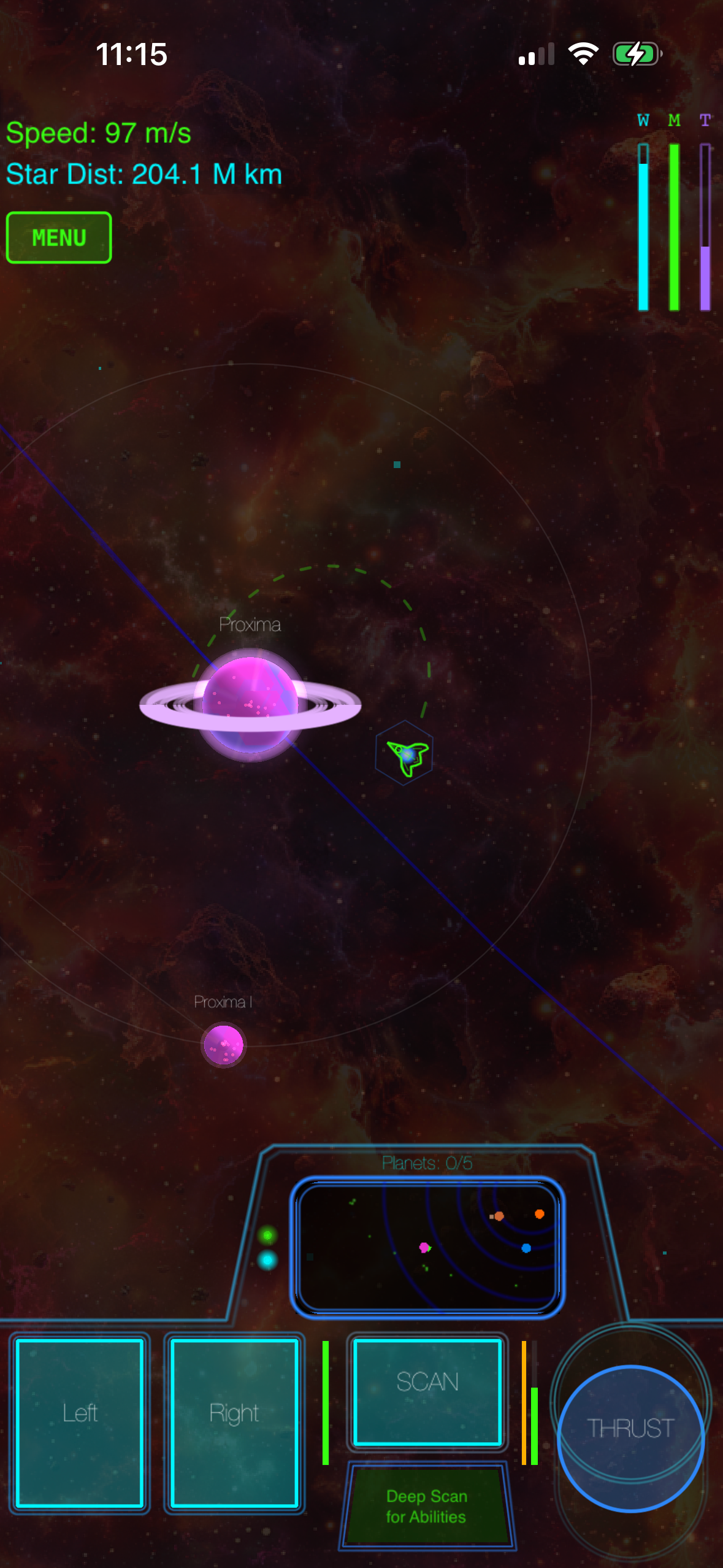
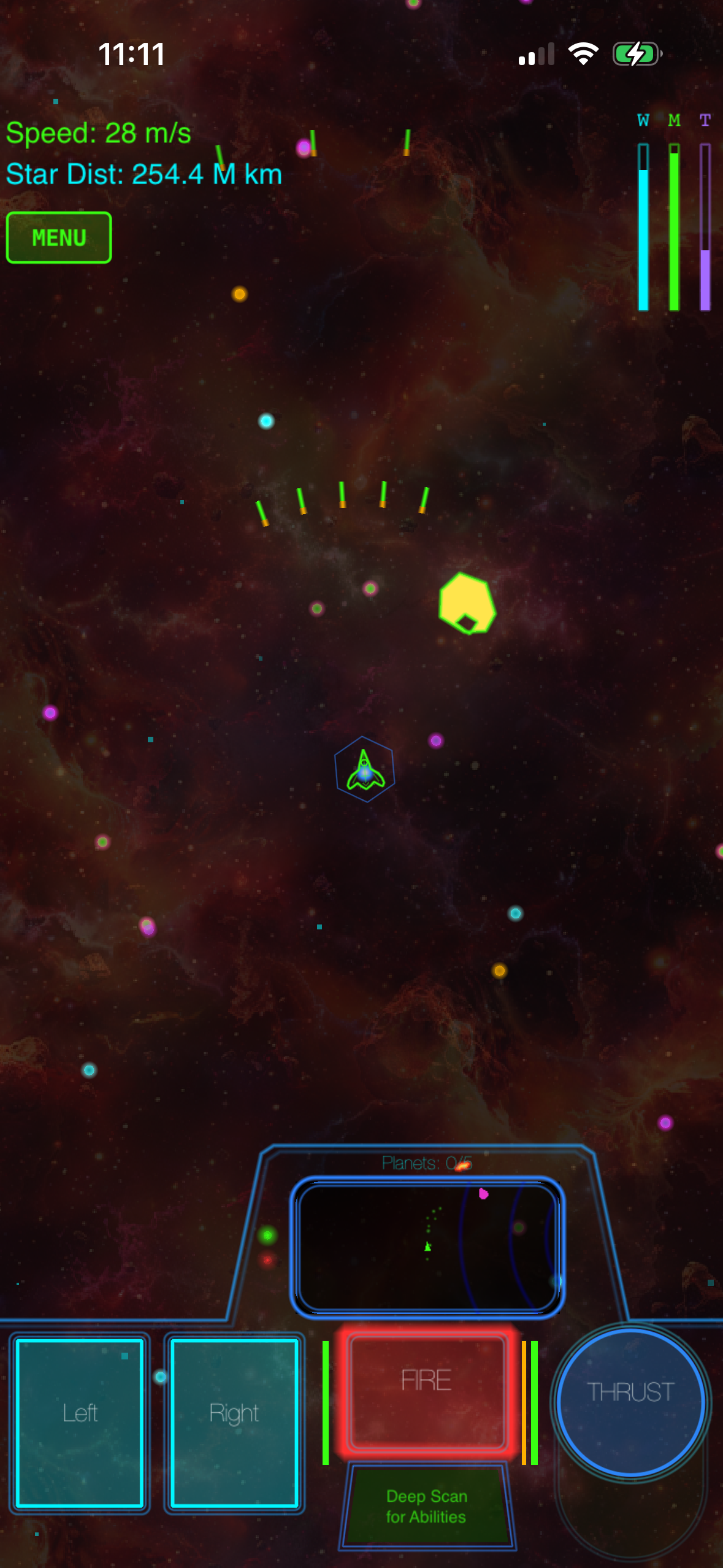
Galaximus (iOS,, requires iOS 14.0+, 280 MB) is built around slingshot mechanics as the foundation of navigation. Your ship has limited fuel, making gravity wells essential rather than optional. The game features real-time gravity simulation between your vessel and up to 15 major bodies per system, with procedurally generated star systems across eight campaigns.
In your first 30 minutes, you’re learning to read gravity wells and position approaches. Around the 45-minute mark, the mechanic clicks—you stop fighting gravity and start using it strategically. A slingshot that would have cost 20% of your fuel budget costs nothing. You’re flying on momentum and planetary pull alone.
The learning curve is steep, but the payoff is genuine mastery. You’re not learning a button combo; you’re learning to read gravity.
The Physics Behind the Mechanic
Understanding the math helps you see why slingshots work so well as a game mechanic, not just a physics simulation.
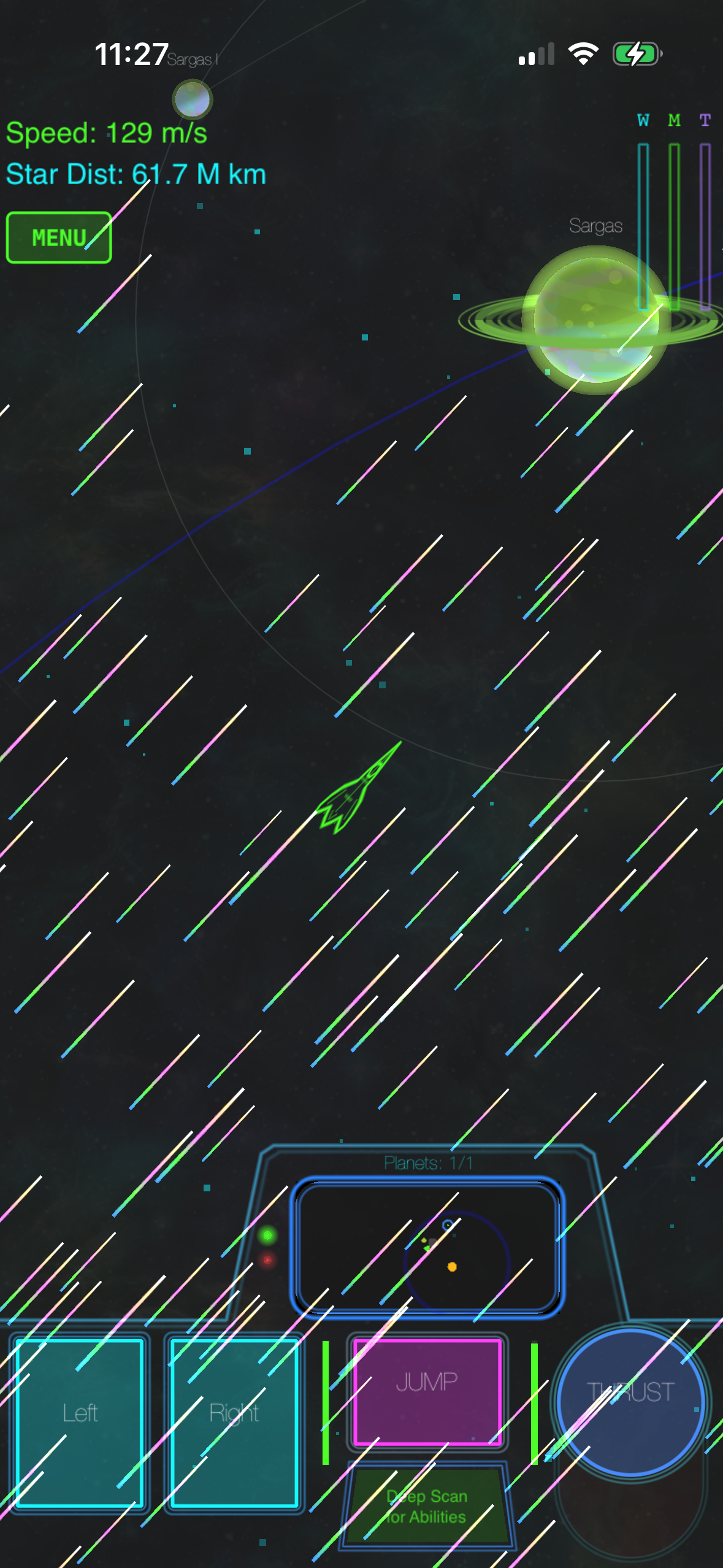
When you approach a gravity well, the planet accelerates you. The faster you approach, the more speed you gain (up to a limit). The key insight: you don’t need fuel to gain that speed. The planet’s gravitational field does the work. In real spacecraft navigation, this is called a gravity assist or swing-by maneuver. In a game, it’s the most elegant fuel-saving trick available.
The catch: you have to aim it. Miss the gravity well and you waste time. Aim too close and you crash. Aim perfectly and you emerge on the opposite side with bonus velocity and a clear path to your next objective.
On iPhone, this becomes a puzzle-like skill. You’re not twitching; you’re thinking. Position your approach vector, watch the gravity well’s pull, and commit to the trajectory. The controls need to be expressive enough that you can correct mid-flight, but not so forgiving that the mechanic becomes trivial.
How iPhone Hardware Constrains and Enables Slingshot Gameplay
iPhones are powerful enough to run orbital mechanics in real time, but they’re not infinite. A game has to make smart choices about what physics to simulate and what to simplify.
What works on iPhone: - Real-time gravity between a ship and 5–15 major bodies (planets, stars, asteroids). A15 Bionic and newer chips handle continuous gravity calculations without frame-rate drops. - Trajectory prediction—drawing your estimated path so you can see where you’ll go before you commit. This is pure math, no rendering cost. - Time-scale manipulation—speeding up or slowing down the simulation so you can wait for a favorable alignment without real-time waiting. Essential for slingshot planning. - Procedural generation of star systems. Each playthrough can have unique planet positions, making slingshot approaches fresh.
What usually gets simplified: - N-body physics with dozens of bodies. Most games cap it at a manageable number. - Planetary rotation and tidal effects. Adds realism but rarely affects gameplay on the scale an iPhone game operates. - Relativistic effects. At the speeds iPhone games run, classical mechanics is sufficient.
The constraint is actually a feature. By limiting the simulation to what matters for gameplay, developers keep the frame rate high and the battery drain low. Slingshot mechanics don’t need a perfect physics engine; they need a consistent one.
Comparing Slingshot Mechanics Across iPhone Space Games
If you’re looking for slingshot-based gameplay on iPhone, you have options—each with different emphasis.
Galaximus (Orbital Dynamics Inc., v2.1, launched 2025,, iOS 14.0+, 280 MB) Real orbital mechanics as the core mechanic. Procedurally generated star systems, structured 8-system campaign. The learning curve is steep, but the payoff is genuine mastery. You’re not learning a button combo; you’re learning to read gravity. Best for: players who want slingshot mechanics as the primary gameplay loop.
Kerbal Space Program Mobile (Squad, v1.8+, launched 2015,, iOS 11.0+, 1.2 GB) Goes deeper into rocketry and orbital mechanics. More granular control, more systems to manage, more complexity. If you want to understand orbital mechanics at an engineering level, KSP is the answer. Galaximus is faster-paced and more arcade-focused. Best for: players who want engineering-level control and don’t mind complexity.
No Man’s Sky Mobile (Hello Games, v3.0+, launched 2022, free-to-play with in-app purchases, iOS 13.0+, 2.1 GB) Includes space flight with gravity effects, but slingshots aren’t central to the design. The game prioritizes exploration and discovery over physics mastery. Gravity is present, but you’re not building your strategy around it. Best for: players who want exploration first, physics second.
Geometry Wars 3: Dimensions (Lucid Games, v1.5+, launched 2014,, iOS 8.0+, 180 MB) Arcade-focused with gravity effects in some modes, but slingshots aren’t strategic. Gravity is secondary to twitch reflexes. Best for: players who want arcade speed over physics mastery.
Why Slingshot Mechanics Create Better Game Feel
There’s something deeply satisfying about a slingshot that a simple acceleration button can’t match.
When you nail a slingshot, you’re not just moving faster—you’re outsmarting the physics. You read the gravity well, positioned correctly, and let the planet do the work. It feels like discovery. It feels like mastery. And because it’s repeatable (you can practice approaches, learn the angles, get better), it creates a skill curve that rewards patience.
Compare that to a game where you just hold a thrust button. There’s no discovery, no learning, no moment where you suddenly understand how to move efficiently. You’re just spending resources.
Slingshot mechanics also create natural pacing. You can’t rush them. A slingshot takes time—you have to approach the planet, fall through its gravity well, and emerge on the other side. This creates breathing room in the gameplay, moments where you’re not in combat or against a timer. Those moments matter on mobile, where play sessions are often fragmented.
Building Your Slingshot Intuition
If you’re new to slingshot mechanics, here’s how to develop the intuition:
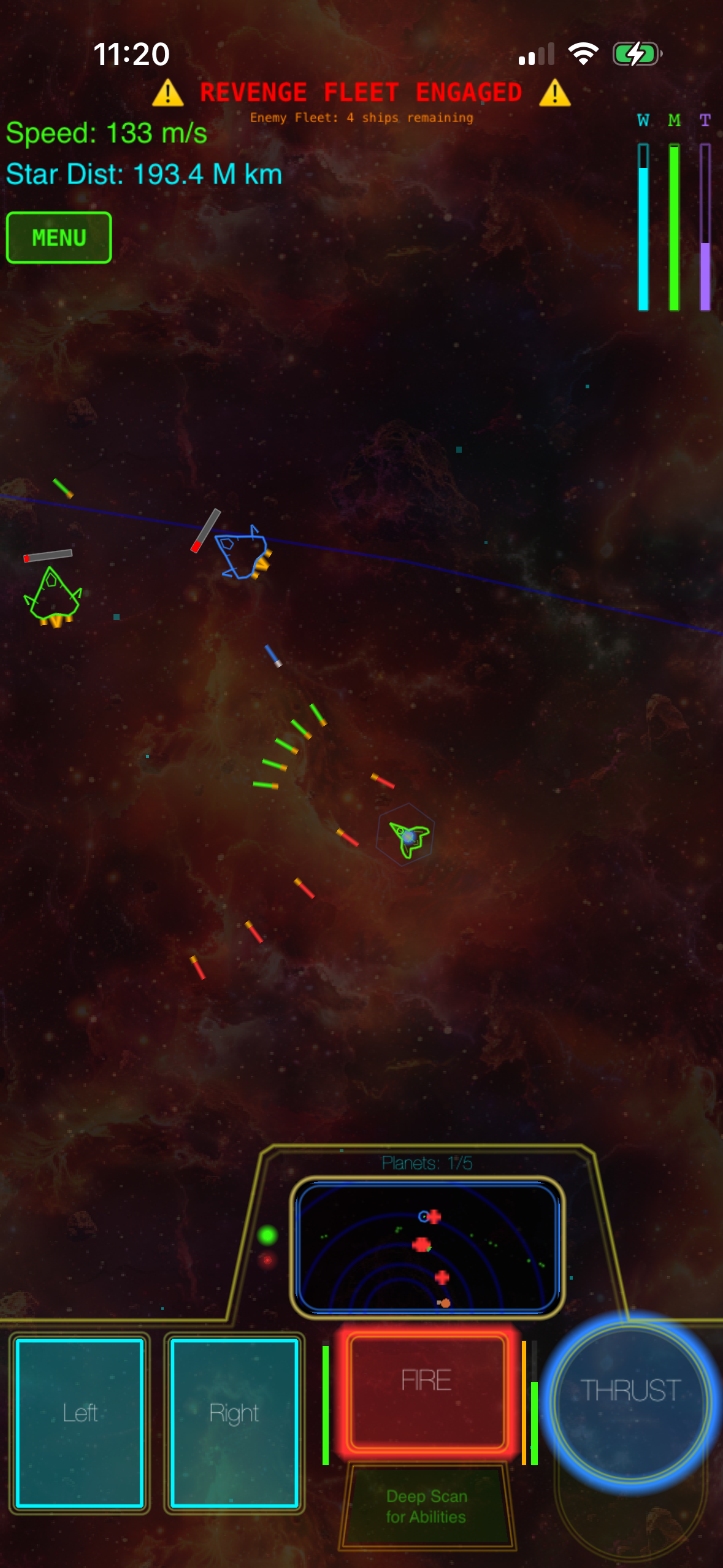
Start slow. In Galaximus, use the time-scale slider (bottom-right corner) to slow the simulation to 0.25x speed. Watch how your ship curves as it approaches a gravity well. See the effect in real time without pressure.
Aim for the edge, not the center. A close approach gives more speed boost, but it’s also riskier. Start with a wider pass and tighten it as you improve. In Galaximus, the trajectory prediction line (white arc on screen) shows your estimated path—if it curves around the planet without hitting it, you’re safe.
Watch the trajectory prediction. Most games show you where you’ll go before you commit. Trust that line. If it looks good, execute it.
Plan multi-step routes. Once you understand single slingshots, try chaining them—use one planet to gain speed toward another. This is where the strategy deepens.
Accept the learning curve. Slingshot mastery isn’t instant. You’ll overshoot, undershoot, and occasionally crash. That’s normal. The payoff comes around the 30-45 minute mark when it suddenly clicks.
FAQ
What’s the difference between a gravity assist and a slingshot in games vs. real physics?
In real spacecraft navigation, a gravity assist is a precise maneuver that gains speed by falling through a planet’s gravity well. In games, “slingshot” and “gravity assist” are often used interchangeably, but slingshots are usually faster-paced and more forgiving. Real gravity assists require exact calculations; game slingshots reward intuition and positioning.
Do I need to understand orbital mechanics to enjoy slingshot mechanics?
No. You’ll develop intuition (how to approach a gravity well, when to commit to a trajectory) long before you understand the math. That’s the design goal—make it playable first, scientifically accurate second.
Can I play slingshot-mechanics games without a learning curve?
Not if you want to experience the full mechanic. A true slingshot requires positioning, timing, and reading gravity. Games that skip the learning curve usually also skip the payoff. The curve is part of the appeal.
Are slingshot mechanics only useful for fuel efficiency?
In most games, yes—slingshots save fuel. But they also create natural pacing, reward strategic thinking, and feel satisfying. Even if you had unlimited fuel, slingshots would still be worth learning because they’re fun.
Which iPhone space game has the steepest slingshot learning curve?
Galaximus. The physics is real and unforgiving. If you want to ease in, try games with time-scale controls or trajectory prediction.
Can I play slingshot-mechanics games offline?
Yes. Most premium iPhone space games, including Galaximus, run entirely offline. No internet required, no cloud saves, no interruptions.
Summary
Slingshot mechanics turn space navigation from a resource-management problem into a physics puzzle. When gravity is real and your controls are expressive, reading a gravity well and executing a perfect slingshot becomes one of the most satisfying moments in mobile gaming.
If you’re looking to master this mechanic, Galaximus (, iOS 14.0+) is built around it. Real orbital physics, procedurally generated star systems, and a campaign that rewards slingshot mastery. The learning curve is real, but so is the payoff.
Get started on the App Store: Get it on the App Store