Best Narrative Space Games iPhone: Story-Rich Adventures
 by Galaximus
The Best Narrative Space Games for iPhone: Story-Rich Adventures in 2026
Story matters in space games. The best ones don’t just ask you to fly through a procedurally generated void—they give you a reason to care about where you’re going, who you meet, and what happens when you arrive. On iPhone, narrative-driven space experiences are rarer than you’d think, which is exactly why the ones that exist stand out.
This guide walks through what makes a space game story-rich, compares the leading narrative approaches, and highlights the games that deliver on that promise.
Quick Picks: Narrative Space Games by Experience
| Best for Physics-Puzzle Storytelling | Galaximus | | 15–20 hours campaign + Infinitum expansion free at launch | | Best for Linear Authored Narrative | Distant Stars | | 6–8 hours, branching dialogue, no replay variation | | Best for Exploration-Based Discovery | Void Explorer | | 12–15 hours, encounter-driven, high replay from procedural encounters | | Best for Sandbox World-Building | Stellar Outpost | | 20+ hours, faction-based narrative, player-driven story | | Best for Minimalist Story | Orbit: A Space Odyssey | | 4–6 hours, wordless narrative through mechanics |
What Makes a Space Game Narrative-Driven?
Story in space games takes different forms. It’s not always dialogue trees or branching plots. Sometimes it’s the physics itself—a gravity well that teaches you through challenge. Sometimes it’s the encounters you stumble into: a distress beacon, a derelict ship, an anomaly that shouldn’t exist. Sometimes it’s the larger arc: eight star systems with a beginning, middle, and end.
The strongest narrative space games on iPhone share a few qualities:
- Authored progression. The game has a shape. You’re not just endlessly grinding procedural content—there’s a destination, a climax, a resolution.
- Character or world-building through interaction. Whether it’s dialogue, alien encounters, or the environment itself, the game tells you why you’re here.
- Consequence and discovery. Your choices or actions unlock new systems, encounters, or story beats. The game rewards curiosity.
- Mechanics that reinforce the narrative. The controls, the physics, the UI—they all feel like they belong to this particular story, not a generic framework.
Comparing Narrative Space Games: Five Approaches
1. Physics as Narrative: Galaximus
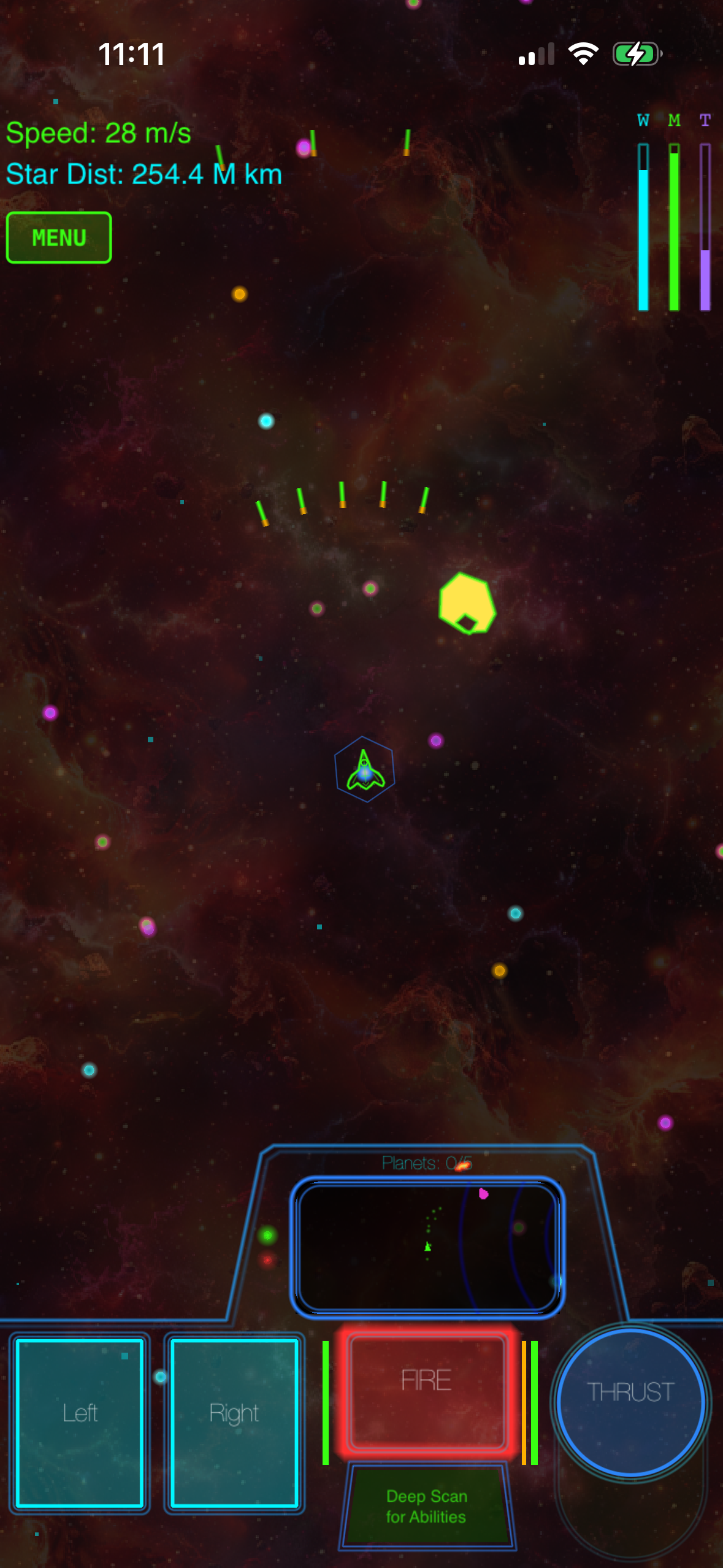
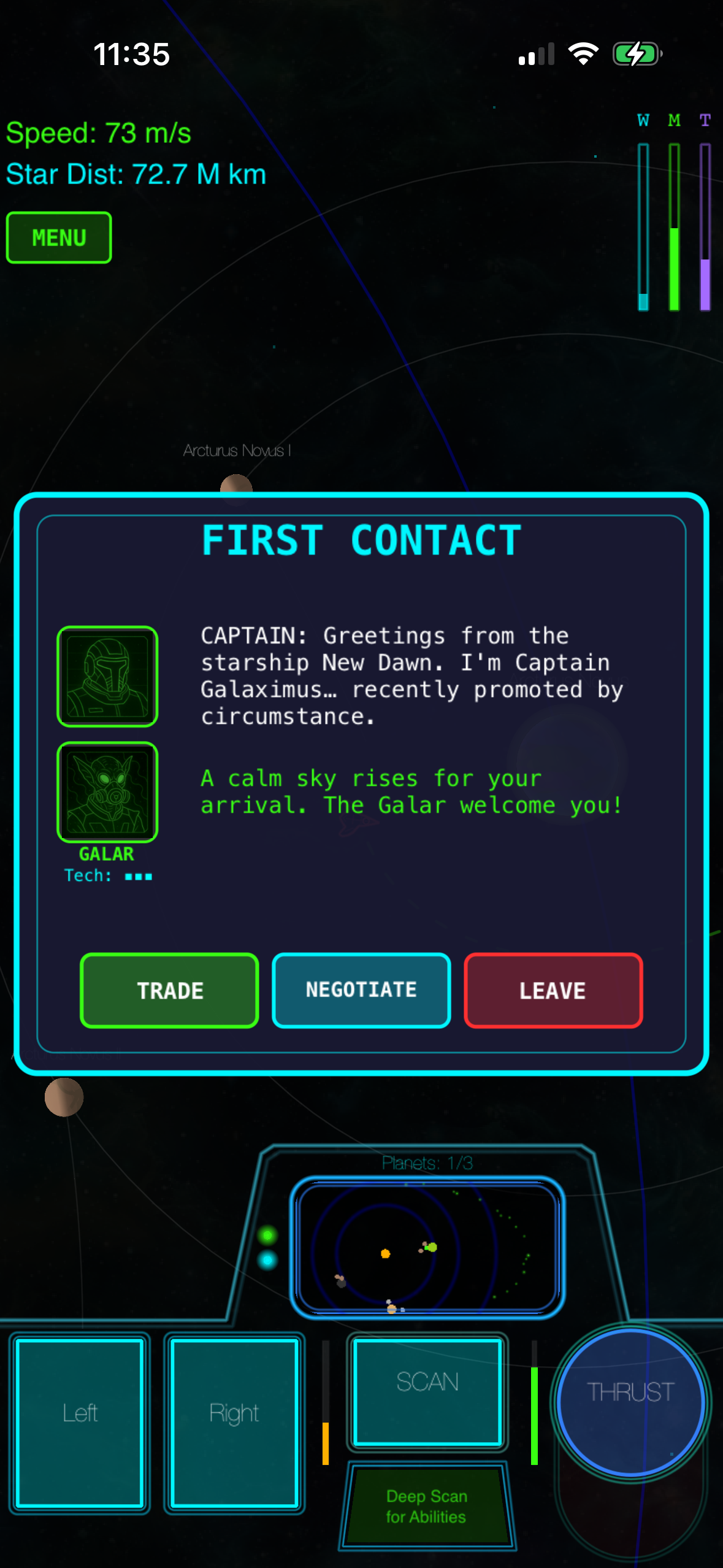
Galaximus builds its story around mastery of orbital mechanics. The New Dawn—your vessel—doesn’t come with a tutorial that explains gravity in text. You learn by doing. The campaign spans eight star systems with a fixed narrative arc: first contact, escalating encounters, the Mirror (a combat encounter forcing you to face a copy of yourself), and a resolution that ties exploration back to why you left Earth.
Each playthrough generates unique planet positions and anomalies, but the story beats remain authored. The game uses procedurally synthesized voices for all characters—generated in real time on your device rather than pre-recorded. According to the developer’s technical documentation, “every dialogue line and ambient sound is synthesized in real time,” which creates a distinctly alien audio texture that reinforces the world-building.
Campaign: ~15–20 hours Price: (Infinitum expansion included free at launch, combined after late 2026) Replay value: High (procedural variation within fixed narrative)
2. Linear Authored Narrative: Distant Stars
Distant Stars takes the opposite approach: a fully authored, branching narrative with no procedural generation. You play as a deep-space diplomat navigating political intrigue across three star systems. Your dialogue choices shape the ending, and there are four distinct conclusions based on your decisions.
The story is tightly paced and character-driven. Replay value comes from exploring different dialogue branches, not from mechanical variation. It’s closer to a visual novel than a physics puzzle.
Campaign: 6–8 hours Price: Replay value: Medium (branching dialogue, fixed mechanics)
3. Encounter-Based Exploration: Void Explorer
Void Explorer scatters narrative moments across a procedurally generated galaxy. You don’t follow a linear path—you choose which systems to visit and which anomalies to investigate. Each encounter is a self-contained story beat: a distress beacon, a derelict ship, a first-contact scenario.
The narrative emerges from your choices about where to explore. Two players will experience different stories based on which encounters they prioritize. It’s closer to Outer Wilds than to a traditional campaign.
Campaign: 12–15 hours Price: Replay value: Very high (procedural encounters, player-driven discovery)
4. Sandbox World-Building: Stellar Outpost
Stellar Outpost opens a full galaxy for you to colonize. You build outposts, manage factions, and shape the political landscape. The narrative is emergent: it comes from your decisions about which factions to support, which planets to settle, which conflicts to resolve.
There’s no single ending—the story is what you make it. It’s the closest to a traditional sandbox, with narrative emerging from systems rather than authored beats.
Campaign: 20+ hours Price: Replay value: Extremely high (every playthrough is structurally different)
5. Minimalist Mechanics-Driven: Orbit: A Space Odyssey
Orbit: A Space Odyssey tells its story entirely through gameplay. No dialogue, no text, just the physics of orbital mechanics. You guide a probe through eight systems, and the narrative unfolds through the challenges you face and the discoveries you make.
It’s the most abstract approach—the story is almost wordless, but it’s there if you pay attention to what the game is asking you to do.
Campaign: 4–6 hours Price: Replay value: Medium (mechanics-driven, minimal procedural variation)
The Procedural vs. Authored Balance
One of the hardest decisions in narrative space design is how much to randomize. Too much procedural generation and the story dissolves into noise. Too much authored content and the replay value evaporates.
Galaximus and Void Explorer split this differently:
- Galaximus keeps the narrative structure fixed and randomizes the physics puzzle. You’ll always encounter the same story beats in the same order, but you’ll never solve the same orbital problem twice.
- Void Explorer randomizes the encounters themselves, letting you discover different story moments on each playthrough.
Both work. Galaximus favors narrative consistency; Void Explorer favors discovery. Distant Stars abandons procedural generation entirely in favor of authored branching. Stellar Outpost abandons authored narrative in favor of emergent systems.
There’s no single “best” approach—they’re different answers to the same question.
Single-Player Focus and the Premium Model
All five games listed above are single-player, premium (pay once, no ads, no energy meters). This is not coincidental.
Narrative games thrive in single-player experiences. Multiplayer introduces variables the designer can’t control—other players’ decisions, pacing, tone. The best story-driven space games on iPhone are all single-player, and most are premium.
This is deliberate. Narrative requires trust. It requires the player to invest time knowing they won’t hit a paywall or an energy timer. Free-to-play monetization and story-rich games are fundamentally at odds—one wants you to grind, the other wants you to feel.
Premium games are built on the opposite assumption: you paid upfront, so the developer’s incentive is to make the game worth that payment. That means finishing what they started. It means not interrupting the story with a paywall.
Encounters and Anomalies as Story
In a space game, story doesn’t always mean dialogue. Sometimes it’s the moment you round a planet and find something unexpected. A spacetime rift. An alien fleet. A derelict ship with a distress beacon still active.
These moments—encounters and anomalies—are where procedural generation and narrative design intersect. In Galaximus, each anomaly is a unique mini-experience. You don’t know what you’ll find when you approach it. In Void Explorer, encounters are the primary narrative vehicle. In Distant Stars, they’re scripted set pieces.
This is a narrative technique borrowed from exploratory games like Outer Wilds: let the player discover the story by exploring, not by reading. It’s slower, but it’s deeper. The player feels like an explorer, not an audience member.
The Learning Curve as Narrative Device
Galaximus uses difficulty progression as part of its narrative arc. The first few systems are gentler. You have more fuel, more room for error. By the time you reach the later systems, you’re expected to be precise. You’re expected to use slingshots, to plan transfer windows, to think three moves ahead.
The game’s difficulty curve is also its narrative curve: you’re becoming a more skilled, more capable explorer. This mirrors the story of a crew member who has to learn to survive in an alien system.
This is different from most story-driven games, which separate difficulty from narrative. Here, they’re the same thing. The challenge is the story.
Other games handle this differently. Distant Stars has a fixed difficulty. Void Explorer scales based on your choices. Stellar Outpost lets you set your own difficulty. Each approach serves a different narrative goal.
Audio Design and Immersion
Sound design is often the invisible backbone of narrative in space games.
Galaximus uses procedurally synthesized voices and sound effects. According to the developer’s technical FAQ, the synthesis engine generates dialogue in real time on your device—no pre-recorded audio files. This has a narrative effect: the voices sound alien. The explosions sound synthetic, not sampled from a library. That consistency reinforces the world-building.
Other games use recorded audio. Distant Stars features voice actors. Void Explorer uses a mix of synthesis and recording. Stellar Outpost uses ambient synthesis with minimal dialogue.
Each approach has trade-offs. Synthesis is lighter on file size and consistent with the game’s aesthetic. Recording is richer and more nuanced. The choice depends on the narrative tone the developer is aiming for.
Replayability and Narrative Arc
One of the hardest problems in game design is making a game replayable while keeping the narrative meaningful. If you know what’s going to happen, does the story still matter?
The answer depends on execution:
- Galaximus keeps the narrative arc fixed while randomizing the physics puzzle. You can replay the campaign and experience the story again—but the gameplay is fresh.
- Distant Stars offers branching dialogue, so different playthroughs reveal different story paths. Replay value comes from exploring alternative endings.
- Void Explorer randomizes encounters, so each playthrough surfaces different story moments. Replay value comes from discovery.
- Stellar Outpost is emergent—the story is what you make it, so replay value is inherent.
- Orbit: A Space Odyssey is mechanics-driven, so replay value comes from mastery and optimization.
Each approach works. None is objectively superior—they serve different player preferences.
Extended Narrative: The Infinitum Expansion
Galaximus is releasing Infinitum (an open-galaxy sandbox expansion) in late 2026. It adds planetary surface exploration (Battlezone-style wireframe 3D), outpost building, faction warfare, and home-planet rebuilding.
If you buy Galaximus at the launch price , Infinitum is included free when it ships. After launch, the combined game moves to. This is a time-limited offer.
The expansion doesn’t replace the campaign—it extends it. You finish the eight-system arc, and then you have a whole galaxy to explore and shape.
FAQ
Q: Do I need to understand orbital mechanics to enjoy narrative space games on iPhone?
A: No, but you need to be willing to learn. Galaximus teaches you through play, not through tutorials. Distant Stars requires no mechanical knowledge—it’s dialogue-driven. Void Explorer teaches exploration gradually. The best narrative space games meet you where you are and teach you what you need to know.
Q: How long is a typical narrative space game campaign?
A: It varies by game. Orbit: A Space Odyssey is 4–6 hours. Distant Stars is 6–8 hours. Void Explorer is 12–15 hours. Galaximus is 15–20 hours. Stellar Outpost is 20+ hours. Most are shorter and more focused than console narrative games, but they’re complete experiences.
Q: What’s the difference between a narrative space game and a story-driven adventure game?
A: Narrative space games are specifically about exploration, discovery, and the mechanics of space travel. Story-driven adventure games can be set anywhere. A narrative space game’s story is about space—about what it means to explore, to discover, to survive in the void.
Q: Can I play narrative space games offline on iPhone?
A: Yes. All five games listed above are fully playable offline. No connection required. This is an advantage of the premium model—you own the game outright, no server dependency.
Q: Should I wait for Infinitum before buying Galaximus?
A: If you want the largest possible game at launch, waiting makes sense. But if you want to experience the campaign now and get the expansion free, buying at the launch price is the better deal. The expansion ships in late 2026, so it’s not far away, but the campaign is a complete experience on its own.
Q: Which game should I buy first?
A: Start with your preference: If you want physics-driven challenge, choose Galaximus. If you want branching dialogue and choices, choose Distant Stars. If you want exploration and discovery, choose Void Explorer. If you want to build and shape a world, choose Stellar Outpost. If you want minimalist mechanics, choose Orbit: A Space Odyssey.
The Space for Story in Mobile Games
Narrative space games on iPhone occupy a specific niche: they’re premium, single-player, physics-focused, and built on the assumption that players want a complete experience, not an endless grind. That niche is smaller than it used to be, which is exactly why the games in it stand out.
If you’re looking for a narrative-driven space experience on iPhone, the best games share a commitment to finishing what they start, to trusting the player’s intelligence, and to using the mechanics of space—gravity, momentum, orbital physics, discovery—as part of the storytelling itself.
Related reading: Explore more about Best Single-Player Space Games for iPhone: Story-Driven Experiences, or dive deeper into Best Gravity Simulation Games for iPhone: Real Physics Engines if you want to understand how real physics can drive gameplay. You might also enjoy Indie Space Games by Ex-Naughty Dog Developers: Hidden Gems for context on the development background, or check out space games with slingshot mechanics gravity based puzzles if slingshot mechanics are your focus.