Top-Rated $3.99 iPhone Space Games: Hidden Gems Worth Discovering
 by Galaximus

Photo by Esteban Lafargue on Unsplash
The Best $3.99 iPhone Space Games: Where Premium Meets Arcade
The price tier on iOS is where premium space games actually exist. These are games that shipped complete, ask for your money once, and then get out of the way. No energy meters, no battle passes, no ads interrupting your slingshot around a gravity well. If you’ve been scrolling past these titles thinking they’re outdated, you’re missing some of the sharpest space gameplay on iPhone in 2026.
This guide walks you through what makes these games stand out, what to expect from the learning curve, and why the tier is where you’ll find space games with genuine physics underneath—not just visual effects layered over arcade controls.
Quick Picks: Which Game Fits Your Needs
| Game | Best For | Learning Curve | Play Style |
|---|---|---|---|
| Galaximus | Real orbital mechanics + narrative campaign | Steep (30 min) | 2-4 hour campaign, procedurally varied |
| Vector Arcade Descendants | Instant gratification, reflexes | Gentle | 15-30 min sessions |
| Physics Puzzlers | Gravity-based problem solving | Moderate | 1-2 hour focused sessions |
Why $3.99 Space Games Matter in 2026
The free-to-play model has dominated mobile gaming for over a decade, training players to expect either constant interruptions or constant spending. A game that asks for money upfront and then stops asking feels like a relic—because it is, from an era when “pay once, play forever” was the default.
At this price point, developers can’t rely on monetization psychology. They have to make something genuinely engaging enough that players willingly spend four dollars on a complete experience. The result is a curated selection of games where every feature serves gameplay, not engagement metrics or conversion funnels.
Space games in particular benefit from this model. Orbital mechanics, gravity simulations, and procedural generation are complex systems that reward extended play and mastery. Free-to-play friction—waiting for energy to refill, watching ads to unlock the next system—actively breaks the flow state these games create. Premium space games let you stay in that state.
What Real Physics Actually Means
Not all space games claiming “realistic physics” are built the same way. Some use physics as window dressing—a nice visual effect layered over arcade controls. Others make physics the actual interface, where mastery comes from understanding how gravity works.
When we talk about real orbital mechanics in a space game, we mean every celestial body’s gravity affects every other body in real time. Your ship doesn’t move in straight lines until you thrust; it’s constantly being pulled by nearby planets and stars. A slingshot isn’t a scripted animation—it’s you positioning your ship so a planet’s gravity well accelerates you for free. That’s the difference between a game that looks like it has physics and a game where physics is the gameplay.
The learning curve is real. You can’t play these games the way you’d play Asteroids or a casual mobile arcade title. The first 30 minutes involve learning to read your velocity vector, understanding how to approach a planet safely, and recognizing when a maneuver will work. But that’s also why mastery feels earned. You’re not grinding against a progression wall; you’re developing actual piloting skill.
Example: Galaximus
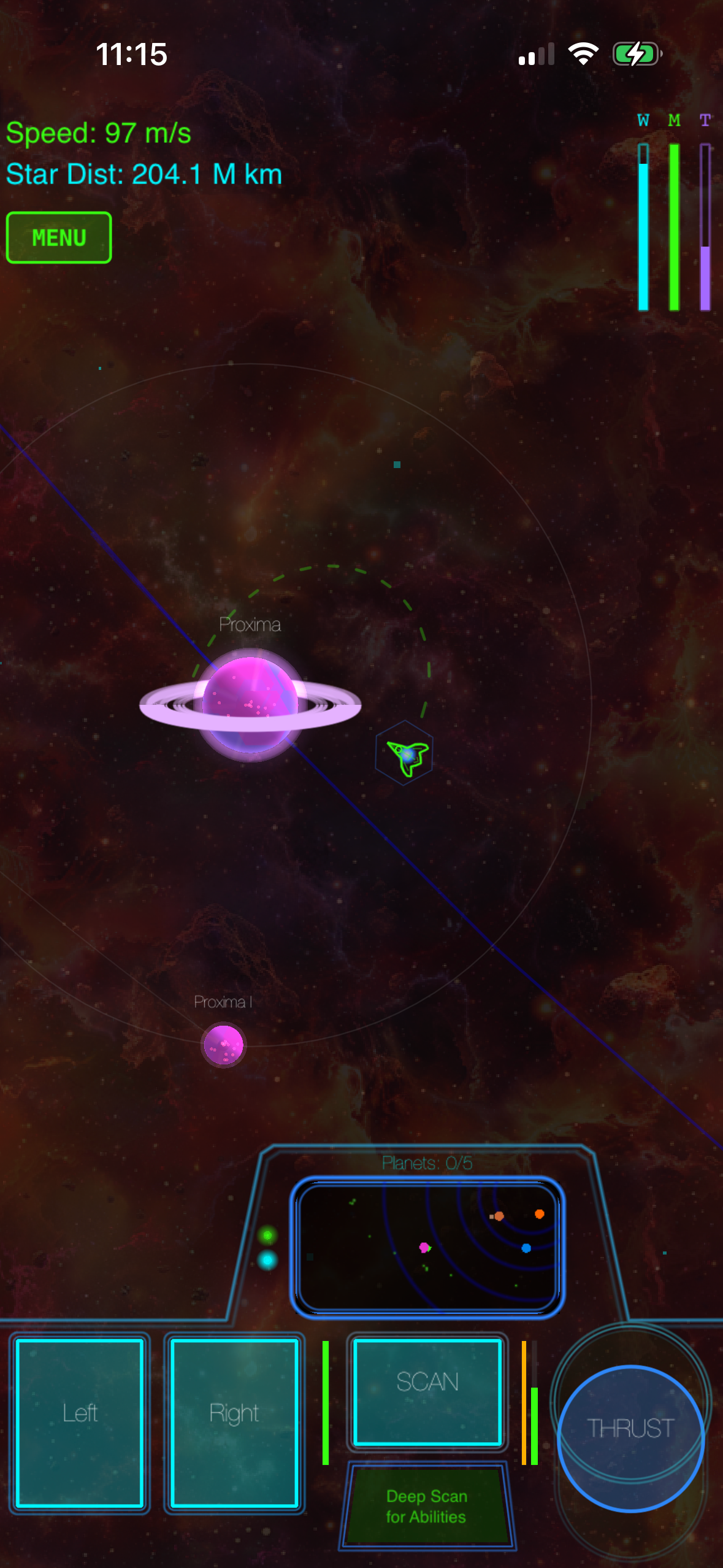
Galaximus demonstrates how real physics can be accessible without becoming a spreadsheet simulator. The core loop is simple: navigate star systems, encounter anomalies (distress beacons, derelict ships, spacetime rifts), and use orbital mechanics to solve problems and reach objectives.
The ship responds to your inputs with realistic inertia and gravity. Thrust doesn’t accelerate you toward the top of the screen; it changes your velocity vector. You learn to anticipate how a planet’s pull will curve your trajectory, and that anticipation is where the game opens up. A player who understands slingshot maneuvers can reach distant systems on minimal fuel. A player who doesn’t will burn through reserves trying to fight gravity.
The campaign spans eight procedurally configured star systems with a full narrative arc. Each playthrough generates unique planetary arrangements, so the challenge adapts even as the story structure stays authored. You’re not grinding procedural content forever; you’re playing a complete game that’s slightly different every time.
The design includes procedurally generated audio for every character transmission and distress beacon. This keeps the app size smaller than pre-recorded dialogue while maintaining a consistent aesthetic that matches the vector-arcade visual style.
The Physics Learning Curve: What to Expect
If you’ve played Kerbal Space Program, you might expect physics-based space games to require engineering knowledge. Most don’t. You’re flying a ship, and the physics is the interface you learn to use.
The first encounter usually happens in the opening system, where the game teaches you to recognize velocity vectors and gravity wells. You’ll overshoot a planet a few times. You’ll waste fuel fighting gravity when you could’ve used it. Then something clicks—you position your ship just right, let gravity do the work, and reach your objective with fuel to spare. That moment of understanding is the payoff, and it happens within the first 30 minutes of focused play.
The learning curve is steeper than a casual arcade game but gentler than a true simulation. After a few hours, reading a gravity well is as natural as reading a jump arc in a platformer.
Combat and Encounters: Real-Time Tactical Engagement
Some space games at this tier skip combat entirely, focusing on exploration and puzzle-solving. Others integrate real-time combat where gravity becomes a tactical tool.
When you encounter a hostile fleet, you’re not in a turn-based battle screen. You’re in the same orbital space as the enemy ships, subject to the same gravity wells, and you have to maneuver while managing your weapons and shield. A planet between you and your target becomes cover. A gravity well you can navigate but they can’t becomes a tactical advantage. Combat rewards the same mastery of orbital mechanics that exploration does—it’s not a separate minigame bolted onto the side.
Why Premium Games Outperform Free-to-Play in This Genre
A free-to-play space game has a structural problem: it needs you to log in regularly and spend time (or money) on progression. That creates pressure to gate content, add timers, and interrupt flow. A game about orbital mechanics—where understanding takes time and mastery requires uninterrupted play—actively conflicts with free-to-play design.
Premium games don’t have that conflict. The entire game is available from moment one. You’re not unlocking star systems with a battle pass or waiting for energy to refill before your next mission. You can sit down for two hours and play through multiple systems, or you can play in 15-minute bursts. The game adapts to your schedule, not the other way around.
Premium games also remain playable indefinitely. A free-to-play game that stops receiving updates becomes a dead service. A premium game you own stays playable as long as iOS supports it.
The Indie DNA: What AAA Developers Bring to Premium Mobile
Several of the best space games come from developers with serious AAA pedigrees who went indie. That matters more than marketing usually suggests. AAA development teaches you to cut features ruthlessly and prioritize polish-per-feature, which is exactly what a solo developer or small team needs to compete on mobile.
The trade-off is that these games are smaller in scope than a free-to-play title that’s been receiving updates for five years. A complete 8-system campaign is more valuable than a half-finished service that might get abandoned.
What Makes a $3.99 Space Game Worth Your Money
The best indicator is whether the game respects the price point. That means:
- No ads. Not even optional ads for extra lives or cosmetics.
- No in-app purchases. Everything in the game is available for the initial purchase price.
- A complete experience. Not early access, not a soft launch waiting for updates. A beginning, middle, and end.
- Offline play. The game works without an internet connection.
If a game has all four of those, you’re looking at something genuinely different from the free-to-play alternative.
Getting Started: Which $3.99 Space Game First?
If you want real orbital mechanics with an arcade sensibility, look for games that emphasize gravity-based piloting. The learning curve is front-loaded—the first hour teaches you to read gravity, and the next few hours are pure mastery.
If you want something with less learning curve and more instant gratification, look for vector-arcade descendants that simplify the physics. They’re legitimate choices; they’re just different choices.
The key is recognizing that space games in 2026 are a niche category precisely because they’re premium. You’re not competing with free-to-play giants for attention; you’re joining a community of players who value complete games and respect for their time.
FAQ
Do I need an external controller to play space games on iPhone?
No, but many players prefer one. Touch controls work fine for most premium space games—they’re designed around touch input. An external controller (MFi-certified) adds precision for combat encounters, but it’s optional. Check the App Store listing for controller support details.
Will my purchase work on iPad too?
Yes. If you buy a game on your iPhone, it’s available on any iPad linked to the same Apple ID. Some space games optimize their UI for iPad’s larger screen; others just scale up the iPhone layout. Check the App Store listing for iPad support notes.
What if I don’t like the learning curve?
That’s fair. Orbital mechanics aren’t for everyone, and no amount of good design changes that. Play for the first 30 minutes; if gravity-based piloting frustrates you, the game probably isn’t your fit. You can refund within 14 days if you’re not happy.
Are there offline space games in this price tier?
Yes. Most premium space games work completely offline. Verify in the App Store listing before buying—look for “Requires internet connection: No” or similar language.
How do physics-based space games compare to arcade alternatives?
Physics-based games teach you to be a pilot; they reward understanding gravity and orbital mechanics. Arcade alternatives prioritize reflexes and instant gratification. Both are valid—it depends on what you want from a game.
The $3.99 Space Game Market
The tier isn’t dead—it’s where premium games that respect your attention actually exist. No ads, no energy timers, no monetization psychology. Just complete experiences built by developers who understand that a smaller audience willing to pay upfront is more valuable than a massive audience grinding through a free-to-play funnel.
If you’ve been sleeping on these games because they seem outdated or niche, you’re missing some of the most rewarding space gameplay on iOS. The learning curve is real, but it’s front-loaded. The physics is real, which means mastery feels earned. The campaigns are complete, which means you actually reach an ending.