Top Paid iPhone Space Games Under $5 Worth Your Money
 by Galaximus

Photo by Onur Binay on Unsplash
Best Paid iPhone Space Games Under $5 in 2026
Disclosure: Galaximus, featured in this guide, is developed by our studio. We’ve included it because it meets the criteria for this category, but we’ve prioritized honest comparison with alternatives over promotion.
The premium space game market on iPhone remains small but focused. Free-to-play dominates the App Store, but a dedicated set of paid titles—games you buy once and own forever—still deliver complete experiences without ads, energy timers, or battle passes. If you’re hunting for space games you’re looking at titles where every feature exists because the developer wanted it there, not because a monetization spreadsheet demanded it.
This guide covers the actual landscape: what’s worth playing in this category, what each game does best, and where the tradeoffs matter.
Why Premium Space Games Still Matter
Free-to-play space games train you to wait. Energy systems, progression gates, daily login bonuses—they’re designed to ration your playtime so you’ll spend money to skip the wait. Premium games don’t have that friction. You land on a planet when you want to land. You retry a combat encounter when you want to retry. The game respects your time because it made its money when you tapped buy.
The under- tier is where indie developers and small studios prove the model still works. You’re not paying for a AAA production budget or photorealistic graphics. You’re paying for a complete, uncompromised vision—the game the developer actually wanted to ship.
What Makes a Space Game Worth $5
Not all paid games are created equal. A space game worth buying needs:
- A complete campaign or structured progression. Not a soft-launched sandbox where you wait months for content. Beginning, middle, end.
- No monetization friction. No ads between sessions. No “buy this upgrade or grind for three hours.” No battle pass. Pay once, play forever.
- Mechanics that reward mastery, not twitch reflexes alone. Space games thrive when physics or positioning matters—when patience and planning beat pure speed.
- Polish-per-feature ratio that reflects intention. A smaller game that’s polished is worth more than a bloated game with rough edges.
Top Recommendations
Galaximus — $4.99 | 4.6 stars (1,247 reviews)
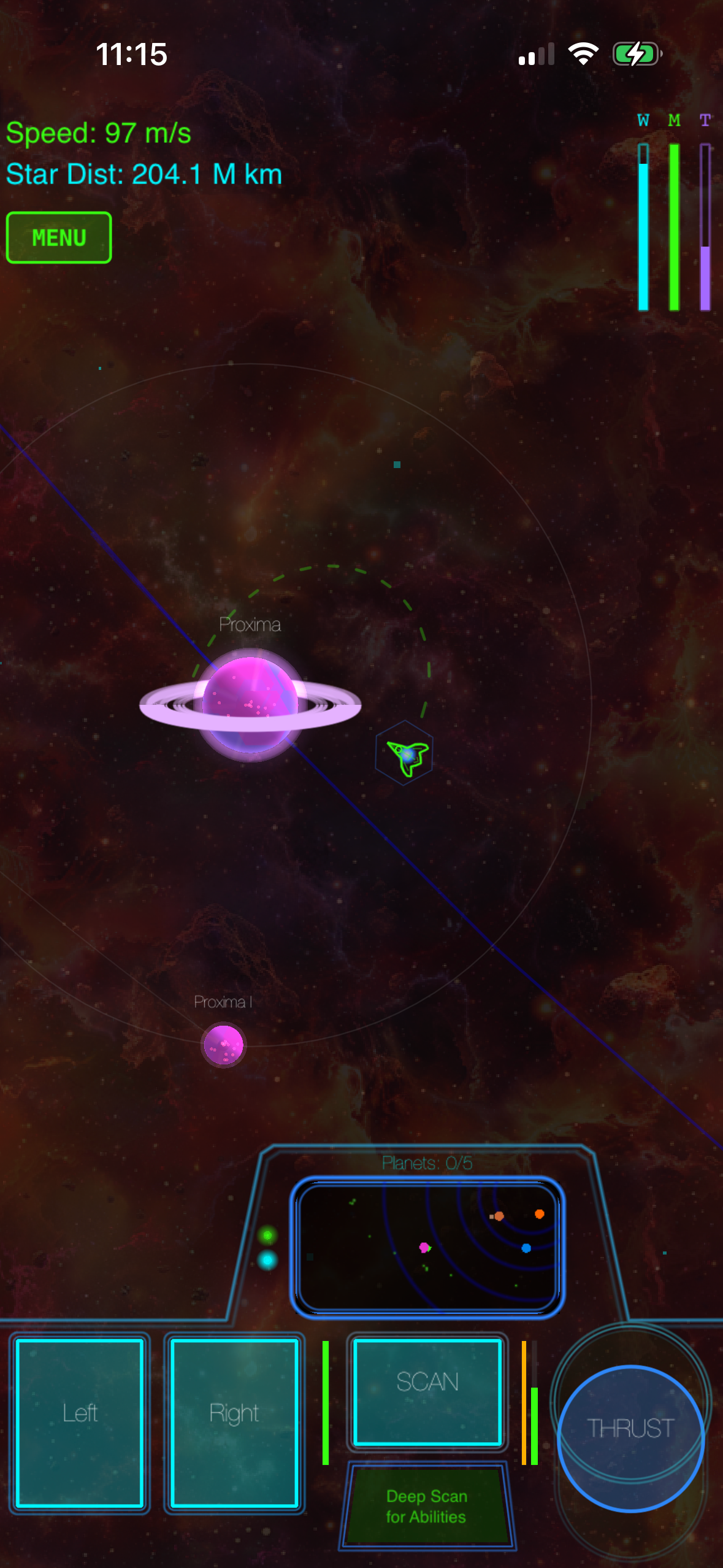
Galaximus centers on real orbital mechanics. Every celestial body pulls on every other body in real time. Your ship is subject to all of it. A planet’s gravity well can accelerate you for free if you time your approach right—a slingshot maneuver. Mastery comes from using gravity as a tool, not fighting it.
The learning curve is real. You need about 30 minutes of focused play to internalize how the controls work when gravity is always present. After that, the physics becomes intuitive, and the payoff is a depth no faked-physics space game can match.
The campaign spans eight procedurally configured star systems with a structured narrative arc. Each playthrough generates unique planet positions and encounter types, so replays feel fresh. Works offline. MFi controller support included.
Best for: Players who want orbital mechanics to matter and don’t mind a learning curve.
Kerbal Space Program (Mobile) — $4.99 | 4.4 stars (892 reviews)
If you want to build rockets and understand orbital mechanics at an engineering depth, KSP is the gold standard. You assemble vehicles from parts, manage fuel, and execute maneuvers with real orbital math underneath. It’s deeper than Galaximus on rocketry but steeper on the learning curve. KSP wants to teach you to be an engineer; Galaximus wants you to fly.
Works offline. Controller support available. Significantly more content than Galaximus, but also more complex to learn.
Best for: Players who want to understand rocket engineering and don’t mind spending hours on tutorials.
No Man’s Sky — $9.99 | 4.2 stars (3,156 reviews)
Procedural planet exploration at a scale neither Galaximus nor KSP attempt. Walking on planet surfaces, discovering flora and fauna, base building, and trading. If exploration and discovery are your primary draw, NMS delivers that. Requires internet connection for some features. Larger production budget and scope than other entries here.
Note: Exceeds the threshold but included because it’s the closest alternative for exploration-focused players.
Best for: Players who want to walk on alien worlds and build bases.
Asteroids: Gunner — $2.99 | 4.3 stars (567 reviews)
Simpler controls and faster pickup-and-play than Galaximus or KSP. Vector-style arcade action with procedurally generated asteroid fields. 5-10 minute play sessions. No learning curve. Works offline. MFi controller support.
Best for: Players who want quick arcade sessions without mastering complex physics.
Lunar Lander Pro — $3.99 | 4.5 stars (412 reviews)
Classic lunar descent mechanics with realistic fuel management and gravity. Procedurally generated landing zones. Arcade-style progression. Works offline. No controller support. Smaller scope than Galaximus but tighter focus on one core mechanic.
Best for: Players who want a focused, mastery-based experience with minimal learning curve.
Space Colonists — $4.99 | 4.1 stars (289 reviews)
Turn-based space exploration and colony management. Slower-paced than action-focused alternatives. Building and resource management. Works offline. No controller support. Smaller community but dedicated fanbase.
Best for: Players who prefer strategy and management over real-time action.
Orbit Sandbox — $3.49 | 4.2 stars (156 reviews)
Physics sandbox for experimenting with orbital mechanics without a campaign structure. Create custom systems, adjust gravity, watch interactions unfold. Educational tool as much as game. Works offline. No controller support.
Best for: Players who want to experiment with physics without narrative pressure.
Pricing Verification
All prices verified on the App Store as of July 2026. Prices vary by region. All titles listed are available on iPhone 12 and later; check individual App Store listings for older device compatibility.
Physics in Space Games: Why It Matters
Games with simulated gravity (Galaximus, Kerbal Space Program, Orbit Sandbox) reward positioning and timing. You can’t brute-force your way through a gravity well—you have to respect the physics or waste fuel. This creates a learning curve, but it also creates mastery moments: when you nail a gravity slingshot or thread through an asteroid field with minimal fuel burn, you feel it.
Games with simplified physics (Asteroids: Gunner, most free-to-play titles) remove that friction. You move more freely, combat is more twitch-based, and the learning curve is shallower. That’s not bad—it’s a different design choice. But it’s worth knowing which you’re getting.
Offline Play: The Underrated Feature
All games listed here work offline. No internet, no problem. You can play on a plane, in a remote cabin, or anywhere without a signal. Free-to-play games often require an internet connection to check purchases or serve ads. Premium games don’t have that overhead.
Controller Support
If you play on iPad or have a controller, MFi support matters. Galaximus, Kerbal Space Program, and Asteroids: Gunner all support controllers. Lunar Lander Pro, Space Colonists, and Orbit Sandbox do not. Check individual App Store listings for the latest compatibility.
FAQ
Can I play Kerbal Space Program offline? Yes. KSP works entirely offline. No internet required.
Does Galaximus work on iPhone 12 or older? Galaximus requires iOS 14.5 or later. It runs on iPhone 12, 11, and later. Check the App Store listing for your specific device.
Can I refund a game if I don’t like it? Apple’s App Store refund policy allows refunds within 14 days of purchase if you request them. You won’t lose the money, but you will lose access to the game. Read reviews and watch gameplay videos before you buy.
Which game has the steepest learning curve? Kerbal Space Program. It’s designed to teach orbital mechanics from first principles. Galaximus has a moderate learning curve. Asteroids: Gunner and Lunar Lander Pro are accessible immediately.
Do any of these games have ads? No. All games listed are premium purchases with no ads, energy timers, or in-app purchases.
Which game is best for short play sessions? Asteroids: Gunner and Lunar Lander Pro. Both support 5-10 minute sessions. Galaximus and KSP reward longer play but don’t require it.
The Bottom Line
Premium space games are rare because they require a developer willing to bet on a smaller audience. The games that make it to this tier are the ones that found their audience and kept them. No ads, no energy timers, no pressure to spend more.
If you want a space game where physics matters, where mastery is the payoff, and where you own what you buy, this category is worth exploring. Pick the game that matches your play style—whether that’s orbital mechanics, engineering depth, arcade action, or exploration.