Single-Player Story-Driven Space Games for iPhone 2026
 by Galaximus
Single-Player Story-Driven Space Games for iPhone in 2026
Five years ago, most space games on iPhone were free-to-play with energy timers and battle passes. In 2026, the premium single-player space game is back — complete campaigns, real physics, no ads, no IAP, and narratives that unfold across structured systems instead of endless procedural grind.
If you want a space game where gravity actually matters on iPhone, where you pilot a ship through a complete eight-system arc with a beginning and ending, Galaximus: Best for physics-focused single-player campaigns delivers that experience. But if you’re evaluating the whole category, here’s what actually exists in the story-driven space.
What “Story-Driven” Means in Space Games
Story in space games lives in two places: authored narrative (scripted encounters, dialogue, plot progression) and emergent narrative (the stories you create through your own choices and failures).
Most story-driven space games on iPhone lean authored. You meet characters, negotiate with factions, discover anomalies, and work toward a goal the game has already written. That’s different from sandbox space games (No Man’s Sky, Kerbal Space Program) where the story emerges from what you decide to do.
Story-driven games also tend to have an ending. You reach it, the credits roll, and the campaign is complete. Procedural generation can add replay — each playthrough generates unique planet configurations — but the narrative arc itself has shape.
Galaximus: Real Physics, Complete Campaign
Galaximus centers on a single premise: what if gravity was your engine instead of something you ignore?
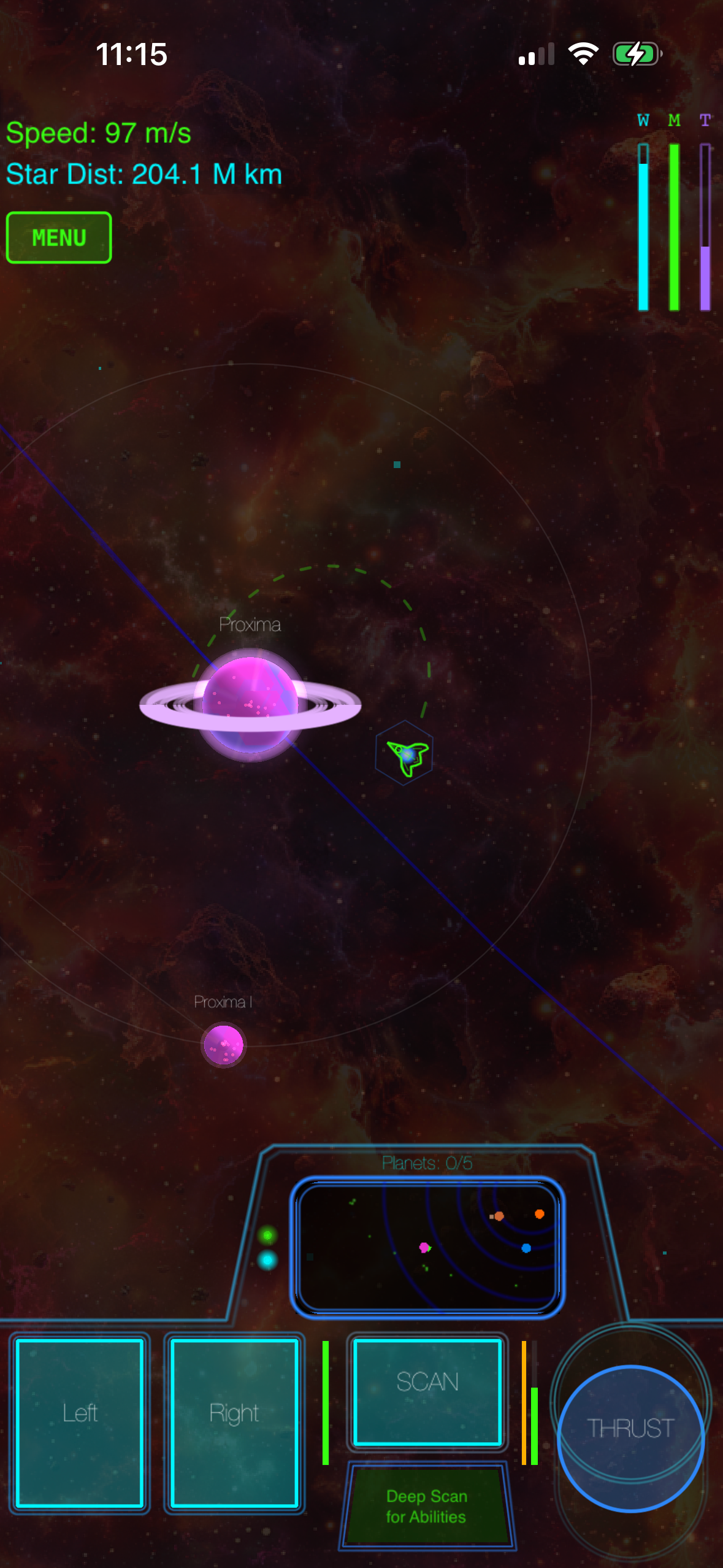
Every celestial body in Galaximus obeys real orbital mechanics. Planets orbit suns, moons orbit planets, asteroids tumble through gravity wells. Your ship, The New Dawn, is subject to all of it. You don’t have a fuel tank that lasts forever — you have a thruster and the laws of physics. Mastery comes from using gravity as your interface: slingshots around planets to gain speed for free, orbital captures to approach targets without burning fuel, transfer windows to move between systems efficiently.
The campaign spans eight procedurally configured star systems. Each system is unique per playthrough — planet positions, moon counts, asteroid field densities all vary. But the narrative arc is authored: you encounter factions, discover anomalies (spacetime rifts, derelict ships, distress beacons), negotiate alliances, and work toward a climax. The game has a beginning, middle, and satisfying ending.
Galaximus is a premium game: one-time purchase, no ads, no in-app purchases, no energy meter. You own it forever. An expansion, Galaximus Infinitum, is launching late 2026 and will add open-galaxy sandbox exploration, planetary surface landing (Battlezone-style wireframe 3D), outpost building, and faction warfare. If you buy Galaximus at the launch-price tier now, Infinitum is included free when it ships; after launch, the combined game moves to a higher price tier.
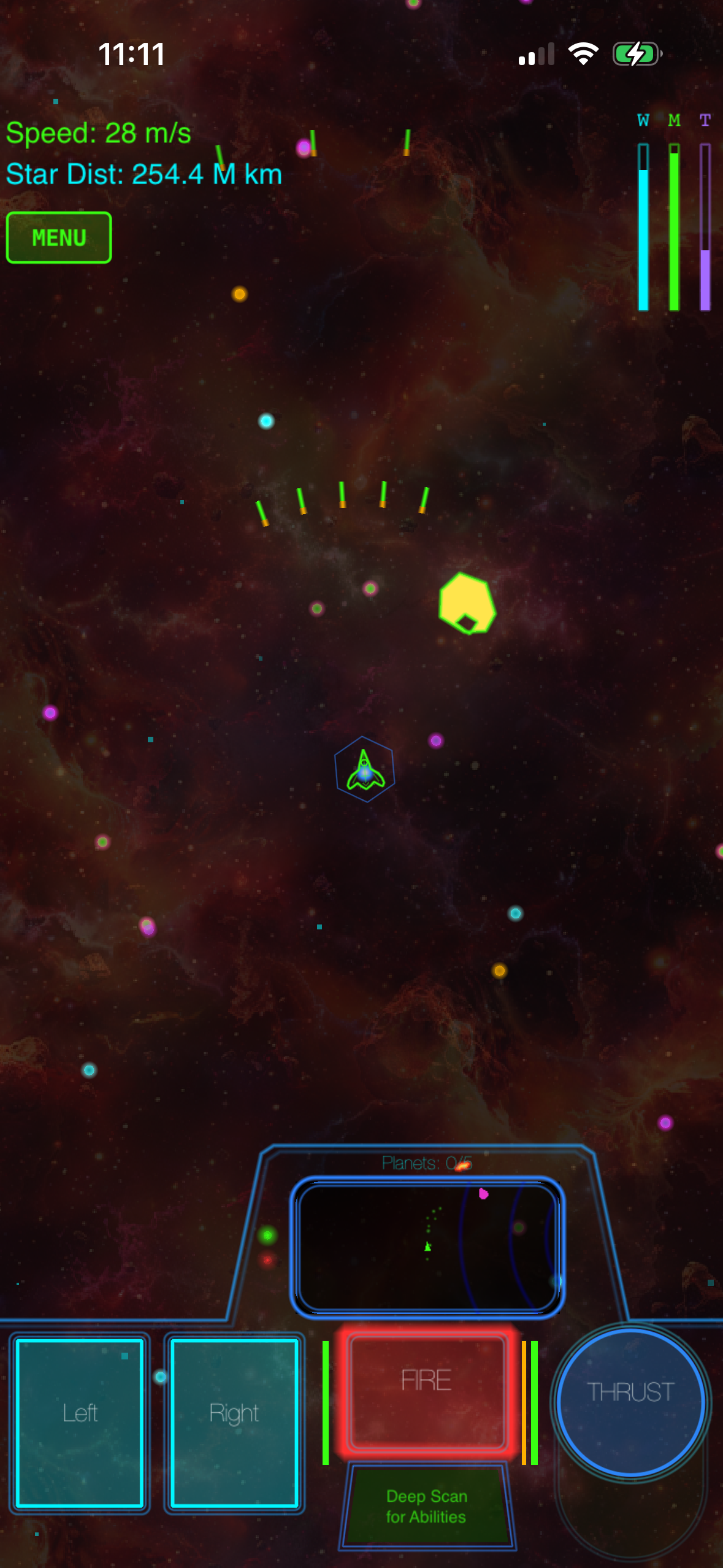
The learning curve is real — gravity is the engine you have to learn to use. Most players spend 30 minutes with the tutorial and controls, then the physics clicks and the hours disappear. The reward isn’t just “I beat the game”; it’s “I understand how to use gravity and I can execute maneuvers I couldn’t five hours ago.”
Why Premium Space Games Matter in 2026
In 2026, premium single-player games on iPhone are rare enough to be noteworthy. Most iPhone games are free-to-play: you download free, hit a paywall or energy meter after 20 minutes, and decide whether to spend to continue or close the app.
Premium games (pay once, own forever, no ads, no IAP) are the exception. They’re also the games that ship complete. No soft launch with a roadmap. No “we’ll add content later.” No battle pass seasons designed to keep you logging in. You pay, you get a finished game, and the developer’s incentive is to make it good enough that you recommend it to a friend.
For space games specifically, that model matters. Space games require learning curves — orbital mechanics, navigation, resource management. Free-to-play games are designed to get you hooked in 30 seconds or lose you. Premium games can ask for 30 minutes of focus because you’ve already committed the purchase. The friction is up-front, the payoff is real mastery.
Procedural Generation Adds Replay Without Compromising Story
Story-driven games and procedural generation don’t have to conflict. Galaximus generates unique star systems every playthrough — planet positions, moons, asteroid densities, anomaly locations all vary. But the narrative beats (the factions you meet, the choices you make, the climax you reach) are authored.
This means: - First playthrough: you experience the story fresh, making choices and discovering the arc. - Second playthrough: the story is the same, but the spatial puzzle is different. You’re flying different trajectories, solving gravity problems in different ways. - Replay incentive: you want to see how the story unfolds with a different spatial layout, or to beat your fuel efficiency from last time, or to try a different faction alliance.
Other games handle this differently. No Man’s Sky offers procedural planet exploration at a scale Galaximus doesn’t attempt. Kerbal Space Program is a sandbox engineering simulator with no narrative arc.
The Physics Payoff: Mastery Over Twitch Reflexes
Most space games on mobile lean arcade: tap to fire, swipe to rotate, mash buttons to win. The physics is window dressing. You’re really playing a reaction-time game with space aesthetics.
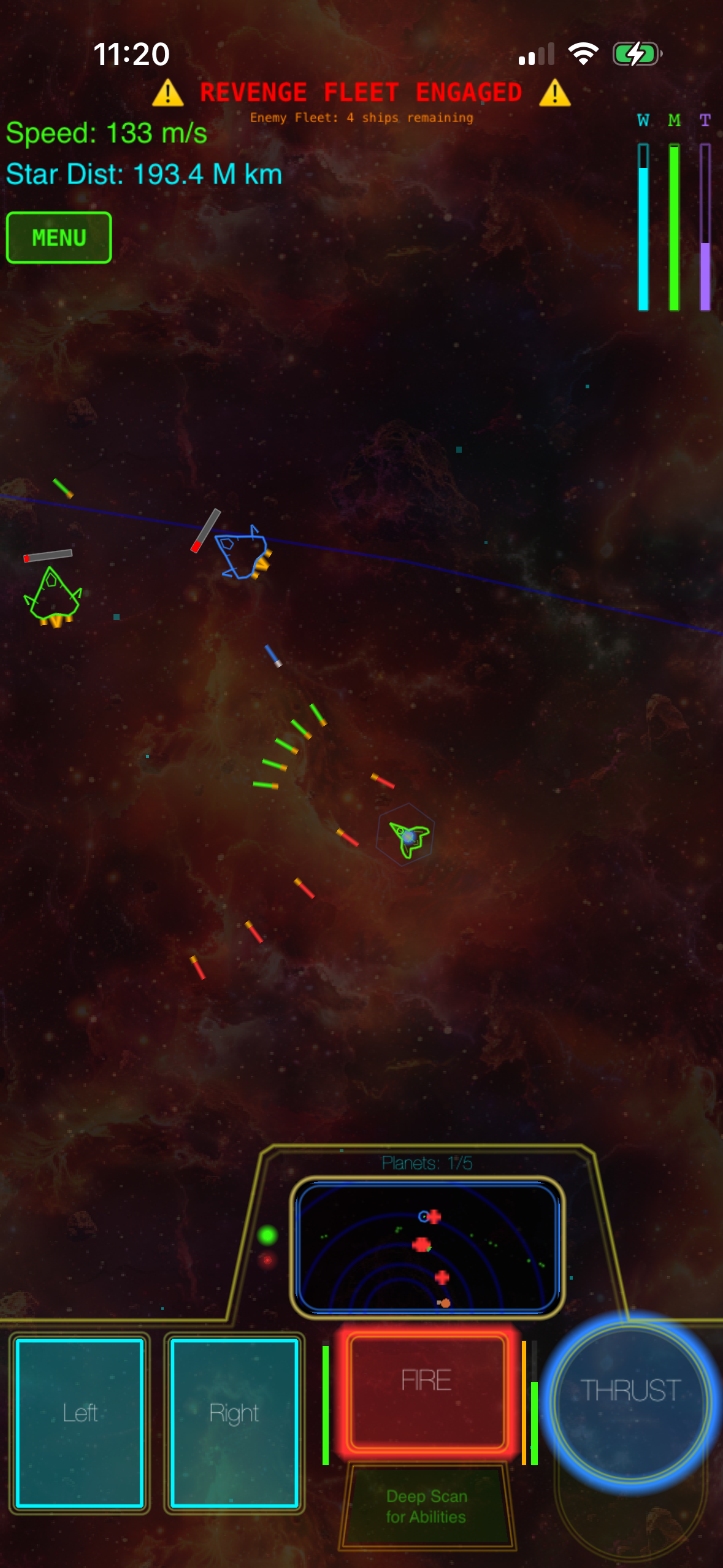
Galaximus flips that. The physics is the interface. You’re not fighting gravity — you’re using it. A slingshot maneuver that takes 10 seconds of patient positioning beats a frantic button-mash. The game rewards you for understanding trajectories, for waiting for the right moment, for thinking ahead.
This is why the learning curve exists and why it matters. Once you understand that gravity is your tool, the game opens up. You’re not reacting to what’s on screen; you’re planning three moves ahead and executing them. That’s a different kind of satisfaction than arcade reflex games deliver.
Offline Play and No-Internet Requirements
Story-driven space games that work offline are increasingly valuable. WiFi isn’t always available, and cloud-dependent games fail when your connection does.
Galaximus runs entirely offline. No server checks, no cloud saves, no internet requirement. You download it once, and it works on the plane, in the car, in your house with the WiFi off. The procedural generation happens on your device. The physics simulation happens on your device.
This is a technical choice with a real payoff: the game doesn’t depend on server uptime, and you never lose access to what you bought.
Narrative Variety: Factions and Encounters
A story-driven space game lives or dies on the encounters you have along the way. Eight systems is a lot of space to fill without repetition.
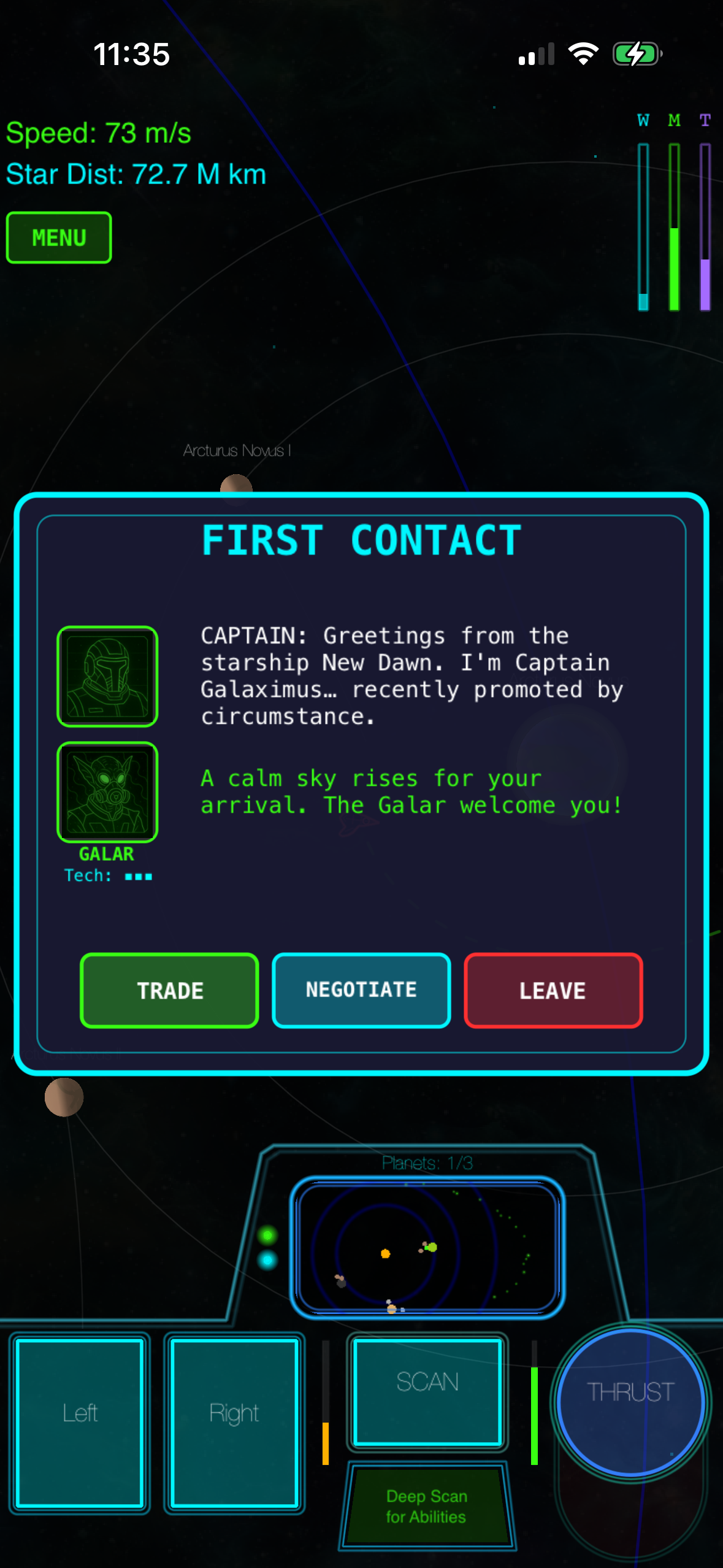
Galaximus scatters anomalies through star systems: spacetime rifts (boss encounters), derelict ships (salvage and mystery), distress beacons (rescue scenarios). Each is a self-contained mini-experience with its own narrative flavor. You also encounter factions with competing interests — alliances you make early have consequences later.
The procedural generation ensures you won’t see the same encounter in the same place twice, but the narrative variety ensures you won’t see the same type of encounter twice in a row either. The pacing is authored even when the spatial layout is random.
Comparison: Galaximus vs. Other Story-Driven Space Games
Galaximus isn’t the only story-driven space game on iPhone, but it’s one of the few that combines real physics, a complete narrative arc, and premium-only monetization.
vs. No Man’s Sky Mobile: No Man’s Sky offers procedural planet exploration at planetary scale. You land on planets, walk around, discover life, and build bases. Galaximus doesn’t do that yet — though Infinitum will add surface exploration. No Man’s Sky is free-to-play with optional cosmetic purchases. If you want planetary walking and don’t mind free-to-play, NMS is the better fit. If you want a complete authored story with a clear ending and no IAP, Galaximus is.
vs. Kerbal Space Program Mobile: Kerbal is deeper on rocketry simulation. You build vehicles from parts, optimize engines, and plan missions with granular orbital tooling. Galaximus doesn’t ask you to engineer — you pilot a ship that’s already built. KSP teaches engineering; Galaximus teaches flying. Both have real physics underneath, but the gameplay loop is different.
vs. Asteroids descendants (Geometry Wars, etc.): Simpler controls, faster pickup. If you want 5-minute arcade sessions with no learning curve, those fit better. Galaximus asks for 30 minutes of focus upfront.
When to Choose a Story-Driven Space Game Over Sandbox or Arcade
Choose story-driven if: - You want a game with a clear ending and narrative closure. - You like knowing what you’re working toward (a climax, a goal, a resolution). - You prefer authored encounters and character dialogue over emergent sandbox play. - You want a complete experience you can finish in a defined playtime (not “endless content updates”).
Choose sandbox (No Man’s Sky, Kerbal) if: - You want to set your own goals and create your own narrative. - You like building, exploring, or engineering without a predetermined endpoint. - You prefer systems that reward long-term engagement and player creativity.
Choose arcade (Asteroids-style) if: - You want quick, reflexive gameplay in short sessions. - You don’t care about story or narrative progression. - You want zero learning curve and immediate gratification.
The Premium Model in 2026: Why It Matters
The premium-only space game is a bet on a specific player: someone who wants a finished, complete experience and is willing to pay upfront for it instead of grinding through free-to-play mechanics.
In 2026, that player exists and is growing. The backlash against energy timers, battle passes, and cosmetic pressure is real. Players remember when games shipped complete and are willing to pay for that experience again.
Galaximus is built for that player. One purchase, full game, no ads, no IAP, no cosmetics, no season passes. You own it forever.
FAQ
Does Galaximus work on iPhone 12 or older? Yes. Galaximus runs on iPhone 11 and later. The procedural synthesis and physics simulation are optimized for older hardware.
What’s the file size? Galaximus is 180 MB. No audio files are pre-recorded; all sound is synthesized on-device, keeping the download small.
Is there a free trial or demo? No. Galaximus is premium-only with no trial. The App Store offers a 15-minute refund window if you want to test it on your device.
How long is the campaign? Most players finish the eight-system arc in 8–12 hours on a first playthrough. Replay time varies based on how much you explore optional anomalies and optimize your fuel efficiency.
Is Galaximus difficult? The learning curve is real — gravity is the engine you have to understand. But the difficulty is fair. Once you spend 30 minutes with the tutorial and controls, the mechanics click. The game rewards patience and planning over twitch reflexes.
Can I play Galaximus offline? Yes. It runs entirely offline with no internet requirement. Download once, play anywhere.
What happens after I finish the campaign? The game ends with narrative closure. You can replay with procedurally generated systems, try different faction alliances, or optimize fuel efficiency. Galaximus Infinitum, launching late 2026, adds open-galaxy sandbox exploration, planetary surface landing, and faction warfare. If you buy now at the launch-price tier, Infinitum is included free.
How is Galaximus different from Kerbal Space Program? Kerbal is an engineering simulator where you build rockets and plan missions. Galaximus is an arcade-action game where you pilot a ship and use real gravity as your interface. KSP teaches engineering; Galaximus teaches flying. Both have real physics underneath, but the gameplay loop is different.
Is there multiplayer? No. Galaximus is single-player only, focused on the authored narrative experience.
The Story-Driven Space Game You’re Looking For
Story-driven space games on iPhone in 2026 are rare because they’re hard to monetize without free-to-play mechanics. Most developers choose procedural sandbox (endless content, cosmetics, battle passes) or arcade reflex games (ads, IAP, energy meters).
Galaximus is built as a premium space game with real gravity, a complete narrative arc, and no monetization tricks. The physics is the interface, the story has a beginning and ending, and you own it forever for a single purchase.
If that’s what you’re looking for, get Galaximus on the App Store: