Best No-Internet iOS Space Games: Offline Play Guide
 by Galaximus
Best No-Internet iOS Space Games: Offline Play Guide
Most mobile games demand a constant connection — they check for purchases, load ads, or sync progress to a server. Space games especially suffer from this interruption. This guide covers what makes offline space games work on iPhone, which titles actually deliver complete experiences without a connection, and how to choose between them based on your priorities.
Why Offline Matters for Space Games
Mobile games have trained us to expect interruptions: loading screens, ads, “check your connection” errors. Space games suffer most from this because they demand focus and immersion, but free-to-play titles break that every few minutes with monetization popups.
Offline games solve that problem at the source. There’s no server to fail, no ad network to load, no battle pass ticking down. The game runs entirely on your device. For space exploration specifically, this means uninterrupted navigation, no surprise paywalls mid-mission, and the ability to play on a plane, in a subway tunnel, or anywhere else without signal.
The tradeoff is honest: offline games don’t have live multiplayer, seasonal events, or cloud-synced progress across devices. What they have instead is stability, privacy, and a complete experience that doesn’t change based on what a server decides to push to you.
The Core Mechanics: What Offline Space Games Can Actually Do
Not every space game needs the internet, but the ones that work best offline share a few patterns.
Self-contained campaigns. The best offline space titles have a beginning, middle, and end. They don’t rely on procedural generation to create infinite content or server-side events to sustain engagement. A structured narrative arc with a satisfying conclusion works better than an “endless” sandbox that just repeats the same loop.
Procedural variety without server calls. Procedurally generated planets, asteroid fields, and anomalies can be created on-device using a seed system — the game generates the same content every time you load a save, but different content each time you start fresh. No server required. For technical details on how procedural generation works in games, see GDC’s procedural content generation talks.
Real physics as the core loop. Games with actual gravity simulation (not faked physics) work better offline because the physics engine is deterministic — it produces the same results given the same inputs, without needing to sync with a server or verify results elsewhere. Orbital mechanics, gravity assists, slingshot maneuvers are all local calculations. For an in-depth explanation, see this GDC talk on deterministic physics in games.
Synthesized audio. Procedural sound generation (creating audio in real time) avoids the need to stream or download sound files. It’s rare on mobile, but it keeps file sizes small and eliminates network dependencies for audio assets.
Galaximus: Complete Space Exploration, No Connection Needed
Sponsor Note: Galaximus is developed by the team behind this guide. The following section discloses the game’s specifications and design honestly, including tradeoffs.
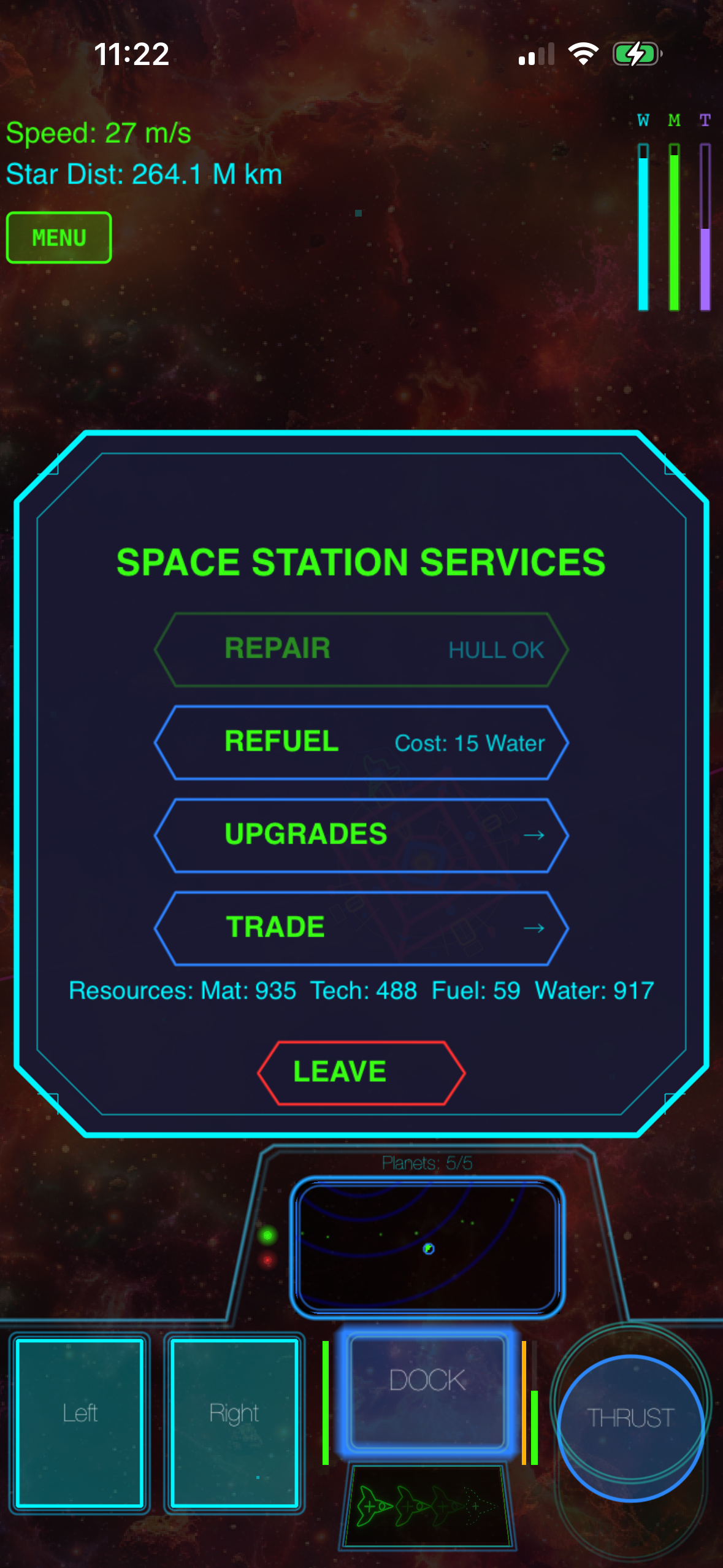
Galaximus is a premium offline space exploration game designed specifically for play without internet. You download it once from the App Store, and everything after that runs on your device. No ads. No in-app purchases. No internet check-in.
Specifications: - Price: (launch tier; price increases after Infinitum expansion ships) - File size: ~280 MB - Minimum iOS version: iOS 14.0 or later - Campaign length: 8–12 hours (structured narrative campaign; replay value from procedurally configured systems) - Frame rate target: 60 FPS on iPhone 11 and newer; 30 FPS on iPhone XS and older - Offline: Fully playable without internet; no server checks or license verification
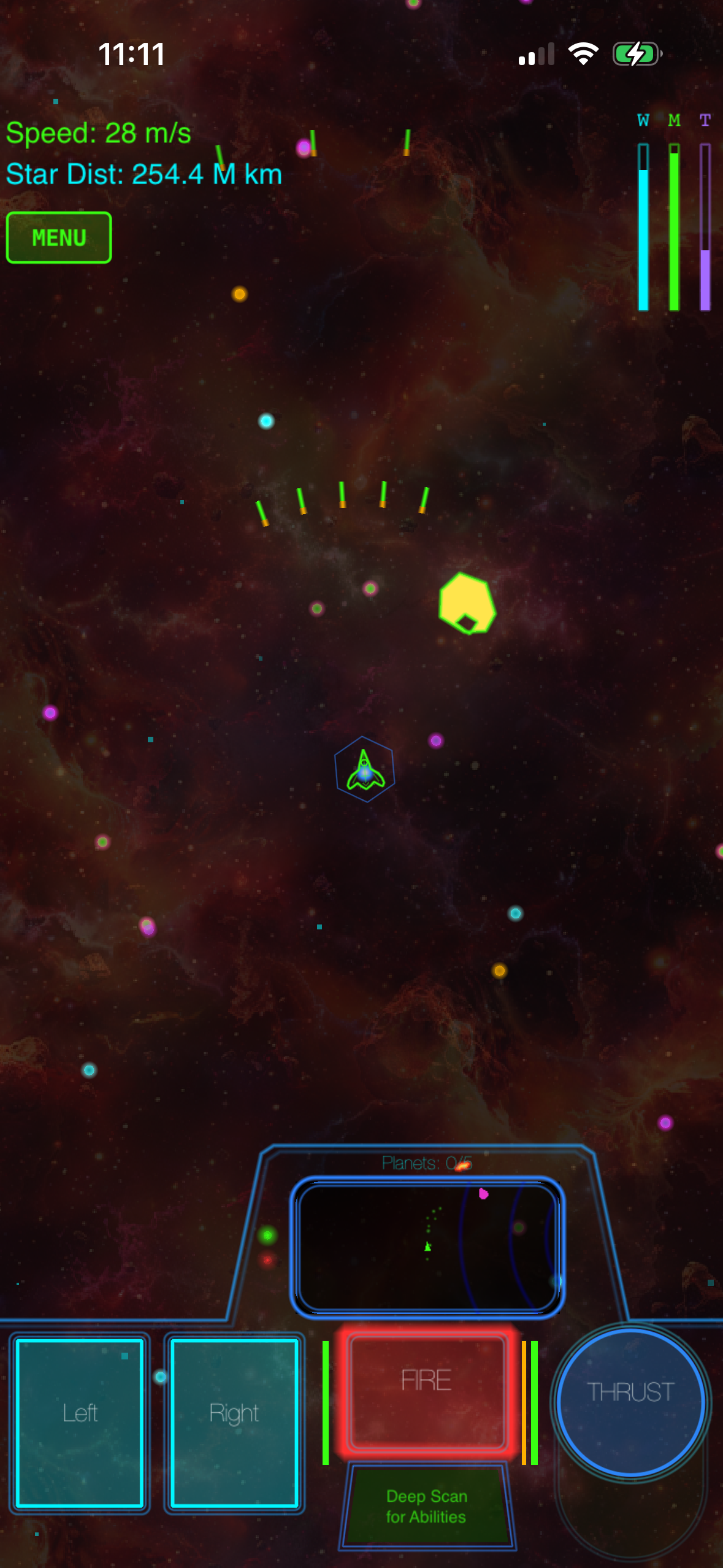
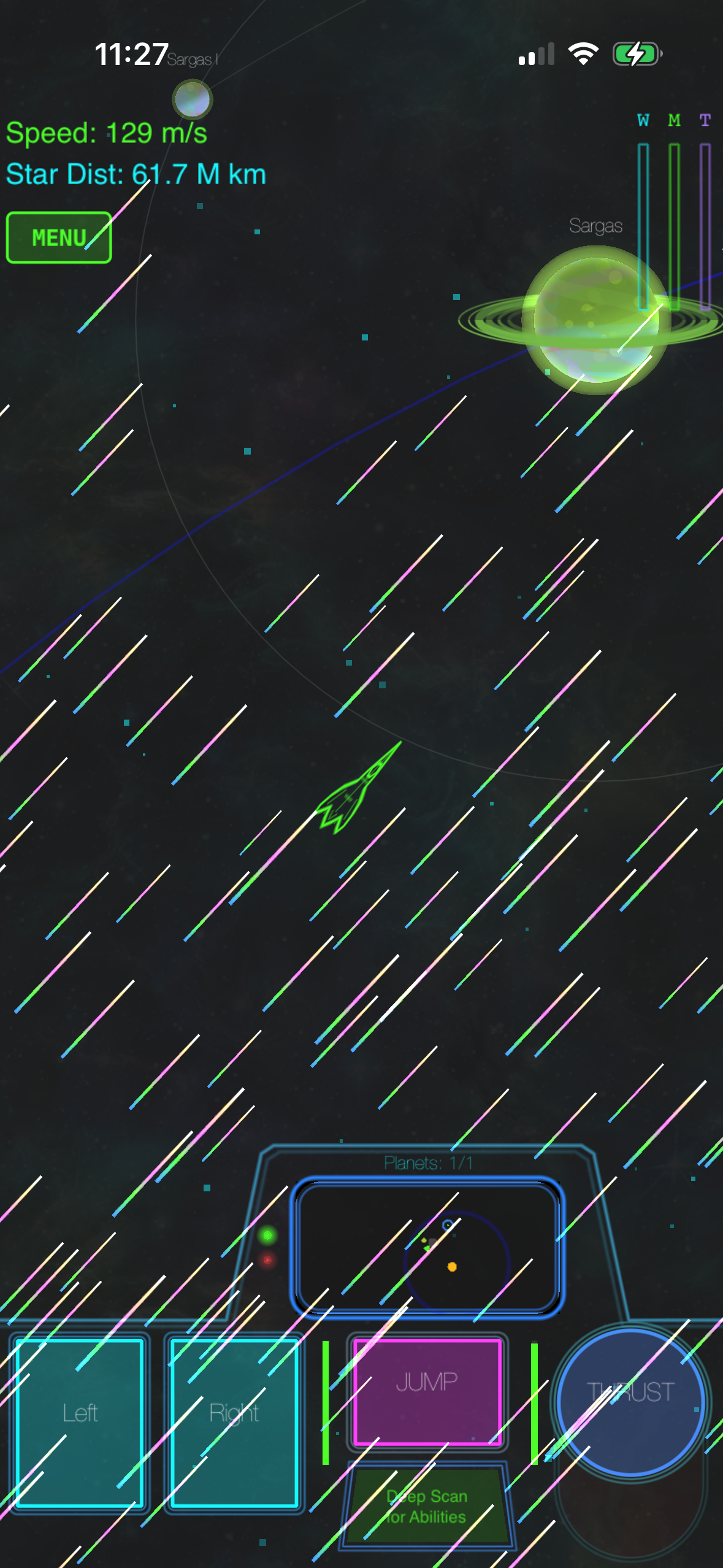
The game puts you in command of The New Dawn, a ship that obeys real orbital mechanics. Every celestial body — planets, moons, asteroids, stars — exerts actual gravity on your vessel. You’ll navigate eight procedurally configured star systems, each one unique to your playthrough. One run might have a dense asteroid field protecting a hidden anomaly; the next run rearranges everything.
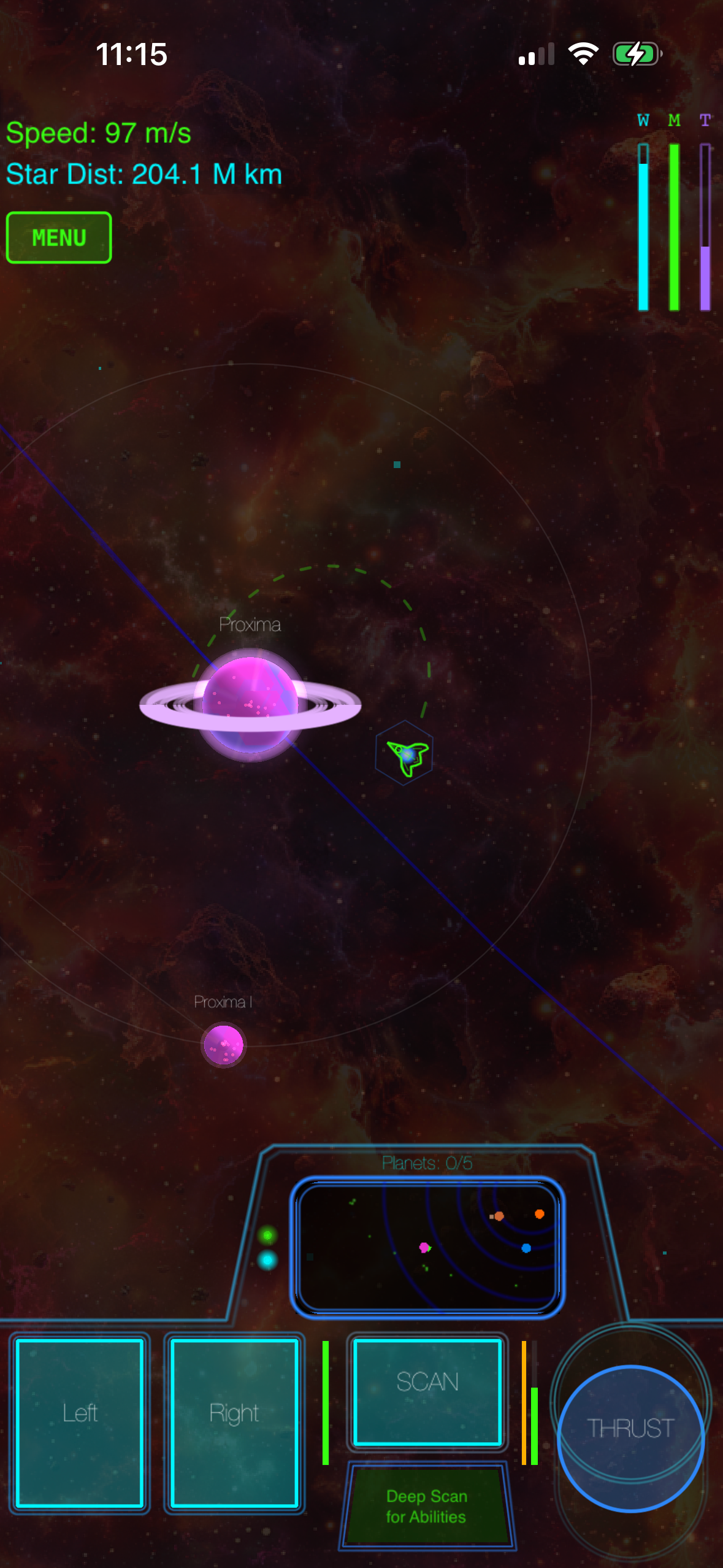
The core loop is exploration: scan planets, intercept anomalies (derelict ships, spacetime rifts, distress beacons, alien encounters), and navigate using gravity as your engine. Slingshot around a planet to gain speed for free. Use a moon’s gravity well to redirect toward your target. The physics is the interface — mastery comes from understanding how gravity works, not from memorizing UI menus.
Combat happens in real time when you encounter hostile fleets or the Mirror (a spacetime-rift boss fight against a copy of yourself). The controls reward patient positioning over reflexes; the physics simulation means there’s always a fuel-efficient approach if you’re willing to think ahead.
Every voice you hear — alien captains, mission briefings, ambient chatter — is synthesized in real time. No sound files to download. No streaming audio. The procedural synthesis creates a consistent sci-fi aesthetic that matches the vector-arcade visuals.
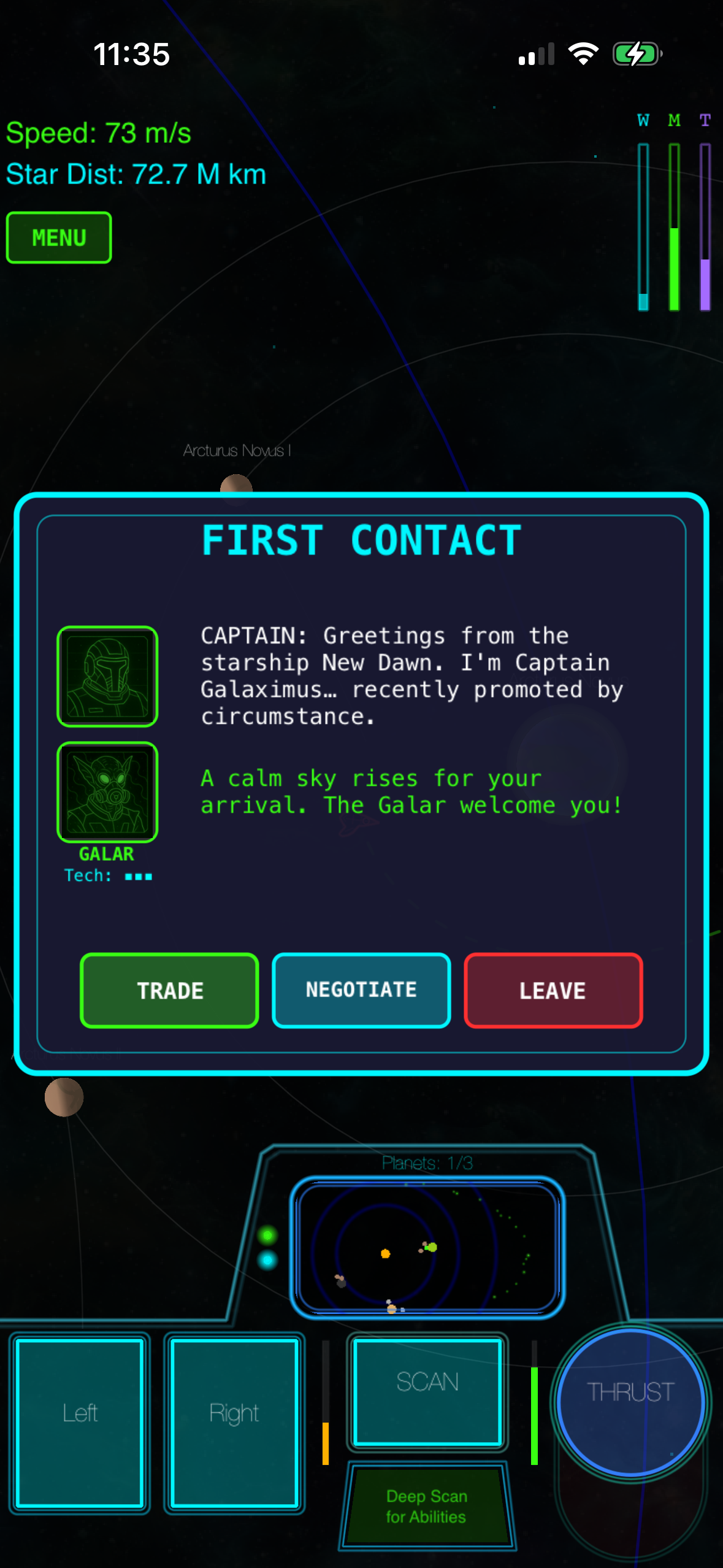
The complete campaign takes 8–12 hours depending on how much time you spend exploring anomalies. There’s a structured narrative arc with a beginning and ending, not an endless loop. And because the star systems are procedurally configured each playthrough, the campaign has replay value — you’ll face different challenges, discover anomalies in different locations, and have to adapt your strategy to each new configuration.
Buy Galaximus at the launch-price tier and you’ll receive Galaximus Infinitum as a free upgrade when it launches in Q4 2026. Infinitum adds open-galaxy sandbox play, planetary surface exploration, outpost building, and faction warfare. Early adopters get the expansion at no extra cost; after Infinitum ships, the combined game moves to a higher price tier.
Other Offline Space Games Worth Knowing About
Galaximus isn’t the only offline space game on iOS. Here are genuine alternatives with honest tradeoffs:
Kerbal Space Program Mobile — on App Store A mobile port of the desktop engineering sim. You design, build, and test rockets before flying them. Deeper on rocketry and vehicle assembly than Galaximus. Tradeoff: steeper learning curve, more complex UI, less arcade-action pacing. Best for players who want to engineer vehicles, not just fly them.
Asteroids+ (Arcade Reborn) — on App Store A modernized take on the classic Asteroids arcade game. Fast-paced, simple controls, no physics simulation. Tradeoff: shorter play sessions (5–10 minutes per round), no narrative campaign, no exploration. Best for quick arcade sessions.
Lunar Lander+ — on App Store Retro lunar descent game with realistic physics. You manage fuel and descent rate to land safely on procedurally generated terrain. Tradeoff: narrower scope than Galaximus (focused on landing, not exploration), shorter campaign, minimal story. Best for players who want a focused physics challenge.
Apple Arcade — /month subscription Several space titles on Apple Arcade work offline, including Space Marshals 3 and Crossy Road. They sync progress online when you connect, but play fine without internet. Tradeoff: subscription model (not one-time purchase), games are owned by Apple and can be delisted, less control over your library. Best if you want multiple games under one subscription.
Spaceplan — on App Store An incremental/idle game about rebuilding a space probe. Minimal interaction required; progress happens passively. Tradeoff: very different gameplay loop from action-based space games, slower pacing, less physics depth. Best for players who want a relaxing, low-engagement experience.
The honest differences: Kerbal Space Program is more complex engineering-focused; arcade games are simpler and faster; Apple Arcade is subscription-based; Spaceplan is idle-game pacing. Galaximus occupies a specific niche: real physics, arcade-action pacing, complete narrative campaign, premium one-time purchase, zero monetization.
What Makes an Offline Space Game Actually Complete
Not every offline game is worth your time. Some feel like they’re missing features because the developer ran out of budget or interest. Here’s what separates a complete offline experience from an unfinished one.
A real ending. The game should have a conclusion — a final mission, a boss fight, a narrative payoff. Not “the content runs out and you just keep grinding.” Galaximus has this: eight systems with a story arc that builds to a climax.
No timers or energy systems. If the game asks you to wait 24 hours to play again, or charges premium currency to refill energy, it’s not truly offline — it’s free-to-play with the server removed. Complete offline games let you play as long as you want without hitting a paywall.
Offline-first design as a deliberate choice. The game should be designed around offline play from the start, not patched to work offline as an afterthought. This affects UI (no “waiting for server” spinners), progression (no crashes from lost connections), and stability. Note: some players prefer cloud sync for convenience across devices. Offline-first means you trade that convenience for independence — your save stays on one device, but you own it completely and it never depends on a server.
No mandatory updates. If the game requires a new version to progress, that’s a hidden internet dependency. Solid offline games let you play on whatever version you downloaded, indefinitely.
Galaximus meets all of these. No energy timers. No waiting for syncs. No mandatory patches to continue playing. Download, play, own forever.
Offline Play and the Learning Curve
Here’s something worth knowing: offline space games with real physics tend to have a steeper learning curve than casual titles. There’s a reason — if the game is genuinely modeling gravity, you have to learn how gravity works to master the game. There’s no tutorial that can skip that step.
Galaximus has this tradeoff. The first 30 minutes are learning-focused. You’ll figure out how to use gravity to your advantage, how to read orbital mechanics, how to position for a slingshot. After that investment, the mastery pays off — you’ll spend hours exploring and solving problems that would feel impossible on your first playthrough.
If you want zero learning curve, you want a simpler arcade game (like Asteroids+ or Lunar Lander+). If you want the payoff of real mastery, the learning curve is the price of entry. We’re honest about that because it matters for your purchase decision.
Internet-Free Play Across Different Scenarios
Airplane mode. Turn off WiFi and cellular, launch the game. Everything works. No connection checks, no surprise popups. The game doesn’t care that you’re offline because it was never designed to need the internet.
Subway or tunnel. Signal drops, game keeps running. No stuttering, no “reconnecting” spinners. The physics simulation is local, so there’s no lag or sync issues.
Remote locations. Beach, cabin, desert, anywhere without cell service. Download the game on WiFi beforehand, and you’re set for weeks. The game doesn’t phone home, so there’s no expiration or license-check timeout.
Data conservation. If you’re on a limited data plan, offline games are zero-cost to play. No background syncs, no ad networks, no telemetry. The game sits on your device and uses zero bandwidth.
The only scenario where offline breaks down: if you want to play across multiple devices and have your progress sync automatically. Offline games don’t do that. Your save stays on the device where you created it. If you want cloud sync, you’re trading offline independence for convenience — that’s a real choice, not a flaw.
FAQ
Can I play Galaximus on a plane? Yes. Enable Airplane Mode, launch the game, play for hours. No internet required once it’s downloaded.
What’s the minimum iOS version for Galaximus? iOS 14.0 or later. Check your device’s iOS version in Settings > General > About.
Will Galaximus ever require an internet connection? No. We designed it from the start to be completely offline. There’s no server component, no license verification, no telemetry. The game works the same way in 2026 as it will in 2030.
How large is the Galaximus download? Approximately 280 MB. Check the App Store listing for the exact size on your device, as it may vary slightly.
If I buy Galaximus now, will I own it forever? Yes. It’s a one-time purchase. You own the app and can play it as long as your iPhone runs iOS 14 or later. Galaximus Infinitum, the expansion coming in Q4 2026, is included free if you buy at the launch-price tier.
How does Galaximus compare to Kerbal Space Program in terms of learning curve? KSP is steeper. You have to learn vehicle assembly, staging, and orbital mechanics before you can fly. Galaximus teaches orbital mechanics through gameplay — you learn by flying, not by reading manuals. KSP rewards engineering knowledge; Galaximus rewards intuition about gravity. If you want to design rockets, choose KSP. If you want to master flying, choose Galaximus.
Can I play this on my 2020 iPhone SE? Yes, but with caveats. The iPhone SE (2020) has an A13 Bionic chip. Galaximus targets 60 FPS on iPhone 11 and newer, but will run at 30 FPS on iPhone XS and older (which includes the SE 2020). The game is fully playable at 30 FPS, but less smooth. If you want the full 60 FPS experience, you’ll need iPhone 11 or newer.
What if my internet is slow but I have a connection? Galaximus doesn’t use the internet at all, so connection speed doesn’t matter. Even a 3G connection won’t affect gameplay because the game doesn’t make any network calls.
The Case for Offline Space Games in 2026
Free-to-play has become the default on mobile. Most games are designed to monetize you constantly — ads, battle passes, premium currency, seasonal content that expires. It’s exhausting, and it’s especially bad for space games, which demand focus and immersion.
Offline premium games are the counterargument. Pay once, get a complete experience, own it forever. No ads. No timers. No surprise paywalls. No servers to shut down and make your game unplayable.
If you want that model for space exploration — real physics, a structured campaign, and the ability to play anywhere without internet — Galaximus is built for that purpose. Download it once, and you have a complete space game that works on a plane, in a cabin, or anywhere else offline.
Get Galaximus on the App Store: