Premium Space Games for iPhone: Comparison & Reviews
 by Galaximus
Premium Space Games for iPhone: Comparison & Reviews
Full disclosure: Galaximus is a product developed by the author. This article reviews it alongside competitors to provide context, but readers should weigh this bias when evaluating recommendations.
As of June 2026, only four premium space games remain on the App Store without ads or in-app purchases—a sharp decline from 2024, when free-to-play dominated but premium titles still had shelf space. Most publishers migrated to free-to-play with battle passes and seasonal content. The premium segment—games you buy once and own forever—is smaller and fiercer. This guide compares the serious contenders and shows you where each one excels.
Why Premium Space Games Matter in 2026
The free-to-play model dominates mobile gaming, but it comes with friction: daily login bonuses to chase, limited energy, cosmetic FOMO, seasonal passes that reset your progress psychologically. A premium space game removes all of that. You pay once. You own the experience. No algorithm decides when you’ve “earned” the next mission.
In 2026, premium space games on iPhone fall into two camps: arcade-action with real physics underneath, and narrative-driven exploration. The first group rewards mastery and pattern recognition. The second rewards patience and curiosity. Galaximus combines both—real orbital mechanics as the core interface, wrapped in a structured 8-system campaign with anomalies and encounters that change each playthrough.
Get Galaximus on the App Store: Get it on the App Store
The comparison below covers the major premium titles worth your attention. Each has a specific strength; none does everything equally well.
Real Physics vs. Arcade Accessibility: The Core Tradeoff
Most space games on iPhone fake gravity for accessibility. They simulate the feeling of space—stars, planets, zero-gravity movement—without modeling the actual math. This keeps the learning curve flat and the pickup-and-play window wide.
Real physics games do the opposite. They model orbital mechanics accurately: every body’s gravity affects every other body in real time. A planet’s pull is genuine. A slingshot—using a planet’s gravity well to gain speed for free—works because the math works, not because the designer decided it should feel good.
The tradeoff is real. Real physics has a learning curve. Thirty minutes of focused play gets you to competence; three hours gets you to mastery. Faked physics is instant gratification; real physics is earned satisfaction.
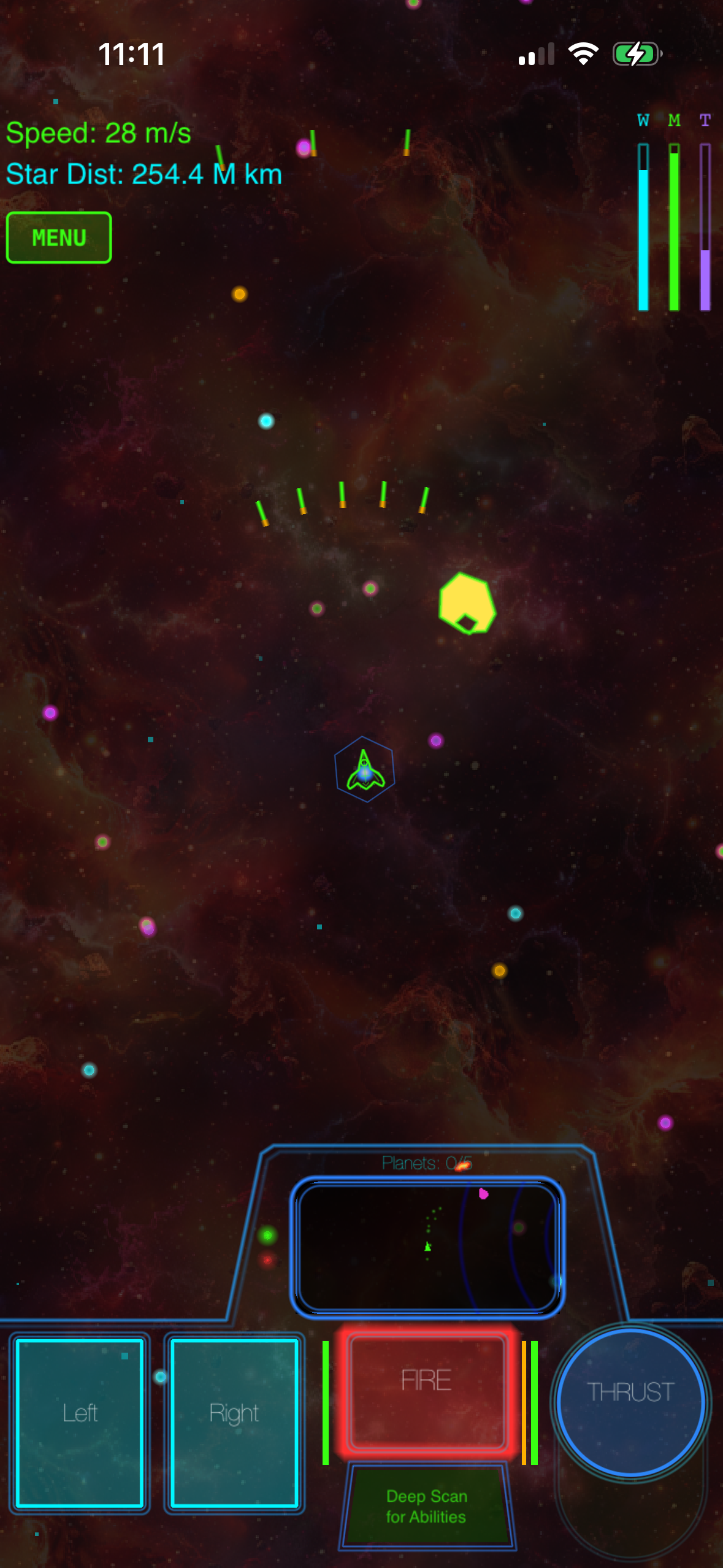
When designing Galaximus, we chose real physics because mastery is the payoff that no faked-gravity game can offer. Once you understand how gravity works in the game, you can predict what will happen next. You can plan a slingshot three moves ahead. That’s not possible in a game where gravity is just visual feedback.
If you want to learn orbital mechanics while playing, real physics is non-negotiable. If you want to jump in and fly around a space environment without thinking about it, arcade-action with simplified physics is the better fit.
Galaximus: Real Gravity, Real Mastery
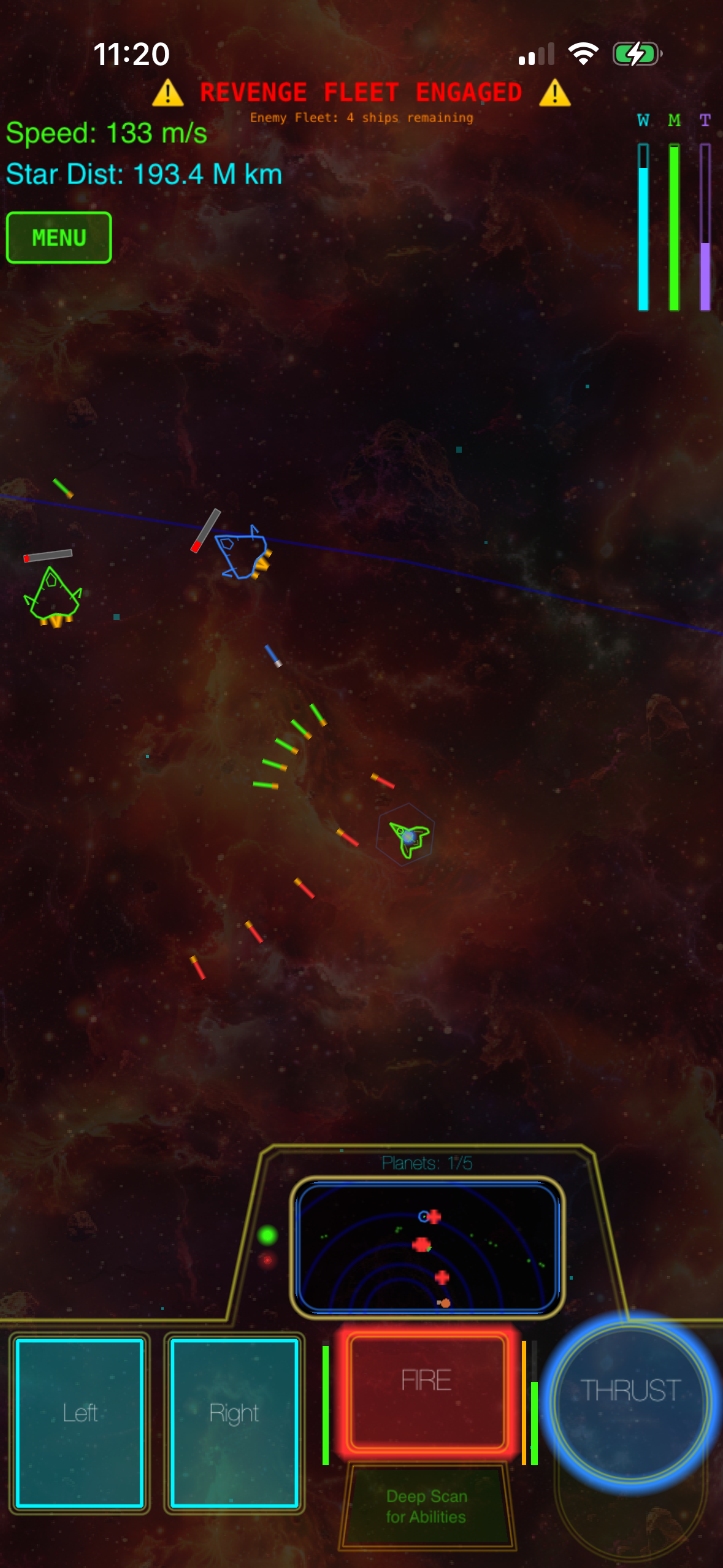
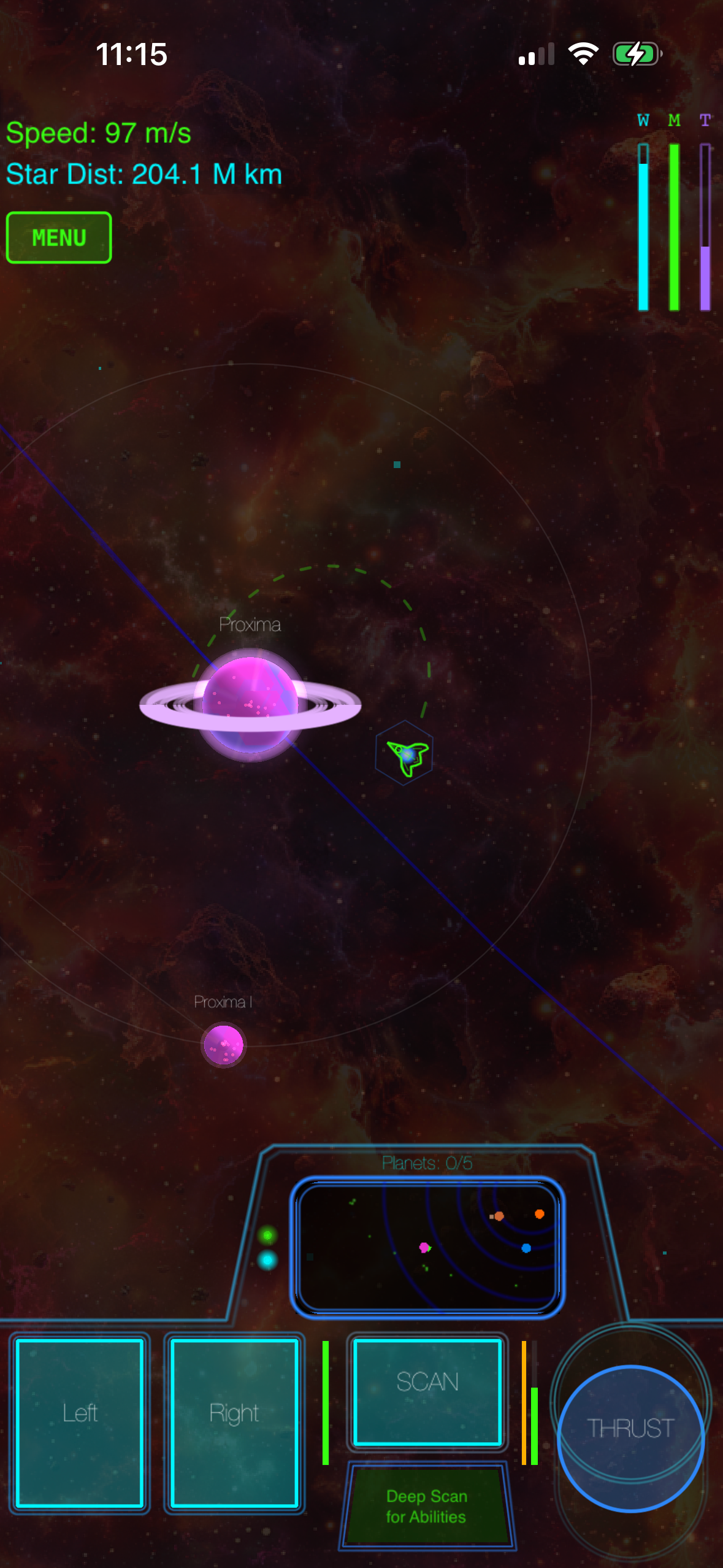
Galaximus is a premium arcade-action game where orbital mechanics are the interface, not the gameplay loop. You pilot The New Dawn, a ship subject to every planet’s gravity in real time.
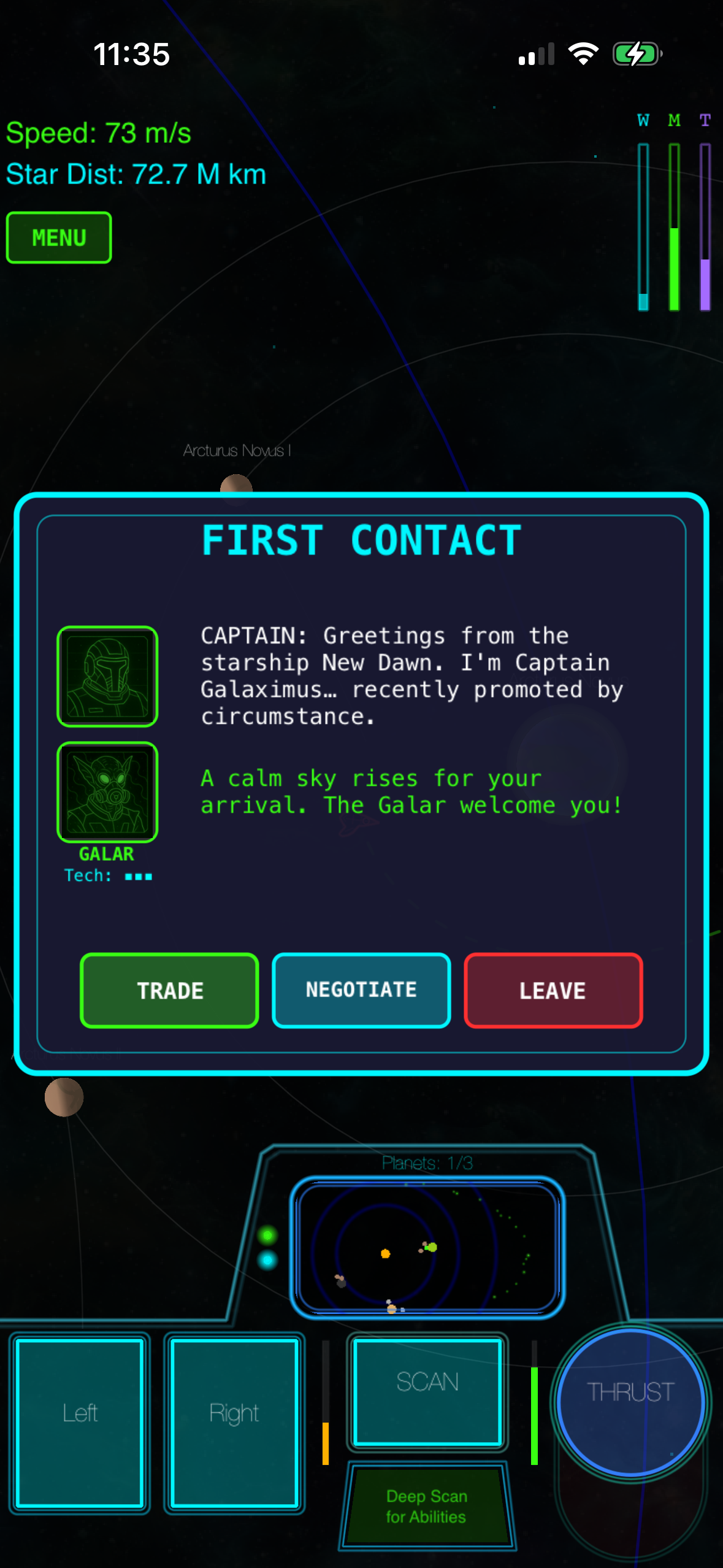
Core mechanics: - Orbital mastery — Every celestial body obeys real gravity. Slingshots, orbital captures, and transfer windows work because the physics is accurate. Mastery comes from understanding how to use gravity as your engine. - Procedural star systems — Each playthrough generates eight unique star systems with different planet configurations. The narrative arc is authored (beginning, middle, satisfying ending), but the celestial layout is fresh every run. - Encounter variety — Eleven unique encounter types scattered through each system: spacetime rifts, derelict ships, distress beacons, first-contact scenarios with alien captains, and the Mirror—a spacetime-rift boss fight against a copy of yourself. (See gameplay footage: [demo-video-link]) - Real-time synthesized audio — Every laser, explosion, engine burn, alien voice, and ambient hum is generated on the device in real time using procedural synthesis. The procedural audio ties the visual aesthetic (vector arcade) to the audio identity. - No ads, no IAP, no energy timers — Pay once at the launch-tier price, own forever. After Galaximus Infinitum launches in late 2026, the combined game moves to a higher price tier; launch-tier buyers receive the expansion free.
Who it’s for: Players who remember when games shipped complete. Indie game enthusiasts. Kerbal Space Program fans who want something more arcade. Anyone who wants a space game that doesn’t ask for money every time you open it.
The honest learning curve: Gravity is the engine you have to learn to use. The controls are expressive (thrust, rotation, firing), but the strategy is orbital. If you want a game that teaches you something about how space actually works, that’s the payoff. If you want instant gratification, the first 30 minutes will feel slow.
Kerbal Space Program (Mobile): Engineering Depth
Kerbal Space Program Mobile v1.12.3 (last updated March 2026),. On iPad, it’s the gold standard for rocketry simulation on mobile. You design vehicles from components (engines, fuel tanks, avionics, landing gear), test them, crash them, iterate, and eventually reach orbit. The learning curve is steeper than Galaximus, but the depth is unmatched.
Strengths: - Granular orbital tooling (maneuver nodes, delta-v calculations, staging) - Vehicle assembly from first principles - Sandbox and career modes with progression - Multiplayer support on some platforms
Tradeoffs: - Requires patience with UI navigation on smaller screens - The tutorial is dense; expect 2–3 hours before you feel competent with vehicle assembly and orbital mechanics - Kerbal Space Program wants to teach you to be an engineer; it’s not arcade action
Galaximus vs. KSP: KSP teaches you rocketry. Galaximus teaches you to fly. KSP is engineering; Galaximus is piloting. Both use real physics. KSP is deeper on the engineering side; Galaximus is faster to mastery and more focused on moment-to-moment action.
No Man’s Sky (Mobile): Exploration at Scale
No Man’s Sky Mobile v4.18 (last updated April 2026),. On iPhone, it’s procedural planet exploration at a scale Galaximus doesn’t attempt. You land on planets, walk the surface, gather resources, build bases, engage in trade and faction warfare. The universe is vast—billions of procedurally generated planets.
Strengths: - Seamless planet-to-space transitions - Procedural generation at massive scale - Base building and outpost mechanics - Faction warfare and progression
Tradeoffs: - Mobile version is a port of a larger experience; some features are simplified - Performance on older iPhones can be uneven - The learning curve for base building and resource management is steep
Galaximus vs. NMS: No Man’s Sky is exploration-first; Galaximus is action-first. NMS has planetary surface gameplay; Galaximus has orbital mechanics. NMS is bigger; Galaximus is more focused. Both are premium (no ads, no IAP). NMS is better if you want to lose yourself in a vast sandbox; Galaximus is better if you want a complete campaign with a narrative arc.
Notably, planetary surface exploration is coming to Galaximus in Infinitum (late 2026), though it will be Battlezone-style wireframe 3D, not photorealistic walking.
Asteroids and Lunar Lander Descendants: Arcade Purity
If you want the fastest pickup-and-play experience, the descendants of Asteroids and Lunar Lander are still worth exploring. Games like Lunar Rescue (modern Lunar Lander clone) and Asteroids+ (modern Asteroids remake) strip away narrative and focus on pure arcade mechanics.
Strengths: - Minimal learning curve; playable in seconds - High-score chasing and replayability - Retro aesthetic with modern polish - Often budget-tier pricing
Tradeoffs: - No progression or narrative - Limited depth after the first few hours - Most rely on procedural generation to extend playtime
Galaximus vs. arcade descendants: These games are faster to enjoy; Galaximus has more depth. Asteroids and Lunar Lander games are pick-up-and-play; Galaximus rewards mastery. If you have 5 minutes and want instant fun, Asteroids wins. If you have an hour and want to feel like you’re learning something, Galaximus wins.
Premium Model: Why It Matters
In 2026, premium space games on iPhone are a rarity. Most publishers chose free-to-play because the monetization is predictable: players spend money on cosmetics, battle passes, and energy refills. Premium games bet on the opposite: that some players will pay once and never spend again, and that’s enough.
Galaximus is premium-only. No ads. No IAP. No energy timers. No cosmetic FOMO. You buy it once at the launch-tier price and own the full experience. When Infinitum launches later in 2026, launch-tier buyers receive the expansion free; the combined game then moves to a higher price tier for new players.
This model is rare enough that it’s worth highlighting. If you’re tired of free-to-play friction, premium is the escape hatch. The tradeoff is that you pay upfront instead of “free” with optional spending. But the math is clear: a premium game at the launch tier costs less than a single cosmetic outfit in a free-to-play title.
Feature Comparison Table
| Feature | Galaximus | Kerbal Space Program | No Man’s Sky | Asteroids+ |
|---|---|---|---|---|
| Real orbital mechanics | ✓ | ✓ | ✓ (simplified) | ✗ |
| Campaign/narrative | ✓ | ✗ (career mode progression) | ✓ | ✗ |
| Vehicle building | ✗ | ✓ | ✓ (limited) | ✗ |
| Planetary surface exploration | Coming in Infinitum | ✗ | ✓ | ✗ |
| Procedural generation | ✓ (systems) | ✗ | ✓ (planets) | ✓ (asteroids) |
| Premium-only, no IAP | ✓ | ✓ | ✓ | ✓ |
| Replayability | High (procedural systems) | Very high (sandbox) | Very high (infinite planets) | High (high-score chasing) |
How to Choose: Decision Framework
Choose Galaximus if: - You want real orbital mechanics without engineering complexity and can learn gravity mechanics in 30 minutes - You prefer a complete campaign with a narrative arc (8 systems, 30–40 hours) over open-ended sandbox - You like arcade action that rewards mastery over 3–5 hours of focused play - You want to learn how gravity actually works while playing
Choose Kerbal Space Program if: - You want to design and build rockets from components and have 2–3 hours to invest in learning the UI - You want unlimited sandbox depth and vehicle variety - You’re interested in the engineering side of spaceflight
Choose No Man’s Sky if: - You want seamless planet-to-space transitions and planetary surface exploration with walking mechanics - You want a vast, nearly infinite universe to explore (billions of procedurally generated planets) - You like base building and faction mechanics - You’re OK with a larger download footprint (15+ GB)
Choose Asteroids or Lunar Lander descendants if: - You want the fastest pickup-and-play experience (playable in seconds) - You prefer high-score chasing over narrative - You have limited time (5–10 minute sessions) - You want the lowest price point
FAQ
Q: Do I need an internet connection to play these games? A: Galaximus, Kerbal Space Program, and Asteroids+ are fully offline. No Man’s Sky requires an internet connection for cloud saves and multiplayer features, though single-player exploration works offline on some platforms.
Q: Which game has the steepest learning curve? A: Kerbal Space Program. Expect 2–3 hours before you feel competent with vehicle assembly and orbital mechanics. Galaximus gets you to competence in 30 minutes. Asteroids and Lunar Lander descendants are playable in seconds.
Q: Which of these games supports cross-platform play? A: Kerbal Space Program supports multiplayer on PC and console versions, but mobile multiplayer is limited. No Man’s Sky supports cross-platform multiplayer on some platforms. Galaximus and Asteroids+ are single-player only.
Q: Is the Infinitum expansion worth waiting for, or should I buy Galaximus now? A: Buy now at the launch-tier price and the expansion is included free when it ships. After Infinitum launches, the combined game moves to a higher price tier. Early adopters get the expansion at no extra cost.
Q: Which game is best for iPad? A: Kerbal Space Program and No Man’s Sky both benefit from the larger screen. Galaximus works well on both iPhone and iPad, though the iPad version gives you more space to see the orbital mechanics unfold.
Q: Are there other premium space games I’m missing? A: Most other space games on iPhone have moved to free-to-play or subscription models (Apple Arcade). The premium-only segment is small—these four represent the major contenders as of June 2026.
The Bottom Line
Premium space games on iPhone in 2026 are a deliberate choice. You’re opting out of the free-to-play model—no ads, no energy timers, no cosmetic FOMO. The games that remain in the premium segment are built by developers who believe the game itself is the product, not the monetization layer.
Galaximus exists in that category. We built it because we wanted to make a space game that doesn’t ask for money every time you open it. Real orbital mechanics, no learning-curve apologies, complete campaign with procedurally unique playthroughs, and a roadmap (Infinitum) that’s already funded by the purchase price.
If you want a space game that respects your time and your wallet, premium is the way to go. And if you want real gravity as your engine, we’ve built the game for that.
Get Galaximus on the App Store: Get it on the App Store


