Orbital Mechanics Games for iPhone: Physics Explained
 by Galaximus
Orbital Mechanics Games for iPhone: How Gravity Becomes Your Engine
Orbital mechanics sounds like something only rocket scientists need to understand. But on iPhone, it’s become the core mechanic of some of the most rewarding space games you can play — and the good news is that the physics works intuitively once you see it in action. Every planet’s gravity pulls on your ship. Every burn of your engine trades speed for direction. Every slingshot around a gas giant is a free acceleration you’ve earned through positioning, not reflexes.
Disclosure: We built Galaximus, an orbital mechanics game for iPhone. This guide covers the genre broadly, but Galaximus is our product.
This guide walks you through what orbital mechanics actually means in a game, why it matters, and how to recognize when a space game is using real physics versus faking it for accessibility.
What Orbital Mechanics Actually Means
Orbital mechanics is the physics of objects moving through gravitational fields. In the real world, it’s what keeps satellites in orbit and governs spacecraft trajectories to Mars. In a game, it means:
- Every body has gravity. Planets, stars, moons, asteroids — they all pull on you and everything else simultaneously.
- Gravity is a continuous force. You’re not in a vacuum with no forces; you’re in a dynamic system where acceleration is always happening.
- Velocity and position are linked through gravity. You can’t just “move north” — your trajectory is the result of your current velocity and the gravitational forces acting on you.
- Orbits are the default state. If you’re moving at the right speed relative to a body’s gravity, you’ll naturally fall into orbit around it.
The appeal for game designers is that this creates emergent gameplay: players learn to use gravity as a tool rather than fight against it. The appeal for players is mastery — once you understand the system, you can do things that feel impossible at first, like reaching a distant planet on almost no fuel by timing a gravity slingshot perfectly.
Slingshots: The Core Mechanic
A gravity slingshot (or gravity assist) is the signature move in orbital mechanics games. Here’s how it works:
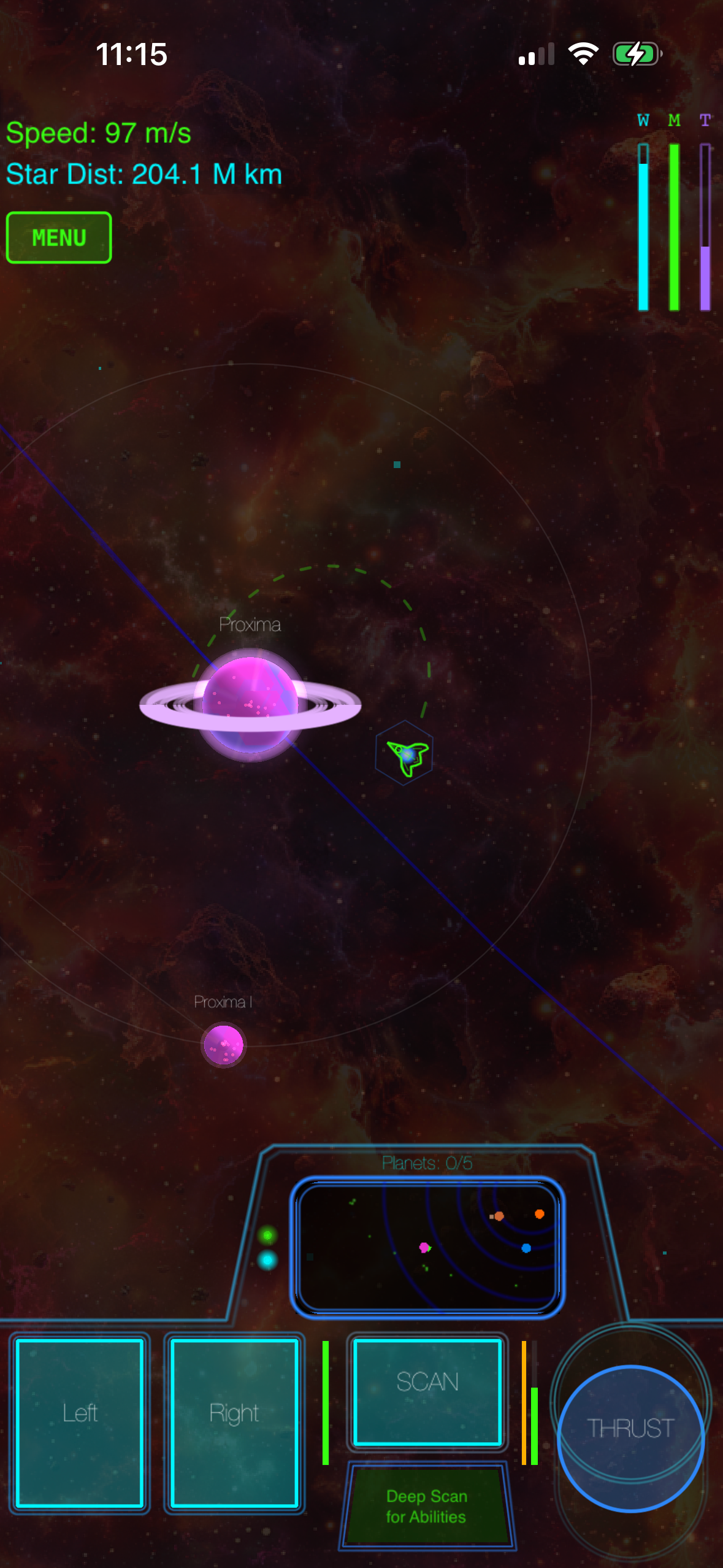
You approach a planet at an angle, not head-on. As you pass near the planet, its gravity pulls you, bending your trajectory. If you time it right, you exit the gravity well moving faster than you entered — you’ve stolen kinetic energy from the planet’s orbital motion around its star. You’ve gained speed without burning fuel.
In games, slingshots are the payoff for understanding the system. A player who doesn’t understand orbital mechanics will try to burn fuel to reach a distant target. A player who does will position for a slingshot and arrive with fuel to spare. The physics rewards patience and positioning over twitch reflexes.
Transfer Windows and Orbital Alignment
Real spacecraft missions don’t just leave Earth and head to Mars on any random day. They wait for a transfer window — a period when the orbital geometry between two bodies is optimal. Launch too early or too late, and you’ll need vastly more fuel.
Games that model this create a second layer of strategy: when you depart matters as much as how you depart. Some games abstract this into a “fuel cost” that varies by destination and date. Others make it explicit — you can see the planets’ positions and calculate the window yourself.
Galaximus uses procedural generation to create unique planetary configurations in each playthrough, which means transfer windows are different every time. The system rewards players who learn to read the orbital geometry and plan ahead, but it doesn’t punish you with a 3-month wait like real space missions do.
Why Real Physics Matters in Mobile Games
You might ask: why not just fake it? Why not let players point at a destination and press “go”?
The answer is that faked physics removes the skill expression. Games like Space Colonists let you auto-pilot to any destination, removing the slingshot mechanic entirely. Without gravity as a constraint, there’s no moment where you realize you can reach a distant star on half the fuel you thought you needed. There’s no learning curve that pays off.
Real orbital mechanics creates a learning curve with a payoff. The first 30 minutes feel hard — you’re fighting the gravity system, overshooting targets, wasting fuel. Then something clicks. You understand how to read your velocity vector, how to approach a planet, how to time a burn. Suddenly you’re doing things that felt impossible.
That progression — from struggle to mastery — is what separates orbital mechanics games from simpler space games. And it’s why players who want that experience specifically search for it.
How to Spot Real Orbital Mechanics in a Game
Not every space game claims to use real physics, and not every game that claims it actually does. Here’s what to look for:
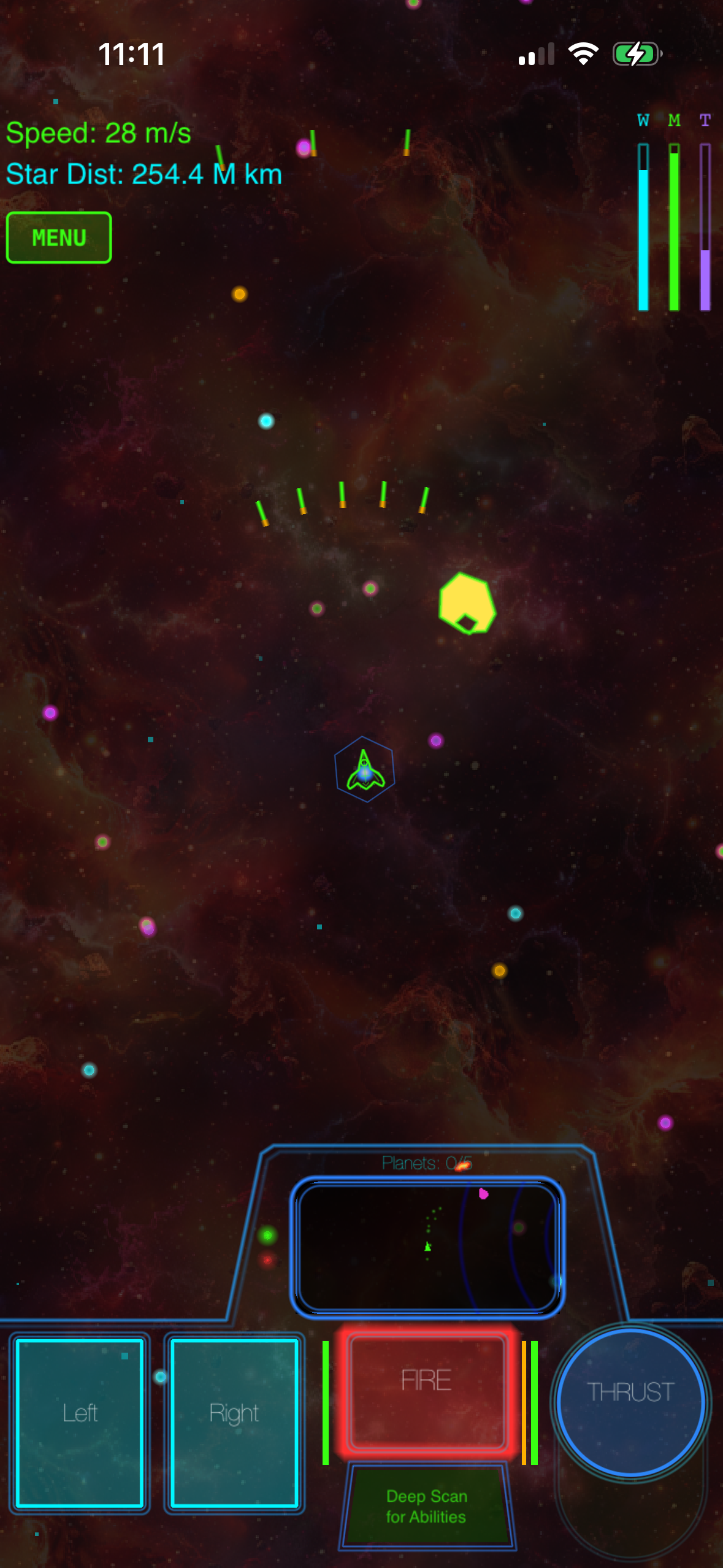
Real orbital mechanics games typically show: - A velocity vector (an arrow showing your current direction and speed) - Orbital prediction lines (showing where you’ll go if you don’t burn) - Gravity wells or influence spheres around planets - Fuel as a meaningful constraint (you can’t just burn to anywhere instantly) - Orbital decay or escape velocity mechanics (you can’t stay in orbit forever without work)
Games that fake it typically: - Let you point at a destination and auto-pilot there - Use fuel as a cooldown timer rather than a resource - Don’t show gravitational effects on your trajectory - Treat space like a 2D grid where you move in cardinal directions
The difference is subtle in marketing but massive in gameplay. One teaches you something about physics; the other is a resource-management game that happens to be set in space.
Galaximus: Our Orbital Mechanics Game
We built Galaximus because we wanted to ship a game where real orbital mechanics was the core interface, not an optional simulation mode for hardcore players. The New Dawn (your ship) responds to gravity just like any other object in the system. You can’t ignore it; you have to learn to use it.
The learning curve is real — we don’t hide that. But it’s also compressed. You’re doing meaningful orbital maneuvers in minutes. The arcade-action controls make mastery fast; the real physics makes it deep.
Get Galaximus on the App Store:
Which Game Teaches Which Mechanic?
Here’s a quick reference for what each orbital mechanics game emphasizes:
| Learning Goal | Best Choice | Why |
|---|---|---|
| Slingshot mechanics | Galaximus | Fast feedback loop; gravity assists are central to every mission. |
| Transfer windows | Galaximus | Procedural planets create varied windows; you learn timing naturally. |
| Escape velocity | Kerbal Space Program | Explicit staging and thrust calculations show why escape velocity matters. |
| Multi-body gravity | Galaximus | Procedurally generated systems force you to account for multiple gravitational sources. |
| Orbital decay | Kerbal Space Program | Atmospheric drag is modeled; you learn why low orbits decay. |
| Casual introduction | Galaximus | Arcade controls and 20-minute learning curve; no engineering prerequisites. |
Each game is honest about what it teaches. Pick based on your patience for complexity and your preferred playstyle.
FAQ
Q: What’s the difference between escape velocity and orbital velocity?
A: Escape velocity is the speed you need to leave a planet’s gravity entirely (roughly 11 km/s for Earth). Orbital velocity is the speed at which you fall around a planet instead of toward it (roughly 7.8 km/s for Earth orbit). In games, if you’re going slower than orbital velocity, you’ll crash. If you’re going faster, you’ll escape. The sweet spot is orbital velocity.
Q: Why do slingshots work?
A: A slingshot works because you’re borrowing kinetic energy from the planet’s motion around its star. When you approach a planet from behind and let its gravity bend your path, you exit moving faster relative to the star than you entered. You haven’t violated physics — you’ve used the planet’s own momentum to accelerate yourself. It’s free speed if you time it right.
Q: How long is the learning curve?
A: Most players grasp the basics in 20–30 minutes of focused play. Full mastery (understanding transfer windows, multi-body gravity interactions, fuel-efficient routes) takes longer, but the payoff is immediate.
Q: Can I play an orbital mechanics game casually, or is it hardcore-only?
A: Depends on the game. Galaximus is designed so you can play in short sessions and still make progress. Kerbal Space Program demands longer play windows. Check the specific game’s design.
Q: If I like Kerbal Space Program, will I like Galaximus?
A: Probably, but they scratch different itches. KSP is engineering-focused; Galaximus is action-focused. If you love the physics but want faster, more arcade gameplay, Galaximus is worth trying. If you love the engineering puzzle itself, KSP is deeper.
Q: Do I need to understand real physics before I start?
A: No. The game teaches you as you play. You don’t need to know what an escape velocity is before you start; you’ll learn it by trying to leave a planet and failing, then adjusting your approach.
Why This Matters Now
In 2026, premium space games on iPhone are rare. Most of what’s available is free-to-play with energy timers and battle passes. That’s why orbital mechanics games matter — they’re islands of complete, premium experiences where the design can focus on physics and mastery instead of monetization.
If you’ve been searching for an iPhone space game where gravity actually matters and you own the game outright, orbital mechanics games are your answer. And if you’re new to the concept, now’s the time to try one. The learning curve is real, but the payoff — that moment when you nail a gravity slingshot and realize you’ve just saved half your fuel — is worth every minute of learning.
Ready to pilot a ship through real gravity? Galaximus is built for players who want orbital mechanics to be the interface, not the obstacle. Buy once at the launch-tier price, and when Infinitum ships later in 2026, the expansion is included free.
Get Galaximus on the App Store:

