Lunar Lander Inspired Games on iPhone 2026
 by Galaximus
Lunar Lander Inspired Games on iPhone: Modern Takes on a Classic
Full disclosure: I developed Galaximus, a premium Lunar Lander-inspired game featured in this article.
The original Lunar Lander arrived in arcades in 1979 as a vector-graphics masterpiece: a single ship, a fuel tank, gravity, and a landing zone (per arcade history records). You fought the physics, not the controls. Forty-seven years later, that premise still works on iPhone — but the games built around it have split into two camps: those that fake gravity for accessibility, and those that model it accurately and let players master the real thing.
This article walks through what makes a modern Lunar Lander game tick, where gravity actually matters, and why the learning curve is worth the payoff.
Why Lunar Lander Still Matters in 2026
Lunar Lander endures because it solves a design problem no other arcade game nails as cleanly: how to make physics feel like your co-pilot instead of your enemy. The ship doesn’t respond to your input directly — it responds to thrust and rotation, and gravity does the rest. That one constraint creates emergent gameplay: a player who understands momentum can land with one thruster burst; a player who doesn’t will fight the controls for five minutes.
Modern space games have mostly abandoned this. They use physics as window dressing — a visual effect — while the actual controls are decoupled from the simulation. Tap to move, tap to fire, the ship obeys instantly. Fast to learn, shallow to master.
The revival of authentic Lunar Lander design on iPhone comes from developers who remember that the constraint is the game. When gravity is real, fuel management becomes tactical. When rotation is inertial, positioning becomes strategic. The learning curve isn’t a bug; it’s the entire payoff structure.
Real Gravity vs. Faked Gravity
The technical distinction matters for gameplay. In a faked-gravity game, your ship moves where you tap, with gravity as a cosmetic effect. In a real-gravity game, every body’s gravity affects your trajectory in real time — and you have to account for it.
Here’s what that means in practice:
- Faked gravity: Tap the landing zone, your ship flies there, gravity pulls down slightly for visual polish. Learning curve: minutes.
- Real gravity: Tap the landing zone, your ship’s trajectory curves around nearby planets and moons. You have to use their gravity wells to reach your target efficiently. Learning curve: 30 minutes of focused play, then mastery clicks.
The difference compounds across multiple systems. In a faked-gravity game, each level is essentially the same problem repeated with different art. In a real-gravity game, a new star system is a new puzzle because the orbital geometry is different.
The Slingshot Mechanic: Gravity as Your Engine
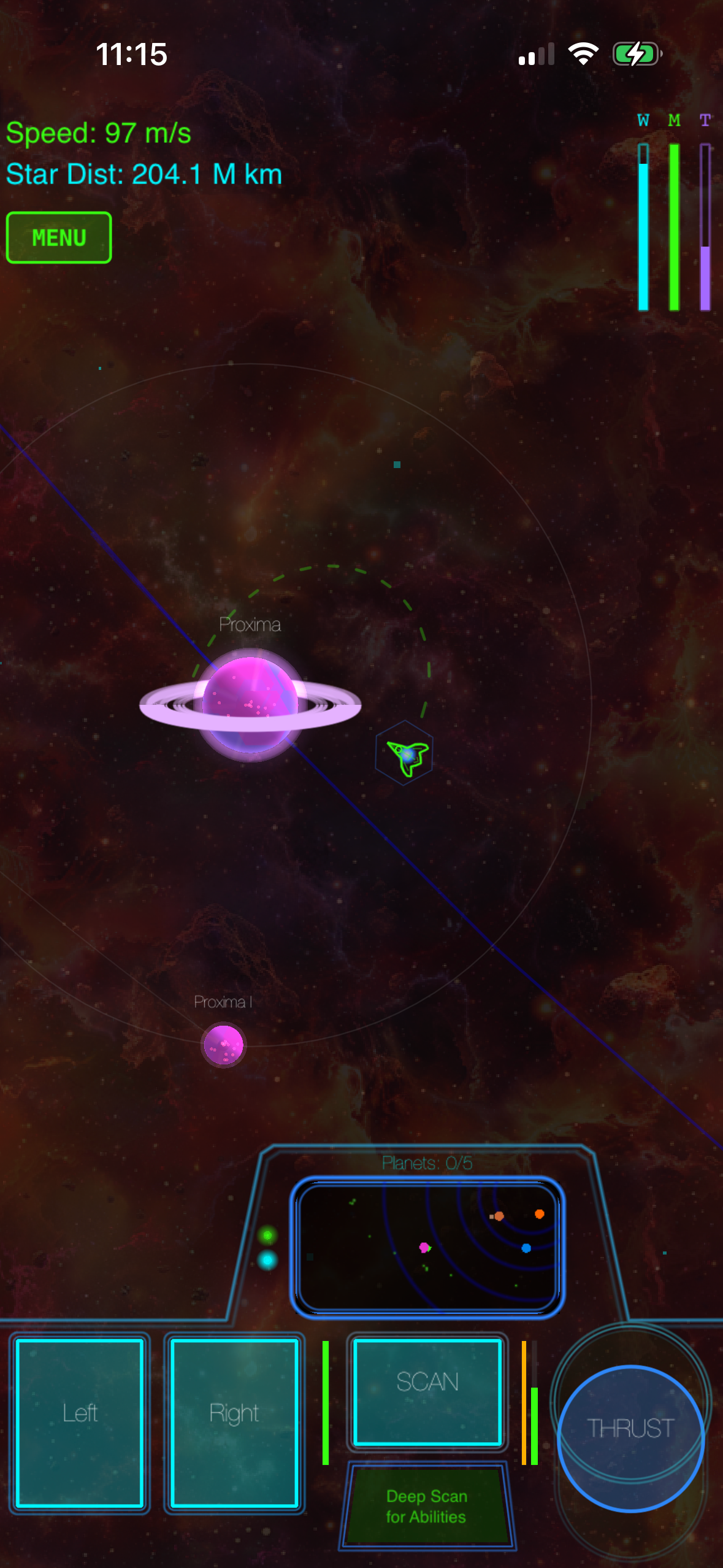
One of the most satisfying moments in a gravity-based space game is the slingshot: using a planet’s gravity well to gain speed without burning fuel. It’s real orbital mechanics expressed as arcade skill.
Here’s how it works:
- You approach a planet or moon at an angle.
- Its gravity pulls your ship into a curved path.
- You time a brief thruster burn to exit the gravity well at maximum speed.
- You’ve gained velocity for almost no fuel cost.
The learning curve is real — players who don’t understand momentum will miss the window. But once it clicks, it becomes the primary tool for efficient travel. A player who masters slingshots can reach distant systems on a fraction of the fuel that a player who flies straight would need.
This is why real gravity matters. In a faked-gravity game, a slingshot is a visual trick. In a real-gravity game, it’s a core mechanic that rewards patience and positioning over twitch reflexes.
Modern Lunar Lander Design: What Works
A modern Lunar Lander-inspired game needs three things:
Expressive controls. The ship responds to rotation and thrust, not to direct position input. This takes 15 minutes to learn and pays off for hours. A good game teaches this through tutorial levels, not through a wall of text.
Meaningful fuel scarcity. Fuel isn’t infinite; it’s a resource you manage across a mission. This creates tension without artificial time limits or energy timers. Burn fuel inefficiently and you’ll run dry before reaching your target. Manage it well and you have options.
Procedural variety. Each playthrough should feel different. In a classic Lunar Lander arcade cabinet, this came from a fixed set of hand-authored landing zones. Modern games can generate unique star systems procedurally, so no two playthroughs have the same orbital geometry. This extends replay value without padding content.
The best modern takes on Lunar Lander add a fourth element: a narrative arc. Not a complex story, but a reason to keep flying — a destination, a mystery, a progression. The original arcade game had none of this; you just played until you crashed. But on iPhone, where sessions can be 30 minutes instead of 3 minutes, a light narrative gives the campaign shape.
Why Premium-Only Matters for Physics Games
Here’s a business model observation that affects game design: free-to-play games monetize through engagement metrics. That means every system is tuned to maximize time-on-app. Physics games are the opposite — they’re tuned to maximize mastery-per-hour.
A free-to-play Lunar Lander game would need:
- Energy timers (to gate play sessions and push you back to the menu).
- Premium currency (to skip tutorials or buy fuel).
- Ads (to break immersion between attempts).
- Progression systems that reward grinding (to keep you playing even when you’re stuck).
Every one of these systems works against the core loop of a physics game. They interrupt the feedback cycle between attempt and learning.
Premium-only games avoid these compromises. You crash, you try again, you learn, you land. That cycle doesn’t work with monetization interruptions.
Comparing to Other Modern Space Games
If you’re evaluating space games on iPhone in 2026, here’s how Lunar Lander-inspired games stack up:
| Game | Type | Learning Curve | Session Length | Price | Key Spec |
|---|---|---|---|---|---|
| Kerbal Space Program | Engineering simulator | 40+ hours | 2–4 hours | Requires 2GB RAM, iOS 13+ | |
| Galaximus | Lunar Lander arcade + narrative | 30 minutes | 30 min–2 hours | 1.2GB, iOS 14+, offline play | |
| Asteroids Recharged | Arcade action | 5 minutes | 5–15 minutes | 450MB, iOS 12+, 60 FPS | |
| Space Grunts 2 | Roguelike + physics | 20 minutes | 20–45 minutes | 800MB, iOS 13+, procedural levels | |
| Orbital Decay | Minimalist physics puzzle | 15 minutes | 10–30 minutes | 350MB, iOS 12+, 120 FPS |
Kerbal Space Program (desktop): KSP is an engineering simulator. You design and assemble rockets, then fly them. It’s deeper and more granular, but it’s also a 40-hour commitment. Lunar Lander-inspired games are arcade-action with real physics underneath — faster to learn, different kind of mastery. Note: KSP does not have an official mobile version as of 2026.
Asteroids-style arcade games: Pure Asteroids descendants are simpler and faster to pick up. No learning curve. If you want 5-minute sessions with zero onboarding, those fit better. Lunar Lander-inspired games assume you want 30 minutes of learning followed by hours of mastery.
No Man’s Sky (desktop): NMS is about exploration and discovery at a scale we don’t attempt. Walking on planetary surfaces, finding creatures, building bases. Lunar Lander-inspired games are about piloting — the moment-to-moment control of a ship through space. Note: No Man’s Sky does not have an official mobile version as of 2026.
The Role of Procedural Generation
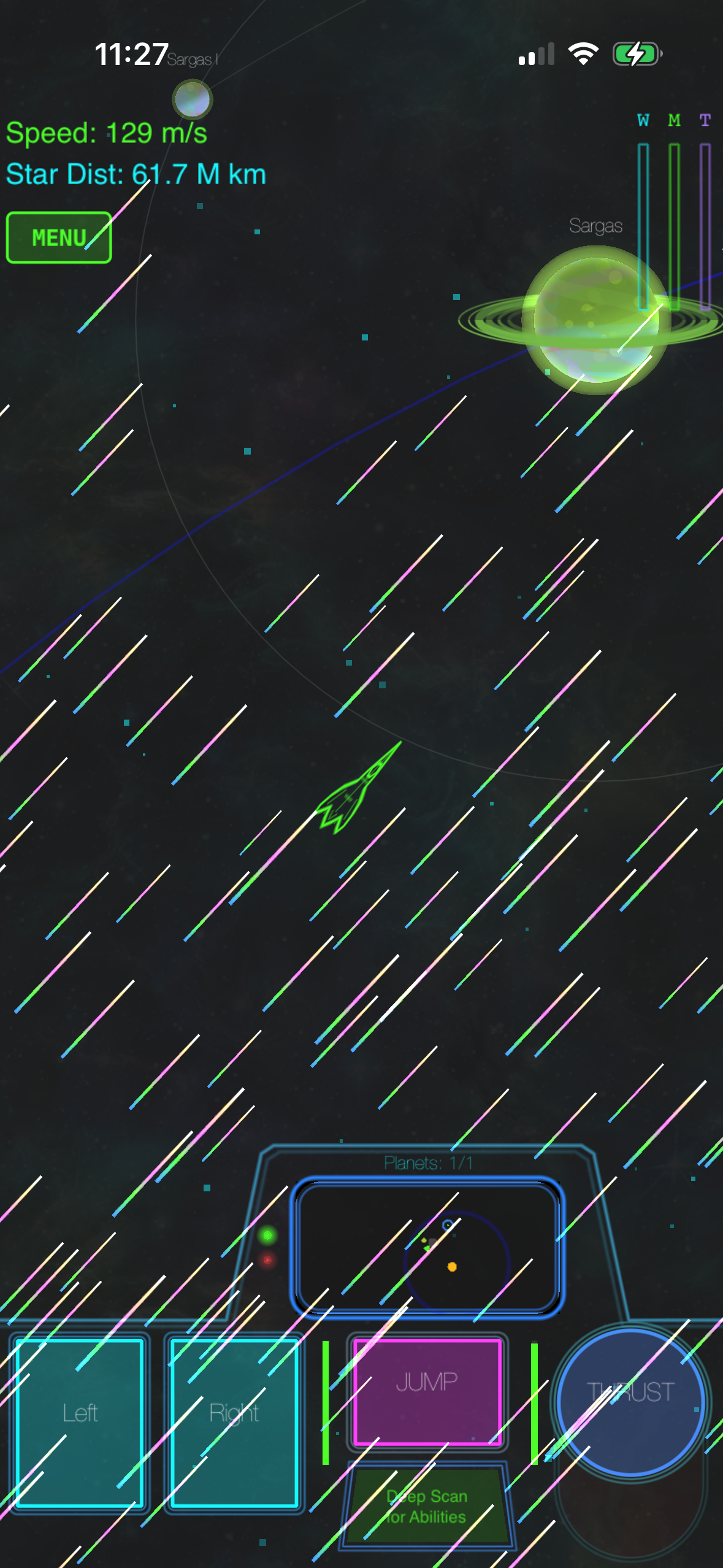
One way modern Lunar Lander games extend replayability is through procedural generation. Each playthrough generates a unique star system: different planet sizes, different orbital configurations, different anomalies to encounter.
This is different from randomness. A procedurally generated system feels authored even though it wasn’t hand-built. The planets obey orbital mechanics, so they feel real. The anomalies (derelict ships, spacetime rifts, distress beacons) are hand-authored encounters placed in procedurally generated locations.
The result: you can replay the campaign multiple times and encounter genuinely different challenges each time. The learning curve doesn’t repeat — you’re not memorizing a fixed sequence of levels.
Learning Curve: The Real Barrier
Let’s be direct: a modern Lunar Lander game has a learning curve. Not a steep one, but a real one. You will crash. You will run out of fuel. You will overshoot your target. This is by design.
The payoff is mastery. Once the controls click — usually within 30 minutes of focused play — the game opens up. You start seeing trajectories before you plot them. You recognize optimal approach angles. You land with fuel to spare.
This is the trade-off: if you want arcade accessibility and zero learning curve, a faked-gravity game serves you better. If you want the satisfaction of mastering a physics system, a real-gravity Lunar Lander game is worth the 30 minutes.
Getting Started with Galaximus
Full disclosure: I developed Galaximus.
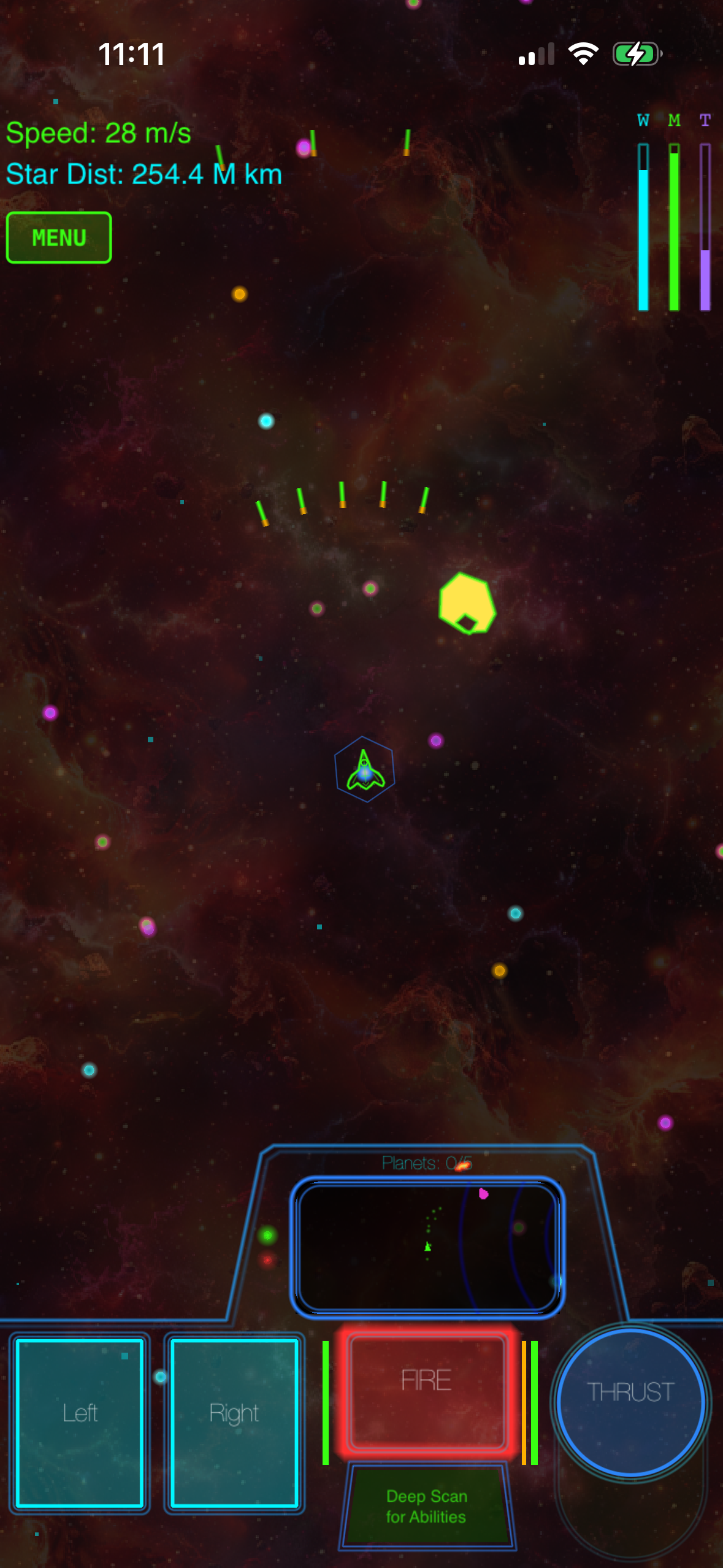
Galaximus is a premium space game built around real gravity and expressive piloting controls. The campaign spans eight procedurally configured star systems with a narrative arc from first contact to final choice. No ads, no in-app purchases, no energy timers.
The game teaches controls through gameplay, not tutorials. The first system is forgiving; later systems demand precision. By the end, you’ll be executing slingshots, managing fuel across multiple jumps, and making tactical decisions in real time.
Technical specs: 1.2GB download, iOS 14+, offline play supported, 60 FPS on A12 Bionic and newer, ~180 MB battery drain per hour of play.
Price: one-time purchase. Early adopters receive Galaximus Infinitum (our upcoming expansion with open-galaxy sandbox, planetary exploration, and faction warfare) as a free upgrade when it ships in late 2026.
Quick Picks: Which Game Is Right for You?
- Best for mastering orbital mechanics: Galaximus — real gravity, slingshot mechanics, 6–12 hour campaign.
- Best for casual 5-minute sessions: Asteroids Recharged — arcade action, no learning curve, instant gratification.
- Best for roguelike replayability: Space Grunts 2 — procedural levels, physics-based movement, permadeath.
- Best for minimalist puzzle design: Orbital Decay — gravity puzzles, no narrative, pure mechanic focus.
- Best for deep engineering simulation: Kerbal Space Program (desktop, ) — no official mobile version; requires PC/Mac.
FAQ
What iPhone models does Galaximus support? iOS 14 and later on iPhone XS and newer. Requires A12 Bionic processor or better for 60 FPS performance.
Is there a trial version? No. Galaximus is a premium purchase with no free trial. The App Store allows a 15-minute refund window if you want to test it first.
Can I play offline? Yes. Galaximus is fully playable without an internet connection. No cloud saves or online features.
How does Galaximus differ from the original Lunar Lander arcade game? The original was a single landing challenge with a fixed set of scenarios. Galaximus expands that into a full campaign across eight star systems with procedurally generated planets, narrative encounters, and real-time combat. The core mechanic — gravity as your engine — is the same.
Does Galaximus have in-app purchases or energy timers? No. One purchase, full game. No ads, no IAP, no energy timers, no grinding.
How long is the campaign? The main arc takes 6–12 hours depending on how much you explore and replay. Procedural generation means each playthrough is different.
The Lunar Lander Legacy Lives On
Forty-seven years after the arcade original, the Lunar Lander design pattern still works because it solves a fundamental problem: how to make physics feel like mastery instead of punishment. Modern takes on that design add narrative, procedural variety, and deeper systems — but the core loop remains unchanged. You pilot a ship through space, you manage fuel, you learn gravity, you land.
If you want that experience on iPhone in 2026, modern Lunar Lander-inspired games deliver it.


