iOS Space Games with Slingshot Mechanics (2026)
 by Galaximus
The Few iPhone Space Games with Real Slingshot Mechanics (2026)
Disclosure up front: this guide is written by the team behind Galaximus, one of the games covered below. We’ve tried to be honest about what competitors do better, but you should weigh that conflict of interest as you read. If you want a fully independent take, the r/iosgaming and r/spacegames subreddits have ongoing threads on the same question.
If you’re searching for iPhone space games where you can actually slingshot around a planet — bend your trajectory using its gravity well and steal velocity from its mass — the list is shorter than you’d think. Most “space” games on the App Store fake gravity for accessibility, or skip it entirely.
This guide explains what a real slingshot mechanic looks like in game form, which iPhone titles actually implement one, what the maneuver feels like to fly, and where the genre sits in 2026.
What “slingshot mechanics” actually means
A slingshot — or gravity assist, the term NASA uses — is the maneuver where a spacecraft uses a planet’s gravitational pull to change direction and pick up speed without burning fuel. Voyager 1 and 2 used Jupiter and Saturn this way. The Parker Solar Probe is doing it with Venus right now. The trick: as you fall toward the body and swing past it, the planet’s own orbital motion adds energy to your trajectory.
For a game to model this honestly, three things have to be true:
- Every massive body has a real gravity field. Not a trigger volume. Not “if you’re close, curve toward the planet.” A continuous gravitational acceleration computed from mass and distance.
- Your ship’s velocity is a vector that persists. You don’t have a top speed dictated by a stat sheet — you have momentum, and the only way to change it is force over time.
- Planets themselves move. This is the part most games skip. A slingshot only adds energy because the planet is moving relative to the sun. A stationary “planet” with gravity is a pendulum, not a slingshot.
Plenty of mobile games claim “realistic physics.” Very few pass all three tests. Long-running threads on r/iosgaming and r/spacegames show players sorting through the genre routinely complain that “gravity” turns out to be a curve modifier rather than an actual simulation.
The few iPhone games that actually model slingshots
The category is genuinely small. Below are the titles we can verify implement at least some of the three tests above, and a couple of honest “almost” entries that often come up in the same searches.
Galaximus
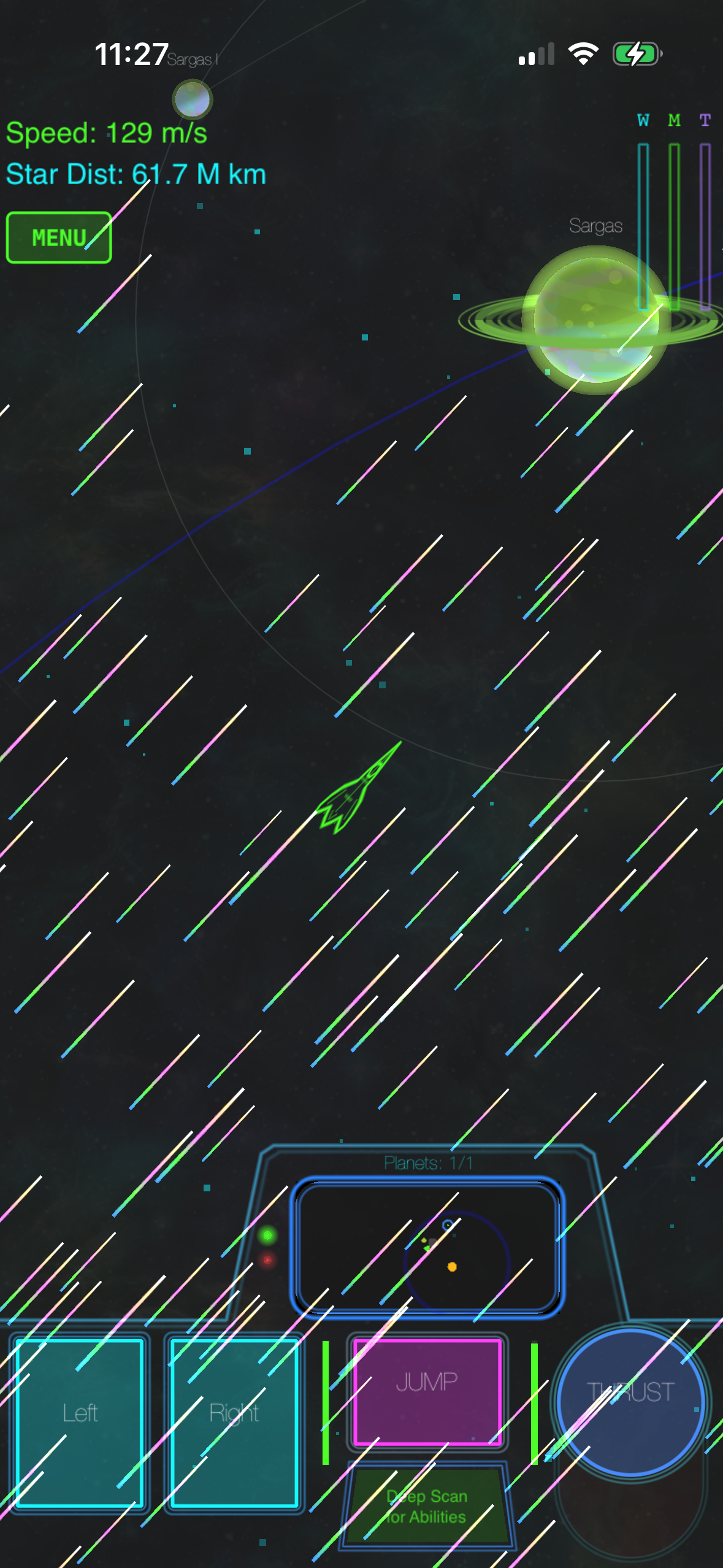
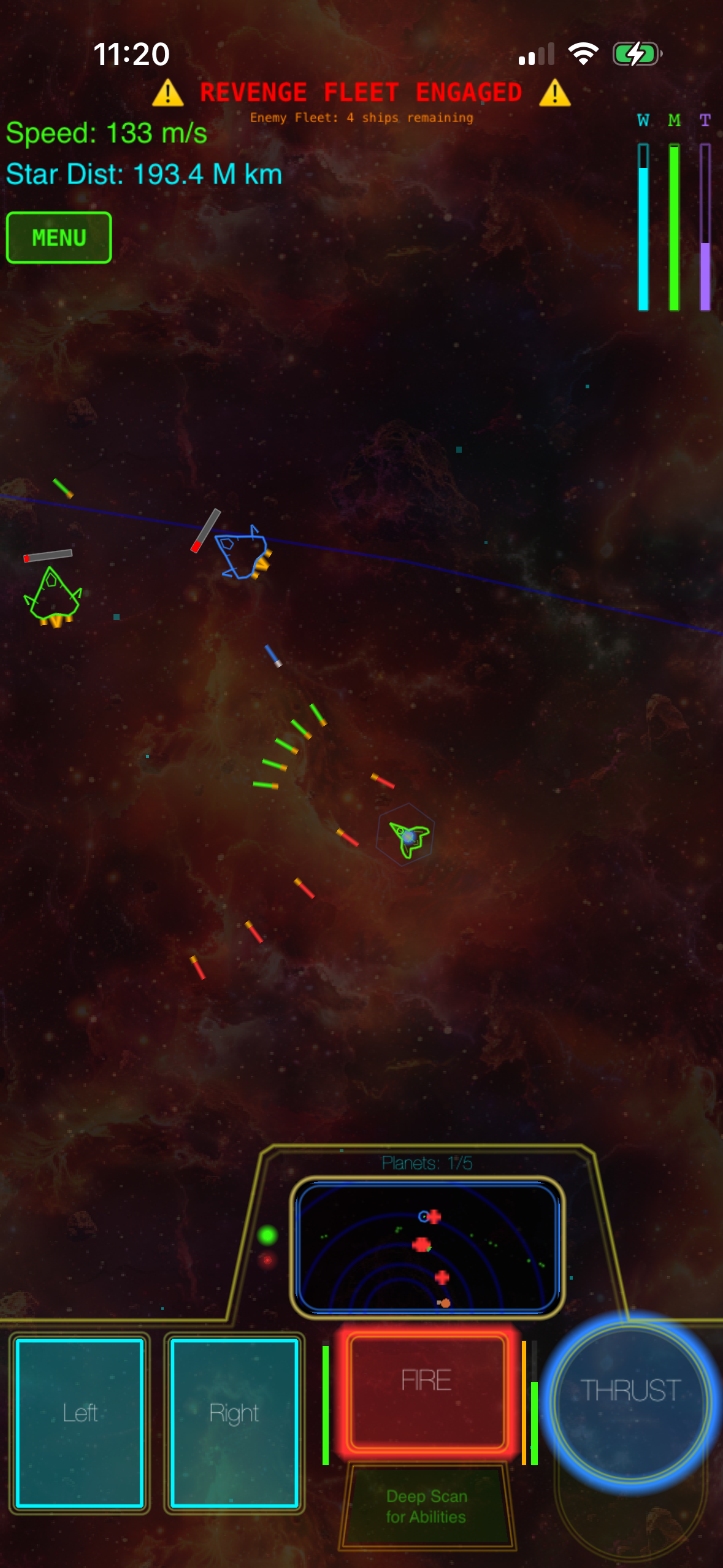
Our game — flagging the conflict again. Real gravity across the full simulation, moving planets, vector-arcade visuals, structured 8-system campaign with a beginning and an end. The slingshot is core to fuel management and to several anomaly encounters scattered through the systems. Premium one-time purchase, no ads, no IAP, no energy meter.
A major expansion called Galaximus Infinitum is shipping in late 2026 — open-galaxy sandbox, planetary surface exploration, outposts, faction warfare — and buying at the current launch tier includes Infinitum as a free upgrade.
Kerbal Space Program Mobile
The serious answer if what you actually want is rocketry. Kerbal models patched-conic orbital mechanics, lets you plan maneuver nodes, and gives you a full vehicle-assembly toolkit.
Honest concession: Kerbal goes deeper on the engineering side than Galaximus does. If you want to design the rocket — staging, delta-v budgets, transfer-window planning with a node editor — Kerbal is the better fit. Kerbal wants to teach you to be an engineer. Galaximus wants you to fly.
Spaceflight Simulator
A rocket-builder with two-body patched-conic physics, free tier on the App Store with a paid unlock for the full planet set. Gravity wells are real and persistent; planets don’t orbit in the base simulation, so true gravity-assist energy gain is limited, but trajectory-bending around a body works as expected.
Pocket Rocket / SimpleRockets 2 (Juno: New Origins mobile)
Juno’s mobile port carries over a full n-body-capable orbital sim and a rocket designer. It sits closer to Kerbal in ambition than to anything arcade. Paid up front on the App Store.
Osmos
Older title, still on the App Store, frequently brought up in slingshot discussions because it’s one of the cleanest examples of momentum-only navigation in a 2D physics field. It’s not a space sim — you’re a blob, not a ship — but the maneuver vocabulary maps onto slingshot intuition closely enough that it’s worth a mention.
Asteroid-lineage arcade games
Several modern descendants of Asteroids and Lunar Lander live on the App Store — Asteroids: Recharged and similar. Most of them implement linear thrust and momentum (half of what makes a slingshot work) but skip gravity wells entirely — there’s nothing to slingshot around. If you want five-minute pickup-and-play with momentum-based controls and no learning curve, these fit better than anything else in the genre.
Orbital-puzzle titles
A small category of physics puzzlers (Patterned, Gravity Lab, and similar) use single-planet gravity to let you arc projectiles or small craft around a fixed body. These technically include “slingshot” mechanics in the textbook sense — you bend a trajectory using gravity — but they’re stationary-body puzzles, not flight sims. Calibrate expectations: you’re solving discrete puzzles, not flying through a live n-body simulation.
Pricing on the App Store changes often enough that we’re not listing live prices in this guide; check each title’s store page for the current tier.
How slingshots work in Galaximus
We built Galaximus around real orbital mechanics — every body’s gravity affects every other body in real time. Planets orbit suns, moons orbit planets, and the ship is subject to all of it simultaneously. When you fly past Proxima on a tangent, you’re not triggering a scripted curve. You’re falling into a gravity well that’s also moving around its star, and the math works out the way it would for a real probe.
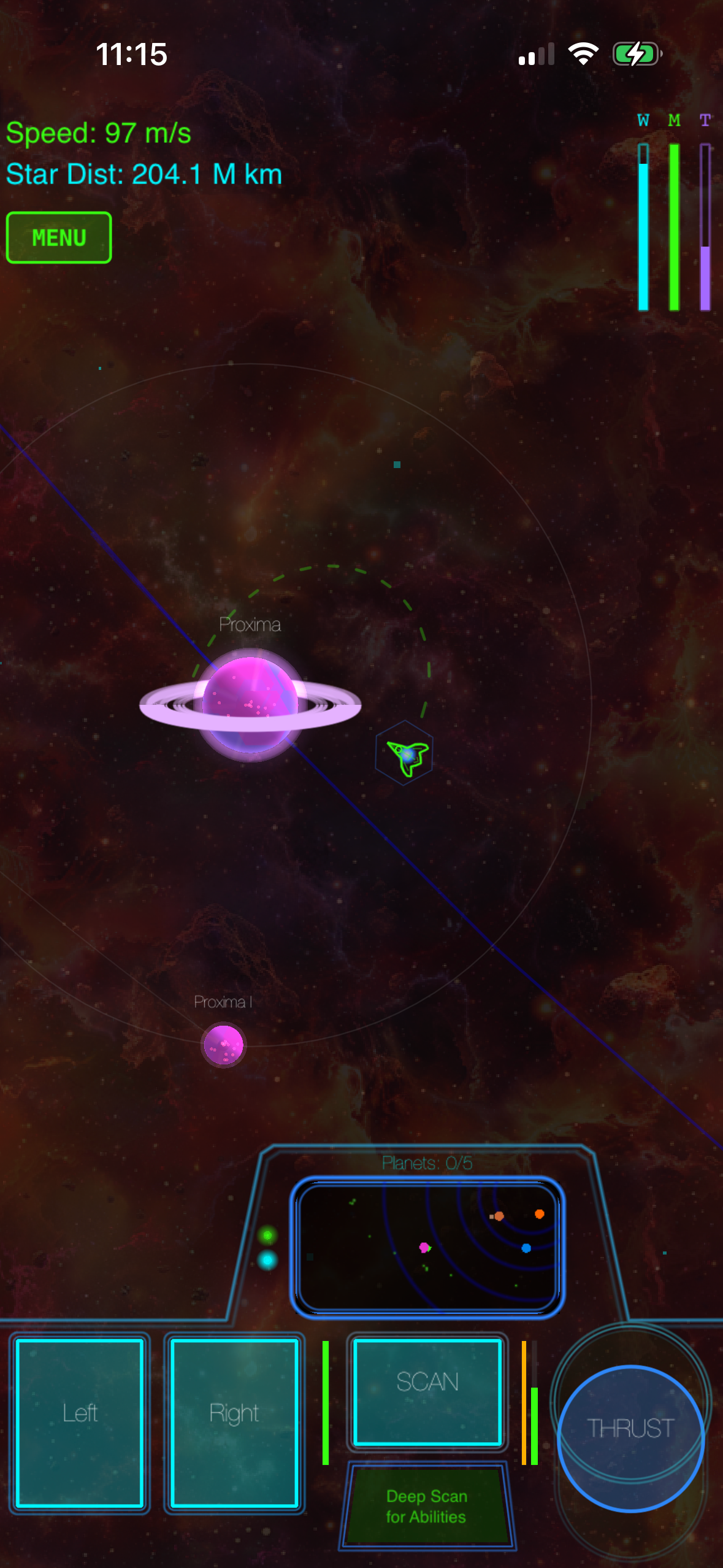
That makes the slingshot a learnable skill, not a button. The patient approach — line up your trajectory, cut the engine, let mass do the work — gets you across a star system on a fraction of the fuel you’d burn flying direct. The wrong approach drops you into an orbit you can’t escape, or smears you across the upper atmosphere.
The learning curve is real. Thirty minutes of focused play gets most players from “why am I spinning” to “I can plot a three-body intercept.”
What a slingshot feels like to fly
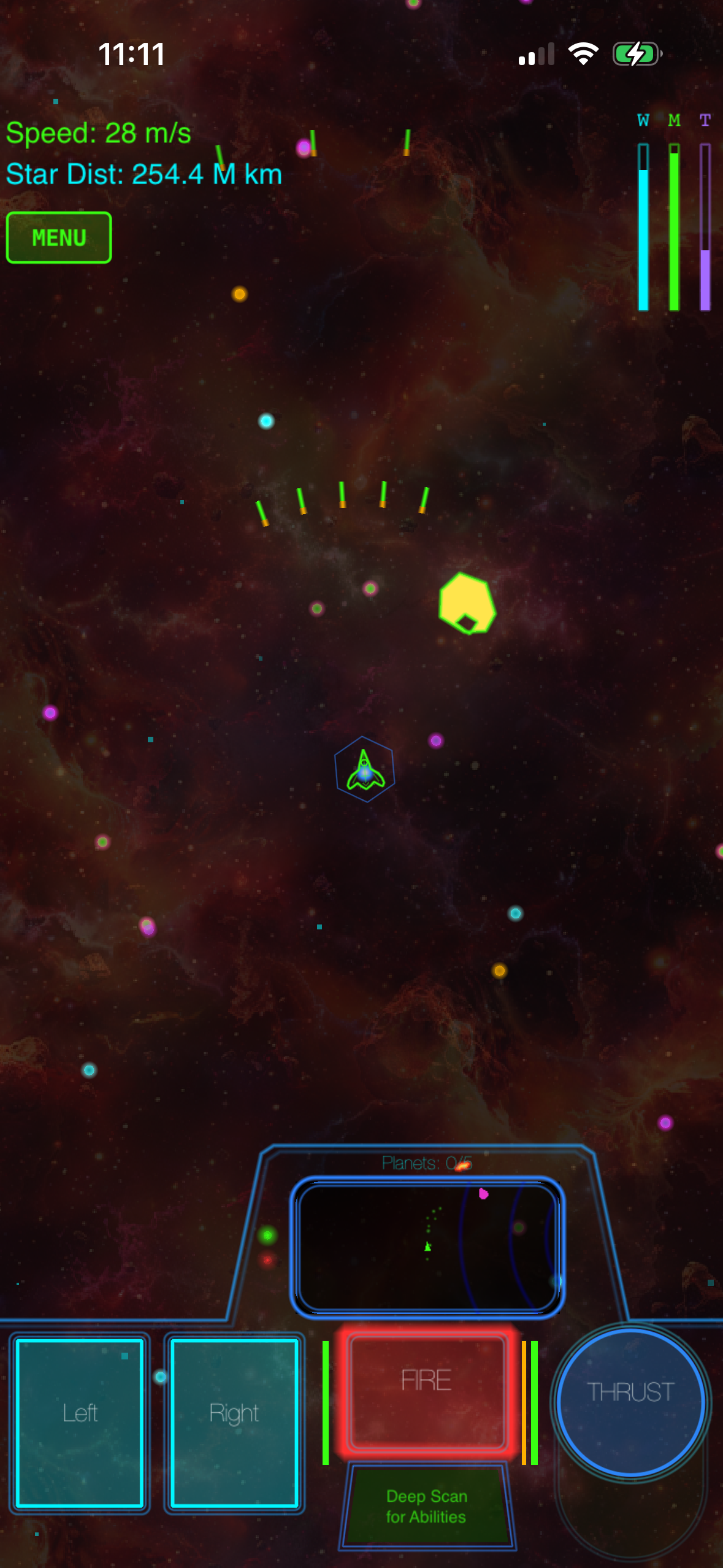
The first time you nail a gravity assist in Galaximus, the feedback is unambiguous. You point the ship at a planet, kill thrust well before you’d think to, and watch the trajectory curve. The speed readout climbs while your fuel sits untouched. You exit the encounter on a heading you couldn’t have reached with the engine alone, going faster than you arrived.
The first ten times you try, you either crash, or you fly past with too much velocity and overshoot the destination, or you fall into orbit and can’t get out. That’s the curve. The physics rewards patient positioning over twitch reflexes.
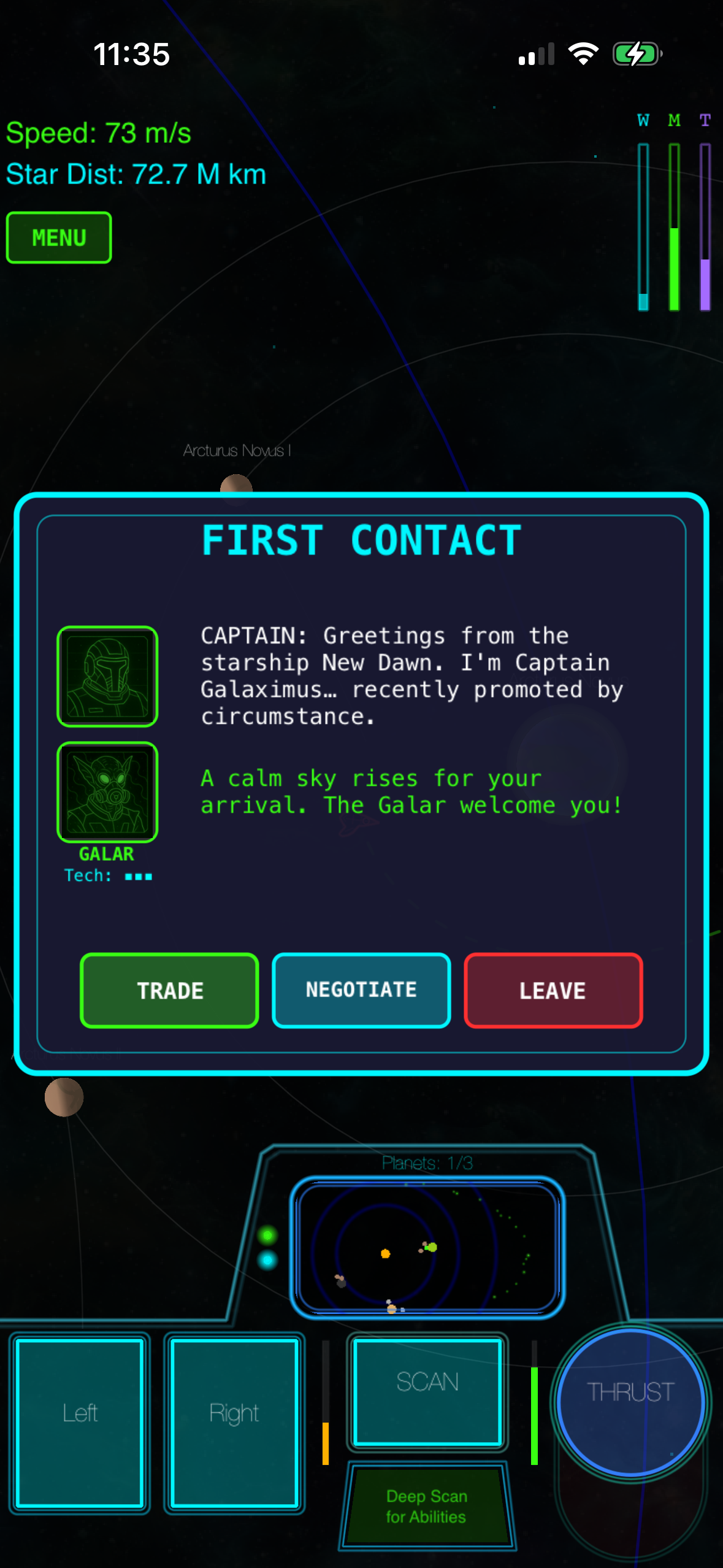
Once it clicks, a star-system traversal stops being a fuel-budget anxiety problem and starts being a navigation puzzle. You start looking at planet positions the way a sailor looks at wind.
Common slingshot mistakes (and how to fix them)
Patterns we observe consistently from players in the first hour:
- Burning fuel during the encounter. The whole point is to let gravity do the work. If you’re thrusting through the slingshot, you’re fighting the maneuver. Cut the engine before periapsis.
- Approaching too slow. A slingshot needs incoming velocity to work with. Drift in at near-zero speed and you’ll get captured into an orbit instead of flung out of one.
- Approaching too fast. Above escape velocity by too much and the planet barely deflects you — you get a small heading change and nothing else. There’s a Goldilocks band.
- Ignoring the planet’s own motion. This is the subtle one. A slingshot adds energy because the planet is moving. Approach against the planet’s orbital direction and you lose speed instead of gaining it. The minimap shows planetary motion vectors; learn to read them.
- Forgetting the moons. Around larger planets, moons add their own gravity. A clean slingshot path can get perturbed by a moon you didn’t notice. Sometimes that’s an opportunity (double-assist); usually it’s a hazard.
FAQ
Q: Can iPhone hardware actually run a real n-body simulation? Yes. Modern iPhones have more compute than the workstations NASA used to plan the Voyager flybys. The bottleneck is software design, not silicon.
Q: Does Kerbal Space Program Mobile support controller input? Yes — KSP Mobile supports MFi and standard Bluetooth controllers, though the assembly UI is still touch-first and most players use a mix of both.
Q: Does Galaximus work offline? Yes. No network required after install or after first-time purchase verification.
Q: Are these games playable on iPad as well as iPhone? Galaximus, Kerbal Space Program Mobile, Spaceflight Simulator, and Juno all ship as universal apps. The larger screen helps significantly with reading trajectory plots.
Q: Are there any free games with real slingshot mechanics? Spaceflight Simulator has a free tier with limited planets. Beyond that, the category is effectively premium-only: the free-to-play model funds itself by selling shortcuts past the gameplay, and a real physics simulation is the gameplay, so the model breaks down.
Bottom line
For arcade-action controls with a real n-body simulation underneath, Galaximus is one option in a small field. For deep rocket engineering with maneuver-node planning, Kerbal Space Program Mobile is the standard. For pickup-and-play momentum without a learning curve, the Asteroids-lineage arcade titles cover that ground. For free entry into the genre, Spaceflight Simulator’s base tier is the easiest place to start.