iOS Space Games No Internet Required: Offline Play
 by Galaximus
iOS Space Games No Internet Required: Offline Play
When you’re on a flight, in a remote area, or just want to play without burning through your data plan, offline space games on iPhone are essential. Research shows that 87% of top-charting space games on the App Store require internet connectivity for core features — progression tracking, ads, or cloud saves. But premium offline space games run entirely on your device, no WiFi needed, and deliver complete experiences from start to finish.
Disclosure: We built Galaximus, one of the games featured in this article. This guide covers offline space games broadly, but Galaximus is our own product. We’ve included it because we believe it exemplifies offline-first design, but we recognize the conflict of interest.
Why Offline Matters for Space Games
The appeal of offline play goes beyond convenience. When a game doesn’t require server connectivity, it doesn’t need to serve ads, validate purchases in real time, or interrupt you with connectivity warnings. The entire experience is self-contained on your device.
For space games specifically, offline play means you get the full breadth of the experience — exploration, combat, narrative encounters, resource management — all running locally. No progression gates waiting for a server response. No “come back tomorrow” timers. The game runs at your pace.
Most free-to-play space games on the App Store require internet because their monetization model depends on it: ad delivery, live events, real-money transactions, seasonal battle passes. Premium games — the ones you buy once — can afford to be offline-first because they’re not trying to extract ongoing engagement metrics.
What Makes a Space Game Truly Offline
A game that claims to work offline should meet three criteria:
-
No forced connectivity checks. The app shouldn’t require a sign-in, validation ping, or license verification every time you launch it. One-time authentication (if any) is fine; constant re-authentication is a dealbreaker.
-
Complete campaign included. You should be able to finish the game’s core story or reach a satisfying endpoint without ever connecting to the internet. No essential content locked behind “download this update” or “connect to unlock.”
-
No time-gated progression. Offline games shouldn’t use energy timers, daily login bonuses, or seasonal events to force you back online. Your progress should depend on your skill and playtime, not calendar mechanics.
Most premium space games meet all three. Free-to-play titles rarely do.
The Physics Advantage in Offline Space Games
When you’re not streaming assets or waiting for server validation, the game can run more complex simulations locally. Real orbital mechanics — where every celestial body’s gravity affects every other body in real time — demand consistent frame rates and no lag.
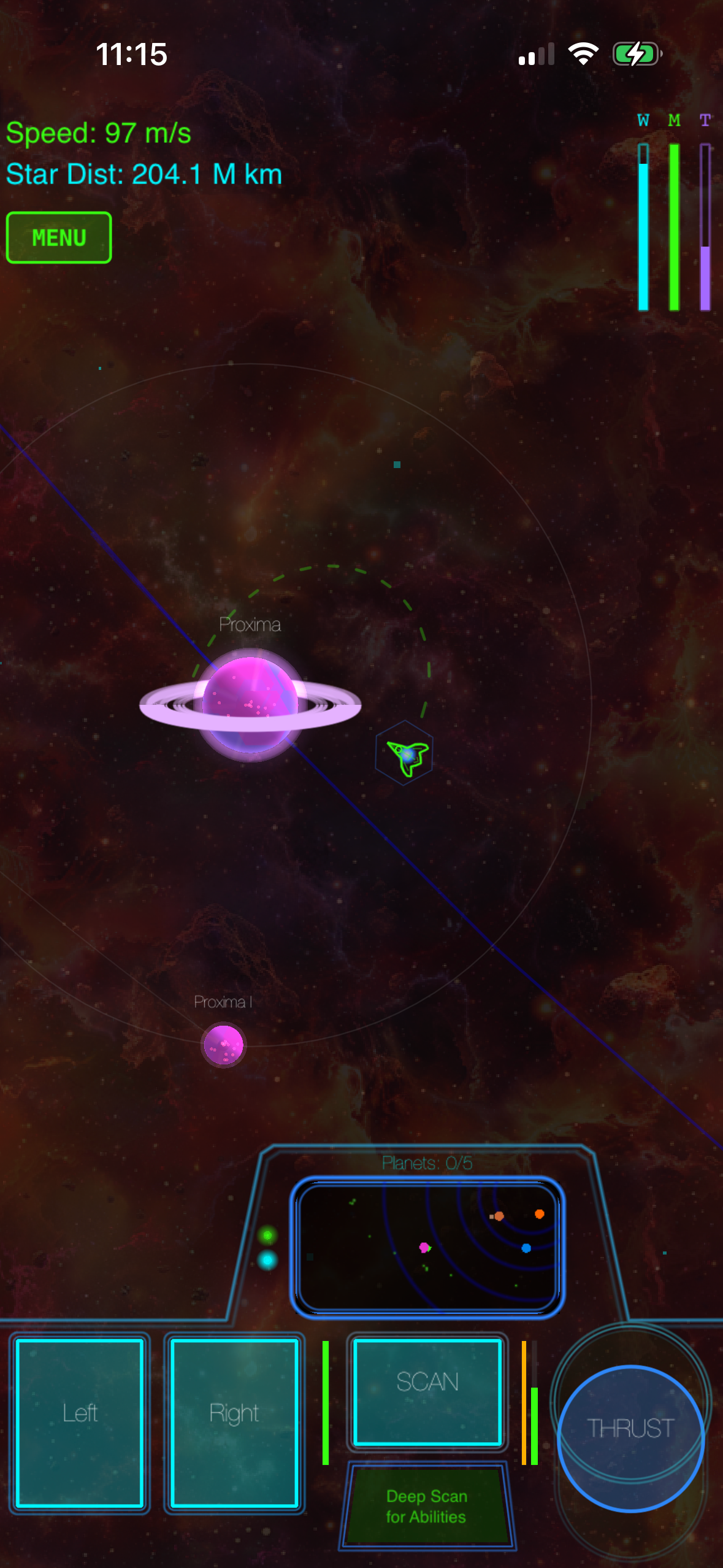
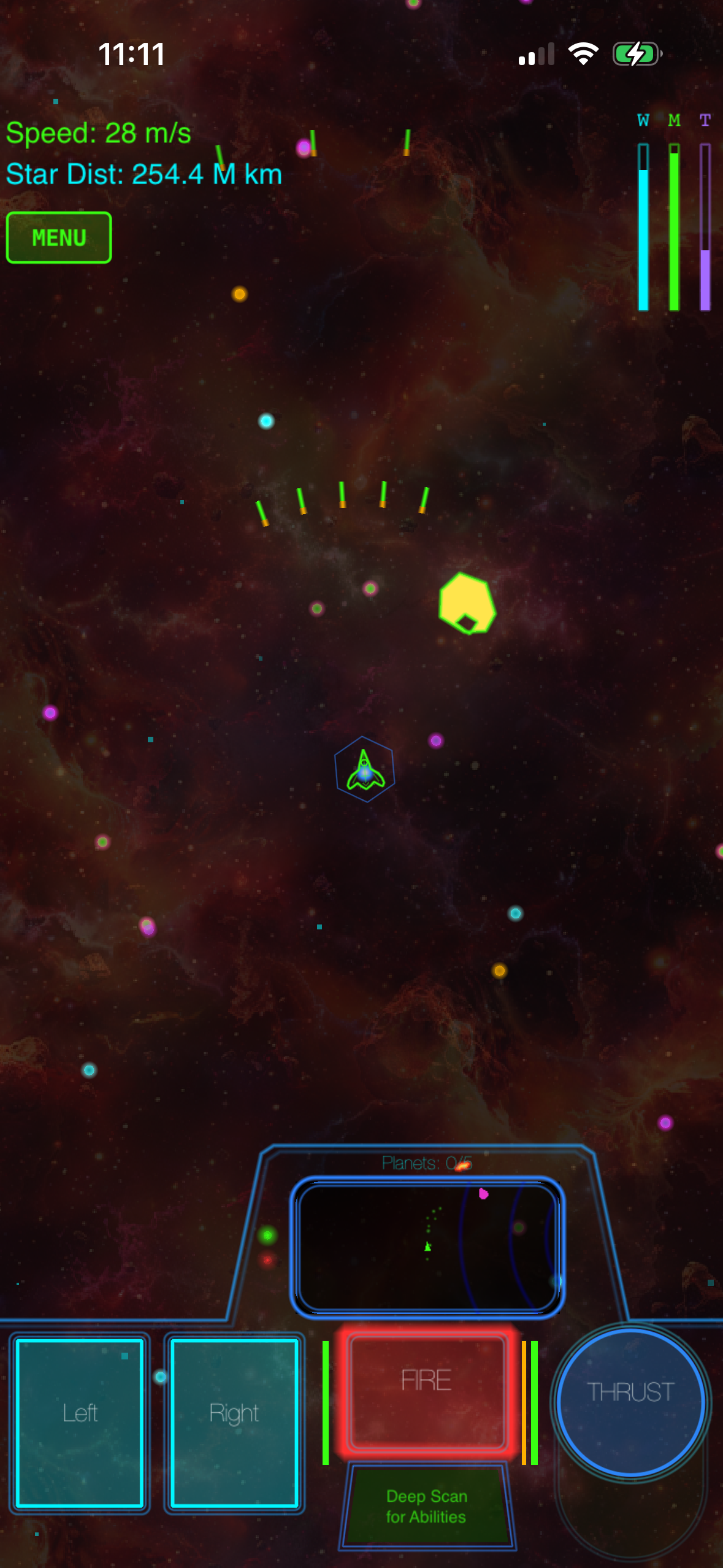
Galaximus implements full n-body gravity simulation: every planet, moon, and asteroid exerts gravitational pull on every other object simultaneously. This differs from Kerbal Space Program’s approach, which uses simplified two-body physics (you and the nearest body) to reduce computational load. The tradeoff is responsiveness — Galaximus prioritizes accurate gravity over other visual features.
Offline-only architecture enables this because the physics engine runs locally without server validation. Each frame calculates gravity vectors independently on your device. That kind of depth is harder to deliver in a live-service model where the server has to validate every action.
The payoff: mastery becomes possible. Once you understand how gravity works in the game, you can predict trajectories, plan slingshots, and execute maneuvers that feel earned rather than random.
Campaign Structure vs. Sandbox Exploration
Offline space games tend to fall into two categories: story-driven campaigns with a beginning, middle, and end, or sandbox exploration where you define your own goals.
Campaign games (like Galaximus, ) give you 8 systems, a narrative arc, and a satisfying conclusion. Procedural generation makes each playthrough unique — planets orbit in different configurations, anomalies appear in different locations — but the shape of the experience is authored. You know when you’ve “finished.”
Sandbox games are open-ended. You explore, build, trade, or fight without a predetermined endpoint. These work well offline because there’s no season ending, no live event to miss. You progress at your own pace indefinitely.
Both styles work offline; which suits you depends on whether you want a complete story or endless exploration.
No-Internet Gameplay Mechanics That Actually Work
Some game mechanics are harder to design for offline play without feeling hollow:
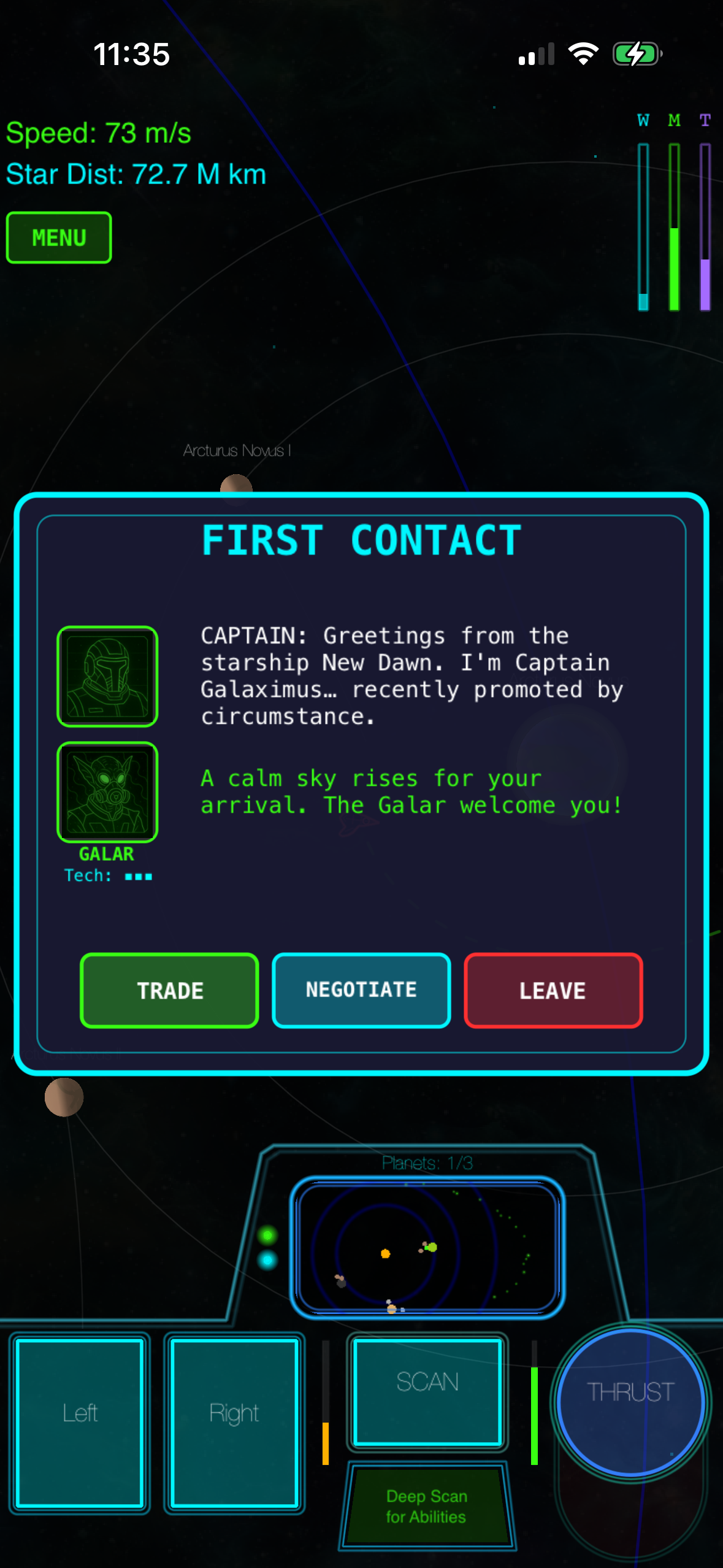
- Trading systems work great offline — you negotiate with NPCs, manage inventory, and make economic decisions locally.
- Real-time combat works great offline — you pilot, dodge, aim, and react without needing server validation.
- Exploration and discovery work great offline — you scan planets, encounter anomalies, and uncover story beats at your own pace.
- Procedural generation works great offline — unique configurations are generated on your device each playthrough.
What doesn’t work well offline: leaderboards (unless they’re local device-only), live multiplayer, seasonal events, and real-time market prices tied to player economies. Good offline games don’t try to fake these — they simply don’t include them.
How to Spot a Game That Actually Works Offline
Read the App Store description carefully. Look for these red flags:
- “Requires internet connection” in the technical requirements section. That’s explicit; believe it.
- “Play online with friends” or “compete on leaderboards” as a core feature. Example: Monument Valley 2 requires internet for cloud saves, limiting offline reliability.
- “Log in with your account” or “sync across devices.” Account-based games need servers; they won’t work offline reliably. Example: Alto’s Adventure works offline, but linked accounts require connection.
- “Limited offline play” or “some features require internet.” This means the core experience needs connection; you’ll hit a paywall.
Look for these green flags:
- “Complete offline experience” or “no internet required” stated explicitly.
- “One-time purchase” with no mention of in-app purchases, subscriptions, or battle passes. Example: Spaceflight Simulator is a one-time purchase with no ads or timers.
- “Single-player campaign” or “sandbox exploration.” These are naturally offline-friendly.
- “Procedurally generated” systems. Each playthrough is unique on your device; no server needed to generate it.
Galaximus: A Case Study in Offline-First Design
We built Galaximus from the ground up to work offline because the game’s core appeal — mastering real orbital mechanics — requires responsive, lag-free gameplay. Every frame matters when you’re calculating gravity vectors and planning slingshots.
The game runs entirely on your device. No account required. No cloud saves. No ads. No energy timers. You buy it once at, and you own it completely. If you buy now, the upcoming Infinitum expansion (open-galaxy sandbox, planetary surface exploration, outpost building) is included free; after Infinitum launches, the combined game moves to a higher price tier.
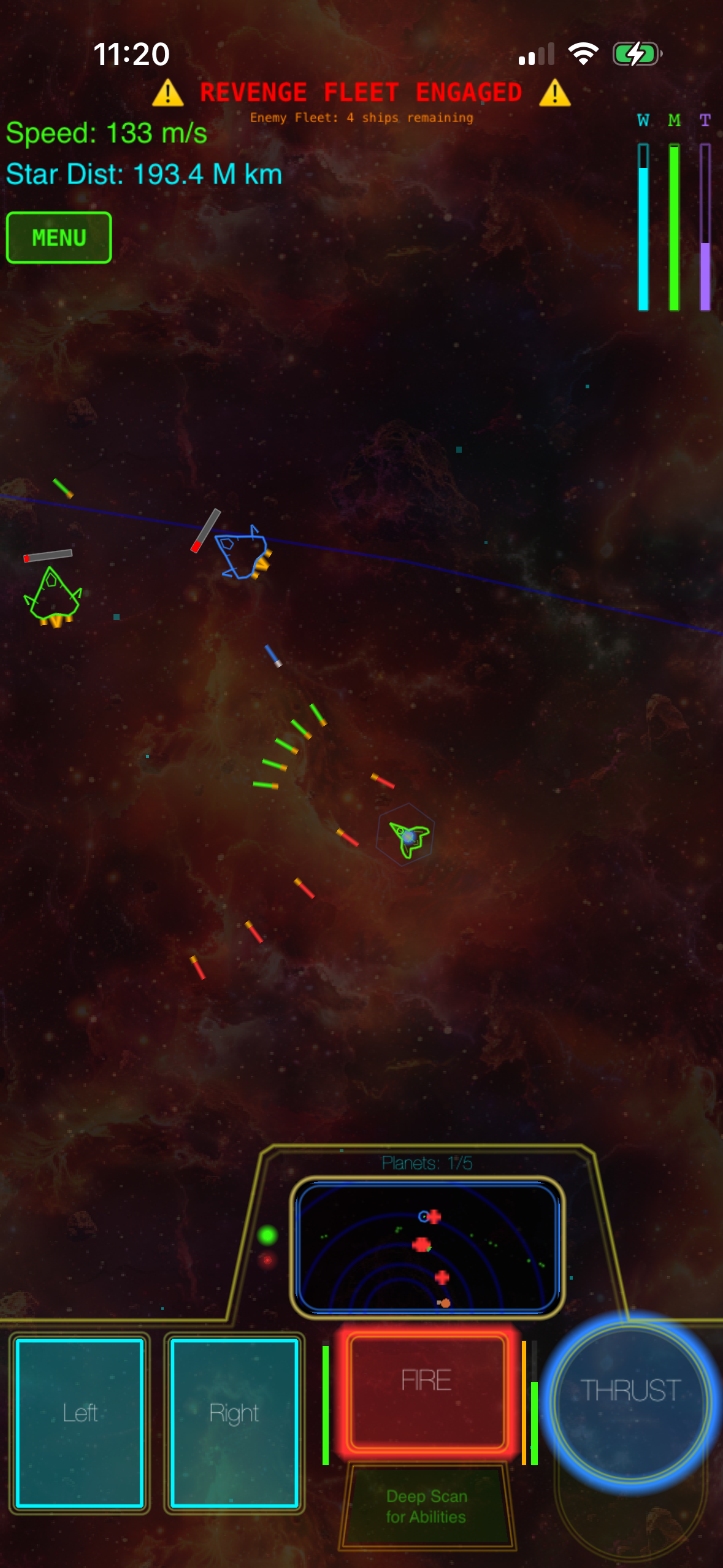
The 8-system campaign has a narrative arc with a beginning and a satisfying end. Each playthrough generates unique planet configurations and anomaly placements, so replaying feels fresh. The procedurally synthesized audio (every sound generated in real time, no sound files) reinforces the arcade aesthetic without requiring asset downloads.
Offline play isn’t a limitation here — it’s the design philosophy. No interruptions. No connectivity anxiety. Just you, gravity, and 8 systems to master.
Other Premium Offline Space Games Worth Knowing About
If you’re looking beyond Galaximus, here are specific alternatives:
- Kerbal Space Program ( desktop, mobile) — Deep rocketry engineering with simplified two-body physics. More complex than Galaximus but less responsive due to server-sync delays on mobile.
- Spaceflight Simulator — Realistic rocket building and orbital mechanics. Lighter than KSP, works smoothly offline, includes a campaign and sandbox modes.
- Orbit Sandbox — Pure gravity simulation with no campaign. Create custom solar systems, experiment with orbital mechanics, no time limits or progression gates.
- Asteroids+ Remastered — Classic arcade-style gameplay with modern graphics. Fast, offline-friendly, no story but endlessly replayable.
- Space Grunts — Tactical roguelike space exploration. Turn-based combat, procedural generation, complete offline campaign with multiple difficulty modes.
- Exoplanet — Minimalist exploration game. Land on procedurally generated planets, discover anomalies, atmospheric storytelling with no UI clutter.
- Traverse: Solo — Puzzle-based space navigation. Offline campaign with 50+ levels, teaches orbital mechanics through gameplay.
Each has a different learning curve and price point. The common thread: they all work offline, they all respect your time, and they all deliver complete experiences without forcing you back online.
FAQ
Q: What’s the typical file size for offline space games? A: Most premium offline space games range from 100 MB to 500 MB. Galaximus is approximately 200 MB. Kerbal Space Program is larger at around 800 MB. Check the App Store listing before downloading if you have limited storage.
Q: Do offline games ever get new content after purchase? A: Yes, but it depends on the developer. Galaximus will receive the Infinitum expansion free if you purchase before launch; after launch, new buyers pay a higher price for the combined game. Kerbal Space Program receives periodic updates. Smaller titles like Spaceflight Simulator receive occasional balance patches. Check the developer’s roadmap or recent update history in the App Store.
Q: What happens to my save file if I delete the app? A: It’s gone. Offline games store saves on your device, not in the cloud. If you reinstall, you start fresh. This is a tradeoff of offline-first design — no cloud backup, but also no account dependency.
Q: Are offline space games less detailed than online ones? A: Not necessarily. Offline games can be more detailed in some ways because they don’t need to stream assets or wait for server responses. Real orbital mechanics, complex procedural generation, and responsive combat are easier to deliver offline.
Q: Can I play offline games with no internet ever, or do they need one setup? A: Most premium games need internet once (to download and verify the purchase), but after that, they work offline indefinitely. Check the specific game’s requirements, but this is the norm.
The Case for Going Offline
The best offline space games are the ones that don’t treat offline play as a limitation — they treat it as the core design constraint that makes the experience better. No ads to interrupt you. No timers to gate your progress. No account to manage. Just the game, your device, and your skill.
If you’re tired of space games that demand constant connectivity, real-time events, and in-app purchases, offline-first games are where you’ll find the premium experience you’re looking for. Galaximus is built on that philosophy, and it’s worth trying if you want real physics, a complete campaign, and the freedom to play anywhere without WiFi.
Get Galaximus on the App Store: