Best Paid iPhone Games Under $5: Space Edition
 by Galaximus
Best Paid iPhone Games Under $5: Space Edition
The premium iPhone game market has shrunk. Most space games now rely on energy meters, battle passes, and cosmetic IAP. Finding a complete, polished space game you buy once and own forever—without ads interrupting gameplay—has become rare. This guide covers space games that still follow that model: pay once, play forever, no strings.
Disclosure: I’m the lead developer on Galaximus, one of the games covered below. I’ve included it because it fits the criteria, but I’ve also included competing games and noted their specific tradeoffs.
Why Premium Space Games Matter in 2026
The free-to-play model dominates mobile gaming. Energy timers, premium currency, seasonal battle passes, and limited-time cosmetics are now standard. Ads appear between matches, during cutscenes, and sometimes mid-gameplay.
Premium games operate under a different contract: the developer gets paid once, so they have no incentive to engineer addiction mechanics or monetize your attention. The game is complete on day one. Updates are either included or optional, not gatekept behind seasonal paywalls.
For space games, this matters. Space games reward patience, planning, and mastery. An energy meter that refills in six hours breaks the flow. An ad after every successful orbit kills immersion. A battle pass that expires in 30 days turns exploration into a grind.
Premium space games let you play at your own pace.
What $4–$5 Actually Buys You
At this price point, you’re paying for a complete, polished experience designed by developers who know how to ship games.
Premium space games on iPhone tend to prioritize depth over breadth. You get 8–20 hours of carefully authored content, not 200 hours of procedurally generated filler. Every encounter is intentional.
You also get no monetization friction. No pop-ups asking if you want to “speed up” build timers. No cosmetic shop. No seasonal resets. The game respects your time investment because the developer already got paid.
Galaximus: Real Gravity, Real Mastery
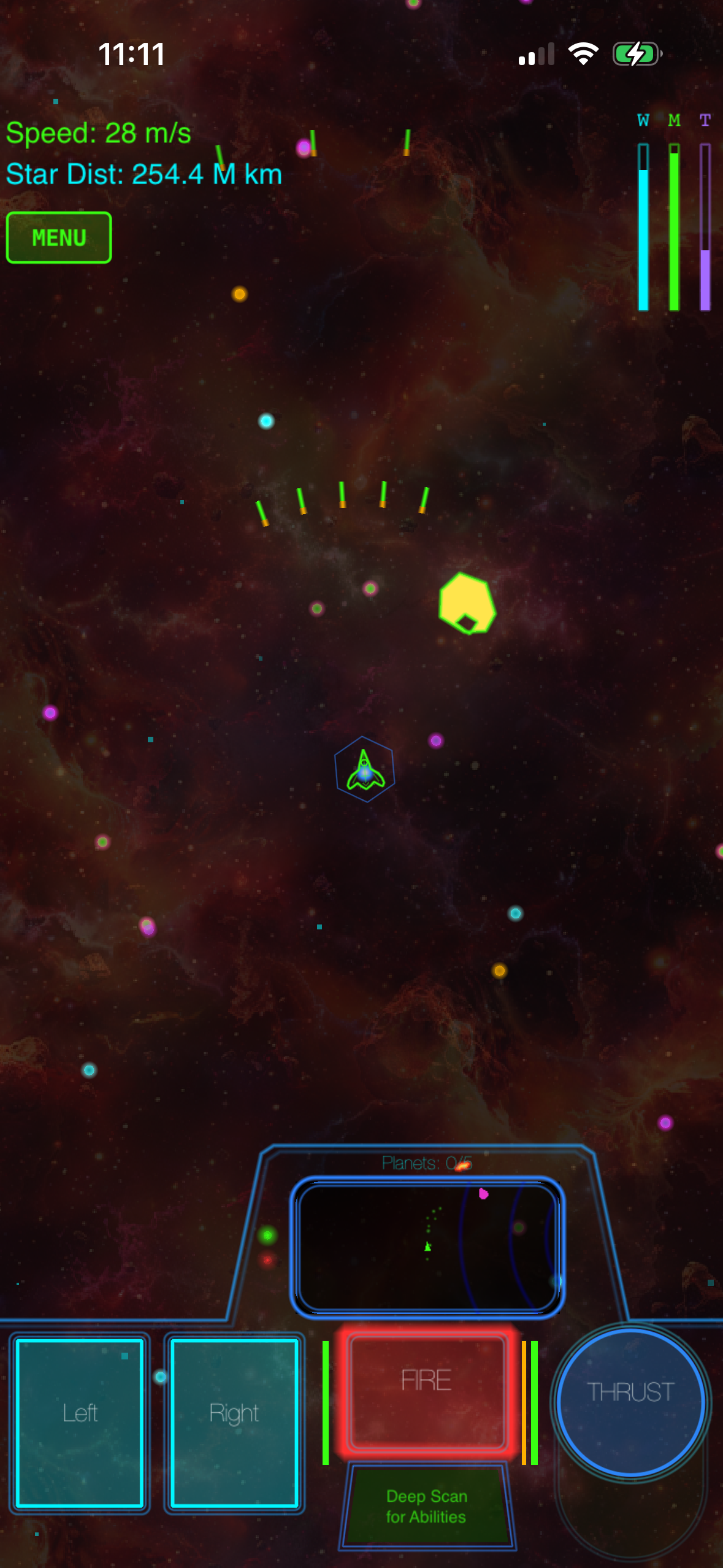
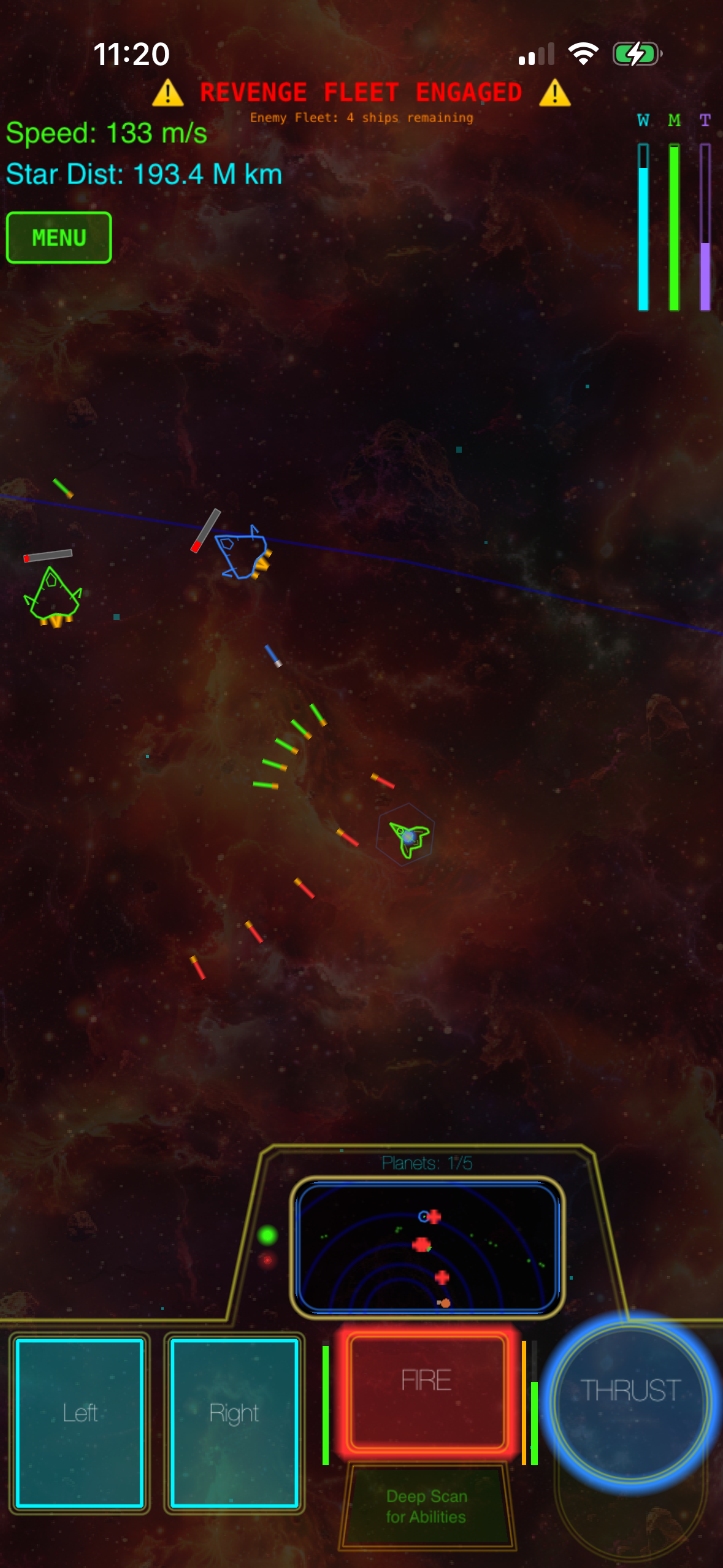
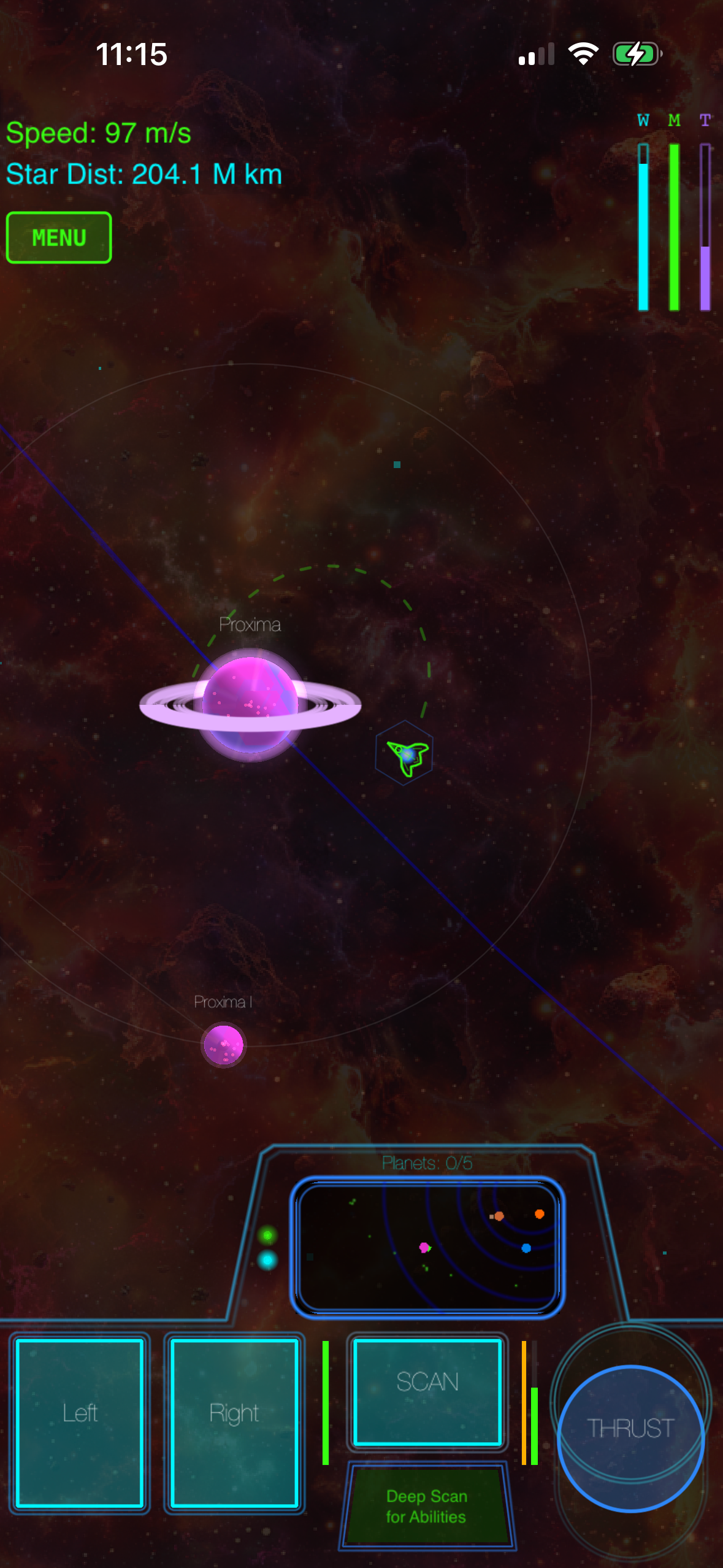
Galaximus is built around a single core idea: gravity is your engine. Not a visual effect—real orbital mechanics. Every body obeys Newton’s laws in real time.
The control scheme lets you execute a gravity slingshot in 30 minutes of focused play. Mastery feels like mastery—you’re using physics, not fighting it.
The campaign spans 8 procedurally configured star systems with a structured narrative arc. Each playthrough generates unique planet positions, but story beats are authored. You have a beginning, middle, and ending.
Combat encounters are real-time and physics-based. You pilot a ship and use gravity wells, momentum, and fuel efficiency to outmaneuver enemies. The game rewards patient positioning over reflexes.
Every sound is procedurally synthesized in real time on your device—no pre-recorded audio files.
Current pricing: Galaximus is at launch. A major expansion called Galaximus Infinitum ships in late 2026 (open-galaxy sandbox, planetary surface exploration, outpost building, faction warfare). Players who buy now get Infinitum free when it ships. After Infinitum launches, the combined game moves to a higher price tier.
Kerbal Space Program: The Engineering Sandbox
Kerbal Space Program (KSP) on mobile is a different experience than Galaximus. KSP is a rocket engineering sandbox where you design and assemble rockets from modular parts, managing fuel, thrust-to-weight ratios, staging sequences, and delta-v budgets.
Version: Kerbal Space Program Mobile (iOS-specific port, not the full desktop version)
Current pricing: on the App Store
Estimated playtime: 10–40 hours depending on depth of engagement
KSP is better if: - You want to understand rocketry at a technical level - You like building and iteration as core gameplay - You’re willing to invest time learning orbital mechanics in depth - You want granular control over vehicle design
KSP is worse than Galaximus if: - You want to fly immediately without assembly tutorials - You prefer arcade-action to engineering simulation - You want a narrative campaign with a defined ending
Both are premium, both are complete on day one. They’re aiming at different players.
Other Premium Space Games Worth Considering
Asteroids: Gunner (Radiangames, ) is a spiritual successor to the 1979 Asteroids arcade game. Simple controls, immediate feedback, no learning curve. You shoot rocks. Rocks break into smaller rocks. You get points. Play sessions are measured in minutes.
This game is genuinely good at what it does. If you want a 5-minute arcade session with zero friction, it fits better than Galaximus or KSP. The tradeoff is no narrative, progression, or mastery curve that pays off over hours.
Star Realm Mobile (Wise Wizard Games, ) is a turn-based deck-building strategy game. You build a deck of cards and manage resources. Completely different from action-based space games, but premium, complete, and ad-free.
All of these games are buy-once, own-forever. No energy timers. No seasonal resets. No ads.
The Free-to-Play Trap (and Why Premium Matters)
Most “space games” on the App Store follow a predictable pattern:
- Day 1: You play for free. The game is fun.
- Day 2–3: An energy meter appears. You can play 5 matches, then wait 6 hours.
- Day 4–7: You unlock a battle pass. Complete daily quests before the season ends in 30 days.
- Week 2: You hit a paywall. Progress slows dramatically unless you spend real money.
- Month 2: You’ve made multiple small purchases and still aren’t “caught up.”
Premium games invert this. The developer gets paid once. There’s no incentive to engineer addiction mechanics. The game is designed to be fun, not to extract maximum revenue.
At this price point, you’re buying the whole game. Not a trial. Not a “starter pack” with the real game locked behind a paywall. The complete, polished version.
How to Evaluate a Premium Space Game Before You Buy
Read the description carefully. If it mentions “energy,” “battle pass,” “seasonal,” “premium currency,” or “cosmetics,” it’s free-to-play masquerading as premium. Real premium games advertise features, not monetization.
Check reviews for monetization complaints. Genuine premium games have reviews saying “worth the price” or “no ads, no IAP,” not “fun until you hit the paywall.”
Look at the developer’s history. Developers who’ve shipped premium games before understand the value proposition. First-time mobile developers sometimes stumble into free-to-play traps because it’s the App Store’s default model.
Test the first 30 minutes. The first half-hour shows whether the game respects your time or is designed to frustrate you into spending. Galaximus, KSP, and arcade descendants all hook you in the first 10 minutes. If a game takes 45 minutes of tutorial before it’s fun, that’s a warning sign.
FAQ
Q: Why are premium space games so rare on iPhone? A: Free-to-play games generate more revenue per user than premium games, so publishers optimize for free-to-play. Premium games require a different business model—they have to be good enough to sell on quality alone. This filters out mediocre games and leaves only the ones developers genuinely wanted to make.
Q: How does Galaximus compare to Kerbal Space Program? A: Different design goals. Kerbal is hard in the way engineering is hard—you need to understand orbital mechanics at a technical level. Galaximus is hard in the way arcade games are hard—you develop reflexes and spatial intuition. Galaximus has a gentler first hour; KSP has more depth if you stick with it.
Q: Can I play these games offline? A: Yes. Most premium space games work offline because they don’t need to sync with a server. Galaximus is fully playable offline. Kerbal Space Program requires internet for the initial download but plays offline after that.
Q: Do these games have multiplayer? A: No. Premium space games on iPhone are single-player. The monetization model (buy once, own forever) doesn’t support multiplayer infrastructure costs.
Q: How long does a typical playthrough take? A: Galaximus campaign: 8–15 hours for a single playthrough. Kerbal Space Program: 10–40 hours depending on how deep you go into mission design. Arcade games: 5–30 minutes per session.
The Bottom Line
Premium space games at this price point are rare, but worth seeking out. You’re buying a complete, polished experience with no monetization friction. No energy timers. No ads. No seasonal resets.
Galaximus is built for players who want real gravity and real mastery without KSP’s learning curve. Kerbal Space Program is for players who want to understand rocketry at a technical level. Arcade descendants are for players who want immediate, frictionless fun.
All of them share one thing: they respect your time and your money because the developer already got paid.