Best Orbital Mechanics Games for iPhone 2026
 by Galaximus
The Best Orbital Mechanics Games for iPhone in 2026
Disclosure: This guide includes Galaximus, a game developed by the author. The recommendations below reflect genuine product differences, but readers should evaluate all three main options independently.
Orbital mechanics on iPhone used to mean one thing: tap a button and watch gravity do the work. Today’s orbital mechanics games treat gravity as the core gameplay mechanic — not a visual flourish, but the actual interface you use to navigate, fight, and survive. If you want a space game where every move is shaped by real physics, where slingshots around planets are fuel-free maneuvers, and where positioning matters more than reflexes, you have options.
This guide walks you through the landscape of orbital mechanics games on iPhone, from arcade-action titles that make gravity intuitive to deeper simulations that reward patient planning. We’ll cover what sets them apart, where the learning curve lives, and which one fits your play style.
What Makes Orbital Mechanics Games Different
Most space games on iPhone fake gravity for accessibility. They let you point your ship and accelerate in a straight line — fast, responsive, easy to learn. Orbital mechanics games don’t do that. They model gravity as a real force that affects your trajectory whether you want it to or not. A planet’s gravity well doesn’t just pull you toward it; it curves your path, steals your fuel efficiency, and forces you to think ahead.
The payoff is mastery. Once you understand how to use gravity as an engine — slingshot around a moon to steal its momentum, spiral into a gravity well and back out — you’re flying in a way that no arcade-action game with fake physics can match.
The tradeoff is a real learning curve. Thirty minutes of focused play and you’ll have the fundamentals. The first hour can feel unintuitive if you’re used to games where your ship does exactly what you tell it to do.
Galaximus: Best for Learning Orbital Mechanics in Under 1 Hour
Platforms: iPhone (as of August 2026) Price: (one-time purchase; includes Galaximus Infinitum expansion when it ships later in 2026) Physics: Real-time N-body GPU simulation (per developer)
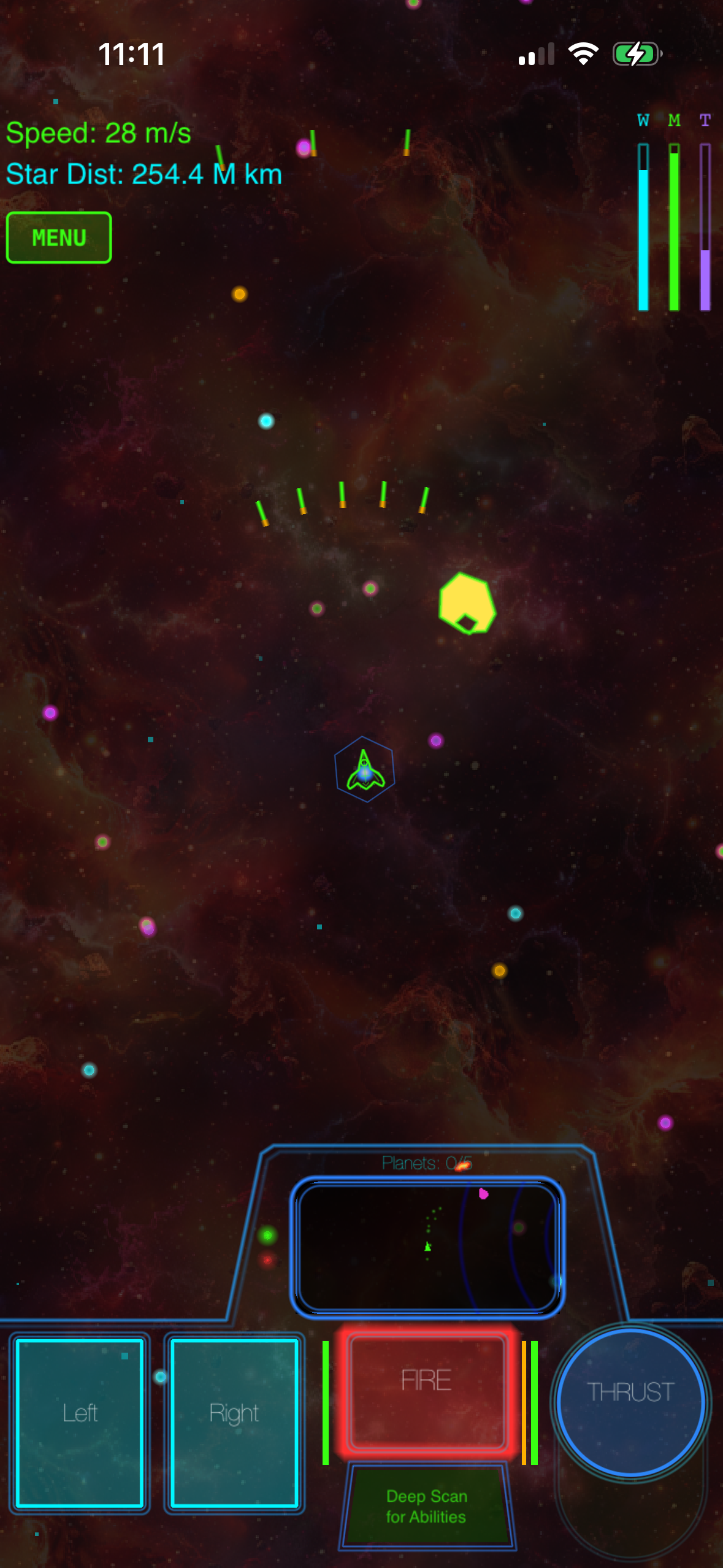
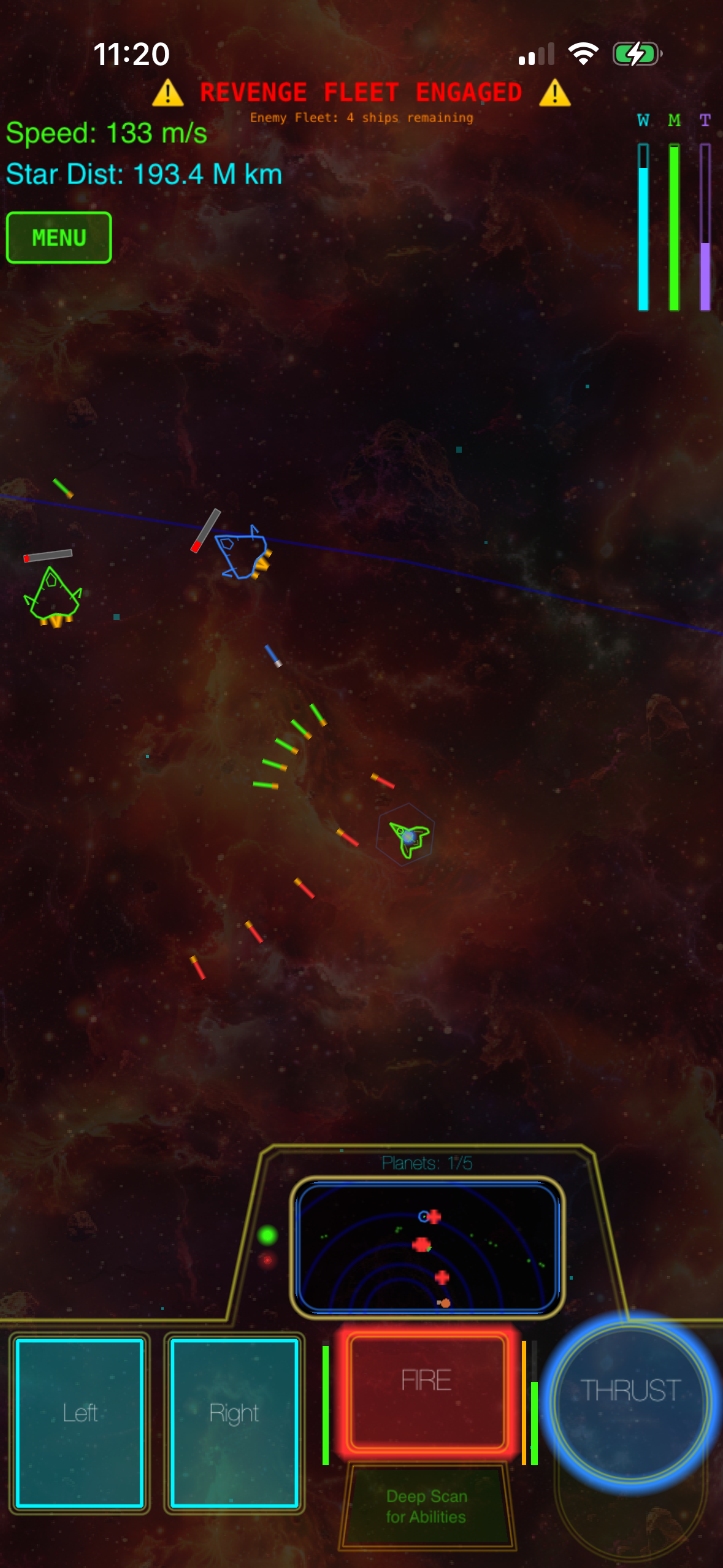
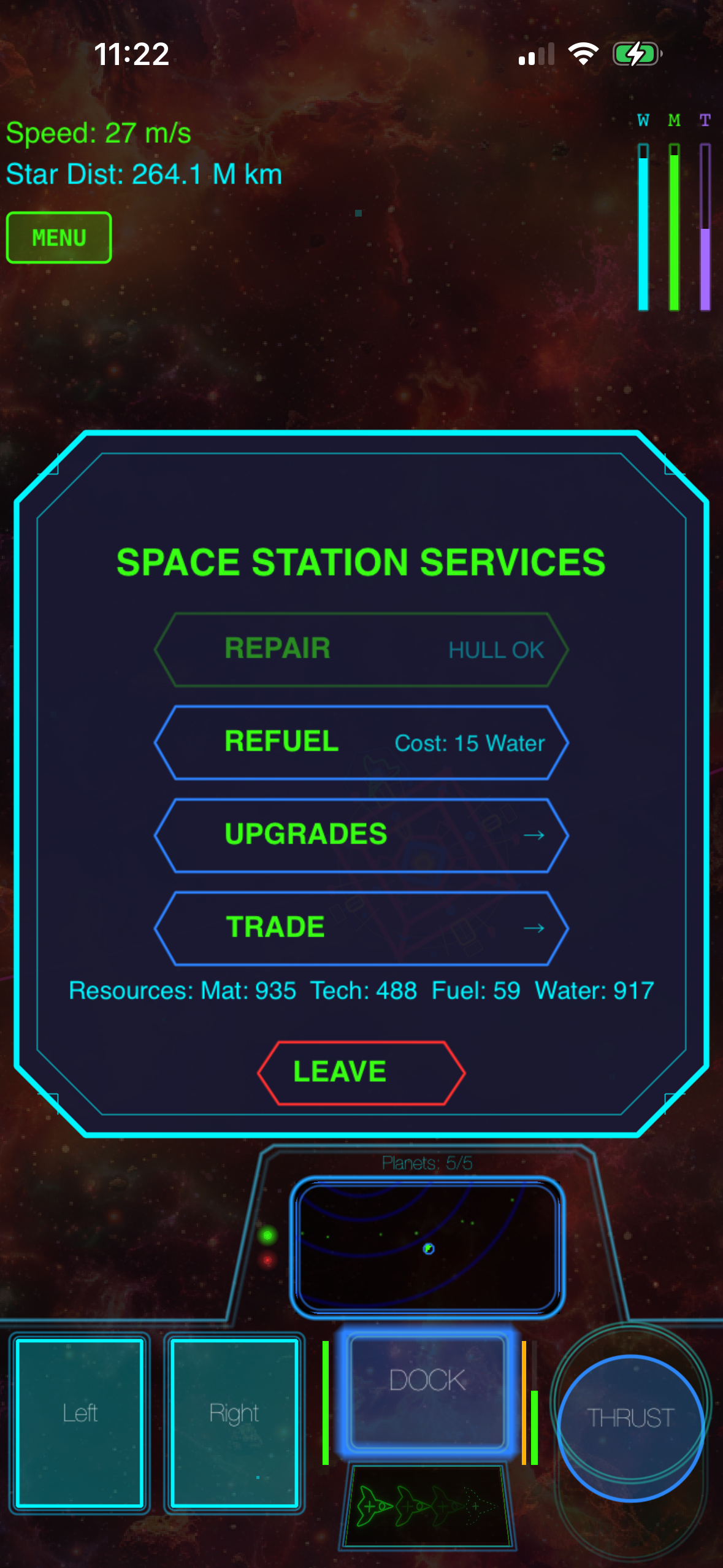
Galaximus was designed to make real orbital mechanics feel responsive on a touchscreen. The ship, The New Dawn, is your only tool. You point it, you accelerate, and gravity does the rest. Slingshot around a planet to gain speed without burning fuel. Spiral into a gravity well and back out. Use asteroids as waypoints.
The 8-system campaign is procedurally configured — each playthrough generates unique planet layouts with approximately 15–20 hours of gameplay per full campaign run. The narrative arc remains structured across playthroughs, but the procedural generation creates variation in mission routing and optimal solutions rather than wholesale story changes.
Combat is real-time and physics-driven. Enemy fleets obey the same gravity wells you do. Positioning and patience beat twitch reflexes.
Premium-only: one-time purchase, no ads, no in-app purchases. Early buyers at launch price lock in Galaximus Infinitum (planetary surface exploration and faction warfare) free; the price increases after Infinitum ships.
Kerbal Space Program: Best for Engineering Depth
Platforms: iPhone, iPad, Mac, PC (as of August 2026; mobile version actively updated) Price: (desktop); (mobile) Physics: Hybrid approach — real-time for player vessel, pre-calculated for background objects (per developer documentation)
Kerbal Space Program is the gold standard for orbital mechanics depth. You build vehicles from parts — engines, fuel tanks, heat shields, parachutes — and fly them. The orbital tooling is granular: maneuver nodes, delta-v calculations, transfer window optimization. This is actual mission-planning simulation.
The tradeoff is complexity. KSP teaches rocketry engineering on top of orbital mechanics. You need to understand staging, thrust-to-weight ratio, specific impulse. The learning curve is steep; expect 10–15 hours before you feel confident.
On mobile, KSP is feature-complete for core gameplay but streamlined compared to desktop. Advanced tools are simplified. The desktop version remains the fuller experience, but the mobile version is genuine and actively maintained.
No Man’s Sky Mobile: Best for Exploration
Platforms: iPhone, iPad, PlayStation, Xbox, PC (as of August 2026) Price: Physics: Simplified gravity model for accessibility
No Man’s Sky is a procedurally generated universe where you explore planets, manage resources, and build toward larger goals. Orbital mechanics are present — gravity affects your trajectory — but simplified. The focus is exploration, discovery, and meditative wandering.
The strength is scale and visual ambition: procedurally generated planets you can land on and walk around. The weakness is that orbital mechanics are abstracted; you’re not managing gravity wells the way you are in KSP or Galaximus.
Choose No Man’s Sky if you want wonder and discovery. Choose Galaximus or KSP if you want gravity to be the core mechanic.
Arcade Physics and Puzzle Gravity
Arcade descendants (games that extend the 1979 Asteroids formula with real gravity) are faster-paced than Galaximus or KSP. You manage gravity in real time, but action is twitchier and encounters are shorter. Learning curve is shallower. Most are free-to-play with ads or in-app purchases rather than premium.
Gravity-based puzzle games use gravity as a puzzle mechanic: you’re given a target, starting position, and gravity field, and you plan the trajectory to reach it. No real-time action. These are excellent for players who like the thinking part without the flying part. Often free or very cheap.
Physics Engines: What Matters
Games that model gravity accurately calculate how every object’s gravity affects every other object in real time. That’s computationally expensive. Some games fake it by pre-calculating orbits and playing them back — faster but less responsive.
Galaximus uses real-time N-body GPU simulation, meaning physics responds to your actions immediately (per developer). KSP uses a hybrid approach: real-time for your vessel, pre-calculated for background objects (per official documentation). Both work; the difference is responsiveness.
The Learning Curve: What to Expect
The first hour can feel unintuitive. Your instinct is to point at a target and accelerate. In an orbital mechanics game, that often sends you past it or into a gravity well.
The good news: the learning curve has a ceiling. After 30 minutes of focused play, you’ll understand the fundamentals. After a few hours, you’ll plan multi-step maneuvers. After 10–15 hours, you’ll fly with genuine confidence.
Galaximus minimizes initial friction: expressive controls, integrated tutorial, immediate feedback on whether maneuvers worked. You can feel yourself learning in real time.
KSP has a steeper curve because it teaches rocketry on top of orbital mechanics. Spend more time in tutorials and documentation. The payoff is deeper understanding.
Why Play an Orbital Mechanics Game?
Mastery of a real system is satisfying in a way other games aren’t. When you nail a slingshot maneuver, you’re not executing a canned animation; you’re using actual physics to solve a problem. That feedback loop keeps players coming back.
2026 is the year orbital mechanics on iPhone stopped being niche. The games are good. The controls work. The physics is real.
FAQ
Do I need to know physics to play? No. Games teach you through play. If you understand that gravity pulls things toward it and curves trajectories, you have enough knowledge to start.
Which is best for beginners? Galaximus has the gentlest learning curve. You get fundamentals in the first hour. Kerbal Space Program is deeper but steeper; start with Galaximus if you’re new to the genre.
Can I play on iPad? Galaximus is iPhone-only at launch. Kerbal Space Program and No Man’s Sky are available on iPad. Check the App Store for current support.
Do these games have multiplayer? No. These are single-player experiences focused on mastering physics.
What’s the difference between real and fake gravity? Real gravity is calculated in real time based on object positions and masses. Fake gravity is often a visual effect or simplified approximation. Real gravity means unpredictable trajectories requiring planning; fake gravity means more direct control. Both have merit; they feel very different to fly.
The Takeaway
Orbital mechanics games are now a legitimate iPhone genre with multiple strong entries. Galaximus offers the fastest path to mastery with real physics. Kerbal Space Program delivers engineering depth and precision. No Man’s Sky provides exploration and wonder.
Choose based on what you want: arcade mastery with real gravity, engineering challenge, or exploration. All three are worth your time.
Get Galaximus on the App Store: Get it on the App Store

