Best Offline iOS Space Games: No Internet Required, Full Experience
 by Galaximus
Best Offline iOS Space Games: No Internet Required, Full Experience
You want to play a space game on your iPhone without burning data, without waiting for servers, without ads interrupting your flight path. Most space games on the App Store either demand a live connection, wrap their campaigns in free-to-play monetization, or both. The ones that don’t are worth knowing about.
This guide covers offline space games for iOS, including Galaximus (which I built). I’ve disclosed this relationship above and aim to give you the full picture — what else exists, how offline space games work on mobile, and which one fits your play style.
Why Offline Space Games Matter on iPhone
An offline game on your phone isn’t just a convenience — it’s a different category of experience. When a game doesn’t need to phone home, the developer can ship a complete, self-contained product. No server-side balance patches that nerf your strategy. No seasonal battle pass that expires. No “the servers are down for maintenance” messages. What you buy is what you get, forever.
For space games specifically, offline play removes a hidden cost. Orbital mechanics simulations — the real-physics kind — are computationally expensive. Running that on-device, without offloading to the cloud, means the developer has to optimize hard. That optimization often results in tighter, faster gameplay.
The trade-off is honest: offline games can’t do live multiplayer, seasonal content drops, or cross-device cloud saves (though local device backups still work). If you want those features, you need a connected game. But if you want a game you own that works on a plane, on a subway, or in a cabin with no signal — offline is the only real option.
What Makes a Space Game Work Offline
Not every space game can run offline well. Real-time physics simulations demand consistent frame rates. Procedural generation (creating unique star systems each playthrough) has to happen on-device, which adds startup load. Voice lines, if they’re pre-recorded, add file size; if they’re synthesized in real time, they add CPU cost.
The best offline space games make deliberate choices about these tradeoffs. Some simplify the physics to run faster. Some use vector graphics instead of 3D models to cut memory. Some generate audio on the fly instead of storing sound files. The games that do this well don’t feel compromised — they feel intentional.
Quick Picks
| Game | Best For | Price | Physics | Campaign Length |
|---|---|---|---|---|
| Galaximus | Arcade-action with real gravity | Full orbital mechanics | 2–6 hours | |
| Kerbal Space Program Mobile | Engineering sandbox & design | Full orbital mechanics | Open-ended | |
| Asteroids+ (or similar arcade descendants) | Quick arcade sessions | Simplified/none | 5–15 min per session | |
| Apple Arcade space titles | Variety without per-game cost | Included with Arcade subscription | Varies | Varies |
Galaximus: Real Gravity, No Internet
Price: (launch tier) App Store: Galaximus on App Store Disclosure: I built this game.
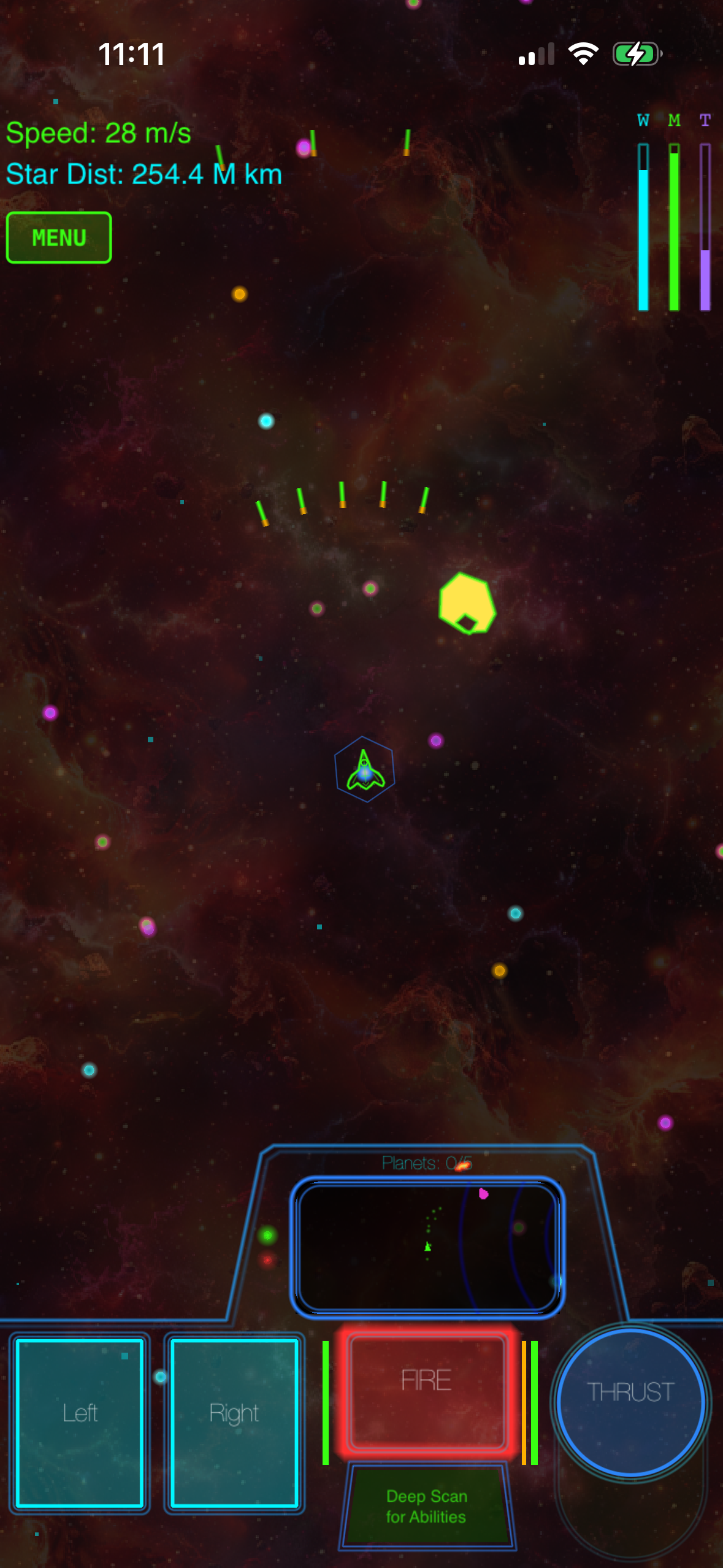
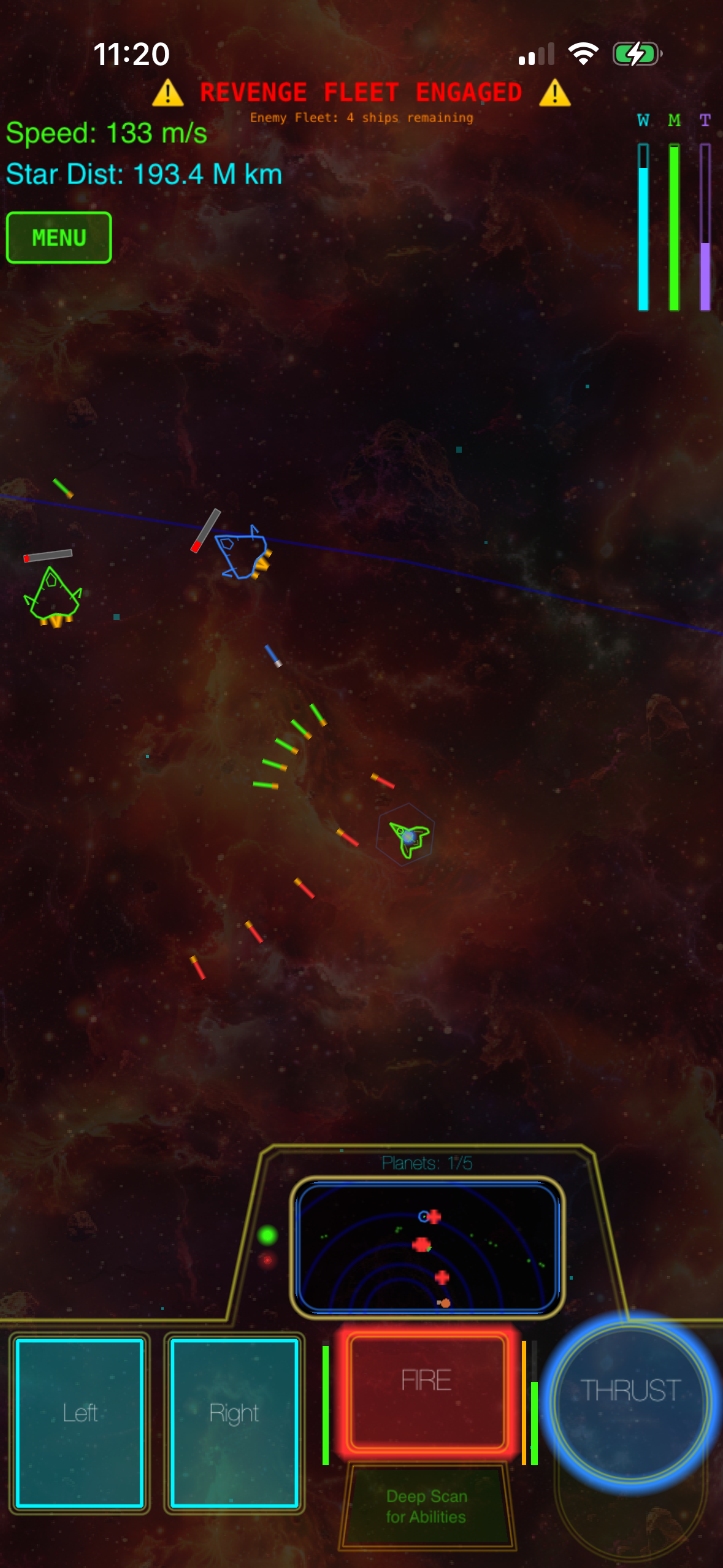
Galaximus is a premium arcade-action game where every celestial body obeys actual orbital mechanics. Your ship, The New Dawn, is subject to gravity just like any other mass in the system. You don’t have a fuel tank that lets you thrust forever — you have a limited burn budget, and the planets’ gravity wells are your engine. A slingshot maneuver around a planet costs nothing but timing.
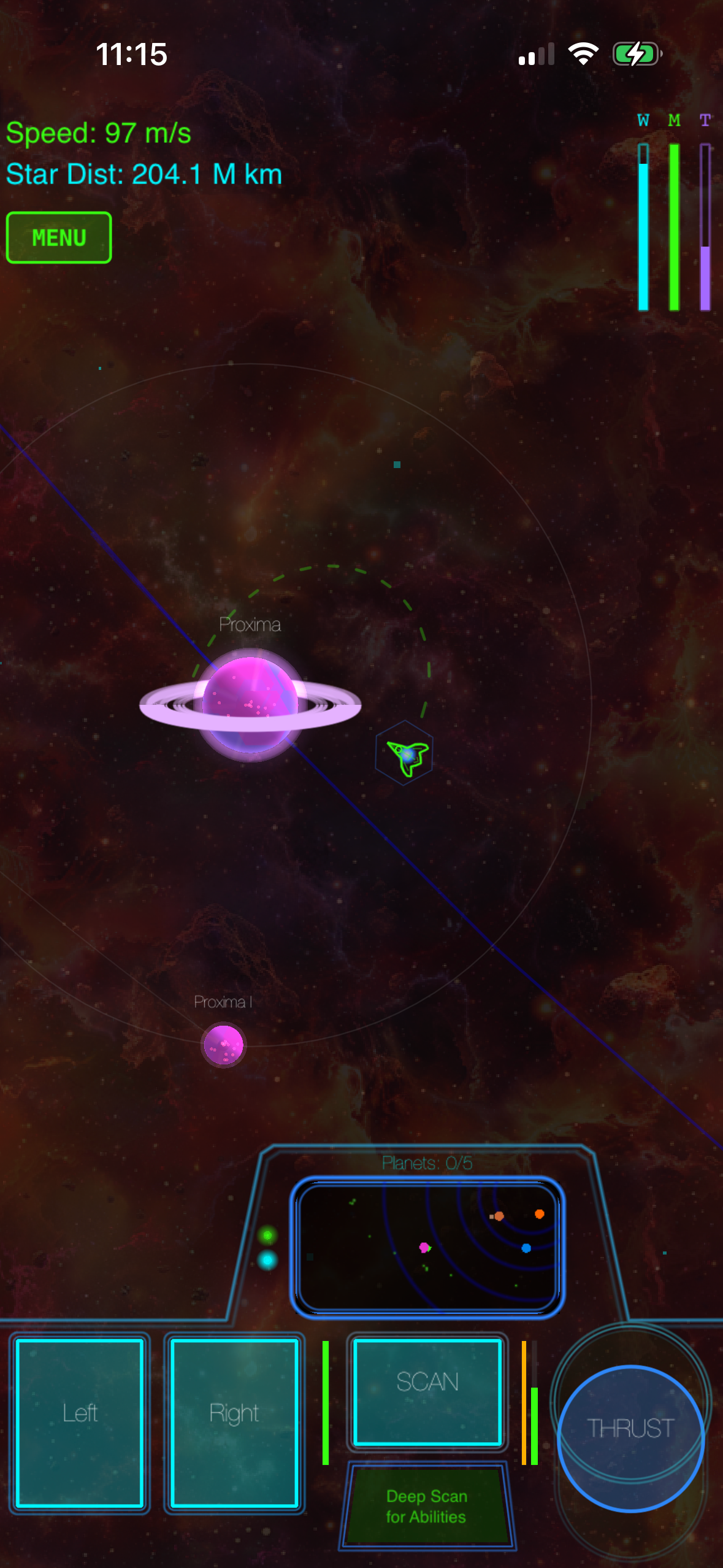
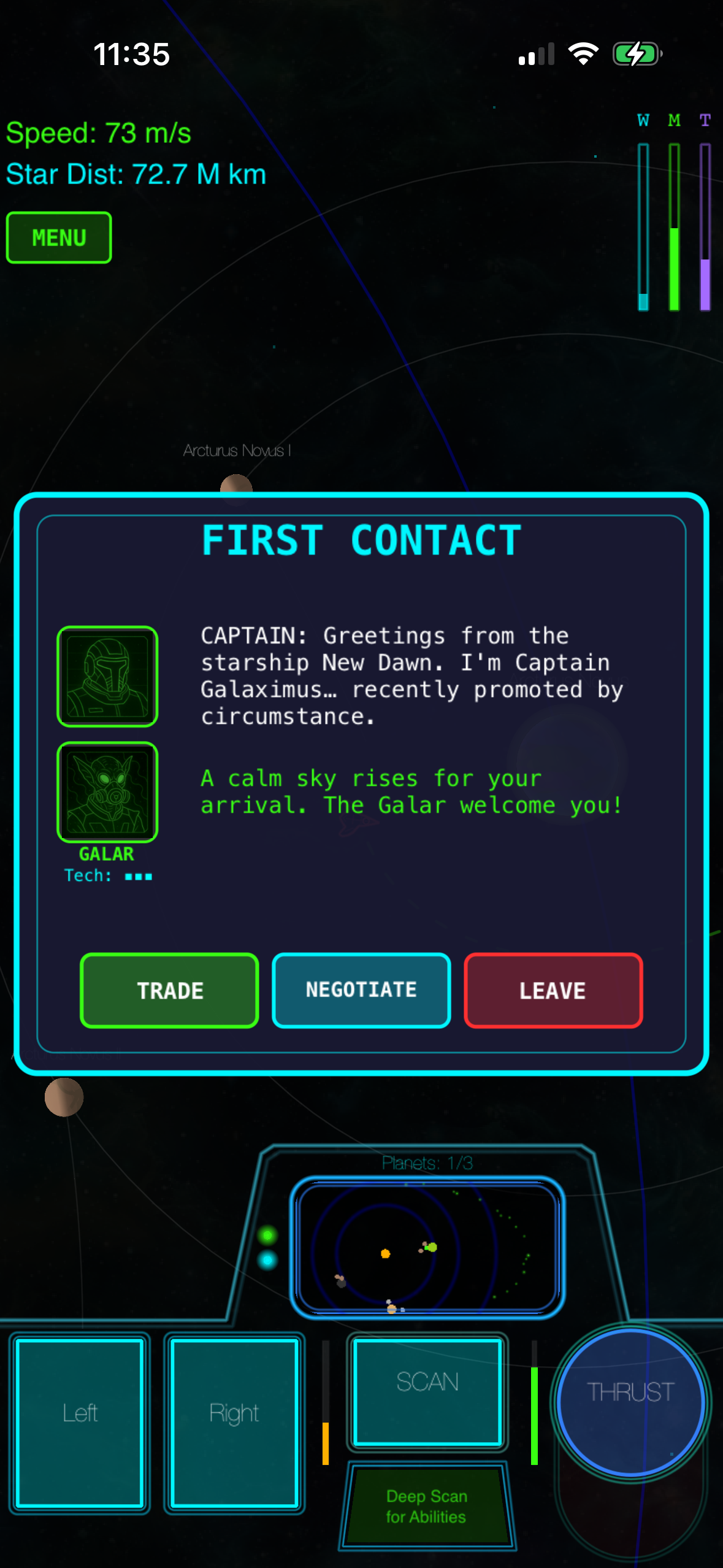
The campaign spans 8 procedurally configured star systems. Each playthrough generates a unique arrangement of planets and anomalies — spacetime rifts, derelict ships, distress beacons, and other encounters scattered through each system. You fly toward them, engage with them, and move on. There’s a narrative arc with a beginning, middle, and end. Campaign length is typically 2–6 hours depending on play style.
The game runs entirely offline. Buy it once, and you own it forever. No ads, no energy timers, no in-app purchases.
Upcoming expansion: Galaximus Infinitum (expected late 2026) will add open-galaxy sandbox play, planetary surface exploration, outposts, and faction warfare. If you purchase Galaximus at the current launch-tier price , Infinitum will be included free when it launches. After Infinitum ships, the combined game will move to a higher price tier.
Kerbal Space Program Mobile: Engineering Depth
Price: App Store: Kerbal Space Program Mobile on App Store
If you want to build rockets instead of just flying a ship, Kerbal Space Program Mobile is the alternative. KSP is a full vehicle-assembly sandbox where you design rockets from engine parts, fuel tanks, and payload modules, then launch them and manage their trajectories in real time.
The learning curve is steeper than Galaximus. KSP teaches you orbital mechanics through engineering — you have to understand apogee, perigee, and delta-v to succeed. Galaximus teaches you through flying — you learn to use gravity by piloting, not by calculating. Both are legitimate; they’re just different games.
KSP Mobile runs offline and is a premium purchase with no ads or IAP. The mobile version includes approximately 40 engine and tank parts (versus 100+ in the desktop edition) and omits some advanced features like docking ports and multi-stage separation. These omissions reduce complexity but don’t prevent you from reaching orbit and completing basic missions. If you want the full engineering-sandbox experience with maximum part variety, the desktop edition is more complete. If you want a focused, mobile-optimized version, the mobile edition delivers that.
Classic Arcade Space Games
Price: each Examples: Asteroids+, Lunar Lander Deluxe, Spacewar! (various implementations)
The iOS App Store has clean implementations of arcade-space classics — Asteroids, Lunar Lander, and their modern descendants. Games like these are fast, simple, and run offline by default. They’re pickup-and-play: five minutes of focused arcade action with minimal learning curve.
These games are genuinely good at what they do — they’re not stepping-stone content. If you want quick space-themed arcade sessions without committing to a longer campaign, they fit perfectly. The tradeoff is scope: they’re not trying to tell a story or simulate physics. They’re trying to deliver a specific, repeatable challenge.
Search the App Store for “Asteroids,” “Lunar Lander,” or “arcade space” to see current options. Availability and pricing vary.
Apple Arcade Space Titles
Apple Arcade includes a rotating selection of space games that run offline. Current titles may include arcade-style games, exploration experiences, and narrative-driven space adventures (specific titles rotate monthly; check the Arcade app for current availability).
The subscription model means zero friction if you’re already paying for Arcade — you don’t buy individual games, you just play what’s available. Some Arcade titles are high-polish premium experiences; others are lighter arcade games.
The tradeoff is that Arcade’s catalog rotates. A game you love today might leave the service next year. If you want to own a game permanently, Arcade isn’t the right model. But if you want a low-commitment way to explore multiple space games without buying each one separately, it’s worth checking what’s currently available in the Arcade app.
The Learning Curve Question
Most offline space games worth playing have a learning curve. That’s not a bug — it’s the payoff. A game that takes 30 minutes to master isn’t wasting your time; it’s giving you something to learn.
Galaximus’ curve is real but front-loaded. The first 20–30 minutes of play teach you how to use gravity as your engine. After that, the challenge is positioning and timing, not understanding the mechanic. Kerbal’s curve is longer and steeper — the engineering knowledge compounds.
If you want zero learning curve, you’re looking at arcade games or casual titles. Those are fine, but they’re a different category. The space games that simulate real physics require you to learn something, because the physics is the interface.
Offline Doesn’t Mean Featureless
An offline game is usually more complete because it has to stand alone. There’s no “we’ll add content later via an update” — the game ships feature-complete.
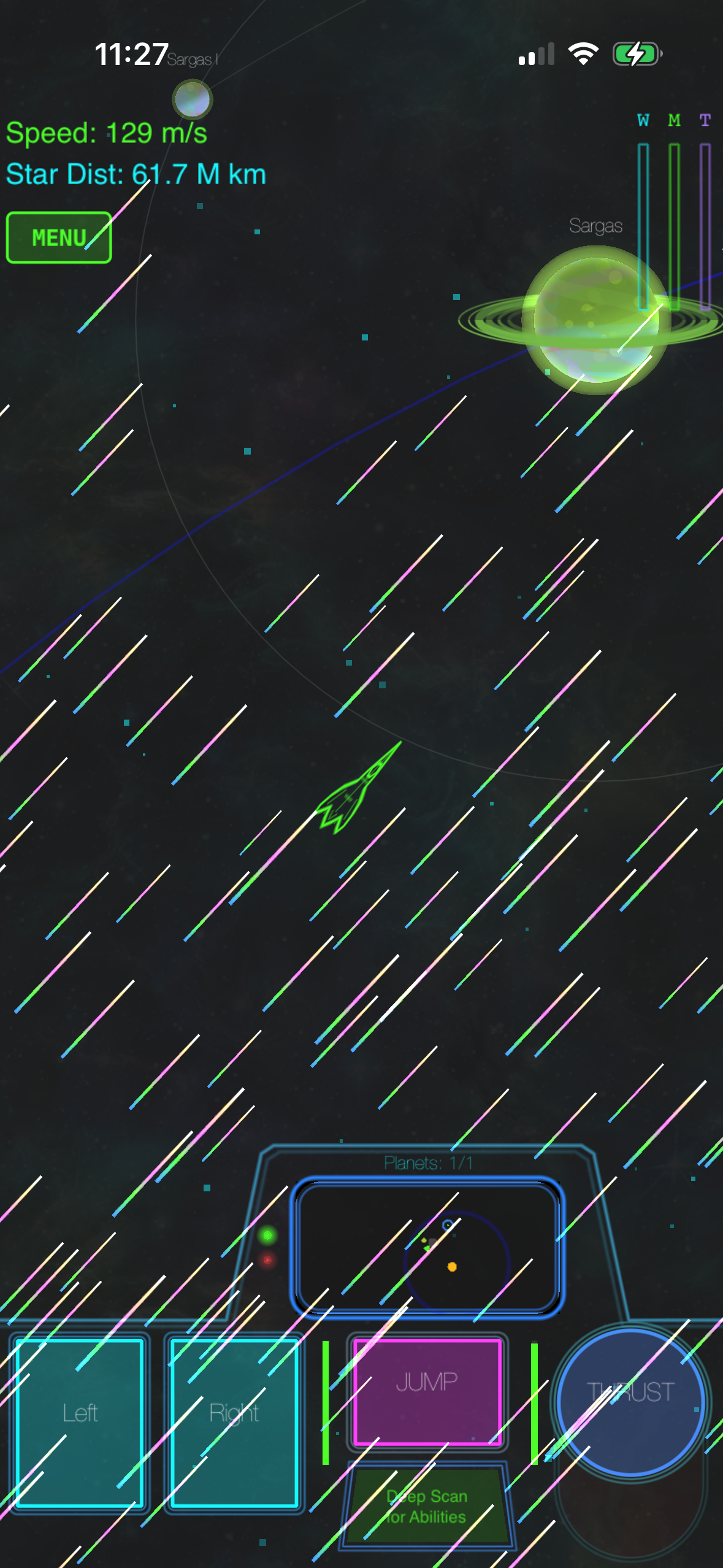
Galaximus ships with a full campaign, 11 anomaly types, a complete dialogue system, and a procedural generation system that creates unique star systems. No battle pass. No seasonal events. No “come back tomorrow” timers. What you buy is the full game.
The same is true for Kerbal Mobile and the classic arcade descendants. They’re not lite versions — they’re self-contained products.
FAQ
How much storage do these games require?
Galaximus: approximately 250 MB. Kerbal Space Program Mobile: approximately 500 MB. Classic arcade games: typically 50–150 MB each. Check the App Store listing for your specific title, as sizes vary by version.
Do these games work on older iOS versions?
Most offline space games require iOS 14 or later. Galaximus requires iOS 15.0+. Kerbal Space Program Mobile requires iOS 14.0+. Check the App Store requirements for your specific game before purchasing.
Can I transfer saves between devices?
Local saves stay on your device by default. You can back up saves to iCloud if the game supports it, but this requires manual setup. Check the game’s settings menu. Offline games don’t use cloud sync automatically like connected games do.
Can I play these on an airplane?
Yes. All the games discussed here run entirely offline. Download them before you fly, and they work without internet for the entire flight.
Do offline space games ever get updates?
Yes, but differently than connected games. Offline games get bug fixes and balance patches via App Store updates, but they don’t get seasonal content or server-dependent features. Galaximus will receive updates, and Infinitum will ship as a free upgrade to launch-tier buyers — but the core game you own today will never become dependent on a server.
Which offline space game has the shortest learning curve?
Classic arcade games (Asteroids descendants) have the shortest curve — you can play effectively in minutes. Galaximus has a moderate curve: 20–30 minutes to understand gravity-based flight, then increasing mastery over hours. Kerbal has the longest curve — understanding orbital mechanics at an engineering level takes dedicated study.
Can I play these on iPad?
Most offline space games scale to iPad. Galaximus is optimized for iPhone but works on iPad with larger controls. Kerbal Space Program Mobile supports iPad natively. Check the App Store listing for your specific title.
What if I want multiplayer?
Offline games can’t do live multiplayer by definition. If you want to compete or cooperate with other players in real time, you need a connected game. That’s a genuine tradeoff — offline and multiplayer are mutually exclusive.
The Bottom Line
In 2026, offline space games on iOS are still a niche. Most developers chase the free-to-play model or require a live connection for gameplay. But the games that go offline tend to be the ones that respect your time and your device. They work without data, without servers, without ads, and without monetization tricks.
If you want a premium space game that you own completely and can play anywhere, you have real options. Galaximus offers real orbital mechanics and a complete narrative campaign. Kerbal gives you engineering depth. Classic arcade games give you instant gratification. The choice depends on what kind of space experience you’re after.
Whatever you choose, the offline model means you’re buying a finished product, not an ongoing service. That’s increasingly rare on mobile — and it’s worth valuing.

