Best $4 Premium iPhone Games: Space & Simulation 2026
 by Galaximus
The Best Premium Space Games for iPhone at the $4 Launch Tier
When you buy a premium space game on iPhone, you’re looking for one thing: a complete experience that respects your time and doesn’t interrupt you with ads, energy timers, or premium currency. The space-game niche on iOS has thinned in recent years—most new titles went free-to-play—which means the premium games still shipping are worth your attention.
This guide covers what’s actually available at the launch-price tier in 2026, what each one does well, and where the tradeoffs are.
Quick Picks
| Game | Best For | Price | iOS Requirement |
|---|---|---|---|
| Galaximus | Learning real orbital mechanics | iOS 14+ | |
| Kerbal Space Program Mobile | Rocket engineering & deep systems | iOS 13+ | |
| No Man’s Sky Mobile | Procedural exploration at scale | iOS 15.4+ | |
| Asteroids-style arcade games | Fast reflexes, no learning curve | iOS 12+ |
Why Premium Space Games Matter on iPhone
The free-to-play model has dominated mobile gaming for over a decade, but it’s created a specific problem: space games designed around energy timers and progression gating, not around the actual experience of flying through space.
Premium games—the ones you pay for upfront—operate under a different constraint. They have to be good enough that you’ll recommend them to a friend without feeling guilty. No energy meter means no artificial stopping point. No ads mean the game doesn’t interrupt itself to make money. No in-app purchases mean the difficulty curve isn’t shaped by what the monetization team wants you to buy.
For space games specifically, this matters. Orbital mechanics are hard enough to learn without a timer punishing you for taking too long to figure out a gravity slingshot. Real-time combat needs to flow without interruption. Exploration rewards patience, and patience is impossible when the game is counting down your energy.
Galaximus: Gravity as Your Engine
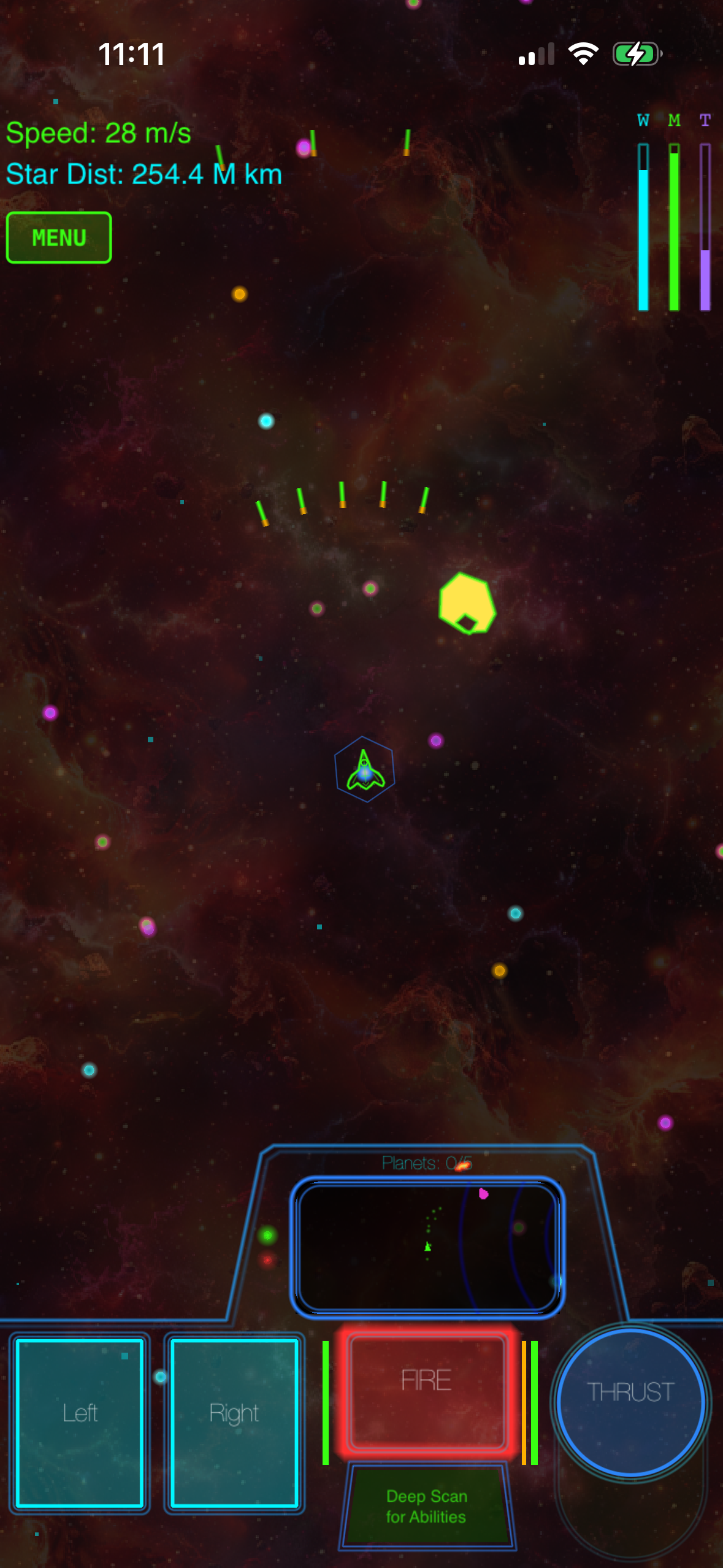
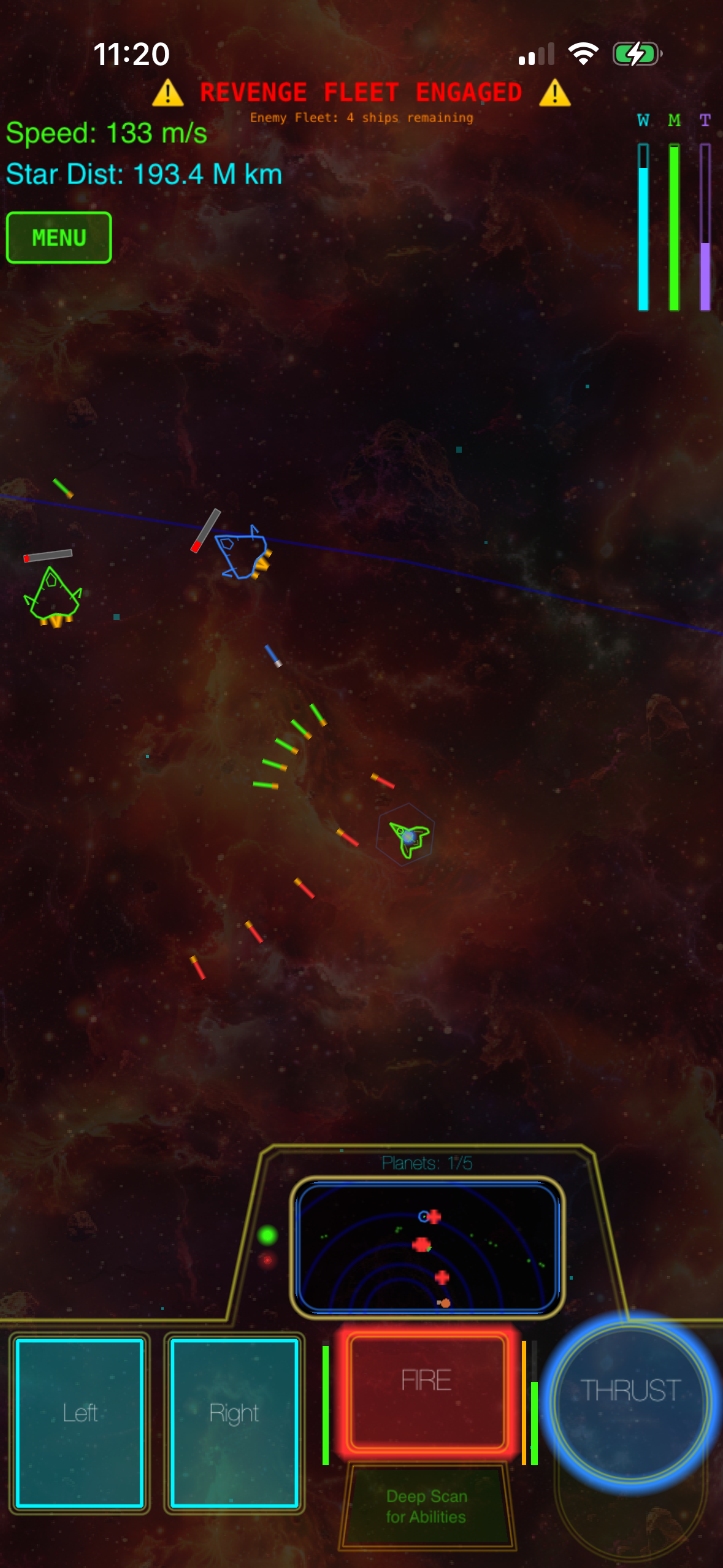
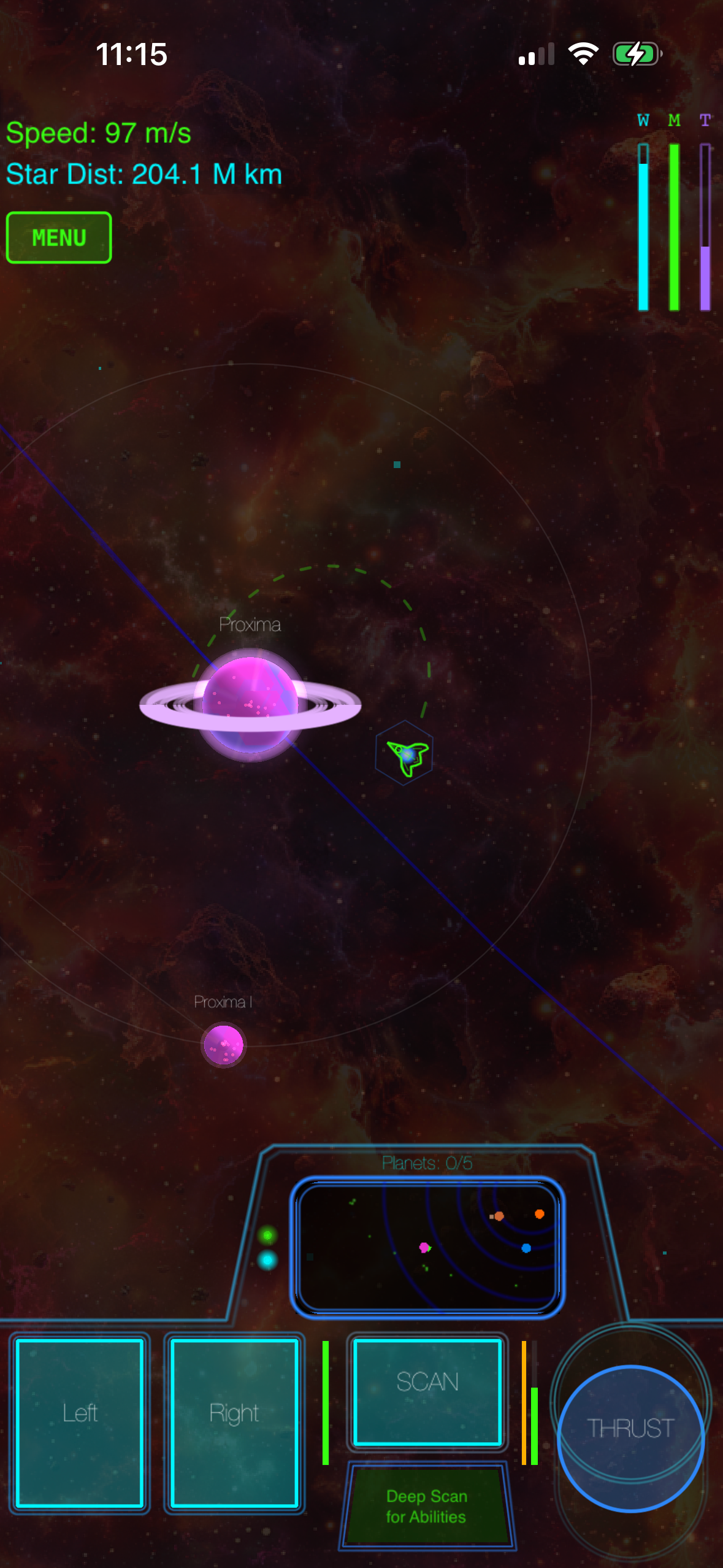
Galaximus is built around a single mechanic: real gravity. Every celestial body—planets, moons, asteroids, even the player ship—obeys actual orbital physics. Your ship isn’t immune to gravity; it’s subject to it. That means every maneuver is a negotiation with the gravity well you’re in.
The payoff is mastery. Once you understand how to use a planet’s gravity to slingshot yourself toward the next system, you’ve internalized something real. You’ve learned a skill that transfers to actual orbital mechanics.
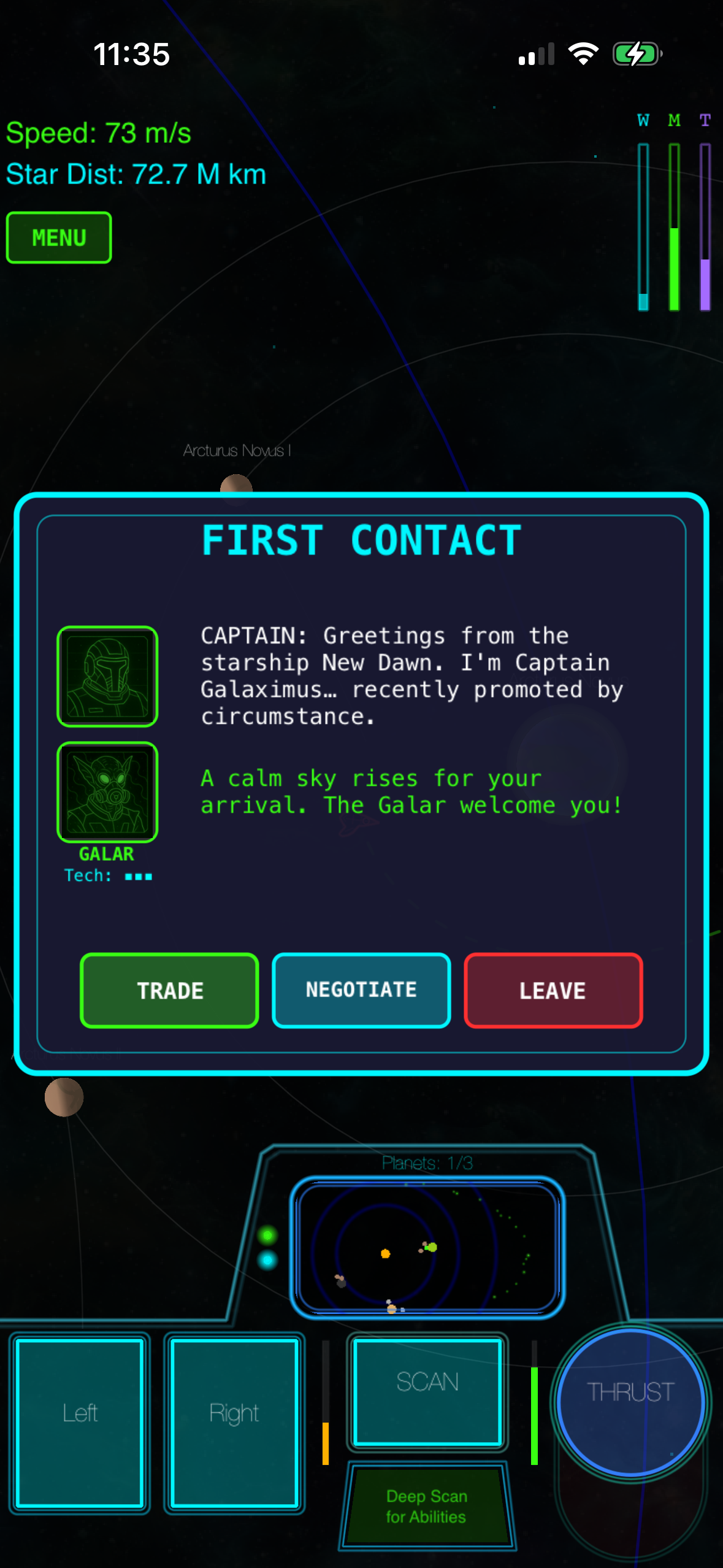
The campaign spans eight procedurally configured star systems. Each playthrough generates unique planet layouts, so the systems feel fresh on replay, but the narrative structure is authored. You’re not waiting for content updates two years after launch. The story has an ending.
Pricing & Availability: on the App Store (iOS 14+). The expansion Infinitum—open-galaxy sandbox, planetary surface exploration, outposts, faction warfare—ships in late 2026. Current buyers at the tier receive Infinitum as a free upgrade when it launches. After Infinitum releases, the combined game moves to a higher price tier.
Kerbal Space Program Mobile: Engineering Over Piloting
Kerbal Space Program (KSP) is the gold standard for space-game depth, and the mobile port delivers the core experience. KSP wants to teach you to be a rocket engineer. You assemble vehicles from parts, plan orbital transfers, manage fuel budgets, and launch from a space center. The learning curve is steep, but the reward is genuine mastery of orbital mechanics at a technical level.
The tradeoff: KSP is engineering-focused. You spend time in menus configuring vehicles. The real-time piloting is only part of the loop. If you want to fly a ship through space, KSP asks you to build one first. That’s not a flaw—it’s the core appeal for players who want to understand rocketry. But it’s different from Galaximus, where piloting is the entire game.
KSP has a dense interface and steep learning curve. You’re looking at hours of tutorials before you launch your first successful mission. Galaximus has a learning curve too—gravity is the interface—but you’re flying within 30 minutes.
Pricing & Availability: on the App Store (iOS 13+). Complete experience at launch; no expansion planned.
No Man’s Sky Mobile: Procedural Exploration at Scale
No Man’s Sky Mobile brings procedural-generation exploration to iPhone. The universe is vast, planets are walkable, and the visual scope is enormous. If the draw is “land on a million different planets and see what you find,” No Man’s Sky is the answer.
Galaximus doesn’t attempt that scale. The campaign is eight systems with a narrative arc, not an infinite universe. The trade is intentional: a complete story rather than a sandbox that feels incomplete at launch.
Pricing & Availability: on the App Store (iOS 15.4+). Available in most regions as of July 2026, but check your App Store to confirm current availability in your location.
Asteroids-Style Games: The Arcade Lineage
If the appeal is simpler—vector graphics, fast arcade action, no learning curve—there are descendants of the original Asteroids that deliver exactly that. They’re faster to pick up, simpler to master, and require no orbital-mechanics knowledge.
These games are genuinely good at what they do. The tradeoff is depth. You’re not learning anything transferable about real physics. The game is about reflexes and pattern recognition, not about understanding gravity. Both are legitimate. It depends on whether you want a 5-minute arcade session or a 30-minute learning experience that pays off for hours afterward.
See Modern Asteroids Games for iPhone: Vector Graphics Revival for a deeper look at that category.
What to Look for in a Premium Space Game
No ads or energy timers. This is non-negotiable. If the game interrupts itself to show you an ad, or if you hit a wall where you can’t play for four hours, it’s not premium—it’s free-to-play with a paywall. Galaximus and KSP Mobile have neither. No Man’s Sky Mobile has no ads or energy timers either.
Complete at launch. The game should feel finished when you buy it. Not “this is the foundation and we’ll add content later.” Not “this is early access.” A complete campaign, complete mechanics, complete experience. Galaximus has an 8–12 hour narrative arc with an ending. KSP Mobile ships with a full career mode and sandbox. No Man’s Sky Mobile is playable indefinitely. Asteroids-style games are complete arcade experiences.
Respects your time. Premium games are shorter than free-to-play games, and that’s intentional. A 10-hour campaign you can finish in a week is better than a 200-hour grind that takes a year. Quality over volume. Galaximus delivers this explicitly; KSP Mobile’s career mode is finite; No Man’s Sky is open-ended but doesn’t demand daily logins.
Matches your play style. If you have 30 minutes a day, a game that demands 2-hour sessions is a bad fit. If you want to learn something, a pure arcade game won’t deliver. Know what you’re looking for before you buy.
FAQ
Do I need to know orbital mechanics to play Galaximus? No. The game teaches you as you play. The first 30 minutes are guided; you learn by doing. If you’ve never heard of a gravity slingshot, Galaximus will show you how one works in real time. The learning curve is real, but it’s intentional—mastery is the payoff.
Can I play these games offline? Yes. Galaximus, KSP Mobile, and No Man’s Sky Mobile all work completely offline. No internet required. This is a key advantage of premium games over free-to-play—no server dependency, no login walls, no connectivity checks. You own the game and can play it anywhere.
How long is the Galaximus campaign? A single playthrough takes 8–12 hours depending on your playstyle. Procedural configuration means replays feel different. There’s no “endgame” grind; the story has an ending, and that’s the goal.
Is Galaximus harder than Kerbal Space Program? Different kind of hard. KSP is harder to learn—the interface is complex and the systems are deep. Galaximus is harder to master—the controls are simple but gravity is unforgiving. If you want to understand rocketry, KSP is the deeper experience. If you want to fly well under pressure, Galaximus demands more precision.
Which game should I buy if I only have? Start with Galaximus . It teaches real orbital mechanics, has a complete campaign, and includes the Infinitum expansion free when it launches. If you want deeper engineering systems after that, KSP Mobile is the next step.
The Bottom Line
Premium space games on iPhone in 2026 are rare, which means the ones that exist are worth taking seriously. Galaximus delivers real gravity and a complete narrative arc. Kerbal Space Program offers engineering depth. No Man’s Sky brings procedural exploration at scale. Asteroids descendants give you fast arcade action.
The choice depends on what you want from a space game. But whichever direction you lean, the advantage of buying premium is clear: you own the full experience, no ads interrupt you, and no timer tells you to come back tomorrow. You pay once and play as much as you want.
For more on premium games without ads or IAP, see Premium iPhone Games No Ads No IAP: Space Focus. For a broader look at space games in 2026, check Best Paid Space Games iPhone 2026: Updated Rankings.