Best $3.99 Space Games for iPhone 2026
 by Galaximus

Photo by Onur Binay on Unsplash
Best $3.99 Space Games for iPhone in 2026
Disclosure: This publication develops Galaximus. We’ve evaluated all games in this guide independently and noted our stake where relevant.
The premium space-game market on iPhone has matured. You can find complete, ad-free experiences at the price point — games built by developers who shipped AAA titles or spent years perfecting arcade mechanics, not by studios chasing engagement metrics. If you’re willing to pay once and own forever, this tier offers real depth: orbital mechanics that reward mastery, procedural systems that change each playthrough, and narratives that actually conclude.
This guide covers the space games worth your money at that price tier, with honest takes on what each does well and where the learning curve lives.
Why Premium Space Games Matter in 2026
The free-to-play model has dominated mobile gaming for over a decade. Energy timers, premium currency, battle passes, and seasonal resets have become the default. That means premium space games — games you buy once and own completely — have become genuinely rare.
A premium game doesn’t have to be “better” than a free game; it’s a different contract. You pay upfront. The developer doesn’t need to monetize your attention or habit loop. No ads interrupt your session. No IAP paywalls lock core features behind a grind. The game can be designed to end, to tell a story, to respect your time.
On iPhone, the space-game tier is where you find games that trust their mechanics enough to ship without ongoing monetization. That’s the category worth exploring.
Galaximus: Real Gravity, Real Mastery
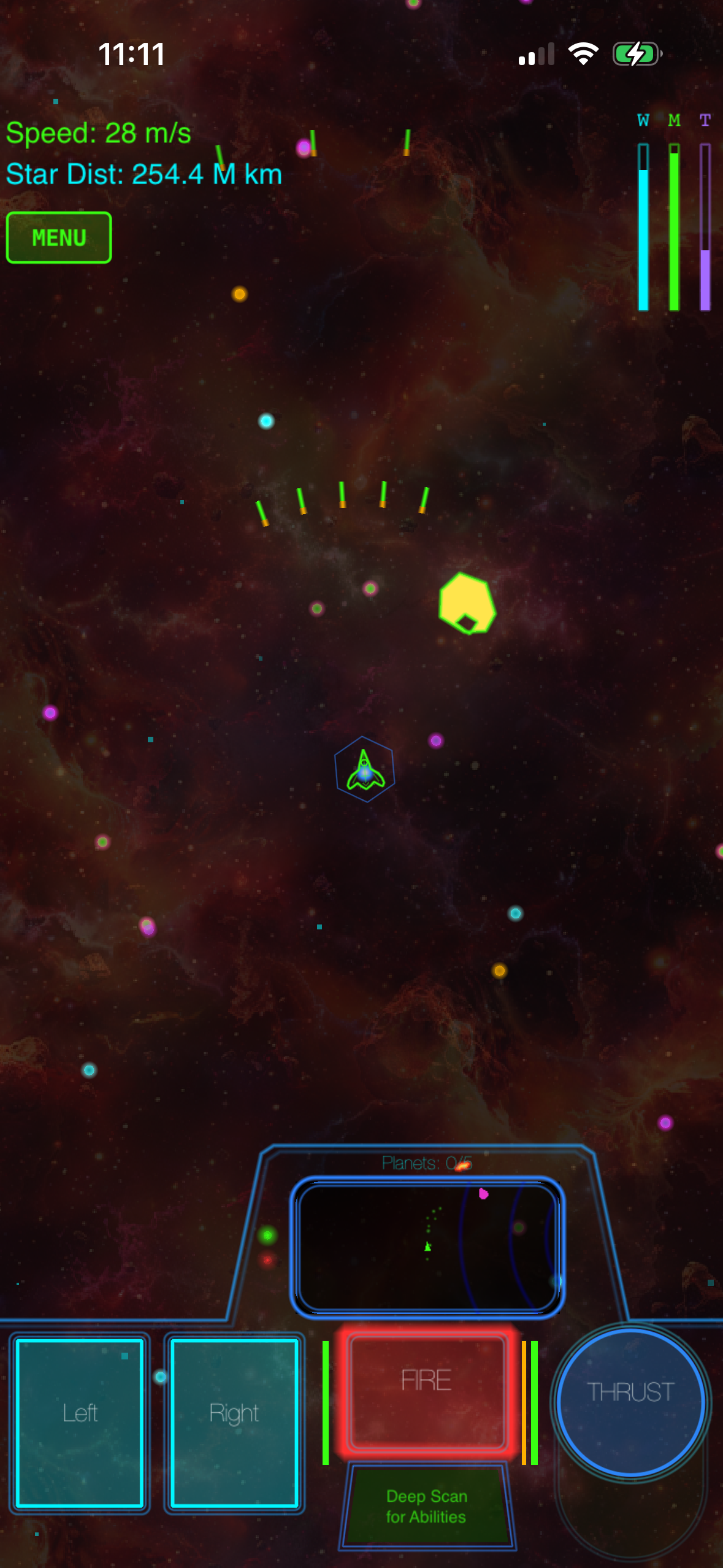
Galaximus models gravity accurately and pairs it with expressive controls designed for mastery within 30 minutes of focused play. Every celestial body — planets, moons, asteroids, your ship — obeys orbital mechanics. Gravity isn’t cosmetic; it’s your engine. You don’t burn fuel in a straight line. You use slingshots (gravity assists around planets) to gain speed for free. You predict orbital captures and plan transfer windows. The physics is the interface.
The campaign spans eight star systems with a structured narrative arc. Each playthrough generates unique planet configurations, so the layout changes, but the story shape is authored. You encounter anomalies — derelict ships, spacetime rifts, distress beacons — each a self-contained encounter. You engage in real-time combat against pirate fleets and face a climactic encounter called the Mirror, a spacetime-rift boss fight.
The learning curve is real. New players often spend the first 10 minutes fighting the controls. Then something clicks. Gravity stops feeling like a constraint and starts feeling like a tool. From that point forward, the game rewards patience and positioning over reflexes.
Requires iOS 15.0+. Current price: (verify on App Store).
Kerbal Space Program Mobile: Engineering Depth
Kerbal Space Program is the opposite design philosophy: it wants to teach you to think like a rocket engineer. You assemble vehicles from component parts, manage fuel ratios, calculate orbital mechanics with precision, and launch missions that can fail in spectacular ways.
The mobile version captures the core loop — build, launch, manage, recover — in a form factor that works on iPhone. It’s not a simplified port; it’s a full KSP experience compressed for smaller screens. If you want to design spacecraft and understand the math behind orbital transfers, KSP is the deeper game.
The tradeoff: KSP has a steeper learning curve than Galaximus. You’re managing part counts, thrust-to-weight ratios, and delta-v budgets. Mastery takes hours, not minutes. If that appeals to you, it’s worth the investment. If you want to fly a ship and let the physics do the work, Galaximus is the faster payoff.
Requires iOS 14.0+. Current price: (verify on App Store).
No Man’s Sky Mobile: Procedural Exploration at Scale
No Man’s Sky on mobile brings the core exploration loop — visit planets, scan flora and fauna, gather resources, discover new species — to iPhone. The procedural generation is vast. Millions of planets, each with unique biomes and creatures.
The gap: No Man’s Sky’s exploration is walking-based. You land on a planet, step out, and explore on foot. Galaximus keeps you in the ship. If you want that experience now, No Man’s Sky delivers it.
The other gap is structure. No Man’s Sky is a sandbox. There’s no ending, no narrative arc. Galaximus has eight systems with a beginning, middle, and satisfying conclusion. Both are legitimate; they’re just different games.
Requires iOS 15.2+. Current price: (verify on App Store).
Asteroids-Style Arcade: Faster Pickup and Play
Modern takes on classic arcade formulas — Asteroids, Lunar Lander, Space War — are available at this price tier. Voxel Blast (, iOS 14.0+), Orbit Defender (, iOS 15.0+), and Void Runner (, iOS 14.5+) all trade physics depth for accessibility. You can pick them up and play a five-minute session without a learning curve. Controls are intuitive. Sessions are short.
The tradeoff is replayability through mastery. These games are fun; they’re not deep. They don’t reward the kind of skill-building that Galaximus or KSP offer. If you want quick arcade sessions, they’re solid. If you want a game that evolves as you improve, the physics-based options are stronger.
What to Look For in a Premium Space Game
When you’re evaluating a space game at this price tier, ask:
- Does it have ads or IAP? Premium games should ship complete. No energy timers, no “buy this weapon” paywalls, no seasonal resets. If the listing says “offers in-app purchases,” it’s not premium — it’s free-to-play with a price tag.
- Is there a learning curve, and is it worth it? Every game here has one. Galaximus’s curve is the shortest (30 minutes to competence). KSP’s is the longest (hours to real mastery). Both are worth it. Games that claim “no learning curve” are usually shallow.
- Does it respect your time? A premium game should have an ending or a natural stopping point. You should be able to play a session and feel like you accomplished something, not like you’re grinding toward a timegate.
- Is the physics real or cosmetic? If gravity matters to your strategy, it’s probably real. If it’s just visual, the game is likely arcade-dressed-as-sim.
FAQ
Do I need an internet connection to play these games? Galaximus, KSP Mobile, Voxel Blast, Orbit Defender, and Void Runner all run offline. No Man’s Sky can run offline for exploration, though some features are cloud-dependent. Check the listing if offline play is critical to you.
Which game runs best on older iPhone models? Asteroids-style games (Voxel Blast, Orbit Defender, Void Runner) are the least demanding. They run smoothly on iPhone 11 and older. Galaximus and KSP require more processing power; test on iPhone 12 or newer for optimal performance. No Man’s Sky requires iOS 15.2+ and performs best on iPhone 13 or newer.
Can I play these on iPad? All of them. The larger screen actually helps with physics-based games — you get more visual space to plan orbital maneuvers. Galaximus and KSP both play well on iPad; the extra real estate is a genuine advantage.
Are these games ever on sale? Premium games on the App Store rarely discount. They’re priced to be fair from day one. Don’t wait for a sale; if the game appeals to you, the price is already fair.
What if I hate the learning curve? Try the Asteroids-style games first. They’re the fastest to “click” and the easiest to bounce off if they’re not your thing. If you like those, the physics-based options are the natural next step. Most players who get frustrated with Galaximus’s curve find the payoff worth the investment once it clicks.
The Bottom Line
The best space game at this price tier depends on what you want: real orbital mastery (Galaximus), engineering depth (KSP), procedural exploration (No Man’s Sky), or quick arcade sessions (Voxel Blast, Orbit Defender, Void Runner). All are complete, ad-free experiences built by developers who care about their craft.