Paid-Once iOS Space Games: One Purchase, Unlimited Play
 by Galaximus
Paid-Once iOS Space Games: One Purchase, Unlimited Play
In 2026, the free-to-play model still dominates mobile gaming — energy timers, premium currency, battle passes, and ads interrupt almost every title you download. But a segment of premium iOS games breaks that pattern entirely. You pay once at the App Store. The game is yours. No ads. No in-app purchases. No tiers or seasonal content gates. This article covers what that model looks like, why it matters, and which space games deliver it.
Disclosure: We developed Galaximus, a paid-once space game discussed in this article. This piece reflects our design philosophy, but we’ve included comparisons to other titles to help you evaluate options.
The paid-once model isn’t new — it’s how games shipped on consoles and PC for decades. On iPhone, it’s become uncommon enough to feel deliberate. Galaximus is built around that principle: a complete space exploration game where mastery of real orbital mechanics is the only progression mechanic, unlocked through play, not payment.
Get Galaximus on the App Store: — Get it on the App Store
Why Paid-Once Games Matter
Free-to-play games have a math problem: they need to extract revenue from a small percentage of players, which means the monetization layer has to be aggressive enough to work. Energy systems, cosmetics tied to progression, limited-time events, seasonal battle passes — these aren’t bugs. They’re the product. The game is the vehicle for the monetization.
Paid-once games invert that. The game is the product. The monetization is the transaction at the start — you pay, you own it, you’re done. No dark patterns. No surprise paywalls mid-campaign. No artificial time gates designed to make you spend to skip them.
On iPhone, this matters because you’re holding a device you use constantly. Ads that interrupt gameplay aren’t just annoying — they’re friction in a device designed for seamless interaction. In-app purchases that unlock core mechanics aren’t cosmetics — they’re gating the game you paid for behind additional paywalls. Paid-once games respect that boundary.
The tradeoff is real: paid games have a smaller addressable market than free-to-play. You’re asking the player to commit money before they’ve tried the game. That means the game has to be good enough to justify the ask, and the description has to be honest about what you’re getting.
What “Paid Once” Actually Means
The term covers a spectrum. At one end, it’s a flat purchase with zero additional costs. At the other, it’s a game with a premium tier that includes cosmetics or convenience features available for purchase later. For this article, we’re focusing on the former: games where the campaign, all core mechanics, and all meaningful progression are included in the initial purchase.
The model also assumes the game is complete at launch. Not “early access.” Not “soft launch in one region, full launch in six months.” The game you pay for is the game you get on day one. Updates may add features, but they’re additions to a finished product, not completion of a half-shipped title.
Core Mechanics: Gravity as Engine
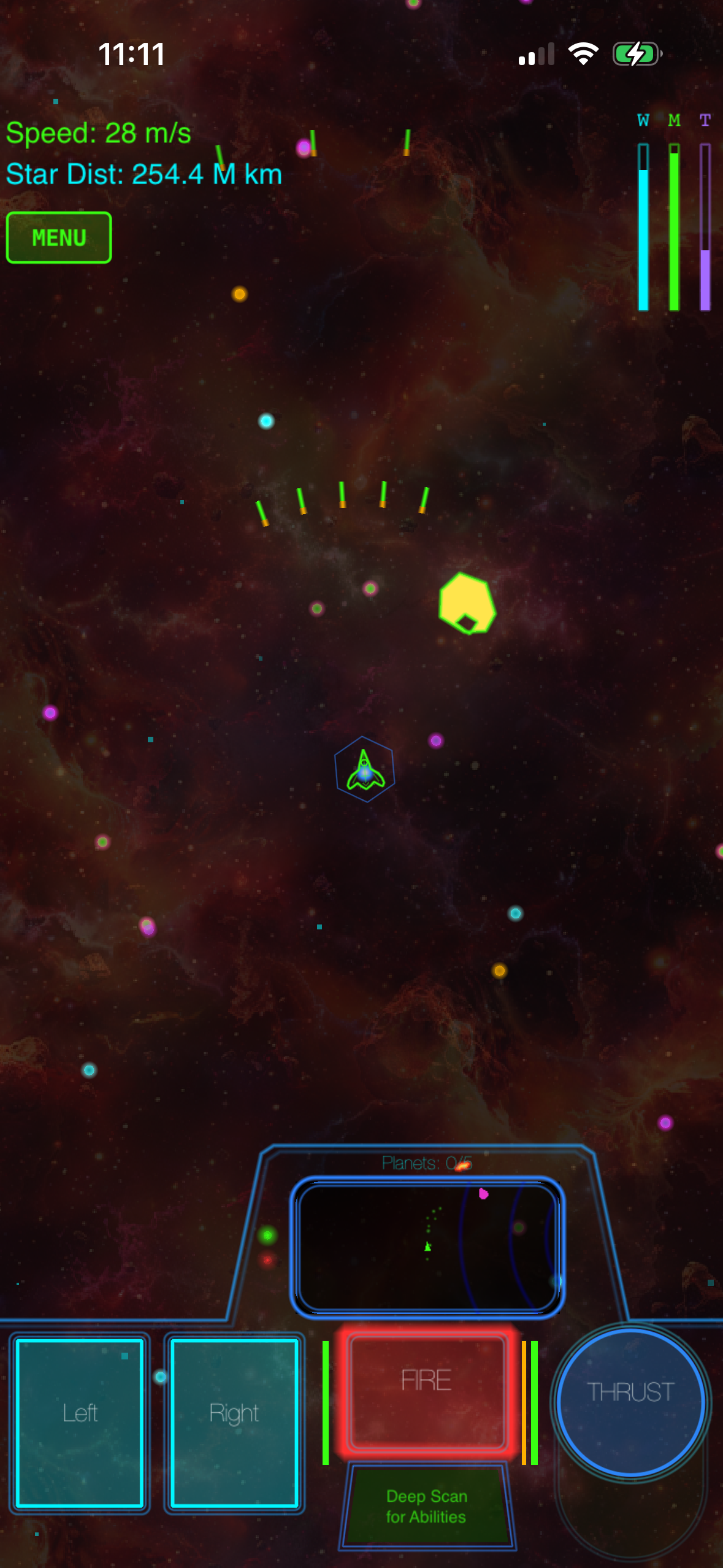
Paid-once space games on iOS tend to cluster around two design philosophies: arcade-action with real physics underneath, or deep simulation with accessible controls. Galaximus sits in the first camp. The ship responds to thrust input and gravity in real time — planets pull you, asteroids tumble through the gravity wells, slingshot maneuvers work because the physics is accurate. But you’re not building rockets or calculating transfer windows. You’re flying.
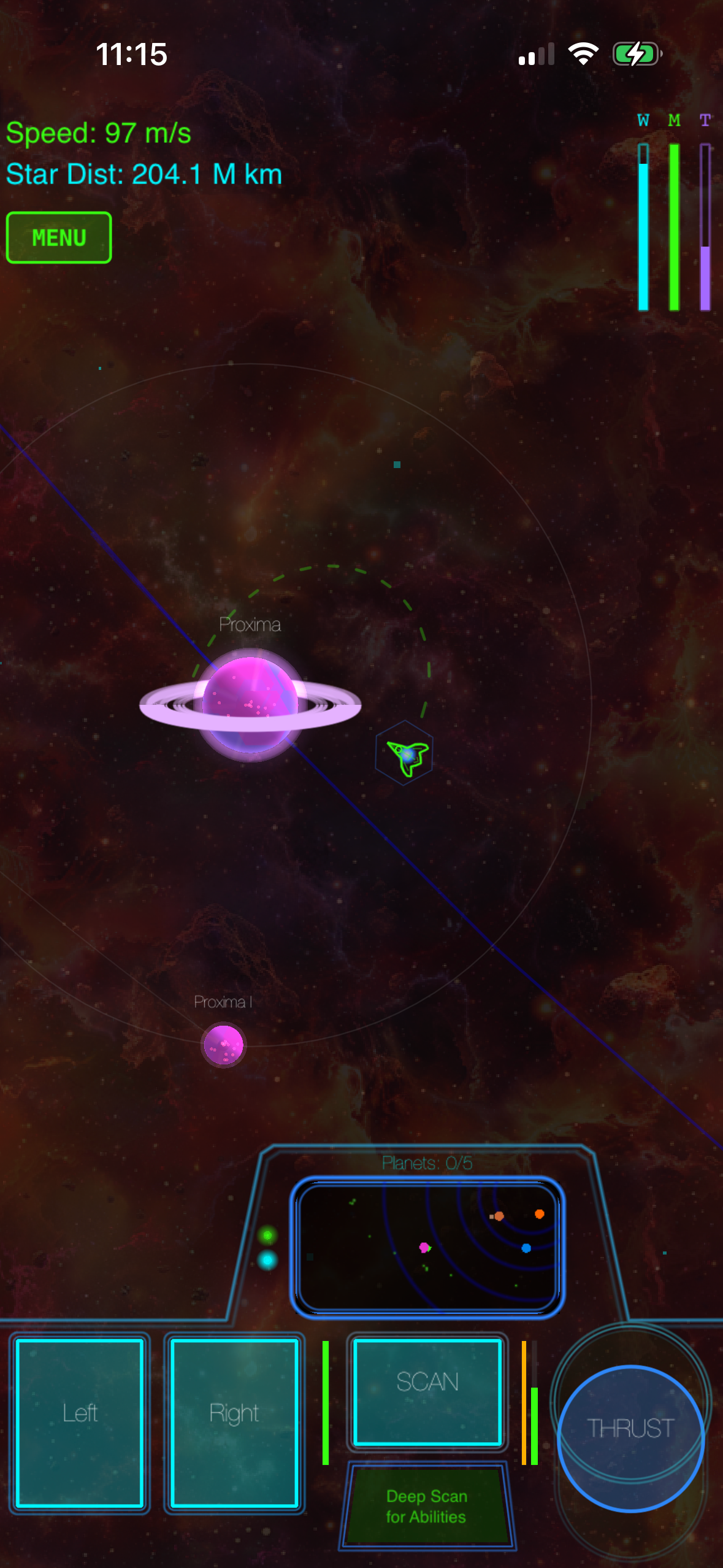
The learning curve is the honest tradeoff here. Real gravity means real consequences. A player used to games where thrust is a simple vector will find themselves overshooting planets and needing to replan their approach. Thirty minutes of focused play and the controls reward patient positioning over twitch reflexes. Two hours in, you’re executing maneuvers that feel impossible to a new player.
Campaign Structure vs. Sandbox
Paid-once space games split into two narrative shapes: authored campaigns with a beginning, middle, and end, or procedural sandboxes that generate new content indefinitely.
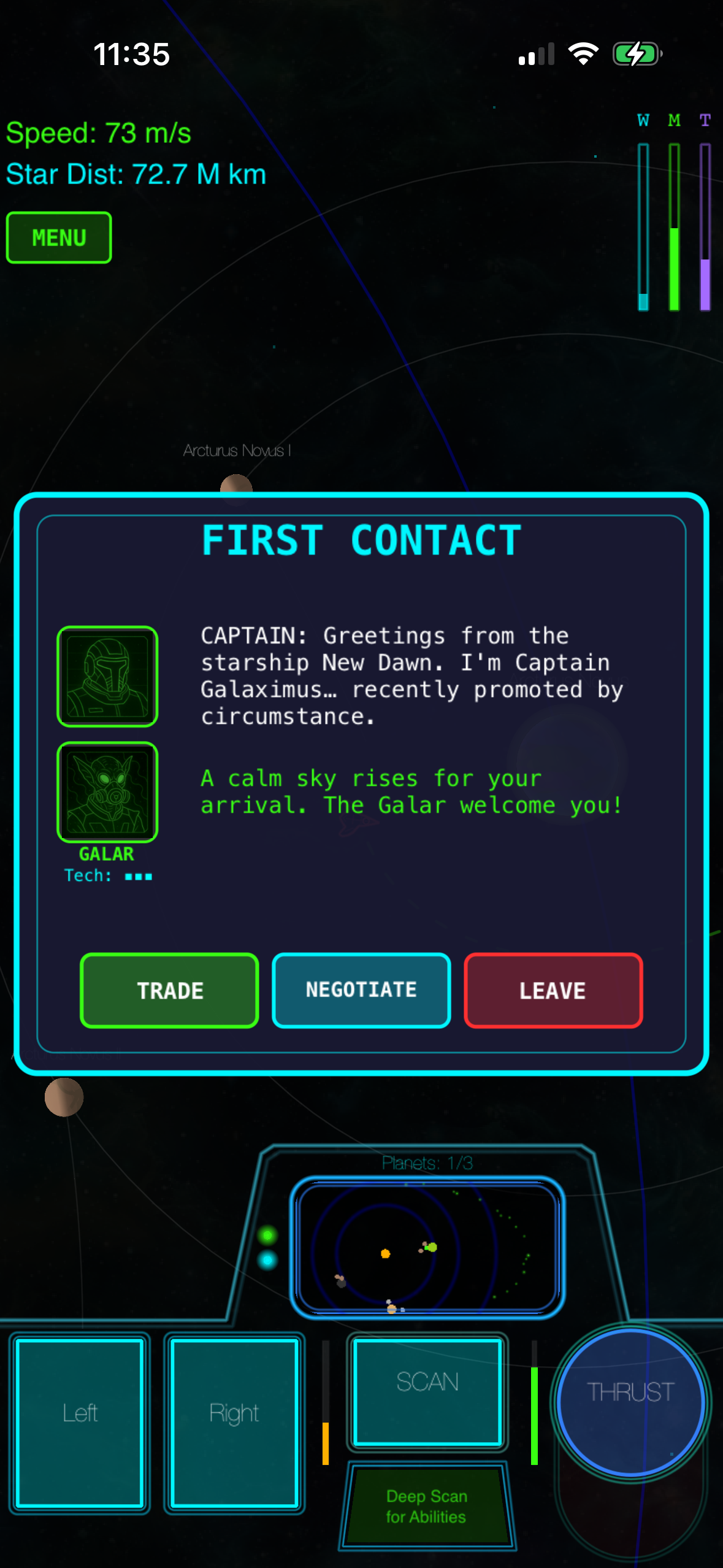
Galaximus uses the first approach. Eight procedurally configured star systems with a full story arc. You begin in one system, discover why the previous explorer disappeared, and work through a sequence of encounters that build toward a climax. The procedural generation means each playthrough has unique planet positions and configurations, but the narrative shape is authored. You know when you’ve finished the game.
The advantage: the game respects your time. You can complete it in a single session or across a week of play. You’re not chasing an endless content treadmill. The disadvantage: once you’ve seen the story, the replay incentive depends on the procedural variation and the difficulty curve.
Sandbox games — procedurally generated open galaxies with no end condition — offer the opposite tradeoff. No Man’s Sky (, also on iOS) exemplifies this approach: infinite content, but no narrative closure. Both are legitimate; the question is which fits your play style.
Procedural Audio: Sound Design as Differentiator
Most space games ship with pre-recorded sound files — laser blasts, explosions, engine burns. Galaximus generates every sound in real time via procedural synthesis. Every laser, every explosion, every alien voice is synthesized on the device as it plays.
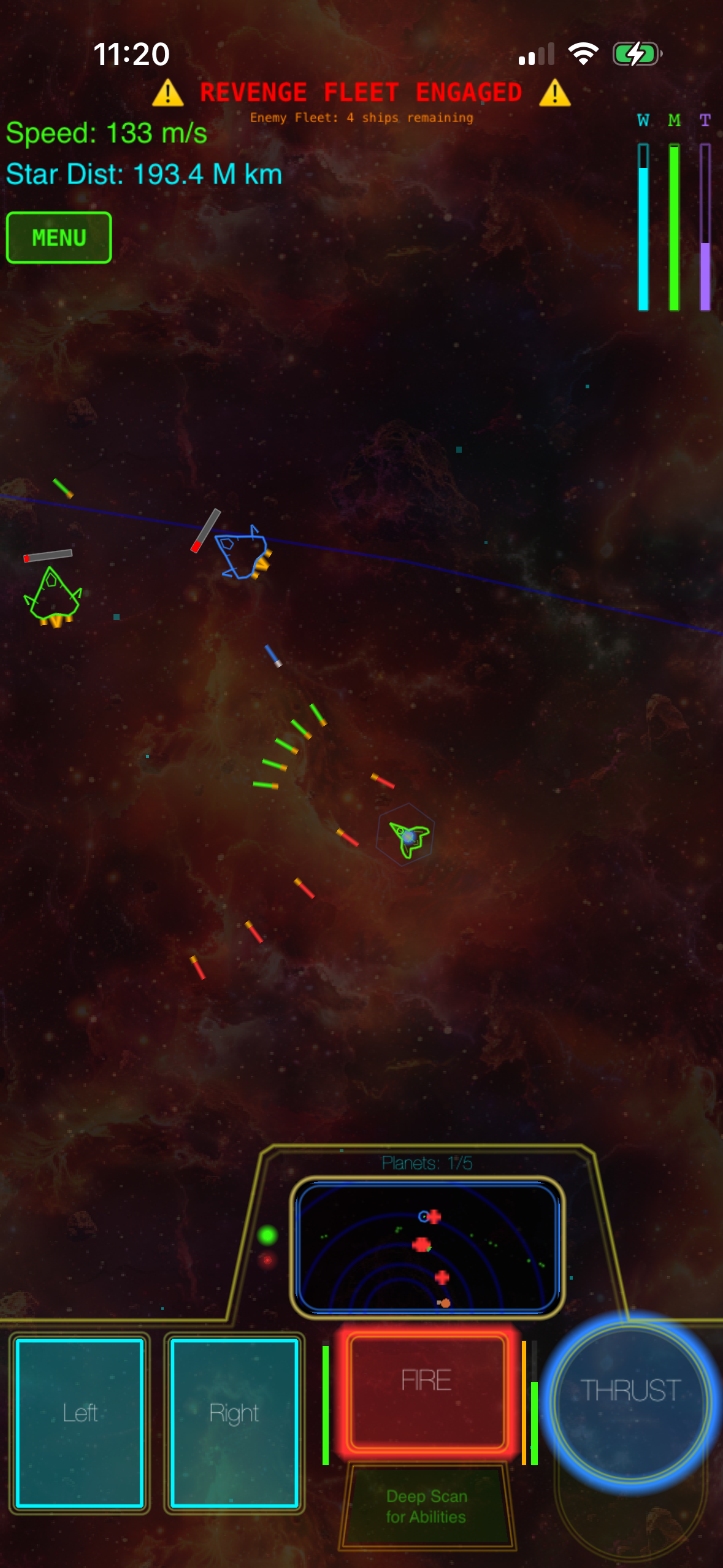
This approach ties the sound design to the vector-arcade visual style — everything feels generated, consistent, intentional. Practically, it means the audio is never a bandwidth bottleneck and the game’s audio footprint is minimal.
Comparison to Alternatives
If you’re deciding between paid-once space games, here’s what each does well:
Kerbal Space Program ( on desktop; mobile version on iOS) is deeper on rocketry than Galaximus. KSP teaches you to be an engineer — you design and assemble rockets, manage resources across complex subsystems, and learn orbital mechanics through experimentation. Galaximus teaches you to fly a ship. Different games, both legitimate. KSP is the choice if you want to spend hours optimizing a launch sequence. Galaximus is the choice if you want to master a control scheme and execute maneuvers under pressure.
No Man’s Sky ( on iOS, also available on PlayStation, Xbox, PC) includes procedural planet exploration at a scale Galaximus doesn’t attempt. Walking on a planet surface is core to NMS’s identity. Galaximus is adding surface landing in the Infinitum expansion, but it’s a feature addition, not the primary focus. If planetary surface exploration is your main draw, NMS delivers that at a larger scale.
Asteroids-style arcade games on iOS (e.g., Asteroids Plus, ) are simpler to pick up and play in short sessions. If you want five-minute arcade gameplay with no learning curve, those fit better than Galaximus. The tradeoff is that they don’t have the depth of campaign or the physics-based mastery that Galaximus offers.
Quick Pick: Space Games by Scenario
| Scenario | Best Choice | Price | Why |
|---|---|---|---|
| Learning orbital mechanics | Galaximus | Real physics, focused campaign, arcade-friendly controls | |
| Engineering deep dives | Kerbal Space Program | (iOS) | Rocket design, subsystem management, experimental learning |
| Planetary exploration | No Man’s Sky | (iOS) | Procedural planets, surface walking, infinite content |
| 5-minute sessions | Asteroids Plus | Arcade action, no learning curve, instant gratification | |
| Offline play | Galaximus | Fully on-device, no backend required, complete campaign |
Why Premium Model Matters for Space Games Specifically
Space games benefit from the paid-once model in specific ways. The genre demands precision — orbital mechanics don’t work if the game is interrupted by ads or if core mechanics are gated behind paywalls. A slingshot maneuver requires focus and timing. An ad break in the middle destroys that.
Progression in space games should come from mastery, not from grinding or paying to skip grind. Paid-once space games sidestep that entirely — progression is purely mechanical.
The genre also scales well to offline play. A space game doesn’t need live servers or constant connectivity. You can play on an airplane, in a subway, or anywhere without internet. Paid-once games lean into that — the entire experience is on-device, no backend required.
Building a Library Without Subscriptions
If you’re committed to the paid-once model, you’re building a library of games you own outright, not renting through a subscription service.
First, your library doesn’t evaporate if you cancel a subscription. Apple Arcade is convenient — zero friction, one monthly fee, access to a curated set of games. But if you stop paying, you lose access to everything. With paid-once games, you own them indefinitely.
Second, you’re not locked into one platform’s ecosystem. A paid-once game on the App Store is yours on your iPhone. You’re not dependent on Apple’s curation or business decisions.
Third, paid-once libraries encourage completion. Because you’re not paying monthly, there’s no incentive to play as many games as possible to “get your money’s worth.” You can play one game deeply, finish it, and move on.
How to Evaluate a Paid-Once Space Game Before Buying
Since you can’t try a paid game for free, the evaluation has to happen before purchase.
Read the description carefully. A good description tells you the campaign length, the core mechanic, and the learning curve. It doesn’t oversell.
Watch the preview video on the App Store. Thirty seconds of actual gameplay tells you the visual style, the control scheme, and the pacing.
Check the reviews, but weight them carefully. Paid games get more critical reviews because players paid for them — expectations are higher. Look for patterns. If multiple reviews mention a steep learning curve, that’s honest feedback. If multiple reviews say the game is broken or unfinished, that’s a real problem.
Understand the tradeoff you’re making. Paid-once games are smaller in scope than free-to-play games with the same budget. The developer chose to ship a focused experience rather than stretch the scope and monetize it. That usually means the game respects your time and your wallet.
Check for physics-specific signals in space games. Does gravity affect the ship’s trajectory? Can you use planetary gravity for slingshot maneuvers? Are orbital mechanics simulated or faked? These details separate games that teach you how space actually works from games that use space as a cosmetic backdrop.
The Galaximus Infinitum Expansion
We’re shipping a major expansion called Galaximus Infinitum in late 2026. It adds open-galaxy sandbox exploration, planetary surface landing (Battlezone-style wireframe 3D), outpost building, faction warfare, and a home-planet rebuild mechanic.
Players who buy Galaximus at the current launch-price tier receive Infinitum as a free upgrade. After Infinitum ships, the combined game moves to a higher price tier; early adopters get the expansion at no extra cost. This is a real, time-limited offer — if you’re considering the purchase, buying now locks in the free upgrade.
FAQ
Can I refund a paid game if I don’t like it?
Apple allows refunds within 14 days of purchase if you haven’t used the app extensively. After that, refunds are case-by-case. Watch the preview video, read reviews, and make sure the description matches what you want before you buy.
Are paid-once games ever abandoned?
Yes. Smaller developers sometimes stop supporting a game after launch. The good news: the game still works. You own it. It’s not dependent on a live service or backend. Even if the developer stops updating it, you can still play the campaign.
Will Galaximus work offline?
Yes. The entire game runs on-device. No internet required.
What’s the difference between Galaximus and Kerbal Space Program?
Kerbal is a rocketry engineering simulator. You design, build, and launch rockets. Galaximus is an arcade-action game where you fly a ship and use real gravity as your engine. Kerbal if you want to be an engineer. Galaximus if you want to be a pilot.
The Case for Paid-Once Games
The paid-once model won’t dominate mobile gaming. Free-to-play monetization is too profitable. But for players who want a complete, uninterrupted game experience — one where progression comes from skill, not spending — paid-once games are the only option.
Space games especially benefit from that model. The genre demands precision, focus, and the ability to play offline. Ads break that. In-app purchases that gate mechanics break that. Paid-once games align the incentives: the developer makes money when the game is good, not when it’s addictive or monetizable.
Galaximus is built on that principle. One purchase . Eight systems. A complete campaign with real orbital mechanics, procedurally generated encounters, and a story that has an ending. No ads. No IAP. No battle pass. Just a space game that respects your time and your wallet.
Get Galaximus on the App Store: — Get it on the App Store