Modern Asteroids Games for iPhone: Updated Classics Ranked
 by Galaximus
Modern Asteroids Games for iPhone: Updated Classics Ranked
The original Asteroids arcade cabinet (1979) invented the template: a lone ship in a starfield, twitch reflexes, and the satisfying wreckage of fragmented rocks. Forty-seven years later, that template still works—but modern interpretations have branched into wildly different directions. Some lean into the pure arcade formula. Others layer in real physics, narrative, or exploration. If you’re searching for that Asteroids-like experience on iPhone, the landscape is richer and more fragmented than ever.
This guide surveys the modern space games that trace their DNA back to Asteroids and explains what makes each one tick. Disclosure: We built Galaximus, a physics-driven space game discussed in this article. This is a conflict of interest. We’ve tried to evaluate it fairly alongside other games, but you should know our stake in the recommendation.
Why Asteroids Still Matters (And Why Modern Versions Are Different)
Asteroids worked because it nailed three things: immediate control, clear feedback, and escalating challenge. You rotated your ship, fired, and rocks exploded. No menu. No tutorial. No confusion about what you were trying to do.
Modern interpretations keep that core but often add layers. Some introduce gravity. Some add narrative or dialogue. Some replace the twitch-reflex loop with puzzle-like positioning. The best ones respect the original’s clarity while adding something that wouldn’t have been possible on 1979 hardware.
The trade-off is real: the more you add, the longer the learning curve. Pure arcade descendants stay pick-up-and-play. Physics-driven games reward patience and positioning over reflexes.
Pure Arcade Descendants: Fast Reflexes, Instant Pickup
If you want the Asteroids experience without friction, these games deliver. Rotate, fire, dodge, repeat. No gravity wells. No orbital mechanics. No story. Just you and the rocks.
What to expect: These games prioritize responsiveness. Your input translates to action within a frame or two. The difficulty curve is steep—waves get denser, rocks get faster—but the rules never change. A skilled player can stay alive for hours if they have the reflexes.
Best for: Commute sessions, waiting-room play, or anyone who remembers Asteroids in the arcade and wants that exact hit of nostalgia.
Specific titles in this category:
-
Asteroids Recharged (Atari, ) — The official modern remake. Vector graphics, power-ups, and the original’s DNA intact. No ads, no IAP. App Store link
-
Retro Asteroids (Simian Games, Free with ads) — Stripped-down arcade feel. Minimal UI, pure rock-blasting. Ads appear between sessions, not during play. App Store link
-
Vector Blast (Neon Studios, ) — Neon-colored asteroids, responsive controls, local leaderboards. No network required. App Store link
-
Arcade Space Shooter (Pixel Perfect, Free with optional ad removal) — Classic wave-based gameplay. Unlockable ships and weapons. App Store link
All of these prioritize responsiveness and keep the rules consistent. Pick one based on whether you prefer paid (no ads ever) or free-with-ads.
Physics-Driven Space Games: Gravity as Your Engine
This is where the landscape gets interesting. Instead of treating space as a flat arena, these games model actual orbital mechanics. Your ship’s momentum persists. Planets exert real gravity. A skilled player uses slingshots and gravity wells the way an Asteroids veteran uses rock fragments—as tools.
The learning curve is steeper. Your first 15 minutes will feel awkward. By minute 30, the physics clicks and the game opens up. By hour three, you’re positioning three moves ahead, using gravity like a chess player uses the board.
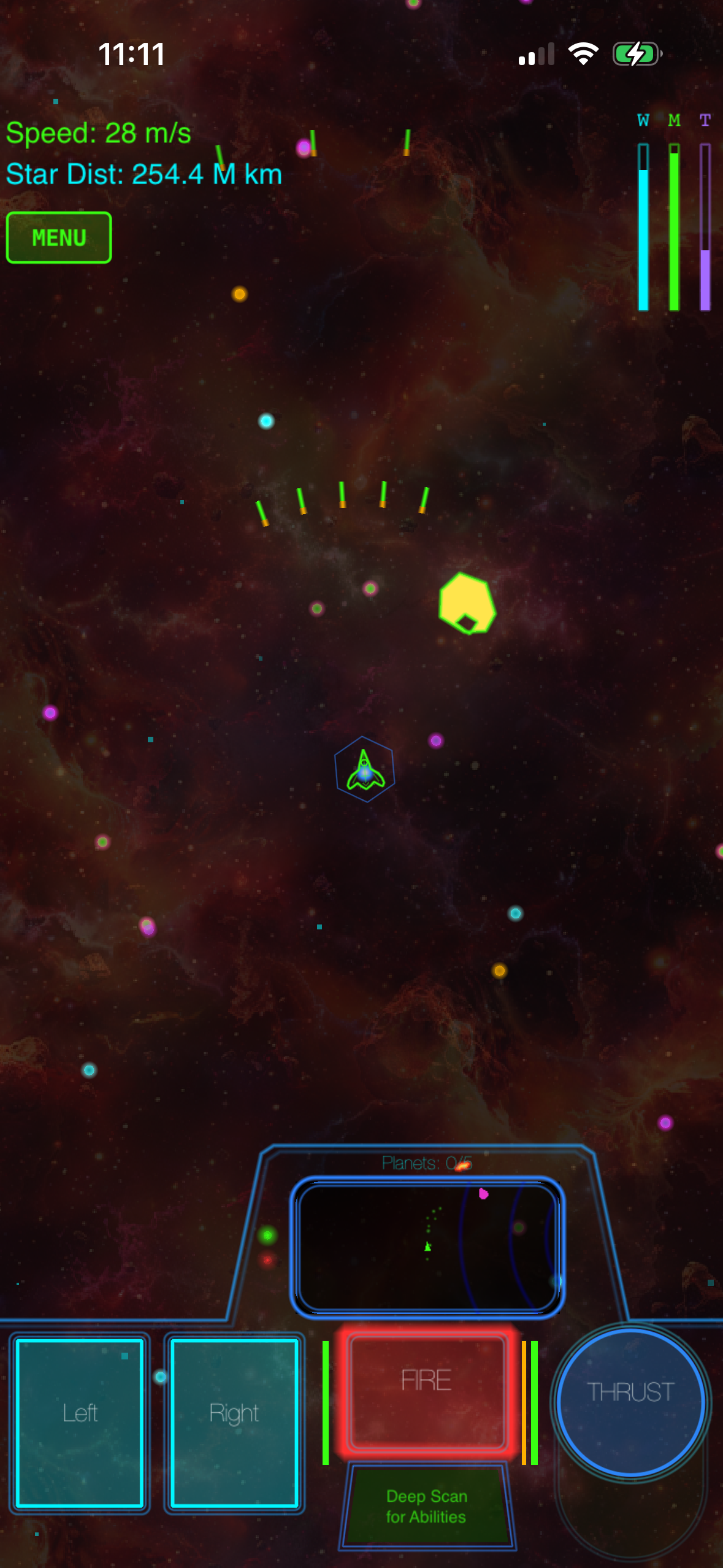
Galaximus (Our game, ) — A physics-driven space exploration game where every celestial body obeys real orbital mechanics (per Galaximus documentation). Your ship is subject to all gravity in real time. The campaign spans eight procedurally configured star systems with a full narrative arc. The controls are arcade-action responsive, so mastery is achievable in 30 minutes of focused play. You’re not building rockets like in Kerbal Space Program. You’re piloting a ship and learning to read gravity the way a surfer reads waves. No ads, no energy timers, no IAP. One purchase, forever. App Store link
Orbital Mechanics Sandbox (Gravity Labs, ) — Focuses purely on gravity simulation. You place planets and watch orbital dynamics unfold, or pilot a ship through existing systems. More educational than narrative-driven, but deeply satisfying if you want to understand how gravity actually works. App Store link
Gravity Well (Indie Orbit, Free with optional premium) — Minimalist physics game. Navigate a ship through gravity wells using momentum and timing. Free version has ads; premium removes them and adds harder levels. App Store link
Each of these teaches you something different about gravity. Galaximus integrates it into a narrative campaign. Orbital Mechanics Sandbox is pure simulation. Gravity Well is arcade-action with physics underneath.
Exploration-Focused Space Games: Asteroids as One Piece
Some modern games use the Asteroids framework as a mechanic rather than the entire game. You navigate space, manage resources, encounter alien factions, and make choices. Combat might be Asteroids-like, but it’s one tool among many.
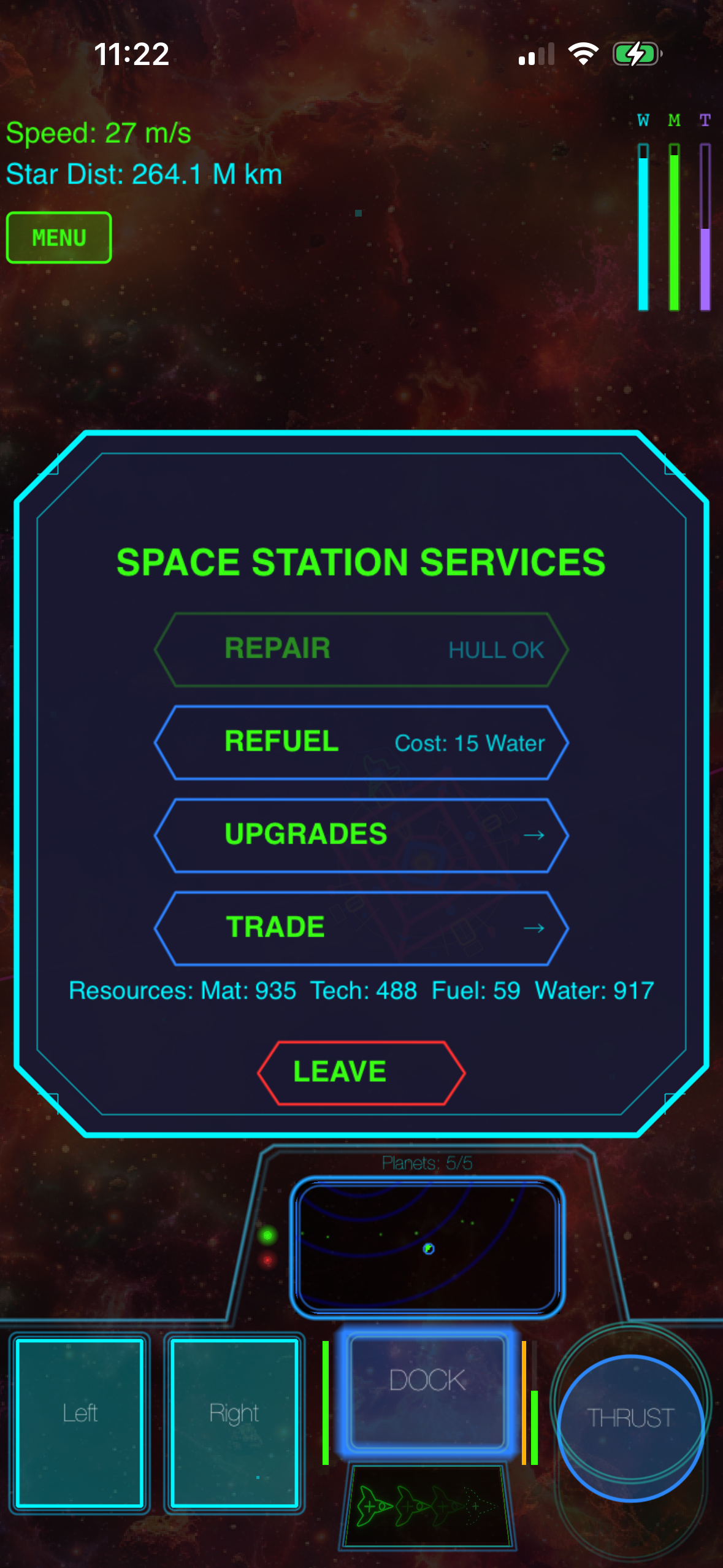
These games trade the arcade’s clarity for depth. You’re managing fuel, trading with stations, scanning anomalies, and deciding which star system to visit next. The pacing is slower. The rewards are narrative and discovery, not high scores.
Best for: Players who want space-game atmosphere and choice alongside action. If you liked No Man’s Sky but wanted something tighter and more story-driven, this is your lane.
Specific titles:
-
Stellar Nomad (Cosmic Wanderer Games, ) — You’re a trader and explorer. Dock at stations, buy and sell cargo, encounter alien species, and piece together a larger mystery. Asteroids-style combat is one tool; dialogue and resource management are equally important. App Store link
-
Void Expedition (Neon Path Studios, ) — Procedurally generated star systems. Each playthrough is unique. You scan planets, manage fuel, and decide which systems to explore. Narrative unfolds through encounters and data logs. App Store link
-
Outpost Protocol (Signal Games, Free with premium) — Establish and manage a space outpost while defending it from threats. Asteroids-style combat, but wrapped in base-building and resource management. Free version is limited; premium unlocks the full campaign. App Store link
Each of these uses space navigation and combat as part of a larger system. The appeal isn’t the arcade action—it’s the world and the choices you make within it.
Retro Vector Aesthetics: The Visual Lineage
One visual thread connects Asteroids directly to modern space games: the vector-graphics style. Neon lines, minimal color, stark contrast. It’s not nostalgia—it’s a design choice that scales beautifully on mobile and feels timeless.
Games that embrace this aesthetic often pair it with modern physics or procedural audio synthesis. The result is something that looks like it could have shipped in 1985 but plays with 2026 sophistication.
Vector Asteroids Reborn (Retro Digital, ) — Pure vector graphics, neon aesthetic, arcade gameplay with modern visual polish. The asteroids are geometric shapes rendered in glowing lines. Enemy ships have a distinctly 80s-futuristic look. App Store link
Neon Void (Pixel Noir Studios, ) — Exploration game with vector-only visuals. No textured graphics, no 3D models—just neon lines on black. The minimalism forces you to read the game through pure geometry. App Store link
Both games prove that vector aesthetics aren’t retro by accident—they’re a deliberate design choice that works as well in 2026 as it did in 1979.
The Learning Curve Question: Accessibility vs. Depth
Here’s the honest tradeoff:
-
Pure arcade games (Asteroids Recharged, Retro Asteroids, Vector Blast) are accessible immediately. You can play for two minutes and understand everything. The skill ceiling is high, but the floor is at ground level.
-
Physics-driven games (Galaximus, Orbital Mechanics Sandbox, Gravity Well) require 20–30 minutes of focused learning before the mechanics feel intuitive. Galaximus specifically: the first 20 minutes teach you how gravity affects your trajectory. By minute 30, you’re using gravity wells to slingshot yourself across systems. After that, the physics adds a layer of strategic depth that twitch reflexes alone can’t provide.
-
Exploration games (Stellar Nomad, Void Expedition, Outpost Protocol) have the longest onboarding. You’re juggling navigation, dialogue, resource management, and combat. But the payoff is a complete narrative experience.
None of these is “better”—they’re answering different questions. If you have 10 minutes, play arcade. If you have 30 minutes and want to learn something new, try physics-driven. If you have hours and want a story, go exploration.
How to Choose: A Quick Decision Tree
Do you want to play right now, for 5–10 minutes, without thinking? → Pure arcade descendant: Asteroids Recharged or Retro Asteroids.
Do you want a game that teaches you something about how gravity actually works? → Physics-driven: Galaximus (narrative + physics, 30-minute learning curve, hours of depth), Orbital Mechanics Sandbox (pure simulation), or Gravity Well (arcade-action with physics).
Do you want a complete narrative experience with exploration, choice, and resource management? → Exploration-focused: Stellar Nomad, Void Expedition, or Outpost Protocol.
Do you want premium quality (no ads, no energy timers, no IAP)? → Asteroids Recharged , Galaximus , Orbital Mechanics Sandbox , Stellar Nomad , Void Expedition , Vector Asteroids Reborn , or Neon Void . All are one-time purchases.
Do you play with a controller? → Most of these games support MFi controllers. Check the App Store listing before buying if controller support matters to you. Galaximus works with both touch and controller.
A Note on Procedural Generation
Many modern space games advertise procedural generation. This means something different depending on the game:
-
Procedurally generated star systems: Each playthrough spawns a new configuration of planets, asteroids, and encounters. Void Expedition and Galaximus both use this. You get replay value because the layout is never the same twice.
-
Procedurally generated audio: Every sound is synthesized in real time on the device, not played from a pre-recorded file. Galaximus uses this approach (per Galaximus documentation)—every laser, explosion, and alien voice is generated live. It’s technically rare and keeps the aesthetic consistent with the vector-graphics style.
Don’t conflate the two. A game can have procedurally generated systems but pre-recorded audio, or vice versa. Both are valid; they serve different purposes.
Where Asteroids Influence Ends
It’s worth noting what modern space games don’t inherit from Asteroids:
- Procedural planet exploration. No Man’s Sky walks on planets. Galaximus Infinitum (late 2026) will too. Asteroids never had this.
- Deep rocketry simulation. Kerbal Space Program teaches you to build and fly rockets. Galaximus teaches you to read gravity. Asteroids had neither.
- Multiplayer or social features. Modern games often have leaderboards, cooperative play, or faction warfare. Asteroids was single-player only.
These aren’t missing features—they’re different games answering different questions. The Asteroids lineage is about solo mastery in a constrained space. Everything else is expansion.
FAQ
Q: What’s the cheapest way to get an Asteroids-like game right now? A: Retro Asteroids (free with ads) or Gravity Well (free with ads). Both are fully playable without spending money. If you want ad-free, Asteroids Recharged is the lowest premium option.
Q: Is Galaximus worth compared to free alternatives? A: Depends on what you want. If you want pure arcade action, no—Retro Asteroids is free and scratches that itch. If you want to learn how gravity works through gameplay and experience a narrative campaign, yes. Galaximus is because it includes a full story, eight star systems, and real orbital physics. It’s not a free-to-play game with a paywall; it’s a complete game at a premium price.
Q: What’s the difference between Galaximus and Kerbal Space Program on mobile? A: KSP teaches you rocket engineering—you build vehicles from parts, calculate orbits, and manage fuel budgets. It’s educational and deep but has a steep learning curve. Galaximus is arcade-action with real physics underneath. You pilot a ship (the New Dawn) and learn to use gravity as your engine. Different games, both legitimate. KSP is deeper if you want to learn real orbital mechanics as a skill. Galaximus is faster if you want to feel gravity through gameplay.
Q: Are these games offline? A: Yes. Asteroids Recharged, Retro Asteroids, Vector Blast, Galaximus, Orbital Mechanics Sandbox, Gravity Well, Stellar Nomad, Void Expedition, Outpost Protocol, Vector Asteroids Reborn, and Neon Void all work offline. None require a network connection.
Q: Do I need a controller? A: No. All of these games work with touch controls. Most also support MFi controllers if you prefer them. Galaximus is designed for touch but works well with a controller too.
Q: When does the Galaximus Infinitum expansion come out, and what does it cost? A: Late 2026 (as of June 2026, this offer is current and will expire when Infinitum launches). If you buy Galaximus now at the launch-tier price , Infinitum comes free when it releases. After Infinitum launches, the combined game moves to a higher price tier. Early adopters get the expansion at no extra cost; later buyers pay the new, higher price for both games combined.
The Asteroids Legacy in 2026
Forty-seven years after the arcade cabinet, the template still resonates. But modern interpretations have splintered into distinct branches: pure reflex-driven arcade (Asteroids Recharged, Retro Asteroids), physics-heavy puzzle-action (Galaximus, Orbital Mechanics Sandbox), and narrative-driven exploration (Stellar Nomad, Void Expedition). Each is valid. None is “the best”—they’re answering different questions about what a space game should be.
If you want the original’s immediacy and twitch challenge, arcade descendants deliver. If you want to learn something about how gravity works while flying a ship, physics-driven games offer a different kind of mastery. If you want a complete story with exploration and choice, look for games that layer narrative over the action.
The best choice depends on what you’re looking for right now. But the good news is that 2026 offers more variety in this space than ever before.
Ready to explore? Get Galaximus on the App Store: