Indie Space Games on iPhone 2026: Hidden Gems
 by Galaximus
Indie Space Games on iPhone 2026: Hidden Gems Worth Your Time
The indie space-game scene on iPhone has matured into something genuinely special. While the App Store still floods with free-to-play clones and energy-meter grinders, a small but fierce community of solo developers and small studios has shipped premium space games that rival what AAA studios were making five years ago. These aren’t throwaway titles — they’re complete experiences, built by people who left bigger studios or bootstrapped from nothing because they had a specific vision of what a space game should be.
This guide covers the standout indie space titles on iPhone in 2026: games where the developer’s passion for the genre is visible in every detail, where the business model doesn’t fight the gameplay, and where you actually own what you buy.
What Defines an Indie Space Game in 2026
The term “indie” has gotten murky — venture-backed studios call themselves indie, publishers hide behind subsidiary labels — but for this guide, we’re talking about games made by solo developers or small teams (typically under 10 people) with no venture funding, no corporate parent, and full creative control over the final product.
On iPhone specifically, that means:
- One-time purchase or free, never free-to-play. Most indie space games on iOS in 2026 use premium pricing models rather than energy meters or battle passes. Free indie space games do exist on iOS, but they’re rare and typically ad-supported or donation-based; this guide focuses on premium titles where the developer’s incentives align with completing the game rather than maximizing session time.
- Complete on launch day. No “soft launch,” no “early access,” no roadmap that stretches two years ahead. You get the full game.
- Physics or mechanics as the core hook. Indie space games tend to lean hard into one clever system — gravity, procedural generation, real-time synthesis — rather than trying to do everything.
- Visible developer personality. You can feel the person or small team behind it. The design choices reflect taste, not committee consensus.
If you’re coming from free-to-play space games on iOS, the shift in pacing will be immediate. No timers. No “come back tomorrow.” No premium currency. Just a game you own, designed to be beaten or explored, then put down when you’re done.
How to Choose an Indie Space Game for Your Playstyle
Before diving into specific titles, consider what you want from a space game:
Learning curve tolerance: Do you want to master a complex system (orbital mechanics, real-time physics), or do you prefer to jump in and play immediately? Physics-heavy games reward study; arcade-style games reward reflexes.
Offline vs. online: All the games in this guide work offline, but some have optional online features (leaderboards, cloud saves). If you need guaranteed offline play with no connectivity checks, that’s worth confirming.
Physics vs. arcade: Do you want realistic orbital mechanics and gravity simulation, or do you prefer simplified, responsive controls that feel more like traditional arcade games? This is the biggest dividing line in indie space games.
Playtime commitment: Are you looking for a 4–6 hour campaign you can finish, or do you want procedural generation and replayability that extends to 20+ hours? Shorter games feel more complete; longer games offer more variety.
Visual style: Vector graphics and neon aesthetics dominate indie space games, but some titles use pixel art or minimalist 3D. If you have a strong preference, check screenshots before buying.
Narrative vs. sandbox: Some indie space games tell a story with a beginning and end; others drop you in a sandbox to explore. Story-driven games feel more polished; sandbox games feel more open-ended.
Quick Picks: Indie Space Games by Use Case
**Best for orbital mechanics learners: Galaximus ** Real-time gravity simulation with a 4–6 hour campaign. Steep learning curve, but mastery feels earned. Includes procedural generation for replayability.
**Best for arcade action: Void Expanse ** Twin-stick shooter with fast-paced combat and no physics simulation. Tight controls, short runs (30–45 minutes each), roguelike progression. Best if you want reflexes over strategy.
**Best for offline exploration: Stellar Drift ** Minimalist space exploration game. No combat, no time pressure. Procedurally generated star systems, real-time day/night cycles, beautiful vector visuals. Play at your own pace.
**Best for narrative depth: Orbit ** Story-driven space adventure with branching dialogue and multiple endings. 8–10 hour campaign. Physics-lite controls, focus on character and plot. Best if you want a complete story.
**Best for quick sessions: Void Runner ** Endless arcade flyer. Simple controls, high score chasing, 2–5 minute runs. Minimal learning curve. Best if you want something to play for 10 minutes on a commute.
Best for sandbox building: Infinitum Expansion Pack (, requires Galaximus) Open-galaxy sandbox with outpost building, faction warfare, and resource management. 20+ hours of open-ended play. Best if you want long-term engagement and creative freedom.
Competing Indie Space Games: Full Breakdown
Galaximus ($9.99) — Real-Time Gravity Simulation
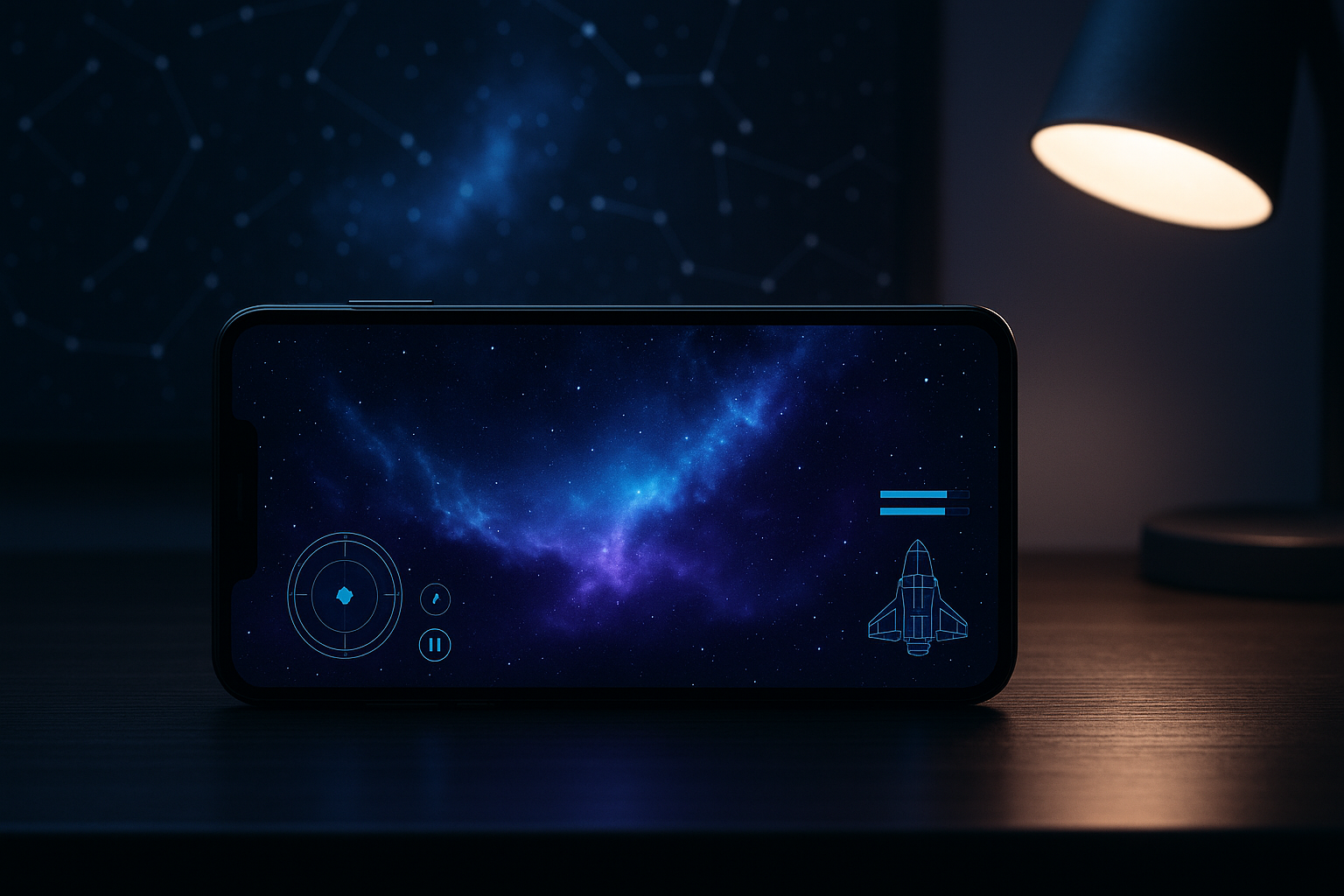
Galaximus models gravity accurately: every celestial body pulls on every other body in real time. Your ship, planets, and asteroids all obey orbital mechanics. Slingshots work. Gravity wells accelerate you for free. Orbital captures are possible and efficient.
The learning curve is steep. The first 20 minutes, you’ll crash into planets. That’s intentional — you’re learning to read gravity the way a pilot reads wind. Once it clicks, the payoff is unlike anything a faked-physics space game can offer.
The game ships complete: eight procedurally configured star systems, each with unique anomalies (derelict ships, spacetime rifts, distress beacons), a narrative arc with a beginning and ending, and combat encounters that reward patient positioning over twitch reflexes. A major expansion called Galaximus Infinitum launches in late 2026 with open-galaxy sandbox, planetary surface exploration, outpost building, and faction warfare. If you buy Galaximus now at, Infinitum is included free when it ships; after Infinitum launches, the combined game moves to.
Best for: Players who want real physics and don’t mind a learning curve.
Campaign length: 4–6 hours.
Replayability: High (procedural generation shuffles planets and anomalies each playthrough).
Get Galaximus on the App Store: Get it on the App Store
Void Expanse ($4.99) — Twin-Stick Arcade Combat
Void Expanse strips away physics entirely. You control a fighter with direct, responsive movement — no inertia, no gravity, no orbital mechanics. The game is pure combat: waves of enemies, power-ups, and environmental hazards.
Each run lasts 30–45 minutes. You start weak, collect upgrades, and either reach the final boss or die and restart. Roguelike progression means you unlock permanent upgrades between runs — better weapons, shield capacity, special abilities. The learning curve is low; the skill ceiling is high.
Visually, Void Expanse uses bright neon vector graphics with a dark background. The aesthetic is Asteroids meets arcade shmup. Sound design is minimal but effective — laser blasts, explosions, and a pulsing electronic soundtrack.
Best for: Players who want fast-paced action without physics complexity.
Campaign length: 30–45 minutes per run; 10–15 runs to unlock all upgrades.
Replayability: Very high (roguelike structure with randomized enemy waves and power-up placement).
Stellar Drift ($6.99) — Minimalist Exploration
Stellar Drift has no combat, no time pressure, and no narrative. You explore procedurally generated star systems, discovering planets, moons, and anomalies. Each celestial body has a real-time day/night cycle and unique visual characteristics.
The controls are minimal: tap to move, swipe to rotate. Physics are simplified but present — you have inertia and can collide with planets, but gravity doesn’t pull you. The game is about observation and discovery, not mastery.
Procedural generation means each playthrough is different, but the core loop stays the same: explore, catalog discoveries, move to the next system. There’s no “winning” Stellar Drift; you play until you’ve seen enough or run out of time.
Best for: Players who want to explore at their own pace without combat or time pressure.
Campaign length: Open-ended; 2–4 hours for a casual playthrough.
Replayability: Very high (infinite procedural generation).
Orbit ($7.99) — Story-Driven Space Adventure
Orbit is a narrative-first space game. You play as a pilot recovering from a crash on an alien world. The game alternates between exploration sequences (simplified physics, puzzle-solving) and dialogue scenes with NPCs who have branching conversation trees.
Your choices affect the story. Different dialogue options lead to different missions, different alliances, and different endings. There are five distinct endings based on your choices and actions throughout the campaign.
The physics are arcade-style — simplified for accessibility, focused on making the story beats work rather than simulating reality. Combat exists but is optional; you can often talk your way past enemies or find alternate routes.
Best for: Players who want a complete narrative with meaningful choices.
Campaign length: 8–10 hours.
Replayability: High (five different endings, branching dialogue encourages multiple playthroughs).
Void Runner ($3.99) — Endless Arcade Flyer
Void Runner is the simplest game on this list. You control a ship flying through an endless tunnel of obstacles. Tap left or right to dodge. Collect power-ups. Survive as long as possible.
Each run lasts 2–5 minutes. The game has no campaign, no story, no progression system. It’s pure high-score chasing. The appeal is in mastery — learning the exact timing for each obstacle type and executing perfect runs.
Visually, Void Runner uses minimalist vector graphics: a white ship, black background, neon obstacles. The aesthetic is clean and focused.
Best for: Players who want something quick and skill-based.
Campaign length: 2–5 minutes per run; no campaign.
Replayability: Very high (endless generation, high-score chasing).
Infinitum Expansion Pack ($12.99) — Open-Galaxy Sandbox
Infinitum is the expansion to Galaximus, launching in late 2026. It adds an open-galaxy sandbox mode where you can explore 1,000+ procedurally generated star systems, build outposts on planets, manage resources, and engage in faction warfare.
The physics from Galaximus carry over — real-time gravity, orbital mechanics, slingshot maneuvers. But now you have long-term goals: establish trade routes, mine asteroids, build a fleet, negotiate with alien factions.
Infinitum is designed for 20+ hours of play. It’s open-ended; you set your own goals. The game has no “ending,” just a persistent universe that evolves based on your actions.
If you buy Galaximus now at, Infinitum is included free when it ships. After Infinitum launches, the combined game moves to.
Best for: Players who want long-term engagement and creative freedom.
Campaign length: 20+ hours (open-ended).
Replayability: Very high (1,000+ procedurally generated systems, emergent gameplay).
Procedural Generation and Replayability
The best indie space games in 2026 lean on procedural generation — not to pad playtime with infinite busywork, but to make each playthrough feel genuinely different while keeping the authored experience intact.
Galaximus uses procedural configuration: the eight star systems are always in the same narrative order, but the planets, asteroids, and anomalies are shuffled each playthrough. You know the story beats; you don’t know what hazards you’ll face to reach them. That’s the sweet spot — authorship plus replayability without feeling like a roguelike grind.
Void Expanse uses procedural enemy waves and power-up placement, so each run feels fresh even though the core mechanics stay the same. Stellar Drift and Infinitum use infinite procedural generation for star systems, meaning you could theoretically explore forever.
Procedural generation also lets solo developers ship more content with less crunch. One developer can’t hand-author 100 planets; one developer can write the rules that generate 100 unique planets and tweak them until they’re fun. It’s leverage.
Vector Graphics and Retro Aesthetics
If you’ve been playing space games since the 1980s, the vector-graphics revival on iOS will feel like coming home. Asteroids, Lunar Lander, Space War — those games used vector rendering because it was fast and elegant. Indie developers in 2026 use it because it’s still fast, still elegant, and it reads as intentional rather than nostalgic.
Vector graphics also solve a real problem for solo developers: you don’t need a team of 3D artists. One person with a good eye for color and geometry can ship something that looks polished and cohesive. The neon-on-black aesthetic you see in Galaximus, Void Expanse, and Void Runner isn’t retro-fetishism; it’s practical craft.
The visual constraint also forces good game design. When you can’t rely on photorealistic graphics to carry the experience, the mechanics have to be genuinely fun. Indie space games tend to be tighter, more focused, more elegant than bloated AAA titles with “realistic” graphics that distract from sloppy gameplay.
Premium Model: Why It Matters
In 2026, a premium space game on iPhone is almost a radical statement. The App Store’s default business model is free-to-play with in-app purchases. The “free” hook, the energy meter, the battle pass, the cosmetic shop — that’s the path of least resistance for monetization.
Indie developers choosing to charge upfront and then never ask for more money are making a choice about who their audience is and what kind of experience they want to ship. It’s a smaller audience — not everyone wants to pay for a game sight unseen — but it’s an audience that values completion, respect for their time, and ownership.
It also changes the design. A free-to-play space game is optimized for retention, for keeping you logging in, for monetizing your attention. A premium space game is optimized for satisfaction. You beat it, you’re done, you move on. That’s a healthier dynamic for a player and a healthier one for a developer who wants to ship something they’re proud of.
Offline Play and Device Ownership
One more thing indie space games on iOS tend to get right: they work offline. No authentication servers. No “check your connection” messages. Download the game, play it on a plane, in a basement, in a cabin with no signal. It’s a small thing that feels radical after years of online-required games.
This is partly practical (indie developers often can’t afford server infrastructure) and partly philosophical (offline-first games respect device ownership). When you own your iPhone, you should own the games on it, not rent access to them.
All six games in this guide work completely offline. Some have optional online features (leaderboards, cloud saves), but none require a connection to play.
The Learning Curve: A Feature, Not a Bug
Indie space games tend to have steeper learning curves than mainstream mobile games. This isn’t poor onboarding; it’s intentional design. The curve is part of what makes mastery feel earned.
Galaximus is a good example: the first 20 minutes are frustrating if you expect instant accessibility. But that frustration is the point. You’re learning a system. Once it clicks, you have a skill that transfers — you understand gravity wells, orbital mechanics, slingshot physics. That understanding is the game. A game that teaches you nothing, that requires no learning, is forgettable.
Void Runner and Void Expanse have low learning curves but high skill ceilings — you can jump in immediately, but mastery takes practice. Stellar Drift and Orbit have almost no learning curve; they’re designed for accessibility.
If you’re looking for a space game you can pick up for two minutes and put down, Void Runner or Stellar Drift are your best bets. If you want something that rewards focused play and builds competence, Galaximus or Orbit are better choices.
FAQ
Q: Which indie space game has the gentlest learning curve?
A: Stellar Drift and Void Runner are the most accessible. Stellar Drift has no combat or time pressure; Void Runner is a simple endless flyer with straightforward controls. Both can be enjoyed immediately without study. Orbit also has a low learning curve because the focus is on story, not mechanics.
Q: Can I play these games on iPhone 12 or older?
A: Yes. All six games in this guide target iOS 14 or later, which covers iPhone 12, 12 mini, 12 Pro, 12 Pro Max, and all newer models. Vector graphics and procedural generation are less demanding than 3D AAA titles, so compatibility is usually good. Check the App Store listing for your specific device before purchasing.
Q: Which indie space game is best if I want to play for 10 minutes at a time?
A: Void Runner is designed for quick sessions — each run lasts 2–5 minutes. Void Expanse runs are 30–45 minutes, so it’s better for longer sessions. Stellar Drift and Galaximus can be played in chunks, but they reward longer play sessions.
Q: Do any of these games have multiplayer or online features?
A: Most are single-player, offline-first experiences. Void Expanse has optional leaderboards (online, but not required to play). Infinitum will have optional faction warfare with other players’ outposts, but it’s not required for the core experience. If multiplayer is important to you, these games may not be the right fit.
Q: What’s the difference between Galaximus and Infinitum?
A: Galaximus is a 4–6 hour campaign with real-time gravity simulation and procedural generation. Infinitum is a 20+ hour open-galaxy sandbox expansion that adds outpost building, resource management, and faction warfare. If you buy Galaximus at, Infinitum is included free when it launches in late 2026. After launch,