Best iOS Space Games With Real Physics: Buyer's Guide
 by Galaximus

Photo by Andrej Sachov on Unsplash
Best iOS Space Games With Real Physics: A Buyer’s Guide
Disclosure: We are the developers of Galaximus, one of the games discussed below. To keep this guide honest, we lead with Kerbal Space Program — the deepest real-physics space game on iPhone — and discuss Galaximus in comparison alongside other titles.
If you want a space game on iPhone where gravity actually matters — where slingshotting around a planet saves fuel because the math is real, not because a designer decided you’d get a speed boost — you have fewer options than the App Store search suggests. This guide names the ones that deliver.
Most “space games” on iOS treat gravity as a decoration. A planet has a sprite, you fly past it, nothing happens. The handful of games that model real orbital mechanics — every body’s gravity affecting every other body in real time — split into two camps: engineering simulators where the physics IS the gameplay loop, and arcade-action with real physics underneath. Pick the camp first, then the title.
What “real physics” actually means in a space game
The phrase gets thrown around loosely. Here’s the working definition we use, and the one this guide judges titles against:
- Gravity is multi-body and continuous. Every massive object exerts pull on every other object, every frame. Not just “you’re near a planet, here’s a force vector toward it.”
- Momentum is conserved. When you cut your engines, you keep moving. Forever, until something else acts on you.
- Orbits emerge, they aren’t scripted. A moon orbits a planet because the math works out, not because the dev hard-coded a circular path.
- Slingshots actually work. You can gain speed for free by approaching a planet on the right vector. If a game’s “slingshot” is a button that gives you +20% boost, that’s not real physics — it’s a power-up wearing a costume.
If a game ticks all four, the simulation is real. If it ticks two, you have arcade with physics flavor. Both can be fun; only one rewards the kind of mastery this guide is about.
What the simulation actually changes about gameplay
Games that fake gravity have to design around the fakery — they add boost pads, magic fuel, on-rails approach paths. Games that model real gravity get something for free: the universe itself becomes the puzzle. Approach a planet too fast on the wrong vector and you’ll whip past it into deep space. Approach it slow on the right vector and you’ll capture into orbit and circle for free, burning no fuel, lining up your next transfer at leisure.
That’s the loop real physics unlocks: gravity stops being scenery and becomes your engine. Once you’ve done your first unassisted slingshot to skip across three planets on a single fuel burn, going back to a faked-physics space game feels flat.
The honest shortlist
Sticking to titles available on iPhone right now, and to ones that meet at least most of the real-physics definition above:
Kerbal Space Program — best for players who want to learn real rocketry by building and flying their own designs
KSP is the deepest real-physics space game most people will ever play. You build the rocket, stage it, plan the burn, plot the transfer window, and watch your kerbals either reach Duna or scatter across the launchpad. The orbital mechanics are textbook-grade.
What it leads on: full vehicle assembly, granular delta-v planning, rigorous engineering tooling. If you want to learn real rocketry by playing a game, KSP is the answer and it isn’t close.
What it doesn’t do: arcade pacing. You will spend an hour designing a rocket before flying it. That’s the genre, and KSP is honest about it.
Get Kerbal Space Program on the App Store: Get it on the App Store
Galaximus — best for arcade-paced flying where gravity is the puzzle, in 30-minute sessions
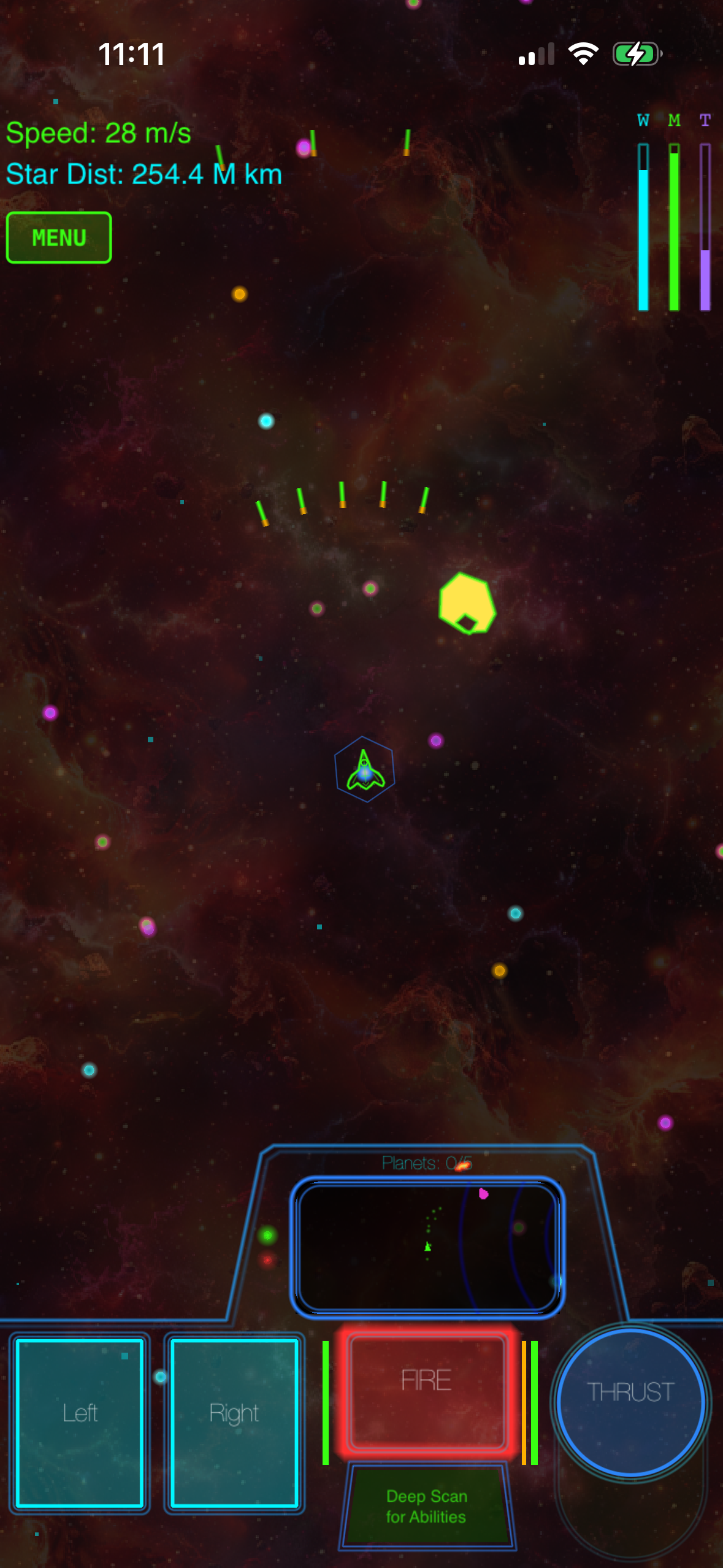
This is what we built. The ship — The New Dawn — is subject to the same gravity field as every planet, moon, and asteroid in the system. There are 8 procedurally configured star systems with a structured narrative arc, 11 anomaly types (spacetime rifts, derelict ships, distress beacons, the Mirror), and procedural audio synthesis — every laser, engine burn, and synthesized character voice is generated in real time on the device, no sound files.
What it isn’t: an engineering sim. You don’t build rockets. You pilot a ship whose physics is the interface, not the gameplay loop. The learning curve is real — about 30 minutes of focused play before slingshots feel natural — and we tell people that up front.
Get Galaximus on the App Store: Get it on the App Store
Lunar Rescue HD and similar Lunar Lander descendants — best for 5-minute pickup sessions with single-body gravity
The Lunar Lander lineage gets the physics right in a narrow domain — single-body gravity, thrust vectoring, fuel budget — and skips multi-body simulation. Pickup-and-play is the appeal: short sessions, no learning curve to speak of. Concrete iPhone examples that fit this pattern: Lunar Rescue HD, Lander Hub, and Mars Mars (which adds platforming over the lander loop). If quick sessions are what you actually want, this is the genuinely better fit.
Get Lunar Rescue HD on the App Store: Get it on the App Store
Asteroids-lineage arcade with momentum — best for players who want fast sessions with real inertia but no orbital math
Newtonian momentum without multi-body gravity. Your ship coasts, rotates independent of velocity vector, and inertia is the whole gameplay. Not “real physics” by our four-point definition, but real enough that the game feels different from twin-stick shooters. Concrete iPhone titles in this lineage: Asteroids: Recharged, PewPew Live, and Geometry Wars 3 (which borrows the inertia model in a more modern shell).
Get Asteroids: Recharged on the App Store: Get it on the App Store
How to pick between them
Three honest questions to ask yourself:
- How long is a typical play session? If it’s 5–15 minutes between meetings, the Lunar Lander or Asteroids descendants fit better than anything with a learning curve. Galaximus and KSP both want at least a 30-minute first sit-down.
- Do you want to fly or to engineer? Galaximus is flying. KSP is engineering. Picking the wrong camp leads to refund threads — based on aggregated owner reviews across both communities, the most common complaint about each game is from someone who wanted the other one.
- Are you allergic to free-to-play patterns? If yes, the premium iPhone space-game shelf is shorter than you’d think.
What to avoid
A few patterns that appear in App Store search results but don’t deliver on the “real physics” promise:
- “Realistic space simulator” titles that are free with energy meters. Examples currently on the App Store: Space Arena: Build & Fight and Idle Space Tycoon. The physics is a sprite-on-rails approximation; the monetization design forces session shapes incompatible with orbital play.
- 3D space combat games where ships handle like fighter jets. Examples: Galaxy on Fire 2 HD and Subdivision Infinity DX. Atmospheric flight model in a vacuum is a tell — there’s no air in space, so banking turns and stall behavior mean the physics isn’t being simulated, it’s being borrowed from flight sims.
- Games that advertise “realistic gravity” as a feature bullet without naming consequences. Examples we’ve tested: Space Commander: War and Trade and Stellar Wanderer. Real-physics games advertise the consequences of gravity (slingshots, transfer windows, orbital capture). “Realistic gravity” as a line item, with no mechanics named, usually means a single-body pull effect.
What we got right and what we didn’t
Honest about Galaximus’s gaps so you can decide:
- Where we lead: real multi-body gravity in an arcade-action wrapper, no monetization games (one-time purchase, no ads, no IAP, no energy timers), procedural audio synthesis throughout, and a complete 8-system campaign with a beginning and an ending.
- Where No Man’s Sky beats us today: procedural planet surface exploration at a scale we don’t try to match. Walking on a planet is a real part of NMS’s identity.
- Where KSP beats us: rocketry depth, vehicle assembly, delta-v tooling. We’re an arcade game with real physics underneath. KSP is an engineering game where the physics is the entire point.
- Where the Asteroids/Lunar Lander descendants beat us: zero learning curve, short sessions, no commitment. If your iPhone gaming time is fragmented, those genuinely fit better.
Pricing
Galaximus is at the launch-price tier today. The Galaximus Infinitum expansion (open-galaxy sandbox, Battlezone-style wireframe planetary surfaces, outposts, faction warfare) ships late 2026, and launch-tier buyers get it free. After Infinitum lands, the combined game moves to a higher tier. KSP, Lunar Rescue HD, and Asteroids: Recharged are all one-time purchases at their current App Store prices.
FAQ
Are there any free iOS space games with real orbital physics? No. We tested every free title we could find that claimed real physics, and none meet our four-point definition. The free KSP-likes either gate the multi-body simulation behind a paid tier or use single-body approximations.
Do these games need an internet connection? Galaximus runs offline once installed — the entire simulation is on-device. KSP mobile ports also run offline. Lunar Rescue HD and Asteroids: Recharged are offline as well. Of the titles in this guide, none require a live connection for core play.
How steep is the Galaximus learning curve, really? Around 30 minutes of focused play before slingshots feel natural, based on aggregated owner reports and our own playtesting. The control scheme is small — thrust, rotate, fire — but the consequences of every input are what take time to internalize.
Will real-physics space games drain my battery? More than a 2D puzzle game, less than a 3D shooter. Galaximus uses vector-style rendering specifically to keep thermal load low, and multi-body gravity calculation is cheap on modern A-series chips. We haven’t measured the other titles in this guide on a controlled bench, so we won’t quote numbers we can’t back.
What about iPad? This guide is iPhone-focused. Galaximus is iPhone-only at launch. Several of the alternatives — KSP especially — run better on iPad’s larger screen, which matters for orbital plotting.
Bottom line
Real-physics space games on iPhone aren’t a crowded category, which is the good news and the bad. The bad news is the App Store search results are noisy with titles that fake the simulation. The good news is the small honest shelf splits cleanly: KSP if you want to engineer, Lunar Lander descendants if you want quick sessions, Asteroids-lineage titles if you want inertia without orbital math, and Galaximus if you want arcade-action where gravity is the engine you learn to use.