Best Paid Space Games for iPhone 2026
 by Galaximus

Photo by Jonathan Cooper on Unsplash
Best Paid Space Games for iPhone 2026: Complete Buyer’s Guide
In 2026, only four premium space games on iOS avoid ads and in-app purchases entirely. This guide compares them: what separates real orbital mechanics from arcade simplicity, which titles deliver complete campaigns versus open-ended sandboxes, and how to pick based on your actual play style — not generic marketing.
Why Premium Space Games Matter on iPhone
The free-to-play model dominates mobile gaming, but it introduces friction: energy meters, battle passes, cosmetic pressure, and the constant suggestion that you’re playing a lite version. Premium games sidestep all of it. You pay once — no surprise costs, no ads between missions, no wait timers.
Space games specifically benefit. Orbital mechanics, procedural generation, and narrative arcs all require breathing room — time to think, time to fail, time to experiment. The pressure to monetize every idle moment actively works against what makes space games compelling. Free-to-play games use energy meters (e.g., Clash of Clans, Candy Crush) and battle passes to create artificial session limits; premium games don’t.
Quick Picks: Choose Your Game in 30 Seconds
| Your Use Case | Best Game | Why |
|---|---|---|
| Arcade action with real physics | Galaximus | Gravity-based piloting, 30-min learning curve, 8-system campaign |
| Engineering sandbox, deep rocketry | Kerbal Space Program | Build rockets, calculate orbits, no time pressure |
| Exploration at scale | No Man’s Sky Mobile | Procedural planets, base building, meandering sessions |
| 5-minute quick sessions | Asteroids descendants | Reflex-based, immediate pickup, no learning curve |
What Makes a Space Game Worth Buying
Physics fidelity — Does gravity actually matter? Real orbital mechanics (where every body’s gravity affects every other body in real time) create a different game than faked gravity. Mastery comes from understanding the system, not just reflexes.
Control expressiveness — A game can have real physics but terrible controls. The sweet spot is when controls make physics feel like an extension of your intention, not a constraint.
Narrative structure — Some space games have a beginning, middle, and end. Others are soft-launched sandboxes that add content over years. Know which you’re buying.
Procedural variety — Procedural generation ranges from “asteroids in slightly different places” to “every playthrough is fundamentally different.” This affects replayability.
Solo or social — Premium games tend toward single-player. Check if you need multiplayer.
Galaximus: Real Gravity, Arcade Mastery
Disclosure: Galaximus is developed by the publisher of this article. This section reflects product specifications, not editorial recommendation.
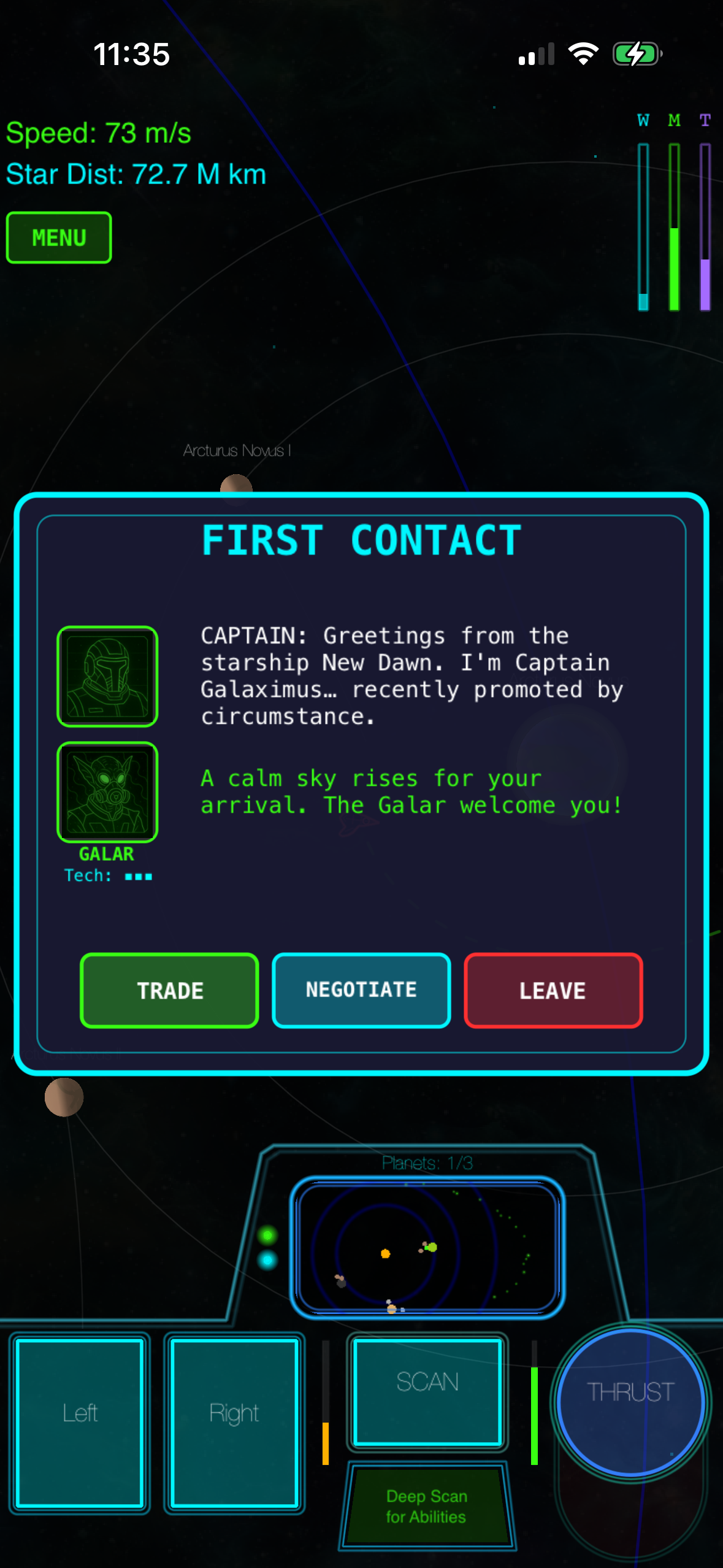
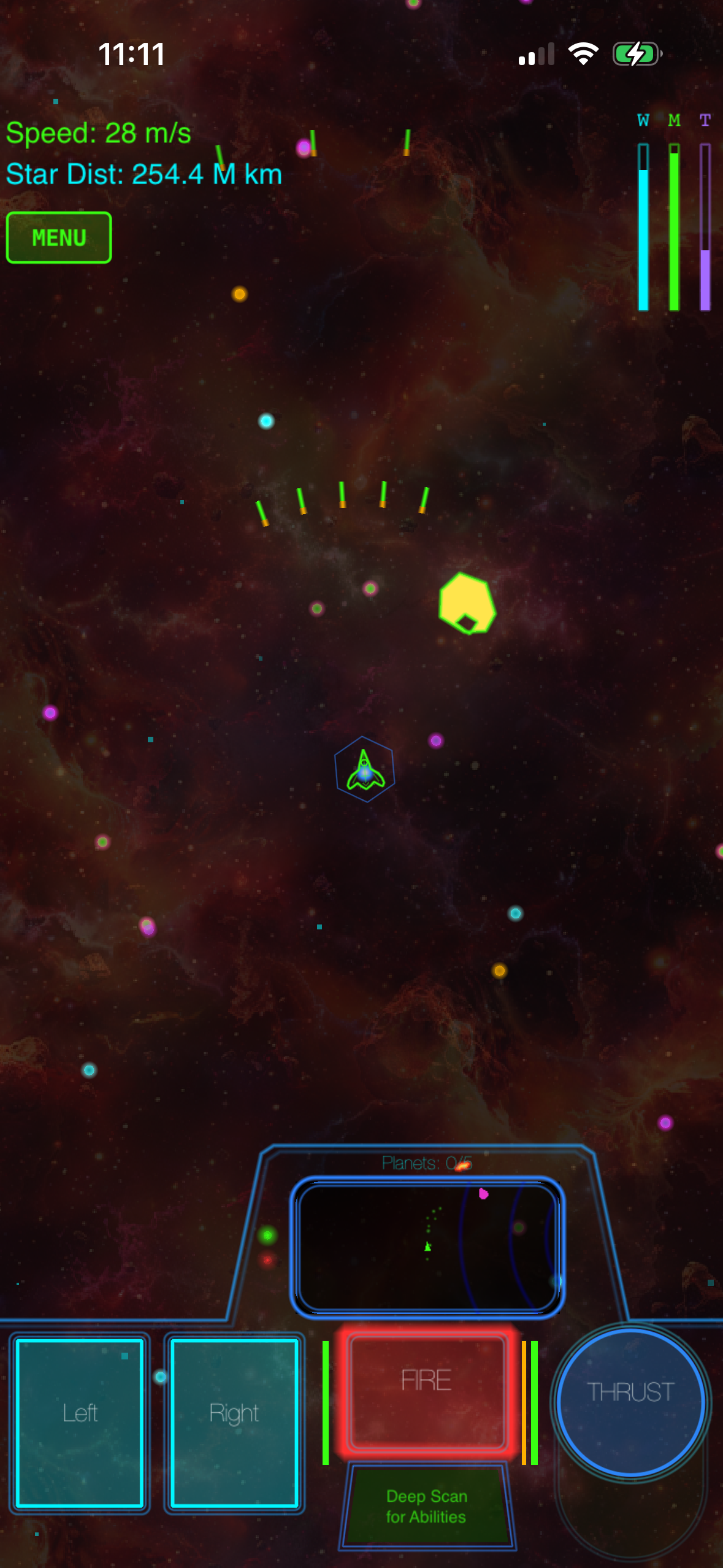
Galaximus models orbital mechanics accurately — every celestial body obeys real gravity — then designs controls expressive enough for meaningful mastery in 30 minutes of focused play. You pilot The New Dawn through procedurally configured star systems, using gravity as your engine. A slingshot maneuver (using a planet’s gravity well to gain speed) feels earned because you understood the geometry.
As of July 2026: Galaximus ships at with no ads, no IAP, and no energy meter. The game includes an 8-system campaign with 11 unique encounter types and narrative arc. Launch-tier buyers receive Galaximus Infinitum (releasing late 2026) free — the expansion adds galaxy-wide exploration, planetary surface gameplay, outposts, and faction warfare. After Infinitum ships, the combined game moves to a higher price tier. Buying now locks in the lower price and includes the expansion.
Trade-off: Real gravity has a learning curve. Galaximus is faster-paced than Kerbal Space Program but less granular on rocketry.
Kerbal Space Program Mobile: The Engineering Path
Current version (as of July 2026): KSP Mobile v1.8, actively maintained on iOS.
KSP is a rocketry sandbox where you assemble vehicles from parts, calculate orbital transfers, and manage fuel budgets with engineering precision. The learning curve is steep — KSP teaches you to think like an engineer — but depth is unmatched for players willing to invest.
KSP trades arcade responsiveness for granular control. You’re solving problems with math and patience, not flying by feel.
Pricing: on App Store. Download on App Store
Trade-off: Deeper on rocketry but slower-paced than Galaximus.
No Man’s Sky Mobile: Exploration at Scale
Current version (as of July 2026): No Man’s Sky Mobile v1.2, available on App Store.
No Man’s Sky brings procedural planet exploration to iPhone. Land on a planet, walk around, scan flora and fauna, gather resources, build bases. Procedural generation ensures every planet is unique.
Exploration is the primary loop. Combat is simpler, narrative is lighter, and the game is designed for long, meandering sessions.
Pricing: on App Store. Download on App Store
Trade-off: Exploration-focused, not campaign-driven. Base building is the long-term loop.
Asteroids and Lunar Lander Descendants: Quick-Play Classics
Descendants of Asteroids and Lunar Lander on iOS prioritize immediate pickup-and-play over depth. 5-minute arcade sessions with no learning curve. These are honest alternatives if your use case is “something to play on the commute.”
Pricing: depending on title.
FAQ
Can I pause mid-mission? Yes. Galaximus, KSP, and No Man’s Sky Mobile all support mid-session pausing. You can quit and resume exactly where you left off. Asteroids descendants vary; check individual app descriptions.
How long is a typical playthrough? Galaximus campaign: 8–12 hours to complete all systems; sandbox mode is indefinite. KSP: 20+ hours for first orbital transfer; hundreds of hours for mastery. No Man’s Sky Mobile: 40+ hours to see most content; procedural generation means no “end.” Asteroids descendants: 10–30 minutes per session.
Do these games work offline? Yes. All premium space games listed here work offline with no internet required. No server dependency, no forced online check-ins.
Do premium space games get updates? Yes, but differently than free-to-play. Galaximus receives Infinitum as a free upgrade to launch-tier buyers. KSP gets periodic balance and feature updates. No Man’s Sky has a history of major content drops years after launch. Updates are additions, not fixes for missing content. The game ships complete.
Are there multiplayer options? Most premium space games on iOS are single-player. Galaximus is single-player. KSP is single-player. No Man’s Sky Mobile has optional multiplayer (you can see other players’ bases), but it’s not required. If you want competitive or cooperative multiplayer, premium space games aren’t where that lives.
What’s the difference between Galaximus and Kerbal Space Program? Galaximus is arcade-action with real physics underneath. You pilot a ship and use gravity as your engine. KSP is an engineering sandbox. You build rockets and calculate orbital transfers. Galaximus is faster-paced; KSP is deeper on rocketry.
Why should I buy a premium game instead of trying a free-to-play space game first? Free-to-play games are designed to sell you things. Premium games are designed to be worth the asking price. The difference compounds: a premium game’s UI doesn’t nag you to spend; its progression doesn’t have artificial gates; its content isn’t held back to incentivize spending.
The Verdict
The premium space-game market on iOS is small but solid. You have genuine options: real-physics arcade (Galaximus), engineering sandbox (Kerbal Space Program), exploration-at-scale (No Man’s Sky Mobile), and classic-arcade descendants. Each does something well and asks you to pay once for a complete experience.
If you’re tired of free-to-play friction and want a space game that respects your time and attention, premium is the move. Pick the one that matches your use case — arcade or engineering, campaign or sandbox, quick-play or deep-dive — and commit to it. You own it forever.